
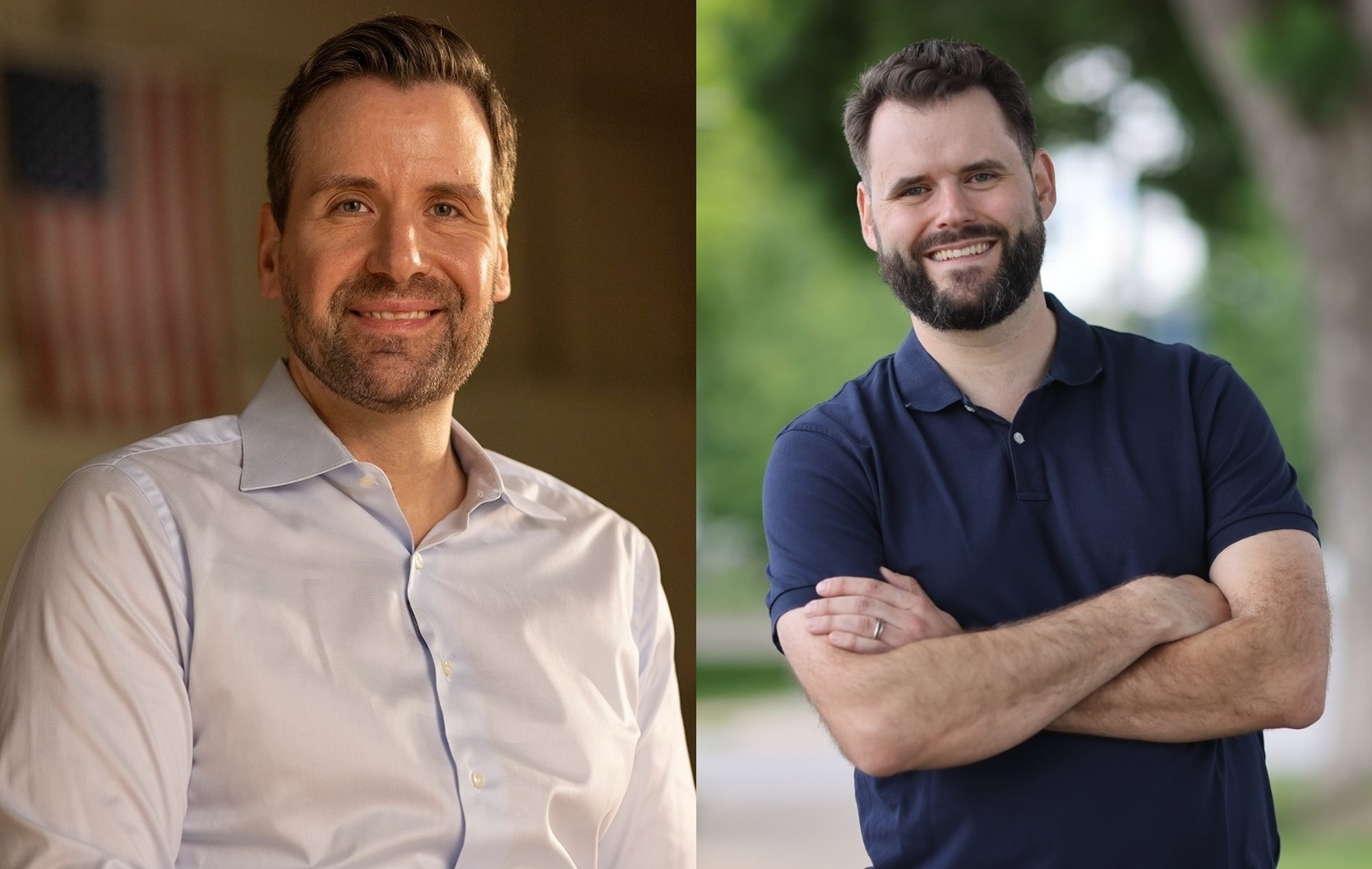
Iowa Democrats will nominate either State Senator Zach Wahls or State Representative Josh Turek for U.S. Senate today. Both are smart and passionate, both have been effective legislators, and both have a solid grasp of the issues.
Since many readers have asked for my thoughts on the primary, I am taking a critical look at key arguments the campaigns have made for and against each candidate. My goal is not to persuade anyone to vote a certain way, but to lay out which points strike me as fair and accurate, and which seem unjustified or misleading.
Choosing between two qualified, capable candidates is inherently subjective. What is obvious to you may seem absurd to me. A deal-breaker for me may not trouble you. So for all points discussed below, your mileage may vary.
Electability
It’s been eighteen years since a Democrat won a U.S. Senate race in Iowa. Many Democrats would be happy to be represented by Turek or Wahls and just want to nominate whoever would do better in the general election.
Both candidates have portrayed themselves as the stronger option for November. Turek notes that he is “battle-tested,” having won twice in an Iowa House district that voted for Donald Trump. In contrast, Wahls represents a blue district where Republicans didn’t field a candidate in 2018 or 2022.
Wahls maintains that this race will come down to “outsiders versus insiders.” He’s repeatedly pledged not to vote for Senator Chuck Schumer as Democratic leader, and argues that someone willing to stand up to leaders in both parties will draw a better contrast with the GOP nominee.
A subjective measuring stick
Bleeding Heartland guest author Dan Guild believes that discussions about electability are mostly a waste of time, because “there is usually little difference between the candidates in trial heats against probable Republican opponents,” and voters “tend to believe the candidate we prefer will inevitably be the most electable.”
Indeed, the few polls we have seen show no clear advantage to either candidate against the likely GOP nominee, U.S. Representative Ashley Hinson. A March survey by the Democratic firm GBAO found Hinson leading Wahls by 47 percent to 44 percent, and Hinson leading Turek by 47 percent to 43 percent. In April, a poll conducted by Echelon Insights found Wahls ahead of Hinson by 46 percent to 44 percent, and Turek ahead by 46 percent to 45 percent.
That’s not a significant difference and could simply reflect higher name ID for Wahls when the polls were in the field. We can’t say for sure who would fare better against Hinson after Republicans spend tens of millions of dollars on attack ads.
As Dan Guild pointed out, if you favor a candidate, you probably think that person is more electable. So Turek fans think it would be ludicrous to pick someone who has never faced a Republican opponent over the top over-performing Democrat elected to the Iowa legislature in 2024. By the same token, advocates for Wahls say he would perform better against the polished Hinson in televised debates, and that he will have broader appeal because of how he is framing the issues, and the fact that he won’t owe anything to D.C. leaders.
There’s a widespread perception that Republicans would rather run against Wahls than Turek. That’s the consensus view among my GOP contacts, and it’s supported by the fact that the National Republican Senatorial Committee commissioned a poll in February with questions designed to juice the results for Wahls. Strategists for Wahls have countered that Hinson and other Republicans were not trying to elevate Wahls, but tried to define him early because they expect him to win the primary.
Crunching the numbers
Turek has demonstrated twice that he can outperform every other Democrat on the ticket. I calculated the 2022 election results for the twelve precincts in Iowa House district 20 where Turek was on the ballot:
- U.S. Senate: 3,698 votes for Chuck Grassley (R), 3,140 votes for Mike Franken (D)
- U.S. House: 3,528 votes for Randy Feenstra (R), 2,893 votes for Ryan Melton (D)
- Governor: 3,789 votes for Kim Reynolds (R), 2,908 votes for Deidre DeJear (D)
- State auditor: 3,622 votes for Todd Halbur (R), 3,127 votes for Rob Sand (D)
- House district 20: 3,397 votes for Sarah Abdouch (R), 3,403 votes for Josh Turek (D)
It wasn’t a fluke. Here are my calculations for the same Council Bluffs and Carter Lake precincts in 2024:
- President: 6,226 votes for Donald Trump (R), 5,270 votes for Kamala Harris (D)
- U.S. House: 6,023 votes for Randy Feenstra (R), 5,052 votes for Ryan Melton (D)
- House district 20: 5,320 votes for James Wassell (R), 5,881 votes for Josh Turek (D)
That 13-point overperformance happened after Republicans and GOP-aligned groups spent hundreds of thousands of dollars against Turek, falsely claiming he “voted to keep sexually explicit material in elementary schools” and “sided with radical environmentalists to ban gas stoves.”
Wahls doesn’t have the same track record, because he has never faced a GOP opponent. That’s not to say he couldn’t beat Hinson. He believes his anti-corruption outsider message will resonate, as well as his experience representing rural areas and small towns in Cedar and Muscatine counties. Fair points—but we have no concrete evidence on whether he would do better or worse than others on the Democratic ticket.
One more thing
I want to address a narrative I’ve seen from a few Wahls supporters lately (though not directly from the campaign): Turek’s victory isn’t impressive, because Democrat Charlie McConkey represented that House district for eight years before retiring in 2022. In other words, Turek didn’t flip a red district, he “only” kept an open seat blue.
The most ignorant version of this case came from Ryan Grim on the popular “Breaking Points” YouTube channel. He posited that Schumer (through the VoteVets super PAC and other groups) spent $9 million to boost Turek because AI mistakenly thought he had flipped a Republican-held district. Grim also suggested that since Council Bluffs historically votes for Democrats at the local level, Turek just “happened to be wrapped into that.”
Grim doesn’t know enough about Iowa politics to understand that Republicans now represent a bunch of cities and towns that elected Democrats to the legislature for generations. I’ve written a short book’s worth of posts about the horrible trendlines in these former blue strongholds. Here’s the reality:
When Democratic incumbents retired from Iowa House seats in Fort Dodge (2018), Newton (2021), Clinton (2022), and Mason City (2024), Republicans immediately picked up all of those seats. Democrats haven’t yet won any of them back.
In addition, Democratic incumbents lost Iowa House races in Ottumwa (2020), Keokuk (2020), Burlington (2022), and Marshalltown (2024). Another House Democrat was barely re-elected in Davenport in 2024. All of these places were considered safe blue districts for many years.
The bottom line: it’s not easy for a Democrat to win an Iowa legislative race in a working-class district where voters preferred Trump. Few have done it. When McConkey retired, Republicans were well-positioned to win that seat in Council Bluffs and Carter Lake.
One could argue Turek overperformed because he was a hometown hero (Paralympic gold medalist) and knocked thousands of doors. That formula might not translate into victory in a statewide race where he can’t make direct personal contact with a large share of the electorate. That is a fair point. We just don’t know.
Outside spending
Many Iowans didn’t appreciate the Democratic Senatorial Campaign Committee’s meddling on behalf of Patty Judge in our 2016 primary and Theresa Greenfield in 2020. So this cycle, the DSCC hasn’t officially endorsed Turek. But even last summer, it was an open secret that top Democrats in Washington, D.C. preferred Turek in what was then a five-way field.
That’s even more obvious now. In April, Turek’s campaign received $10,000 from a PAC associated with Schumer and $5,000 gifts from PACs associated with other Democratic senators: Richard Blumenthal, Patty Murray, and Kirsten Gillibrand.
Those gifts alone wouldn’t do much to influence the race. But the VoteVets super PAC has spent around $10 million to boost Turek’s candidacy—an enormous amount to spend in an Iowa primary, several times more than what the Wahls and Turek campaigns have spent on advertising combined.
Wahls has accused Schumer of trying to “buy” the election. As Dan Merica reported for the Washington Post, there’s no proof of that.
Campaign finance laws bar Schumer from directly coordinating with super PACs. A spokesperson for VoteVets said the organization has not had conversations with Schumer about the spending and is unaware if the Democratic leader has directed any donors to the group. A spokesperson for Senate Majority PAC, a Schumer-aligned group tasked with taking back the Senate, said they had “not transferred funds to VoteVets this cycle.”
Others have objected to Wahls criticizing VoteVets as a “dark money” organization. They say VoteVets has supported many good candidates.
But let’s be real: while VoteVets has received some grassroots donations from veterans or union members, small donors are not driving the massive spending on Turek’s behalf. Some unknown donors decided that Turek would be the best candidate and opted to use VoteVets (rather than the DSCC or another Democratic-aligned organization) as the vehicle to drive up his name ID.
Another sign that VoteVets is acting as a proxy for the D.C. establishment: the group has made no independent expenditures on behalf of Iraq and Afghanistan veteran Graham Platner, a Democrat running for Senate in Maine.
All of the outside spending in Iowa is legal, but Wahls supporters are justified in feeling it’s unfair for D.C. strategists to put their thumb on the scale. Turek fans would be furious if some group were spending $10 million to tip the primary in the other direction.
I don’t agree with Wahls on why VoteVets is promoting Turek. He’s asserted it’s because he vowed not to support Schumer as leader. Or in the words of one fundraising email, “We’re running a campaign ready to shake up the status quo, and that terrifies political insiders on both sides of the aisle. They know that an independent voice, backed by everyday people like you and not special interests, can’t be controlled.”
I think many D.C. insiders genuinely believe Turek would be a stronger candidate than a legislator from the Iowa City area who has never faced a Republican opponent. Wahls was better known to activists going into the campaign, and being from eastern Iowa, where most Democratic primary voters live, gave him another advantage. If you think Turek gives you a better shot at winning the 51st Senate seat, why not support him in the primary?
By the way, I’m aware of the newly registered “Iowa Action Network,” a dark money group that invested at least $150,000 into pro-Wahls digital and TV advertising. Some people associated with Iowa Action have ties to The Next 50, where Wahls used to work. That doesn’t even the score or change the reality about how outside spending influenced this race.
Insiders vs. outsiders
As mentioned above, Wahls has been framing the election as a battle between insiders and outsiders. But I struggle to view him as an “outsider” candidate. He is well-connected after living in Washington for years and attending graduate school on the east coast. He had lots of establishment support when he first ran for the legislature in 2018. His peers in the Iowa Senate elected him to be minority leader during his first term.
For the U.S. Senate race, he’s been endorsed by former U.S. Representative Dave Loebsack, former Lieutenant Governor Patty Judge, 2018 nominee for governor Fred Hubbell, and dozens of current and former state legislators and local officials.
From where I’m sitting, this primary isn’t a battle of insiders vs. outsiders. Different groups of insiders disagree on who is the better candidate.
Differences on the issues
Whereas some Democratic primaries pit an “establishment” or “moderate” candidate against a far more progressive contender, I don’t perceive any significant ideological differences between Wahls and Turek. Their voting records in the legislature are the same on most issues, with a few exceptions.
Reproductive rights
Both candidates are pro-choice. However, Turek was absent for the one-day special legislative session in July 2023, when Republicans passed a near-total abortion ban. He later missed House votes on a bill containing fetal “personhood” language, and the so-called “Baby Olivia” bill, which required public schools to show students fetal development videos.
The Wahls campaign pushed this talking point hard around the Roe v. Wade anniversary in January, and it was a major point of contention during the second televised debate on May 14. Turek described the attack as “disgraceful,” saying he missed the special session due to an illness related to his disability. The other missed votes happened when he was out of state advocating for disability issues. As a member of the minority party, he didn’t control the legislative calendar and couldn’t have known which bills would come up while he was away.
I don’t care for this line of attack. Wahls missed a lot of votes after his son was born during the 2024 legislative session. I wouldn’t accuse him of not caring about issues that came up for Senate debate. When I interviewed Wahls in mid-May, he clarified that he was not accusing Turek of deliberately dodging abortion-related votes. But he suggested that scheduling out of town speaking engagements, “even for causes that you’re passionate about,” was not “the best way to represent your constituents” when the legislature is in session.
Wahls also accused Turek of voting for “crisis pregnancy center” funding in 2023. But several Democrats voted for the same bill in the House Health and Human Services Committee, because of other provisions. Turek and all of his Democratic colleagues voted against the crisis center funding when it was part of a budget bill.
Wahls has clearly been more “loud and proud” on reproductive rights. Last month, he spoke on the Iowa Senate floor against a bill restricting medication abortion. Turek voted against the same bill but didn’t speak during the House debate.
Wahls has also pointed out, accurately, that Turek was the only House Democrat who did not co-sponsor any reproductive rights bills before the 2026 legislative session. One piece of legislation—a state constitutional amendment to guarantee reproductive rights—was co-sponsored by almost all the other House Democrats. When I asked why Turek didn’t sign on to that legislation, his campaign did not comment for the record.
Immigration
There’s a real distinction here. Two years ago, Turek was one of three House Democrats who voted for a bad immigration bill known as Senate File 2340, which sought to create a new state crime of “illegal re-entry.” Federal courts have enjoined the state from enforcing that law. Wahls voted against the bill after listening to advocacy groups who called it extreme, discriminatory, and unconstitutional.
Turek has said “the context is really important”: that the bill came up during the Biden administration, and only applied to individuals who had previously been deported. He has said he’s horrified by what Immigration and Customs Enforcement is doing now, especially since his own wife is an Afro-Latina immigrant and naturalized U.S. citizen.
I don’t defend Senate File 2340 and I understand why some Democrats can’t forgive that vote. On the other hand, I take it as a given that legislators from marginal districts will vote for more GOP bills than their counterparts in safe blue seats. Even Senator Tom Harkin cast some bad votes (for the federal Defense of Marriage Act, for instance). Turek has opposed most of the immigration bills Republicans have brought to the House floor.
Guns
Turek was one of fourteen House Democrats to vote for a GOP gun bill during the 2025 session. House File 924 lowered the minimum age for certain firearms permits from 21 to 18. (Wahls was absent when that bill came to the Senate floor, but most Democrats in the upper chamber voted no.)
The rationale for that bill was that an Eighth Circuit Court of Appeals panel struck down a comparable law in Minnesota in July 2024, saying it violated the Second Amendment rights of 18- to 20-year-olds. If Iowa didn’t change its statute, someone could sue the state and reach the same outcome, because Eighth Circuit precedent is controlling for federal courts in Iowa.
Wahls’ record as Senate minority leader
Wahls has joked that he was both the youngest Iowa Senate minority leader and the youngest former minority leader. His colleagues chose him for the role after the 2020 election; a majority voted to remove him in June 2023, for a variety of reasons. He has suggested that the old guard in the party was resistant to change, and has cited the experience as proof that he is willing to stand up to people in his own party.
Of legislators who have served with both Turek and Wahls, more are supporting Turek.
The Washington Examiner, a conservative publication, reported in April that during his time as minority leader, Wahls received “thousands of dollars in reimbursements for travel, lodging, and meals, including a string of high-cost flights and hotel stays that far exceed what other party leaders have reported.” That rubbed some people the wrong way. Turek raised this topic during the first televised debate between the candidates: “When he was in leadership, he took $30,000 — five times more than any other person in minority leadership. I didn’t even take reimbursement for my gas mileage.”
From my perspective, Wahls raised a lot more money than his predecessors as minority leader, so it’s not surprising he spent more on travel and other expenses, like occasional meals at fancy restaurants. Full disclosure: that’s why I didn’t write about these records when I received a copy of them earlier in the year.
Speaking of fundraising: in 2022, Wahls solicited a $250,000 donation from Nishad Singh, who was an executive of the cryptocurrency exchange FTX. There would have been no way for him to know the company was committing fraud at the time. But later in 2022, FTX collapsed and top executives were facing criminal investigation. Some Democratic candidates or committees around the country returned FTX donations, or donated the same amount to charities in their home states.
Wahls didn’t resolve this issue as minority leader. When I asked him about it last month, he emphasized that when he received the contribution, “no one understood that there was any financial impropriety” with FTX. By the time the fraud came to light, the Senate Majority Fund had already spent the money raised for that year’s elections. He said the U.S. Attorney’s office in the Southern District of New York instructed them to hold on to their records, but did not ask for money to be returned. Wahls had been removed as minority leader before the federal government requested a settlement.
Later, the Iowa Democratic Party reached an agreement with FTX creditors for $200,000. The party is still carrying the majority of that debt. Wahls told me that even after being removed as leader, he was “very involved in continuing to fundraise” for Senate Democratic colleagues, and raised “substantially more” than the $200,000 the party agreed to repay.
Some critics of Wahls have brought up another controversy related to his tenure as leader (though I haven’t heard this from the Turek campaign). The previous Senate Minority Leader Janet Petersen removed State Senator Nate Boulton as ranking member of the Labor and Business Relations Committee following sexual misconduct allegations in 2018. After Boulton was re-elected to the Senate in 2020, fellow Democrats elected him as one of five assistant minority leaders, and Wahls (then the new minority leader) appointed Boulton to be the ranking Democrat on the labor committee.
He told Iowa Public Radio at the time, “So as we get ready to go into 2021, we wanted to make sure that we had an attorney who understands this part of the law able to speak to these issues on the Senate floor and in committee. And Boulton is the only labor attorney in the Iowa Senate, and the [Senate Democratic] caucus felt that he was the right person to do that.” While many Democrats consider the allegations water under the bridge, others remain deeply opposed to Boulton serving in an important legislative role.
“Only candidate who’s not a millionaire”
Turek says in his latest television commercial, “There are 73 millionaires in the United States Senate. I will not be one of them. I was a kid wearing Goodwill hand-me-downs, with the wrong color lunch ticket. A working-class kid in a blue-collar town.” He has often talked about the economic adversity he experienced growing up, and his personal financial disclosure form confirms he has a middle-class income.
In recent months, Turek and his campaign have promoted him as the only non-millionaire in the field. Here’s one statement his staff sent me: “As the only candidate in the race who is not a millionaire, Josh has a unique ability to draw a contrast with Ashley Hinson and fight for Iowans who are currently struggling, because he’s been there.”
It’s certainly valid to prefer a candidate with a working-class background. Some of this “millionaire” rhetoric strikes me as misleading, though. It suggests Wahls is so wealthy that he doesn’t need to work. His personal financial disclosure form shows his net worth is over $1 million. But he told me he’s never earned $1 million in a year or had $1 million in his bank account. Wahls wrote a best-selling memoir as a young adult, inspired by his famous speech to the Iowa House in 2011. He and his sister created a successful business in 2016. He saved and invested most of the profits, and he also owned a portion of a family farm. So the vast majority of his assets are his home (co-owned with his wife), his retirement account, and the college savings fund for his son.
That last-minute ethics complaint
Days before the state legislature adjourned for the year, Kathy Ulrich (a Turek supporter in Cedar Rapids) filed a complaint with the Iowa Senate Ethics Committee. You can read the complaint here; the gist is that Wahls violated the Senate rules when he was executive director of the Next 50 Network from January 2024 through April 2025.
Based on my experience covering ethics complaints, it seems like a document prepared by an attorney or a political consultant. Ulrich declined to comment on who drafted the complaint, and the Turek campaign didn’t respond to my inquiries.
Wahls’ attorney rebutted the various allegations in this letter, saying Wahls was employed by the Next 50 Network, LLC—”not a political action committee” or other organization advocating for candidates. Wahls’ attorney said he did not lead The Next 50 PACs or influence their decisions during his time as executive director of the LLC. Documents showed Wahls had sought guidance from the secretary of the Iowa Senate before taking the job.
The Senate Ethics Committee found no evidence substantiating the claim. The six members (three Republicans and three Democrats) voted unanimously to take no further action and to dismiss the matter unless the complainant produced evidence supporting the allegations within 120 days.
A statement from Wahls slammed what he called “baseless political attack from the Turek campaign.” I don’t have proof the attack came from the Turek campaign, but this complaint didn’t sit well with me. If someone had a genuine concern about Wahls’ work for The Next 50, they could have filed a complaint in 2024 or 2025, instead of weeks before the primary election.
Life before political careers
I’ll close out with two topics that haven’t gotten much attention in media coverage, but may be important to some voters.
The New York Times reported in June 2025 about Wahls as an example of “the risks when younger candidates seek big offices.” During an “Ask Me Anything” thread on Reddit in 2011 (when he was 19 years old), Wahls answered some questions about pornography and volunteered that his parents gave him a subscription to Playboy magazine when he was 16.
Some of my contacts think this would be devastating fodder for general election attacks. My hunch is that anyone who would reject a candidate for what he said about porn as a teenager would not be open to voting for a Democrat anyway.
When I interviewed Wahls in mid-May, and when he met with the Des Moines Register’s editorial board around the same time, he brought up one thing I hadn’t heard before. Voter registration records indicate Turek didn’t participate in Iowa’s midterm elections of 2002, 2006, 2010, 2014, or 2018, or in the 2016 presidential election. Several of those were “monumental” for our state, Wahls said. (Not only did Trump carry Iowa in 2016, but Democrats lost the state Senate seat in Council Bluffs.) Wahls has voted in every election since he turned 18, and he feels that “tells you something about the commitment to this work.”
The Turek campaign declined to comment for the record on why he did not vote in those elections. To my knowledge, he was playing wheelchair basketball professionally in Europe for most of those years. Having lived in Europe myself for about a decade, I know it is possible to get an absentee ballot and vote from overseas. But I knew plenty of expats who were less politically engaged and didn’t jump through those hoops.
Any comments related to Iowa’s Senate race are welcome in this thread.
6 Comments
In a few hours, there will be a winner in this race, and I'll be very happy to vote for him in November.
Getting that winner into the Senate will need and deserve support from all Democrats and all other Iowans who want Iowa and the nation to have a better future. And I hope the candidate who doesn’t win this primary will play a significant role in Iowa’s future, because both candidates in this race have a LOT more to contribute. If only all Iowa primaries today presented such good options.
PrairieFan Tue 2 Jun 11:58 AM
Yes to PrairieFan
My wife was a committed Wahls supporter from way back. So I joined her on my absentee ballot … for all blue candidates. You say the “electability” issue is a draw, and agree. But as we know from past elections, it’s uphill for Democrats. This is the year to let no stone go unturned. Some of my D friends have been critical of Rob Sand for being less than leftwing on party. My take is that his campaign is a model for winning in a state where Democrats are a minority as compared to registered Rs and Is. I hope he has coattails.
Gerald Ott Tue 2 Jun 12:13 PM
I agree with both PrairieFan and Gerald
They are both good candidates and I can comfortably support whoever wins the primary. But I do disagree with Gerald a little bit.
I don’t think Democrats should act like Republicans to get elected. When voters are asked about specific issues with no reference to a candidate or party, they tend to support progressive issues. The problem I see is that over the last 30-40 years Republicans have created a narrative about Democrats and how voters should view themselves. And Democrats have chosen to campaign and govern within that narrative, rather than trying to change the narrative.
Wally Taylor Tue 2 Jun 4:02 PM
Great summary
I contributed to 3 candidates early in the campaign unable to decide. The constant Vote Vets ads, usually immediately followed by Rep MMM ads, started grating on me quickly.
The past decades of declining D results can be traced to the declining labor influence on elections. R’s were very good at appropriating the NRA creed as well as burning Reagan’s “welfare moms” sham into the voting booths.
At the end of the day I voted Wahls for his overwhelming Labor endorsement, being turned off by the $$$ ads, the “snark” of Turek supporters, and finally questioning the real convictions of Turek when he voted to allow the removal of environmental mandated exhaust pollution by farmers etc.
Probably a small issue to most, to me it called into question his decision making process.
A good thing though is that, if Turek wins, Iowans will be able to give $$ to other candidates. Thus allowing the Vote Vets to continue to bankroll his campaign.
BettScott Tue 2 Jun 4:12 PM
Pottawattamie County Chair
I fully admire your writing and amazing ability to keep us informed. One difference in Turek’s district was that it was redistricted, so when he ran it had shifted to more of a red district. Charlie McConkey still had a presence in the area, but there was also new territory for Josh to flip.
Lisa Lima Thu 4 Jun 9:48 AM
No title
I looked at that but the Trump/Biden 2020 numbers were no worse in the new district than the old district, according to the data I had.
Laura Belin Fri 5 Jun 11:59 AM