
Charles Bruner is a former Democratic Iowa legislator (1978-1990), was the founding director of Iowa Child and Family Policy Center (1990-2015, now Common Good Iowa), and is national director of the InCK Marks Initiative’s Child Health Equity Leadership Group.
For more than two centuries, economists have understood the economy through three essential elements: land, labor, and capital. From Adam Smith to David Ricardo, this framework helped explain how wealth is created—and how it is shared.
But something fundamental has changed.
Today, land is no longer just a passive input. It is strained—by climate change, resource depletion, and environmental degradation, concerns long emphasized by ecological economists such as Herman Daly.
Daron Acemoglu and Simon Johnson demonstrate that technological change is increasingly shaped in ways that replace rather than augment workers. Capital—through automation, artificial intelligence, and digital platforms—has become powerful enough to produce growth while using less and less labor.
That shift has consequences. We are living in an economy that generates extraordinary wealth, yet struggles to deliver what once defined its success:
- Stable jobs
- A strong middle class
- Broadly shared prosperity
The issue is not that markets no longer work. It is that they are now tilted toward capital in ways that weaken labor’s role, deplete the land, and concentrate wealth and the power it confers in the hands of the few.
A Return to Basic Principles. Classical economics never argued that capital alone should dominate. It recognized a balance. Land provides the foundation. Labor provides the effort. Capital provides the tools.
When that balance breaks down, so do the outcomes.
Economists like Thomas Piketty have shown how returns to capital now outpace overall economic growth, driving inequality. Naomi Klein reminds us that periods of disruption often deepen these imbalances rather than correct them through shock politics. At the same time, as Joseph Stiglitz argues, we continue to measure economic success in ways that obscure these distortions—focusing on growth while neglecting distribution, sustainability, and well-being.
What Needs to Change. This does not require abandoning markets or private enterprise. It requires rebalancing the economy so that labor—human work, care, and contribution—once again plays a central role.
That means shifting our policy focus from maximizing capital accumulation to ensuring meaningful work and shared prosperity.
This shift has deep intellectual grounding. Hyman Minsky has argued that employment itself is the cornerstone of economic stability, not simply a byproduct of growth. Pavlina Tcherneva has developed this into a modern framework for a job guarantee.
Equally important, much of the most valuable work in society—caregiving, teaching, and community-building—will never be fully valued by markets alone. Nancy Folbre has shown that this “care economy” is not peripheral but foundational.
Recent work by Derek Shearer and Martin Carnoy reinforces this point: full employment should be treated not as an outcome to hope for, but as a public commitment to be secured through policy.
What This Looks Like in Practice. Moving to a labor-centered framework would entail policy directions that:
- Guarantee the opportunity for work in every community
- Invest in care—children, seniors, and families
- Support education, public service, and the arts
- Ensure technology works with people, not against them
- Set fair boundaries on excessive concentrations of wealth
Mariana Mazzucato provides an important complement here, arguing that the state is not merely a fixer of markets but a co-creator of value—capable of shaping missions that align economic activity with public purpose.
Many of these ideas are already visible in policy debates—from childcare expansion to climate jobs to infrastructure investment. What’s missing is a unifying frame that ties them together—and elevates them within electoral politics.
Not Left vs. Right—But Top vs. the Rest. The politics of this shift matter as much as the economics. Framing this as “left versus right” limits its reach. A more accurate—and more powerful—frame is “top versus the rest”:
- Concentrated power vs. broad participation
- Extractive systems vs. productive communities
- Wealth accumulation vs. shared opportunity
This framing speaks directly to the sense of economic and social dislocation described by Martin Sandbu in The Economics of Belonging, where the central challenge is not simply inequality, but the erosion of inclusion and dignity within economic life.
Why This Matters Now. The United States is at a crossroads—not just of political polarization and policy gridlock, but of how we define economic success itself.
If current trends continue, we risk an economy that produces wealth without work—and prosperity without inclusion. That is not a stable foundation for either economic or democratic life.
But there is another path.
By returning to the basic insight that economies must balance land, labor, and capital—and by restoring labor to a central role—we can build an economy that works not just efficiently, but fairly and sustainably.
The Question Moving Forward. What would it take to make this framework part of our political conversation—not just as policy ideas, but as a guiding vision for the next decade?
The references below suggest that we already have the intellectual foundation and economic research to support it. The challenge now is to translate that foundation into a political platform that speaks to—and is shaped by—working people themselves.
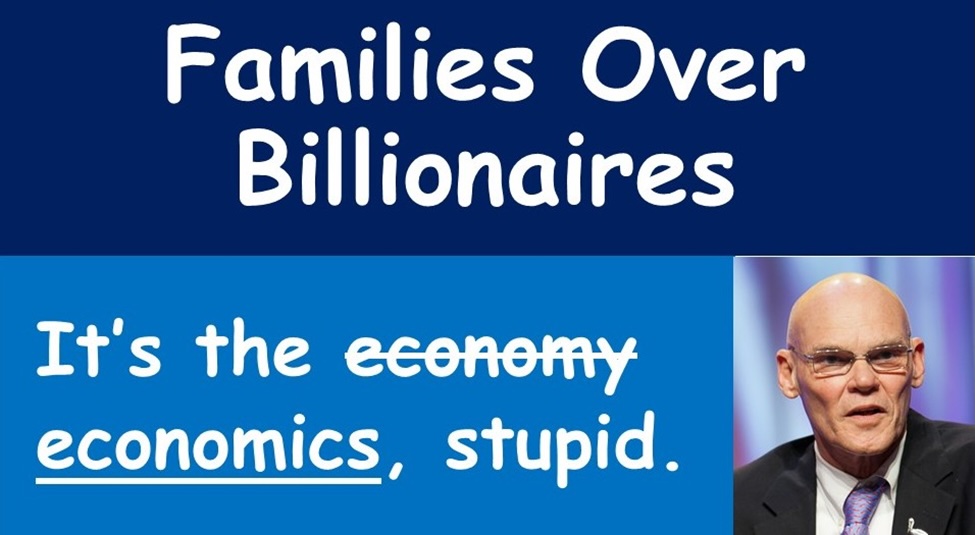
That is the work ahead. I think a “Families First”/”Families over Billionaires” agenda can be a game changer for the 2026 federal Congressional elections. That is my own assignment for my next entry!
Does this resonate? I’ll be exploring how these ideas connect to specific policy choices—and how they might shape the 2026 and 2028 elections and a way to translate our underlying values into votes.
Annotated References
Daron Acemoglu & Simon Johnson – Power and Progress (2023)
Explores how technological change is shaped by political and institutional choices. Argues that innovation can either empower labor or displace it, depending on governance—central to directing technology toward labor rather than capital dominance.
Martin Carnoy, Derek Shearer, and Robert Reich – A Bold Economic Program for America (Institute for Research on Labor and Employment, University of California, Berkeley)
Presents a comprehensive policy agenda centered on full employment, equitable growth, and public investment. Emphasizes the role of government in shaping labor markets, strengthening worker power, and ensuring that economic growth translates into broadly shared prosperity. Bridges academic analysis and actionable policy design in ways closely aligned with a labor-centered economic framework.
Herman Daly – Steady-State Economics (1977; later editions)
A foundational critique of growth-centered economics. Daly argues that economies must operate within ecological limits, reinforcing the idea that “land” is a binding constraint rather than a passive factor.
Nancy Folbre – The Invisible Heart (2001)
Demonstrates how care work—essential to families and communities—is systematically undervalued in market economies, supporting an expanded definition of productive labor.
Naomi Klein – The Shock Doctrine (2007) and later writings
Argues that crises are often used to entrench capital-centered policies. Highlights the political dynamics that can reinforce capital dominance rather than rebalance toward labor.
Mariana Mazzucato – The Value of Everything (2018)
Reframes the state as a co-creator of value, not merely a market corrector, supporting a more active public role in shaping economic outcomes.
Hyman Minsky – Ending Poverty: Jobs, Not Welfare (2013, posthumous)
Advocates for a government job guarantee as a structural solution to unemployment and instability, positioning employment as a core public responsibility.
Thomas Piketty – Capital in the Twenty-First Century (2014)
Documents the long-term tendency for returns to capital to exceed economic growth, leading to wealth concentration and reinforcing capital’s dominance over labor.
Martin Sandbu – The Economics of Belonging (2020)
Argues for an economy that prioritizes inclusion and broad participation. Emphasizes policies that enable individuals to contribute productively, aligning closely with a labor-centered framework.
Guy Standing – The Precariat (2011)
Identifies the emergence of a class defined by insecure work and limited protections, highlighting structural weaknesses in contemporary labor markets.
Joseph Stiglitz – Measuring What Counts (2019, with Fitoussi & Durand)
Advocates redefining economic success beyond GDP to include well-being, sustainability, and equity.
Pavlina Tcherneva – The Case for a Job Guarantee (2020)
Provides a detailed blueprint for implementing a job guarantee, linking full employment to economic stability and social value creation.
Erik Olin Wright – Envisioning Real Utopias (2010)
Explores hybrid economic models that expand democratic control and social ownership within market systems.
Concluding Note
These works, taken together, do not propose a single unified framework but contain most of the elements of it. They do point to a common conclusion: that the balance among land, labor, and capital has shifted, and that restoring labor’s role is essential to both economic performance and democratic vitality.
5 Comments
"Daly argues that economies must operate within ecological limits..."
Boy howdy, would I ever love to see a great big Iowa State Fair exhibit about THAT. In the Agriculture Building.
PrairieFan Wed 15 Apr 10:40 PM
Dont' hold your breath Pairie Fan
In the years that I have been advocating for the environment, I have been extremely disappointed that many times I am opposed by labor unions. To add to what Charles Bruner says, we need to create good jobs that promote the common good. And if unions were stronger, would they be more inclined to consider the consequences of the jobs that are forced on them?
I would also add another book to the list Charles included: Capitalism by Sven Beckert.
Wally Taylor Thu 16 Apr 9:25 AM
Agriculture
It’s a myth we “feed the world,” when most of U.S. agriculture feeds livestock, ethanol factories, or processed food industries — and the vast share of government subsidies goes to large monocrop producers to maximize production even on very marginal lands. Instead, we could better support sustainable agriculture through sustainable family farms emphasizing food-to-market/table production and eco homesteading of marginal lands now in production — which would support biodiversity and climate stability. This also would result in more actual employment for people who really want to farm as a way of life. That does mean taking a lot of current land “out of production” but that will also require stewardship in restoration — thus eco homesteading as a source for meaningful jobs and careers.
Charles Bruner Fri 17 Apr 7:21 AM
That is the work ahead. I think a “Families First”/”Families over Billionaires” agenda can be a game changer for the 2026 federal Congressional elections. That is my own assignment for my next entry!
Bruner asks, “Does this resonate? I’ll be exploring how these ideas connect to specific policy choices—and how they might shape the 2026 and 2028 elections and a way to translate our underlying values into votes.”
At 83, yes, this resonates. There were hundreds of thousands of marchers and protesters a few weeks ago. The generalized theme was overturn the authoritarian’s grip Trump has on America. It would have been great had a brochure inviting participation in Families First/Families B4 Billionaires campaign/agenda.
Few have read this library of texts. I downloaded the policy brief “A Bold Economic Program for America” by Martin Carnoy, Michael (not Robert) Reich and Derek Shearer, October 20, 2025, 110 pages. https://irle.berkeley.edu/wp-content/uploads/2025/10/A-Bold-Economic-Program-for-America-Oct-21-2025.pdf
PS. The midterms are about six months out. Any impact on that agenda needs to be underway … massively, if possibly. I suggest a full day’s seminar lead by Dr. Bruner and including the Democratic candidates for Congress and, maybe, Democrats for Iowa legislature. And the policies and strategies be the center of a discussion. With a simple, common language
Gerald Ott Fri 17 Apr 9:51 AM
Beclert and Taylor
Thanks, Wally and everyone. I ordered the Beckett book on audiobooks (42 hours may be a bit long for me), but here’s a synthesis I secured: Capitalism: A Global History – Sven Beckert. Offers a sweeping account of capitalism as a global system shaped by the interplay of markets, state power, coercion, and technological change. Beckert argues that capitalism did not emerge as a natural or purely market-driven system, but was constructed through processes of land appropriation, labor exploitation, and political domination across continents. He emphasizes the central role of states in enabling capital accumulation and highlights how inequalities between and within nations have been embedded in capitalism from its origins. This work provides a unifying historical framework that complements political economy approaches, reinforcing the need to understand contemporary economic outcomes—particularly inequality and insecurity—as products of structured power relations rather than neutral market forces.
Charles Bruner Sun 19 Apr 11:36 AM