
Diane Porter of Fairfield first published this post in April on My Gaia, an email newsletter “about getting to know nature” and “giving her a helping hand in our own backyards.” Diane also maintains the Birdwatching Dot Com website and bird blog.
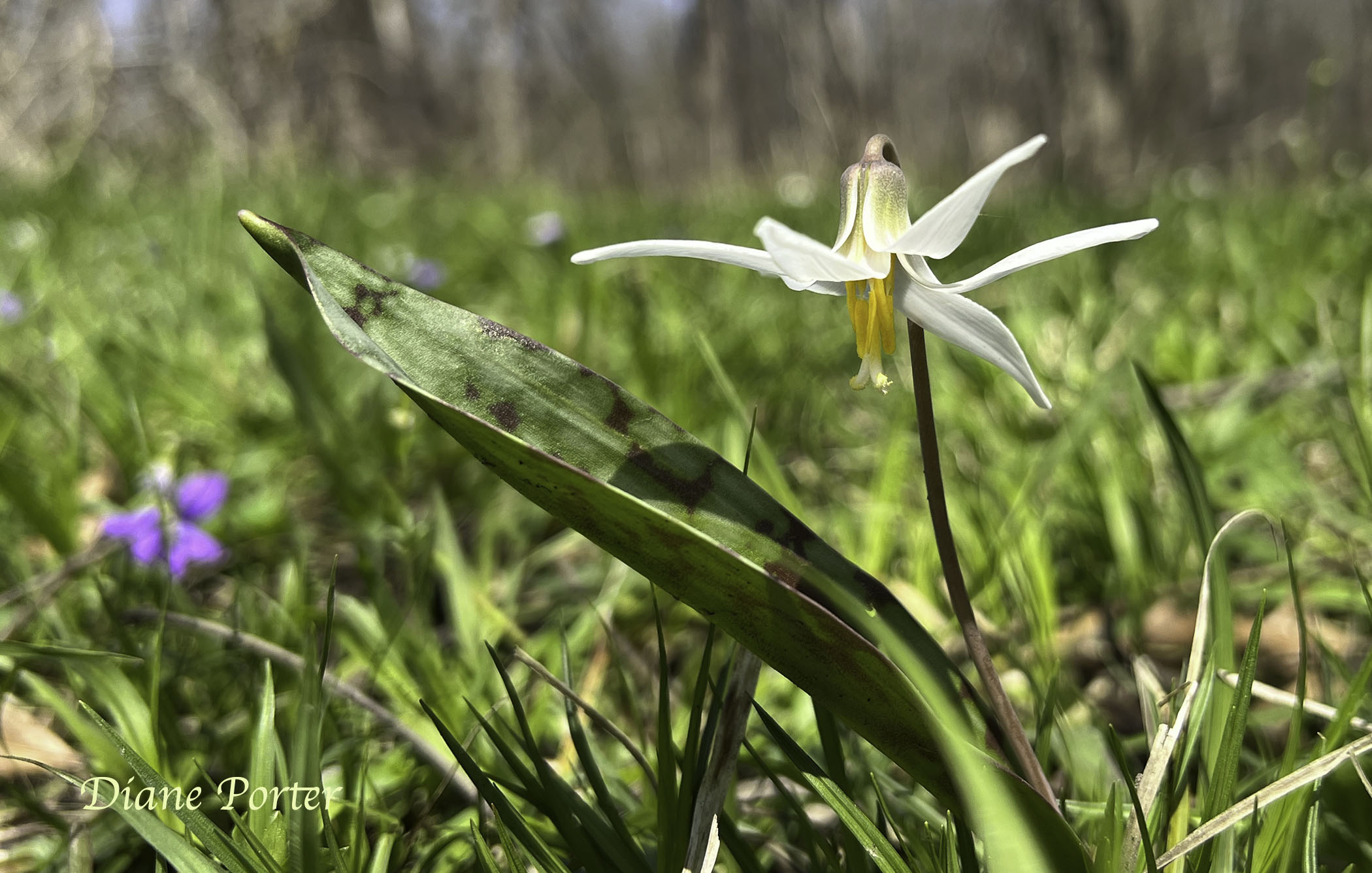
Sunshine lit up the forest floor. Overhead, tall walnut and oak trees had no leaves yet. A white trout lily (Erythronium albidum) stood alone, just above the sparse new grass. Its petals arched in arabesques, as if lifting the flower above the earth.

Some accident of placement or ancestry, of light and moisture, had singled out this one to bloom today. Nearby, the other trout lilies were still asleep on pink stems, their buds drooping.

White trout lily buds
When a trout lily opens, its petals flare out, a skirt in twirl. The open blossom lets rain slide off, protecting nectar and pollen from being washed away.

Newly open flower directs water away from the center
What we usually see is the underside of the petals. The flower turns its face to the ground.

Looking down at a white trout lily and its two spotted leaves
To see its full beauty, to look it in the eye, I lie down on the ground, cheek against the moist earth. I’m within arm’s reach of the flower, close as lovers sharing a pillow.

Downward-facing blossom of white trout lily
From below, I see the structure of the flower. The anthers hang beneath the petals, and the center is a sheltered space that holds the nectar.
A bee who has just emerged from its underground winter burrow arrives hungry. It wants that nectar. Some native bees specialize in early spring flowers like this one, particularly mining bees (Andrena). Each female must feed herself, dig a burrow, lay eggs, and provision the nest. And she must do this quickly, while the flowers last.
Her time in the sun is typically a month or less. It matches the time in which trout lilies bloom.

Trout-lily with Mining Bee (Andrena erythronii). Photo by Stephen Barten, published with permission
A mining bee approaches from below, lands, and then gropes up into the flower. Reaching for nectar, the bee’s body brushes the anthers and picks up some pollen. On the next visit to a trout lily, some pollen is left behind. Flower and pollinator fulfill their contract.
A single plant has one stem. If it flowers, there is one flower. If pollinated, it makes one seed pod, holding about 10-30 seeds.

Seed pod of white trout lily
When the pod ripens and releases the seeds, ants carry them off and leave them to sprout in new places. In the following season, each germinating seed makes a single, small leaf, but no flower. Although they may be growing close together, each leaf in a colony of young trout lilies is a separate plant.

A colony of young trout lilies. Each leaf is a single plant.
The trout lily spends its early years gathering energy from the sun. Each spring it sends up a single leaf and stores what it gains in a small, bulb-like, underground structure called a corm. When the leaf dies, the corm remains, hidden below ground, until the following spring.
Over the years, it expands its reserves. At about age five, it may produce two leaves. The next year, at last, it might put out a single flower.

One plant, two leaves, one flower
Within a day of opening, the petals begin to curl upward, sometimes nearly meeting above.
Even after reaching maturity, a plant may not bloom every year. Sometimes it spends a season building its reserves again, sending up leaves but no flower.
Clusters of trout lilies may be decades or even centuries old. They are evidence of a forest long undisturbed.
1 Comment
I especially appreciate this good post pointing out...
…that plants other than trees can be decades or centuries old. That is true in prairies and other ecosystems as well as woodlands.
That reality is something to remember when there is a claim, and I have read such claims, that no real harm is done by destroying, say, a thirty-acre undisturbed woodland with uncommon wildflowers if trees and shrubs are are planted on a sixty-acre cornfield somewhere else. Not true. And thank you so much to the Iowa individuals and organizations who are working hard to provide permanent protection to good original natural areas. Good reconstructions of natural areas also have huge value, but good originals are irreplaceable.
PrairieFan Fri 8 May 10:08 PM