
Rick Morain is the former publisher and owner of the Jefferson Herald, for which he writes a regular column. This essay first appeared on Substack.
“Thou shalt not steal.” – Eighth Commandment
—God, as reported by Moses
Americans have rarely faced the facts about the role of national theft in the history of their nation. From the time of the first Europeans’ arrival in North America, the newcomers employed theft to secure their well-being. Europeans stole land and resources from native Americans for centuries. They stole free labor from imported African slaves and their descendants for 250 years.
Those facts are undeniable and thoroughly documented. They contributed mightily to securing the wealth and power of the United States as we know it today.
It’s an uncomfortable truth, but without those thefts from indigenous Americans and Black people, the United States would not have reached the level of prosperity that has enabled it to achieve all it has for Americans and others around the world.
The history of the United States, like that of other nations, is both admirable and lamentable. A number of politicians today, in this 250th year of United States existence, would like to erase, or at least minimize, recognition of the lamentable parts. That would not be fair, either to America’s students or to the scholars charged to teach them about their nation’s past.
We’re a stronger nation when we acknowledge both the good and the bad about our past. The place of theft in America’s history is part of our story.
That said:
Rarely, probably never, has theft of other countries’ land and resources appeared to be such a driver of foreign policy for the U.S. president.
President Donald Trump has mused, threatened, and openly advocated American thefts from Greenland, Iraq, Syria, Venezuela, Gaza, Iran, and Canada. There are others as well.
In some instances, the prize is oil. In others it’s land, strategic sites, or rare earth minerals. Trump seems willing to violate the Eighth Commandment without compunction.
And it’s not a new thing for him. Back in 2015, during his first presidential bid, Trump campaigned on seizing Iraq’s oil to repay U.S. costs of occupation. He accused past administrations of failing to take that step.
“We go in, we spend $3 trillion, we lose thousands and thousands of lives, and then . . . what happens is, we get nothing,” he said.
“You know, it used to be to the victor belong the spoils. Now, there was no victor there, believe me. There was no victor. But I always said: Take the oil.”
Three years later he pushed the same argument, this time with Syria. As Bashar al-Assad’s government weakened, Trump said the U.S. had a right to Syria’s oil because we had intervened in the Middle East. “We’re keeping the oil. I’ve always said that—keep the oil. We want to keep the oil, $45 million a month. Keep the oil. We’ve secured the oil. . . . What I intend to do, perhaps, is make a deal with an Exxon Mobil or one of our great companies to go in there and do it properly.”
Venezuela? Same thing. As that nation’s government deteriorated in 2023, Trump, no longer in office, sounded his regret: “We would have taken it over, we would have gotten all that oil, it would have been right next door.”
And he hasn’t dropped the idea. This past December, now back in the presidency, he brazenly laid it out. Referring to Venezuela’s partial nationalization of oil back in 2007, Trump proclaimed, “They took all of our oil and we want it back, they illegally took it.”
Then just a month ago, regarding the current tension with Iran, Trump told reporters, “If it were up to me, I’d take the oil, I’d keep the oil, it would bring plenty of money.”
Iraq, Syria, Venezuela, now Iran: seizing and keeping other countries’ oil resources has occupied Trump’s mind for more than a decade. He has yet to lay out how such thefts coincide with America’s values.
Sometimes it’s not just another country’s natural resources: it’s the whole Lebowski.
After Trump failed to negotiate an American purchase of Greenland during his first presidential term, he upped the ante in his second term. He had said for years that the United States must own Greenland, for defense purposes as well as the potential prize of the island’s buried rare earth minerals.
In January 2026 he took a more in-your-face position. Existing treaty rights, he claimed, are insufficient, and an American lease of Greenland is not enough: American full ownership “is psychologically needed for success.” He threatened Greenland, and its partner Denmark, in brutal terms. Among his statements:
The U.S. “would do something” about Greenland “whether they like it or not.” He would take Greenland “the hard way” if Denmark did not yield. “ . . . the fact that Denmark had a boat land there 500 years ago doesn’t mean they own the land.” And “one way or the other, we are going to have Greenland” and “we’re talking about acquiring, not leasing and not having it short-term.”
And Greenland didn’t seem to be enough for Trump’s expansion dreams in the Western Hemisphere. Ever since his inauguration in January 2025 he has talked about annexing Canada, and making it the 51st U.S. state. He sometimes calls the Canadian Prime Minister “Governor,” suggests that the U.S.-Canada border be moved northward, and notes that if the U.S. and Canada were united, Canada would not be saddled with the present American tariffs.
The president has soft-pedaled such statements in recent months but has never forsworn them.
And Gaza? In February 2025, shortly after his inauguration, Trump proposed that the United States “take” Gaza and transform it into “the Riviera of the Middle East.” The Gaza Palestinians would be temporarily relocated to other countries while the reconstruction took place; whether and how soon they would return was unclear, and Trump has waffled about Gaza’s inhabitants off and on thereafter. Finalization of the plan, and buy-in from the region’s stakeholders, remain undecided.
Most of the world, and most Americans as well, view President Trump’s desire for rapacious predation of other nation’s possessions with dislike, disdain, and distress. While depredation used to hallmark America back in the day, that day is past, or should be, in most people’s minds.
Thievery on an international scale is no longer admired; it’s thought of as simple bullying of the weak by the strong. It should end, and it’s up to Congress and the courts to bring that about.
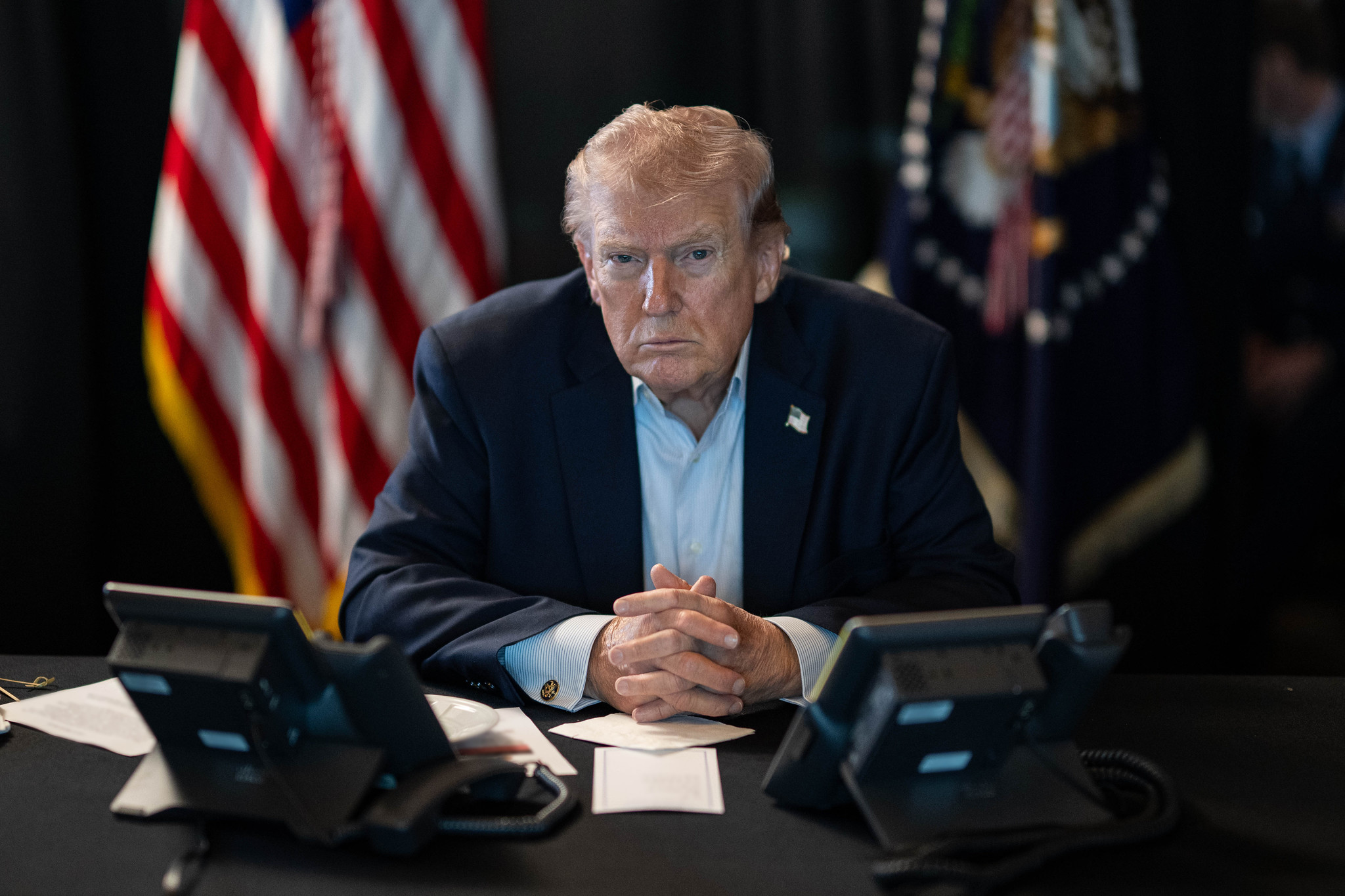
Top photo: President Donald Trump oversees Operation Epic Fury at Mar-a-Lago on March 1, 2026. Official White House photo by Daniel Torok.
4 Comments
Thank you, Rick Morain
Your post made up my mind. I’ll be joining a small Trump protest next week and carrying a sign. I’ve been telling myself I don’t really have time. After reading your post and looking at that terrifying photo, it’s clear that time needs to be found.
PrairieFan Fri 8 May 11:09 PM
“Our oil”
I find myself agreeing with Trump stating that this is our oil. While prices at the pump continue to rise, oil company profits follow the trend and rise as well. They recognize that we are exporting oil, LNG, and petroleum products while the costs at “home” and on the farm and business continue to escalate.
We need an actual energy policy that recognizes non-fossil fuels are becoming cheaper and more reliable than fossil fuels. The policy should recognize the unrealized potential that could be unleashed in this country if we turned towards community energy production, solar and wind. Encourage homeowner solar to lessen the burden on the utility network.
Stop these insane policies driven by monopolies that we are forced to serve that control our supplies and government.
BettScott Sat 9 May 6:05 AM
Brett Scott
Great 2nd paragraph. In 1st paragraph, wish you’d have called on Trump to end the war on Iran. The theocratic regime is evil, but apparently they have a deep bench. Trump and Hegseth have put U.S. between s rock and a hard place. The nukes won’t be dislodged w/o people (boots) going in to get it.
Gerald Ott Wed 13 May 8:37 PM
Cowards in Congress
And yet in recent correspondence with Grassley, it’s clear that he declares there is nothing to be concerned about regarding Trump, just another routine president.. Looks like Grassley and the rest of Iowa’s congressional delegation fear that Trump will punish Iowa or them if they cease their boot licking.
Herb Strentz
Herb Strentz Fri 15 May 12:54 PM