
Al Charlson is a North Central Iowa farm kid, lifelong Iowan, and retired bank trust officer. This commentary was first published in the Waverly Democrat.
With reluctance and apprehension I am beginning 2026 by venturing back into the property tax jungle. In my September column, which focused on farmland taxes, I indicated I would return to address the property tax concerns of my in-town friends and neighbors.
In-town residential property taxes are more complicated for a couple of reasons. Of course, city residents pay city taxes—city finances could easily be the topic for an entire column. I had the opportunity to be a guest Waverly City Council member in January 2025, which included attending annual budget hearings. My overall impression was that our city operating departments are seriously committed to providing the services they deliver as efficiently as possible.
The other complicating factor is that houses are taxed on their estimated market value. That gets interesting. In 2024 the assessed value of our home was increased 15.3 percent. The Assessor only bumped up the value of the house by 6 percent, but increased the value of our lot by 56 percent.
My theory was that a representative of the Assessor’s office drove by shortly after I had cleaned up the flower beds. An Assessor’s office staff member assured me it doesn’t work that way. Rather, the adjustment to our lot value was the result of a countywide adjustment. OK—but I’m going to hang on to my flower bed theory, anyway. The next time I get a “suggestion” that the flower beds need cleaning up, I can respond, “I’m not sure we can afford that.”
Although the rules governing taxation of farmland and in-town homes are somewhat different, owners of both are concerned about increasing taxes. Both Governor Kim Reynolds and Republican legislative leaders have stated they intend to make property taxes a top priority in the 2026 session. Before the discussion in Des Moines plunges us into deep technical details, we all need to take a step back and look at the big picture.
I would suggest these “building blocks” for a reasonable approach:
- We receive a “package” of services important to ourselves and our neighbors from our state, county, city, and school district.
- These services are not free—we pay taxes to provide them.
- We need to look at the state and local (county, city, and school district) government services we receive as a “package” because many services (roads and streets, law enforcement, and public education, for example) are provided cooperatively by two or more levels of government. And, the legislature sets the rules governing how local governments raise and spend tax dollars.
- Based on analysis by the nonpartisan Institute for Taxation and Economic Policy, in 2024 Iowa families in the middle 20 percent (incomes from $53,000 to $87,500) paid an average of 10.5 percent of family income in state and local government taxes—identical to the average of the percentage paid by the Middle 20 percent of families in all 50 states.
- We all pay our taxes from our income, although they are calculated using different bases—primarily income, sales, and property.
- Income taxes are obviously most closely related to a taxpayer’s income (ability to pay) and sales taxes are the least. Property taxes are somewhere in between—generally, higher income people live in higher valued homes. By the way, renters do pay property taxes—ask any landlord how rent is computed.
- The mix of income, sales, and property taxes a state uses to pay for state and local government services determines which taxpayers pay larger or smaller shares of total taxes collected. Over the past ten years, Iowa’s governor and Republican-controlled legislature have emphasized reducing income taxes, to the benefit of higher income Iowans.
At the time of writing this column, neither Reynolds nor legislative leaders have outlined a specific property tax proposal. The governor did indicate she is considering a property tax “freeze” for seniors. [Editor’s note from Laura Belin: Reynolds did introduce a bill on January 14; you can read a summary of key points here or the full text of House Study Bill 563. Senate Republican leaders introduced their property tax proposal on January 12; you can read a summary here or the full text of Senate Study Bill 3001.]
Seniors have long been a focal point in property tax policy discussions. Over long periods of time, a home’s value and associated taxes can grow faster than income, and can particularly add to the hardship when one spouse dies and the survivor faces a significant income reduction.
In 2023, Iowa created a new Seniors Homestead Exemption for homeowners age 65 and older, reducing the home’s taxable valuation by $6,500. Based on the $37.69 per $1,000 of valuation tax rate effective in Waverly for taxes payable in 2025 and 2026 this new exemption provides a $245 tax reduction.
Income tax cuts over the past ten years provide more impact, especially for higher income seniors. Since 2023 all retirement plan income has been excluded from Iowa income taxation. (Social Security benefits have been excluded since 2014.) Consider a hypothetical retired couple, both over age 65, with $125,000 of income consisting of $60,000 retirement plan income, $50,000 Social Security benefits, and $15,000 taxable investment income. Under the rules in effect in 2016 their Iowa income tax responsibility would have been $1,408. Today it would be $0.
Of course, the very high priority the governor and legislature have placed on cutting income taxes since 2016 has restricted the state’s ability to fund other priorities. Based on analysis by State Senator Herman Quirmbach of Ames, the ranking Democrat on the Senate Education Committee, 2025-26 per pupil state K-12 public school funding would have needed to have been 11.4 percent higher to keep up with inflation since 2016-17.
Aggressive income tax cutting also puts more pressure on other sources of tax revenue. As an example, in our personal case the 2025-26 increase in the school district portion of the taxes on our home outweighed our Seniors Homestead Exemption benefit by 33 percent. (We have no complaints–our older neighbors contributed a far larger share of their income to support our sons’ K-12 education!)
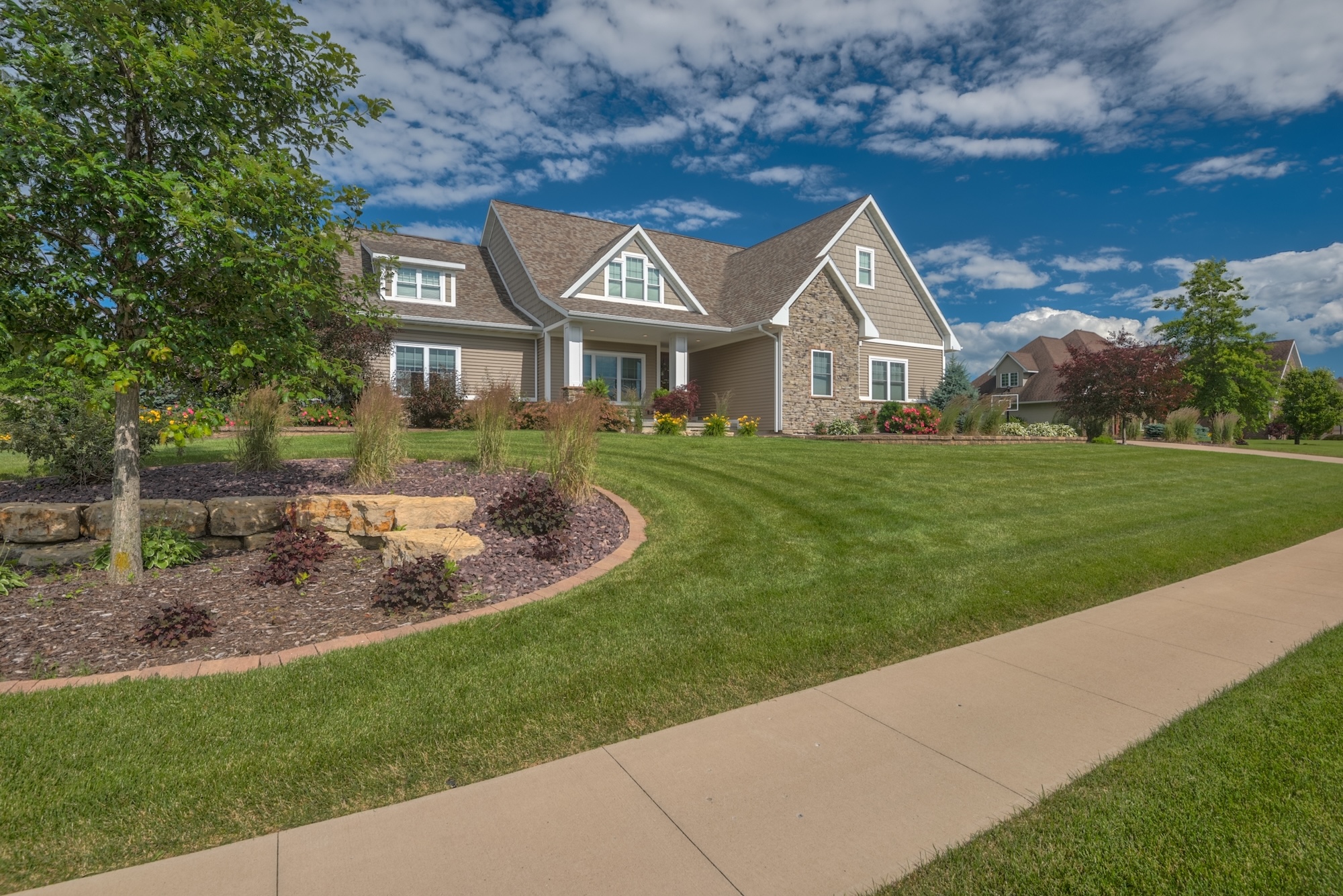
Top photo of a home on the edge of Burlington, Iowa was taken by June 29, 2020 by Matt Oaks; available via Shutterstock.
3 Comments
Renters Don't Pay Property Taxes
Renters pay rent. Property owners pay property taxes. The property tax is capitalized into the value of the property. If you increase property taxes, the value of the property falls, all other things being equal. If you decrease property taxes, the value of the property increases. Rental properties are priced according to an internal rate of return, using a discount rate. If the prevailing interest rate is 5%, for example, then a $100 property tax cut will add to the home’s value: $100 / 5% = $2,000.
The current owner absorbs 100% of the impact of property taxes, in perpetuity. That’s why the massive cut in multi-residential property taxes was such a waste of money. All it did was pad the balance sheet of the owners of multi-residential property. It had no impact on market rents. Landlords do not reduce rents due to reductions in property taxes, and the market does not allow them to increase rents when property taxes rise.
That’s just how it works.
Jon Muller Mon 19 Jan 3:05 PM
Local services
Most of the mainstream Iowa commentary I’ve read about local-government services funded by property taxes focus on schools, law enforcement, and road/sewer-type infrastructure. That is very understandable — those services are vital.
I don’t think it’s frivolous, however, to point out that parks are important too. Iowa is competing for young people with many other states where the opportunities for outdoor recreation are already much bigger and better than in Iowa. Making that disparity worse does not seem like a good plan just from an economic point of view.
PrairieFan Mon 19 Jan 3:32 PM
Response to Jon Muller
Jon – I appreciate your comment. Actually, I think you and I are saying the same thing, but approaching it from different directions. Of course, the landlord does write the check to the County Treasurer. But the net return to the landlord’s investment is computed after all expenses including taxes. If taxes on a rental property increase $600 the landlord will do everything he can increase rent by $600 ($50 per month) in order to maintain his 5% return on investment. Real estate taxes are a significant part of a landlord’s expenses. For a typical single family rental home in Waverly taxes equal 20% to 25% of rent.
Al Charlson Tue 20 Jan 12:18 PM