
State Representatives Heather Matson, Tracy Ehlert, Eric Gjerde, Monica Kurth, Elinor A. Levin, and Mary Madison co-authored this column.
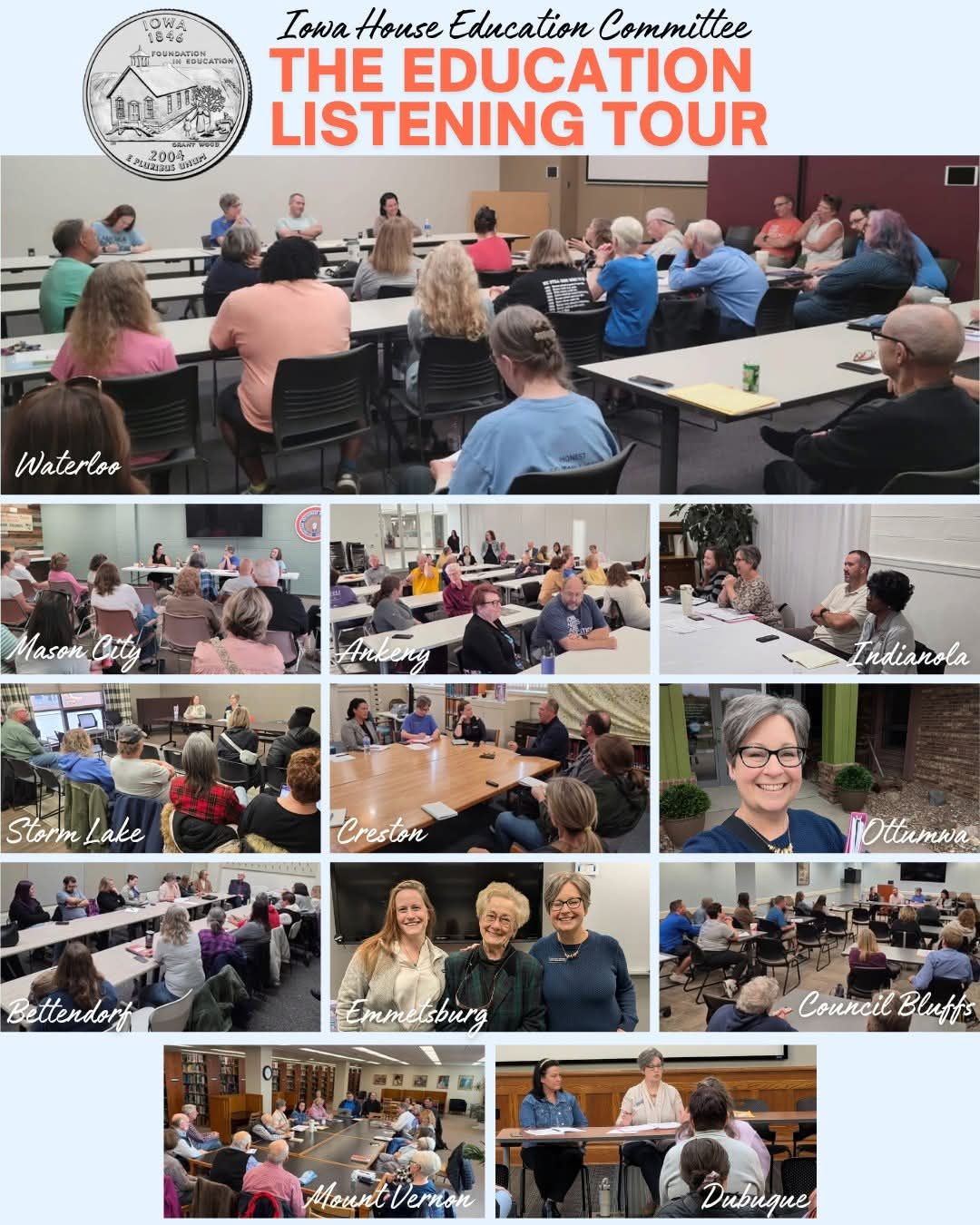
Two months. Twelve stops. All four corners of Iowa on a statewide education listening tour.
That’s how we, as members of the House Education Committee, spent the fall as we focused our attention on how to make Iowa number 1 in education again.
We set out to Mason City, Waterloo, Ankeny, Ottumwa, Indianola, Creston, Council Bluffs, Storm Lake, Emmetsburg, Bettendorf, Mount Vernon, and Dubuque. At each stop we heard from current and retired teachers, paraeducators, principals, superintendents, school board members, community college and higher education professors and leaders, AEA educators, school librarians, nurses, counselors, and mental health professionals, parents, and community advocates.
We flipped the script of traditional town halls—this wasn’t about us talking—it was about listening before legislating. What did we hear? A lot! Here are some of the highlights.
Mental health and behavior challenges need to be met on many levels. Schools don’t have enough counselors, elementary students need more recess, and teachers need more support from their administration when problems arise in the classroom. In some cases, due to AEA changes, mental health supports that used to be in person are now only available through telehealth. The strain on teachers cannot be discounted as they deal with staffing shortages, frequent and volatile policy changes, and the constant requirements to do more with less.
Addressing special education funding was named as a priority at every listening session. As of 2024, all but 26 school districts run deficits, some into the millions of dollars. Districts are stuck raising property taxes to cover the cost. School leaders asked us to review the definitions and increase funding for special education to meet the needs of student populations today.
It’s untenable for Iowa to fund two systems—public schools and vouchers for private schools, which are an unlimited line item in the state budget. School districts feel like they are in an arms race because of vouchers. Competition is great, but it isn’t a “fair fight” when private schools have different rules and lack oversight. Taxpayer dollars must always be accounted for and subject to public review. If private schools want to accept taxpayer dollars in the form of vouchers, they owe it to taxpayers to be transparent and accountable.
This is just a snippet of what Iowans showed up to share. Looking back on about 50 pages of notes, we could write a book on the challenges of declining enrollment, needed professional development and higher pay for paraeducators, AEA changes, child care wait lists, impacts of concentrated poverty on student success, quality of life, failed bond referendums, concerns about AI, travel time on buses, and school safety.
We always asked attendees to share some positives. There are so many amazing things happening in our public schools! Here are a few that we heard.
Every student has a caring adult in Council Bluffs. Students started a library book club in Clinton. The J-Term in Mount Vernon provides internships between semesters. Every student in Dubuque through 7th grade gets an outdoor experience that aligns with the curriculum. Storm Lake is blessed with diversity and has a great adult-to-student mentorship program. Cedar Rapids has strong union trades partnerships. The Greater Regional Hospital in Creston is a financial partner for child care and housing. A school nurse in the Quad Cities gave a first grader with special needs the support and skills to be successful.
Additionally, legislation passed to restrict cell phone use, the creation and support for therapeutic classrooms, and LETRS training around the Science of Reading have been well-received. Locally-led partnerships are also instrumental for student success and so greatly appreciated. Concurrent enrollment with community colleges provide unique opportunities for work-based learning and college credits—this was a highlight at every stop on our tour.
Best of all: teachers still show up and the kids are still awesome.
Innovation is everywhere. But funding matters if we are going to foster a generational view of what it means to invest in public education.
Iowa was number 1 when we believed in abundance, not forced austerity. When we believed in trusted partnerships led at the local level, not micromanaged from Des Moines. When we believed in public education for all our kids as the common-good foundation of our success as a state, not education as an individualized, free-market purchase for each family. We cannot and should not keep pushing education into a business model.
This legislative session, we propose that our budgets reflect the needs of public schools and students, and that the legislation we introduce address real challenges, not culture war politics. Let’s invest in our future by consistently funding our public schools above the rate of inflation, fix special education deficits, bring transparency and accountability to any public funding that goes to private and charter schools, restore our AEAs, empower local partnerships that spur innovation, meet the needs of the whole child, and restore collective bargaining to bring teachers back to the table to negotiate smaller class sizes, mandatory prep time, and meaningful professional development to reduce burnout and improve recruitment and retention.
In essence, we get back to number 1 when we get back to the foundation of what made Iowa so successful for decades—resources and trust. It will take time to rebuild what has been torn down. Our kids and families are counting on us to start now—we are all in this together.
6 Comments
outcomes
Public vs Private has never been a fair fight. For decades if you didn’t have the money to send your kids to private schools you were outta luck. Pendulum has gone in the other direction as vouchers have opened the competition floodgates and scrutiny of public education is at an all-time apex.
Best way to discourage parents and students from fleeing marginal public schools with vouchers is by improving test scores and graduation rates. A look at some of the communities shows some real winners and also some rotten apples:
Storm Lake High School 46% graduation rate, 54% reading proficiency
Emmetsburg High School 97% graduation, 78% reading proficiency
Dubuque Senior 85% graduation, 68% reading proficiency
Ottumwa High School 91% graduation, 60% reading proficiency
https://www.usnews.com/education/best-high-schools
Personally, I prefer a “means test” for those seeking vouchers.
ModerateDem Wed 4 Feb 4:19 PM
appreciate these folks getting out into their communities(Levin is great on outreach) but
this “Competition is great, but it isn’t a “fair fight” when private schools have different rules and lack oversight. Taxpayer dollars must always be accounted for and subject to public review. If private schools want to accept taxpayer dollars in the form of vouchers, they owe it to taxpayers to be transparent and accountable. ” is awful.
First where is the evidence that competition (and not cooperation) is “great” for education?
2nd private religious schools will always be free to discriminate against folks that don’t fit their ministries (including kids with disabilities), and of course people who don’t have the cash to pay tuition/fees, so there isn’t some even playing field available, Our Dem leaders need to lead the people on these issues and better inform them about the war on public ed under the guise of “choice”. If not as a matter of principle then for mere political gain:
https://educationwars.substack.com/p/lessons-from-the-lone-star-state
dirkiniowacity Wed 4 Feb 8:14 PM
Some Iowa Republicans want Iowa schools to become #1 in the nation in a different way...
…meaning that they want Iowa to become the first state in the nation to completely remove vaccination requirements for students to attend Iowa K-12 schools. The bill that would do that got out of committee today and is eligible for debate and a vote on the House floor as early as next week.
Maybe the bill won’t become law. Hope hope. But since it really did pass an actual Iowa Legislative committee, it may be time to toss the phrase “Iowa common sense” into the same wastebasket that now holds “Iowa Nice.”
PrairieFan Wed 4 Feb 11:58 PM
I hear you PF, the non-Feenstra
GOP candidates for Iowa governor back an mRNA vaccine ban, which is nuts. These people are so primitive and dangerous but most of our press (and a Dem elected official or two) insist on treating them as responsible and competent actors.
Indeed we should find suspect anyone who talks about “common” sense in the midst of this deadly culture war.
dirkiniowacity Thu 5 Feb 5:23 PM
Dirk
As John Prine said, “That common sense don’t make no sense no more”
Wally Taylor Fri 6 Feb 9:21 AM
indeed Wally
Prine is much missed and of course (especially in this context) tragically died of COVID complications. It’s not an accident that Trump and company love to talk about Common Sense and that alone should make people wary of politicians who still use the term which is at best an honorific meaning something like only a fool would doubt what I’m saying even tho I have no evidence and am contradicting most experts…
https://www.aaronhuertas.com/we-need-to-talk-about-reactionary-centrists/
dirkiniowacity Fri 6 Feb 2:56 PM