
Herb Strentz was dean of the Drake School of Journalism from 1975 to 1988 and professor there until retirement in 2004. He was executive secretary of the Iowa Freedom of Information Council from its founding in 1976 to 2000.
More than 40 years ago, in his first term as a U.S. Senator, Chuck Grassley gained a reputation as a government watchdog, thanks to his outrage that the Pentagon would spend $435 for a $15 hammer.
Now it is 2026 and the once thrifty Grassley was willing to shovel billions of taxpayer dollars to President Donald Trump’s pet projects. He approved allocating up to $1 billion for security purposes in construction of Trump’s proposed ballroom of 90,000 square feet. That $1-billion proposal has been shelved, at least temporarily, in response to Senate and public outcry. Republicans dropped it from the budget reconciliation bill to fund immigration and border enforcement, which Trump signed earlier this month.
Grassley also supported providing $1.776 billion to compensate victims of so-called “weaponization,” including those who supported Trump by wrecking our nation’s capitol on January 6, 2021. That insurrection was in response to Trump’s lie that the 2020 presidential election was stolen from him. The proposed “slush fund” was also shelved, for now. While acting U.S. Attorney General Todd Blanche says that matter will not be pursued, the Senate refused to ban such payoffs to the thugs among Trump’s legions.
Harvard Professor Steven Kelman may help us bridge the gap from the Grassley outrage over a hammer in the mid 1980s to Grassley’s support of Trump’s spending sprees these days.
Kelman is professor emeritus of public management at Harvard’s John F. Kennedy School of Government and from 1993-1997 was administrator of the Office of Federal Procurement Policy. In print, he has called the $435 hammer “an accounting artifact.“ One 1998 article about his analysis was titled, “The myth of the $600 hammer.”
About the January 6-ers
With regard to the $1.8 billion proposal to reward January 6 protestors, Kelman suggests, “We should be referring to Trump’s astonishing effort to pay the January 6th rioters as ‘pay for putsch’” —a reference to the Nazi’s attempted “beer hall putsch” in 1923.
The now stalled $1 billion for the ballroom and $1.8 billion “slush fund” continue to take twists and turns — few favorable to Trump and Grassley. The political dynamics have raised concerns about the president, even among Republican senators. However, Grassley and Iowa’s junior senator, Joni Ernst, remain Trump stalwarts.
So this post focuses on the “myth” of the $435 hammer of long ago, rather than the more recent ballroom and security proposals.
This approach may seem like misplaced priorities, but the hammer episode has lessons for us in the questionable campaigns to slash government spending in places where it is needed most—like with Elon Musk’s erratic budget-cutting and Governor Kim Reynolds’ attacks upon public schools
Still hammering away
First elected to the Senate in 1980, Grassley has railed against the supposedly $435 hammer for most of his years in office. For example, in a 2018 speech on the Senate floor, he declared, “As many Iowans will remember, I exposed the (Pentagon) spending scandal in the ‘80s.”
In an article from 1985, Kelman mentioned other bizarre expenses, like $91 for one screw available in hardware stores at three for a penny, and $9,609 for a 12-cent Allen wrench.
Further, Government Executive quoted Kelman in 1998 explaining how the $15 hammer became a $435 item or, at times $600:
“There never was a $600 hammer,” said Steven Kelman [….] The military bought the hammer, Kelman explained, bundled into one bulk purchase of many different spare parts. But when the contractors allocated their engineering expenses among the individual spare parts on the list-a bookkeeping exercise that had no effect on the price the Pentagon paid overall-they simply treated every item the same. So the hammer, originally $15, picked up the same amount of research and development overhead-$420-as each of the highly technical components, recalled retired procurement official LeRoy Haugh. (Later news stories inflated the $435 figure to $600.)
After finding the 1998 article, I asked the senator in an email to his office: “Were you ever aware of this explanation— that we wound up saying a $15 hammer cost hundreds of dollars when the absurd cost was a result of bookkeeping?”
Grassley’s response of some 680 words did not mention “hammer” or “$435” once. His opening sentence of 21 words was “Thank you for taking the time to contact me regarding your concerns of inaccurate bookkeeping within the Department of Defense (DOD).”
He did emphasize that he was long aware of and fought wasteful government accounting practices that tack on so much overhead to each item that a $15 hammer is billed at $435.
Perhaps the senator might say that contrasting the $435 for a hammer with $10 billion or more for an aircraft carrier is a distinction without a difference, The total costs of a billing remain the same. Besides that, a $435 hammer certainly is a public-attention getter. We can’t cope with billions and trillions.
But at what cost?
Citizens may want much more for much less
In the 1985 article, back when Grassley began viewing costly hammers with alarm, Kelman had suggested some troubling impacts of the one-item outrage expressed by the senator and others:
THERE ARE FEW BELIEFS more deeply embedded in the popular consciousness than that government wastes a lot of money. Seymour Martin Lipset and William Schneider, in their book The Confidence Gap, report that in surveys asking people how much of each tax dollar they think the federal government wastes, the median response is 48 cents. Lipset and Schneider argue that the paradox of simultaneous public support for tax cuts, and for maintaining or increasing spending in all major categories of government programs, is explained by the perception that waste in government is so rampant that there can be big spending reductions without service rollbacks.
On the other hand, perhaps too many of Grassley’s colleagues in Congress don’t see government spending as so wasteful. After all, doling out big contracts and other rewards to their financial backers and hometown communities supports their re-election. Aiding the needy and the suffering does not.
On the hammer and Trump rankings
A few concluding thoughts:
• A United Press International article (“Pentagon: Days of buying $435 hammers over”) begins, “Pentagon auditors identified $17.5 million wasted in the purchase of spare parts …but the [Reagan] administration pledged Friday that the days of paying $435 for a $15 hammer are nearly over.”
The date of the article? June 1, 1984. And press coverage since has seldom, if ever, touched upon how bookkeeping inflates the $15 paid for the hammer.
• The now shelved $1 billion for the White House ballroom and the $1.8 billion “slush fund” for the January 6-ers likely would pale before the money that Trump and his family are making in their marketing the constitutional Office of the President. They may take home more money than the other 45 presidents combined. With more than two years left for money-raking that may already be the case.
• Further, Trump may be linked to more peacetime deaths than any of his predecessors. The non-partisan National Library of Medicine estimated that between 4,244 and 12,202 deaths from COVID-19 were attributable to “President Donald Trump’s early pronouncements about voluntary mask use and his intention not to use masks.”
The non-partisan KFF (formerly the Kaiser Family Foundation) Health News summarized reports that nearly 17,000 COVID-related deaths in six countries — including 12,000 in the U.S.— were attributable to victims taking the unproven anti-malarial drug hydroxycholoroquine.
Then President Trump repeatedly urged people to take the drug, saying, “What do you have to lose?”
And Global health and humanitarian organizations estimate that U.S. cuts in international medical and nutritional aid—by the Trump administration and Elon Musk’s Department of Government Efficiency (DOGE)—contributed to hundreds of thousands of preventable deaths worldwide. Millions more could die if the funding reductions continue.
So much more is at stake than the cost of a $15 hammer. Yet Grassley favored giving billions more to Trump.
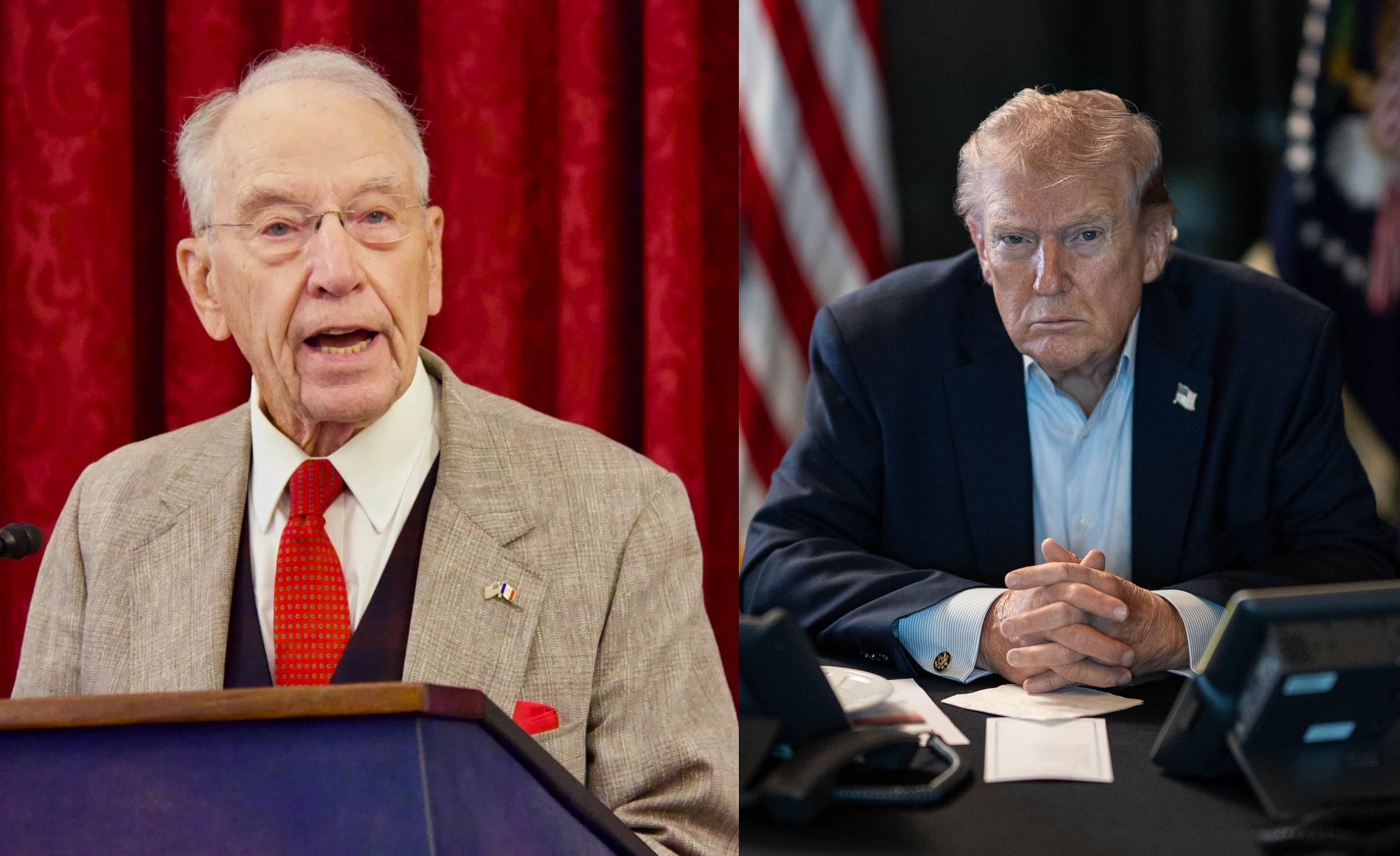
Top photo of Senator Chuck Grassley is cropped from a photo published on his official Facebook page on July 30, 2025. Top photo of President Donald Trump is cropped from an official White House photo by Daniel Torok of the president overseeing Operation Epic Fury at Mar-a-Lago on March 1, 2026.
1 Comment
No title
Thank you for the post. The hydroxycholoroquine figure suprised me. I remember hearing about a few people becoming ill but was some of the deaths tied to people getting ill and not seeking proper treatment in time because they went off on a road to nowhere. As opposed to people who died directly from hydroxy. I thought you were going to write about the couple hundred of people who have died in the Caribean which are not war related deaths. Anyway, keep hammering away.
mlg Sun 28 Jun 9:29 PM