
Bill Bumgarner is a retired former health care executive from northwest Iowa who worked
in hospital management for 41 years, mostly in the state of Iowa.
With the Iowa primary elections behind us and important statewide contests for governor and U.S. Senate coming up in November, I was struck by curiosity.
Does Iowa – 99 counties strong – have a bellwether county?
Over the years, you may have heard about bellwether counties that have correctly selected the U.S. presidential winner many election cycles in a row. (That distinction currently belongs to Blaine County, Montana and Essex County, New York, which have selected every winner since 2000.)
This project is a bit different. It seeks to learn if a single Iowa county’s general election candidate preference percentages closely mirror statewide results over time.
THE METHODOLOGY
To satisfy my curiosity, I opened a spreadsheet and loaded general election results by county for the past five major Iowa statewide contests. This included the elections for president in 2024, governor and Senate in 2022, and president and Senate in 2020.
I assessed how closely each county’s vote percentage margin – between the winning and losing candidate – aligned with the statewide result. As an illustration, let’s take a look at my home county of Clay County.
In the 2024 presidential contest, Clay County voters chose Republican Donald Trump over Democrat Kamala Harris by 70.8% to 27.7 percent. That’s a margin of 43.1 percent. The statewide results were 55.7 percent for Trump and 42.5 percent for Harris, a margin of 13.2 percent.
Accordingly, the margin variance between Clay County and the state as a whole was 29.9 percent (Clay County’s 43.1 percent margin minus the 13.2 percent margin statewide).
To be considered a bellwether, a county’s margin variance to the state results must consistently be close to 0 percent. No surprise to me, Clay County’s 29.9 percent margin variance in the 2024 presidential contest was nowhere close to bellwether status.
THERE IS A BELLWETHER COUNTY
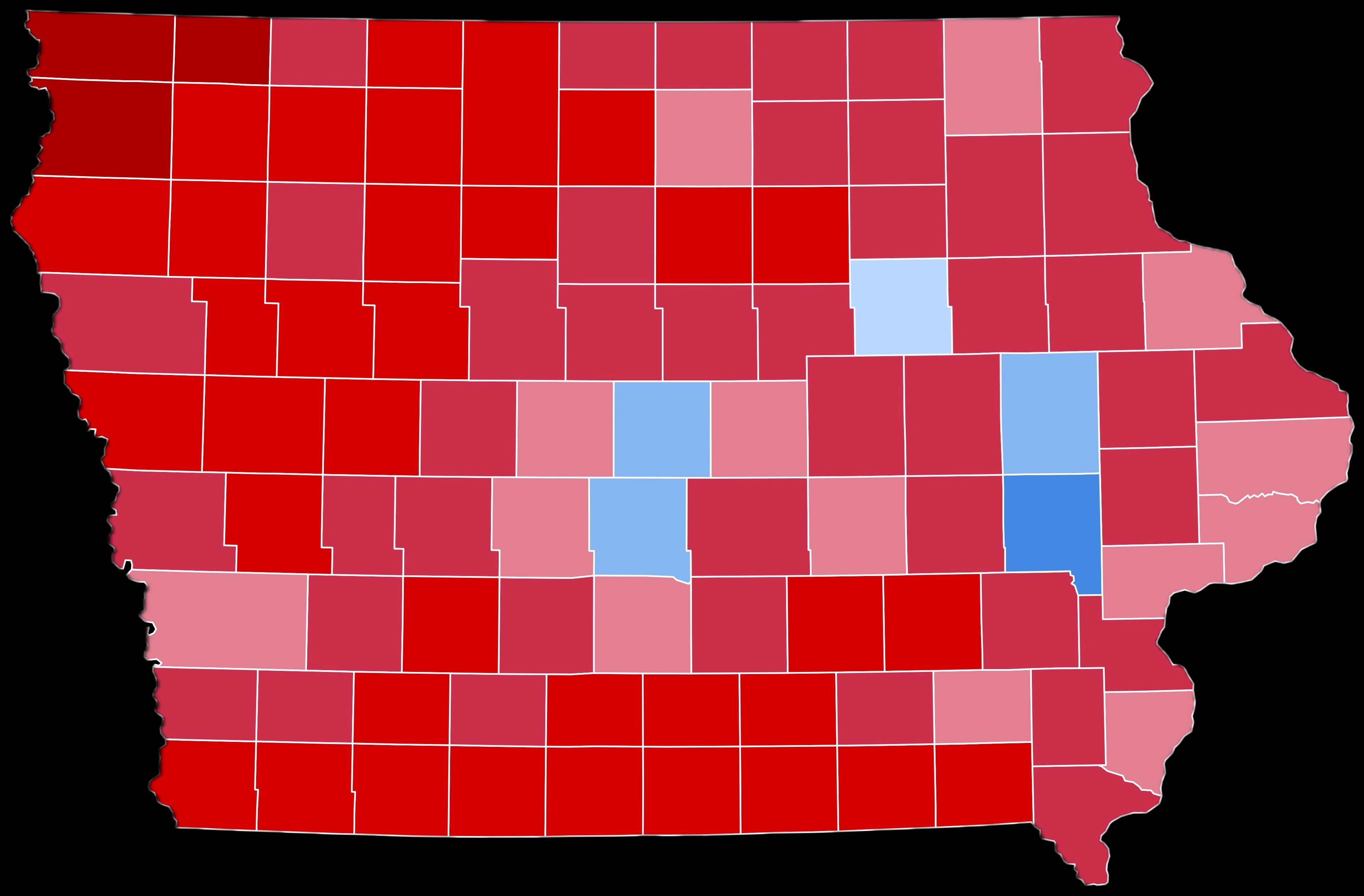
In current times, much like Clay County, more than 90 Iowa counties consistently support Republican candidates. Most are rural counties and the Republican margins are wide, typically exceeding 30 percent and 40 percent. The highest margin in the 2024 presidential race occurred in Sioux County in northwest Iowa, selecting Trump by a margin of 70.7 percent – with Trump receiving 84.5 percent of the vote to Harris’ 13.8 percent.
As a result, bellwether county possibilities are not abundant. But there is one: Des Moines County, located in the southeast corner of Iowa.
Situated on the on the banks of the Mississippi River, Des Moines County joins Dubuque County as one of Iowa’s two original counties. It has a population of 38,077 and is the state’s 16th largest county. Burlington is its largest city and the county seat. Its population of 23,323 makes Burlington Iowa’s 23rd most populous city.
The largest employer in Des Moines County is the Burlington campus of Southeast Iowa Regional Medical Center, with more than 900 employees. It’s the 8th largest medical center in Iowa based on net patient revenue. Another significant employer, the Iowa Army Ammunition Plant – Middletown, employs more than 800 people.
Several manufacturing companies are based in Des Moines County with employment levels ranging from 200 to 900 people. It’s also the home of Southeastern Community College. As is the case in most rural counties, the public schools and local government are significant employers.
As of June 2026, the highest voter registration preference in Des Moines County is “no party” (37.7 percent), followed by Republican (31.6 percent), Democrat (29.6 percent) and “other” (1.1 percent). In terms of Republican-Democrat registration advantage, Des Moines County has a +2.0 percent Republican advantage compared to a +8.6 percent Republican margin statewide.
NOT PERFECT, BUT CLOSE
As Iowa’s bellwether county over the last five major statewide elections, Des Moines County’s median margin variance to the state was 1.8 percent. In contrast, the median margin variance for all Iowa counties in recent election cycles has been in the ballpark of 25 percent.
Here’s the bellwether detail for Des Moines County for the five election contests included in the study. I also noted which county had the lowest margin variance in each election contest.
Recent election results, statewide and in Des Moines County
| election | state GOP | state Dem | Des Moines County GOP | Des Moines County Dem | margin variance | lowest margin variance |
| 2024 president | 55.7% | 42.5% | 56.6% | 41.6% | 1.8% | Cerro Gordo (1.6%) |
| 2022 governor | 58.0% | 39.5% | 58.8% | 38.4% | 1.8% | Poweshiek (1.6%) |
| 2022 Senate | 56.0% | 43.8% | 55.7% | 44.2% | 0.7% | Des Moines (0.7%) |
| 2020 president | 53.1% | 44.9% | 53.1% | 44.6% | 0.3% | Des Moines (0.3%) |
| 2020 Senate | 51.7% | 45.2% | 48.3% | 47.4% | 5.7% | Clinton (0.1%) |
Des Moines County’s results were strikingly similar to the statewide results in every contest with the exception of the 2020 Senate election between Republican Joni Ernst and Democrat Theresa Greenfield. The margin variance in that race was 5.7 percent, significantly higher than the county’s overall median of 1.8 percent for the full study.
The Ernst-Greenfield race was an outlier. Des Moines County voters simply had a higher preference for the Democratic candidate in this instance in contrast to other elections included in the study. There was an above average level of non-major party voting in that contest, both across Iowa and in Des Moines County, but the impact on the margin variance was insignificant.
OTHER COUNTIES TO WATCH
The study also showed that two other counties – Clinton and Muscatine – are borderline bellwether counties. Clinton County had a median margin variance of 2.1 percent and Muscatine County’s was 2.2 percent as compared to Des Moines County’s 1.8 percent.
Clinton and Muscatine counties experienced relatively wider and less consistent bellwether variances over the five elections contests compared to Des Moines County. However, all three counties may offer early insight into the races for governor and U.S. Senate no election night.
It will be interesting to see if Des Moines County maintains its status as Iowa’s most consistent, multi-election bellwether county.
Editor’s note from Laura Belin: Presidential voting in Cedar County closely matched Iowa’s statewide results in the 1996, 2000, 2004, 2008, and 2012 elections. But beginning in 2016, Cedar County voters sharply diverged from the statewide electorate. Also in 2016, Iowa’s presidential voting ceased to be a bellwether for the U.S. as a whole.
Top image: 2024 presidential election results by county, by ZackCarns, available via Wikimedia Commons.

2 Comments
Excellent analysis
Well-researched article, thank you for putting this together.
ModerateDem Sat 20 Jun 8:24 AM
Agree with ModerateDem
This is interesting and I appreciate it.
PrairieFan Sat 20 Jun 4:04 PM