
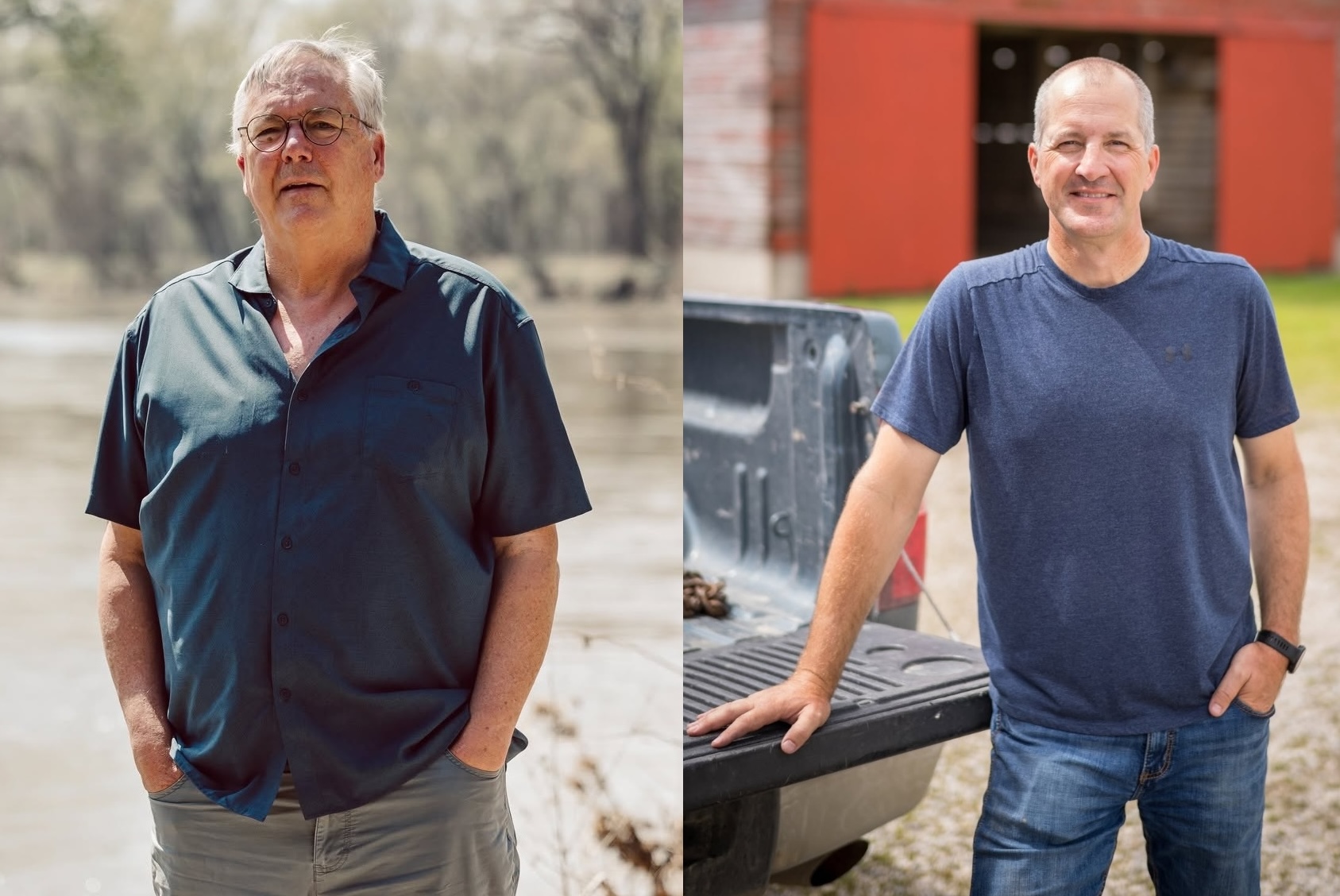
A new poll conducted for Chris Jones’ campaign shows the Democratic challenger is “within striking distance” of Republican Secretary of Agriculture Mike Naig and leads the incumbent after respondents read information about both candidates.
Change Research conducted the poll on behalf of Jones’ campaign from July 28 to August 1 and published key findings in a memo provided to Bleeding Heartland.
Naig led Jones by 42 percent to 40 percent in the first ballot test, before respondents heard biographies of either candidate. That’s within the margin of error (+/- 3.1 percentage points) for the survey of 1,071 likely general election voters. Some 16 percent said they were unsure.
After respondents read background information about both contenders, Jones led Naig by 46 percent to 40 percent, with 13 percent unsure.
Jones told me the poll backs up what he’s seen on the campaign trail: “Iowans are fed up with the status quo and ready for change.”
Naig’s campaign has not released any internal polling. But several signs point to Republican anxiety about the secretary of agriculture race.
Signs of crossover appeal
My first question about any campaign’s internal polling is what did you say about the candidates before the ballot test? Some firms try to manipulate results with phrasing that pushes respondents in one direction. In this case, I wondered whether the poll highlighted Naig’s past work for Monsanto and other Big Ag interest groups, or avoided mentioning that Jones is a Democrat.
The Jones campaign provided the following descriptions from the Change Research survey. They were broadly positive about both contenders and included party affiliation as well as Naig’s incumbency status.
Chris Jones, the Democrat, is a research scientist and author who has spent more than 40 years advocating for clean water and sustainable agriculture across Iowa, including running the water testing lab at Des Moines Water Works, working directly with farmers at the Iowa Soybean Association, and leading water quality research at the University of Iowa before retiring in 2023. He’s not in the pocket of big agribusiness corporations or their PACs, and he’s running to fight for farmers, increase Iowans’ access to healthy locally grown food, and hold the corporations polluting Iowa’s water accountable.
Mike Naig, the Republican, is the fourth generation to work his family’s century farm in northwest Iowa. He’s served as Iowa’s Secretary of Agriculture since 2018, growing new export markets for Iowa farm products, launching the Choose Iowa program to support local farmers and food businesses, and helping lead the state’s response to animal disease outbreaks that have threatened Iowa farms in recent years. He’s running on what he calls an “Iowa First” agenda built around farmers, families, and freedom, saying protecting Iowa’s farms, water, and rural way of life remains his top priority.
According to Change Research, 4 percent of Republican respondents backed Jones initially, but 9 percent did after seeing those biographies. Among “pure independents” (a term referring to voters who do not consistently support candidates from one party), Jones led Naig on the first ballot test by 27 percent to 17 percent, but led by 45 percent to 14 percent after voters learned more about the candidates.
Jones has been framing the secretary of agriculture race as a referendum on clean water in Iowa, and that issue appears to be driving his crossover appeal.
Water quality a top concern for voters
When Change Research asked what should be Iowa leaders’ top priority, the most common answer was “water quality and pollution,” named by 43 percent. Both candidates for governor, Democrat Rob Sand and Republican Zach Lahn, routinely talk about water quality at their campaign events, reflecting how salient that issue is for voters.
Asked about priorities for the secretary of agriculture, “cleaning up Iowa’s rivers, lakes, and drinking water is the most cited priority at 66%. Reducing cancer rates linked to agricultural pollution follows at 56%, and supporting family farmers’ ability to stay on their land and avoid foreclosure ranks third at 45%,” according to the polling memo.
Jones connects the dots between Iowa’s water pollution and cancer crisis in all of his campaign speeches and interviews. He often observes that scientists have known for decades that large-scale agriculture has negative human health consequences, but “leaders in industry and government have refused to take notice.”
When he retired as a University of Iowa research scientist three years ago, Jones imagined winding his days away in his fishing boat and garden. “And so I come to politics not with career aspirations, but out of a sense of duty,” he tells audiences. “Because I believe the degraded quality of life and human health consequences of large-scale agriculture is the issue of our time in Iowa.”
The front page of his campaign website features a “letter to Iowans” that begins:
I imagine a day when a miracle has happened.
On that day our streams run clear, our air smells of nature and not the moldered waste of a swine legion. Children play in our lakes while parents look on unconcerned about infection. From our faucet flows water we can know is safe to drink.
Voters don’t need to visit Jones’ website or hear him speak to grasp his campaign’s central message. “Clean water for Iowa” (with an illustration of a drop of water) is right there on t-shirts, social media logos, and yard signs.

yard sign design for Chris Jones’ campaign
Unlike many Iowa politicians, Jones has been an outspoken advocate for regulating many farming practices that contribute to water pollution. Change Research found that most likely voters share his views.
Poll shows “broad support for agricultural and environmental regulations”
The polling memo highlighted “broad support for agricultural and environmental regulations.” For instance, 87 percent of respondents support “stricter regulations on nitrate runoff from farms into Iowa’s water”—a core part of Jones’ platform for Iowa food and agriculture. Some 63 percent “strongly” support the policy, while just 6 percent oppose it and 7 percent are unsure. Similarly, 85 percent of respondents support stricter regulations on pesticide use. Jones favors “zealous regulation” in that area.
Change Research found 75 percent of likely voters back “requiring Iowa schools to serve food grown by Iowa farmers.” Both candidates for secretary of agriculture have expressed support for farm to school programs, but Jones has put forward a much more ambitious plan. Naig was able to secure $200,000 in state funding for the Iowa Department of Agriculture and Land Stewardship’s Choose Iowa school purchasing program. Jones wants to invest $10 million a year in local food systems, with a ten-year goal of getting Iowa schools to source 50 percent of their food from Iowa. He has called out Naig for failing to stand up to President Donald Trump after the USDA canceled $1 billion in local food funding.
The poll also found 72 percent of respondents support the Iowa Nutrient Reduction Strategy. That’s an all-voluntary approach, with no mandatory pollution reduction measures for farmers. Started under Naig’s predecessor, Bill Northey, the Nutrient Reduction Strategy has been the cornerstone of Naig’s water quality work as secretary of agriculture. Jones has criticized the strategy as ineffective for years, long before he considered running for office. He points out that under the status quo approach, “improvements in water quality are tiny, backsliding is common, and accountability is measured by dollars spent and not by laboratory tests of the water.”
The most unpopular policies Change Research tested were tax breaks for building large data centers (82 percent of respondents against) and legal shields protecting pesticide companies from lawsuits when their products are linked to cancer (also 82 percent against). That’s consistent with a 2024 poll, commissioned by opponents of pesticide immunity legislation, which found 89 percent of Iowa voters and 87 percent of Republican respondents opposed “giving chemical companies like Bayer/Monsanto immunity from lawsuits.”
Bayer (the largest manufacturer of Roundup since purchasing the Monsanto corporation) has lobbied at the state and federal levels to obtain immunity from lawsuits. Naig has sought to avoid taking a public position on such bills, but he previously worked for the pesticide industry and has taken large campaign contributions from PACs affiliated with chemical companies.
When asked about the issue, as during a recent interview on The Iowa Podcast, Naig hides behind language used by advocates for pesticide immunity legislation: denying that glyphosate (the main ingredient in Roundup) causes cancer or other health problems, denying that the bill would give companies “blanket immunity,” and claiming that manufacturers are merely following federal labeling law.
All in all, the Change Research findings suggest Jones can win this race if he can put his message in front of enough voters. The Democrat told me, “This poll is more evidence for what we’ve been seeing on the campaign since January. Iowans are fed up with the status quo and ready for change. And that our message prioritizing clean water and diversifying our agricultural system is resonating with Democrats, Republicans and Independents across the state.”
I haven’t seen any GOP polling on the Iowa secretary of agriculture race. (Confidential tips are welcome.) From where I’m sitting, Republicans seem concerned.
Three signs of Republican unease
Naig had never run for office before Governor Kim Reynolds appointed him to replace Northey as secretary of agriculture in March 2018. He secured the GOP nomination at the party’s 2018 state convention and went on to win in November by a little less than 4 points. Naig had an easier time in 2022—a much more favorable year for Iowa Republicans—winning a second full term by a 22-point margin.
The first clue that Naig wasn’t expecting smooth sailing in 2026 came this spring. The wide-ranging “Iowa Farm Act” he introduced in January didn’t include any major water initiatives. But after years of touting the Nutrient Reduction Strategy’s effectiveness, Naig suddenly found religion on water pollution.
He worked with Republican lawmakers and the governor on a “Farm to Faucet” proposal, introduced at a press conference two days before the legislature adjourned in May. The Iowa Department of Agriculture and Land Stewardship presented the plan as a “comprehensive water quality funding package that modernizes how Iowa invests in clean water—from the farm field to the kitchen faucet.” Planned spending would total $319 million over twelve years. Lawmakers approved the first part of the funding as part of the agriculture and natural resources budget for fiscal year 2027.
I would call this spending a water treatment plan rather than a water quality initiative. Speaking to me hours after Reynolds and Naig announced the plan, Jones likened it to spending money on “band-aids and diapers without addressing the true causes of the pollution.” He noted that the Farm to Faucet initiative “puts the entire financial burden” of this pollution on Iowa taxpayers, asking “nothing of the industry”—from farmers to the Big Ag corporations.
Another clue was lurking in the fundraising report Naig’s campaign filed in mid-May. As expected, the incumbent out-raised the challenger, bringing in about $202,000 to $104,000 for Jones’ campaign.
I noticed that the Republican State Leadership Committee, which supports GOP candidates for state offices other than governor and attorney general, transferred $150,000 to Naig’s campaign just before the May fundraising deadline. That was about three-quarters of what he raised during the first four and a half months of 2026. By way of comparison, the Republican State Leadership Committee gave only $10,000 to Iowa Secretary of State Paul Pate’s campaign this year.
A third clue appeared just this week. The Iowa Field Report website, run by GOP operative Luke Martz, published the first in what will likely be a series of hit pieces. His August 11 post led with a snippet from a 2021 video of Jones saying, “A lot of this grain farming now, it’s not that hard. They’re only working a few weeks out of the year.”
Martz accused Jones of insulting farmers, trying to make their jobs harder, and “running to lecture them.” He warned, “Jones’ own words — on video, on his blog, and in his own tweets — are going to be the centerpiece of this race whether his campaign likes it or not. He wrote them. He said them. Iowa farmers are going to remember them.”
Naig quickly shared the Iowa Field Report post on his Facebook and X feeds, adding his own comment:
If you think farming “isn’t that hard” and farmers only work a few weeks a year, you have no business being Iowa’s Secretary of Agriculture.
Iowa farmers deserve respect, not insults.
Count on Republicans to keep hammering on the alleged “insults.” They made Bruce Braley’s offhand remark about Chuck Grassley (“a farmer from Iowa who never went to law school”) a recurring theme of the 2014 campaign for U.S. Senate.
This frame allows GOP mouthpieces to avoid engaging with Jones’ broader points about unsafe water, rising cancer rates, and how the status quo is hollowing out rural Iowa and not even profitable for most farmers.
One awkward factor for Naig: the Republican nominee for governor echoes some of Jones’ rhetoric. Since before the June primary, Zach Lahn has characterized the dominant agricultural system as an “extraction” economy and has said large multinational corporations exploit farmers. He also claims some of those companies concealed evidence their products are harmful, and he can speak knowledgeably about the research on glyphosate and cancer.
I’ll continue to follow the secretary of agriculture race closely. It could be the most competitive campaign for that office in a generation.
UPDATE: More detailed poll findings with cross-tabs are available here. About 49 percent of the sample were Republicans or GOP-leaning independents, 40 percent were Democrats or Democratic-leaning independents, and 11 percent were “pure independents.” The recalled 2024 presidential vote split 51 percent for Donald Trump, 40 percent for Kamala Harris, 4 percent for a third-party candidate, and the rest did not vote.
Top photos of Chris Jones and Mike Naig were first published on their campaign Facebook pages.
10 Comments
It's a clear cut choice
The DSM TV market shuns any mention of Jones, ever. Meanwhile Naig gets friendly press at the drop of a hat, all the while defending the right to an astronomically high nitrate level in our water supply. It will be interesting to see if Jones’ paddle trip down the Des Moines River next month garners any coverage. Given any exposure at all, Jones would smoke the Monsanto cancer man.
MantenoLorax Wed 12 Aug 8:16 AM
Chris should double down
The strategy of Luke Martz ( whose wife Sarah Martz is chair of the Iowa Utilities Commission and claims to be an Independent so the Commission can essentially have 3 Republicans) to try to use Chris Jones’ words against him will not work if Chris doubles down, doesn’t back away from the statements, and explains what he meant. Laura brings up the Bruce Brailey statement about Chuck Grassley not being a farmer. As I recall, Bruce accepted the Republican narrative and apologized. He should have doubled down and explained his statement. But he did what most Democrats do and caved to the Republican criticism.
Wally Taylor Wed 12 Aug 9:10 AM
learning from Brailey
Laura applied a valuable lesson from Brailey’s campaign to Chris’s former statement. I don’t know for sure what a Jones campaign should say or do. I do remember the Brailey campaign hoped the problem would go away, just like the Democratic candidate from Wisconsin hoped people would forget her comment on Thanksgiving.
I still try to help out campaigns. I tell current candidates that not everyone has the ability (or money) of a Rob Sand to do his 100-county tour and all his schtick. But there are lessons:
1. Watch the audience: Brailey, I believe, was speaking to and trying to appeal to an out-of-state donor room—and it offended many Iowans. Again, like Hillary’s comments in 2016 about “deplorables.”
2. Don’t drop the ball on policy: Brailey dropped the ball by not focusing on policy. Critique an opponent’s legislative or judicial philosophy rather than their background, education, or occupation.
3. Own it immediately: Brailey unsuccessfully tried to defuse and pivot. He needed to visibly own it immediately and counter by authentically connecting to local roots and justice/judiciary issues.
I hope Chris’s campaign reads this column because his opponents will weaponize it.
Ralph Rosenberg Wed 12 Aug 10:52 AM
No title
Republican campaign officials and influencers are looking for any distraction to divert voter attention from their horrendous record – on issues across the board – at both the state and national level.
I’d encourage Chris not to take the bait and spend a lot of time in the rural areas of the state spreading his message. The turnout that Sand, Turek and the congressional candidates will drive in the more populated blue areas will benefit Chris also.
J.D. Scholton could offer excellent advice about a strategy to engage Republicans and Republican leaning independents. Chris has the message, knowledge and personality to connect with a wide range of voters. People are listening.
Bill Bumgarner Wed 12 Aug 12:28 PM
I hope enough Iowans will figure out, even if some Iowa media people don't...
…that just repeating what amounts to “I deeply care about water, let’s keep doing what we’re doing, I deeply care about water, let’s keep doing what we’re doing” just means more of the same awful water policies that are keeping Iowa water filthy. And that goes for Zach Lahn as well as Mike Naig.
Oops, I did forget one phrase that Mike Naig has been hauling out constantly because apparently his PR people think it will impress voters. “Clean water is not negotiable.” How ironic, because Naig has clearly demonstrated his willingness to “negotiate” clean water into the far-distant future.
PrairieFan Wed 12 Aug 2:05 PM
Any “political operative” who thinks Chris Jones needs help
Getting his message out straight needs to turn around and opine yourself in another state.
Jones is capturing the hope and dreams of an electorate that could give two sticks about politics. They are hearing someone who isn’t playing the Party games and is saying what he has been saying for years. No watering down of the crisis for assumed political gains and relaying the same facts for years.
Authenticity will be his North Star and as long as he can remain himself he’ll be just fine. Issues with proposed changes instead of blathering on about focus group reckoning. A few more Iowa D’s need to campaign like Jones, Willems, and Sands.
BettScott Thu 13 Aug 11:00 AM
Who is Gilbey Strub?
Who is Gilbey Strub in relation to Chris Jones’ campaign? Relatedly, who is Chris Jones? My assumption is that I will wait several days before this post is published based upon recent experience.
Nancy Dugan Thu 13 Aug 4:35 PM
Thank you, Ralph Rosenberg...
…for offering your advice and continuing to help with others’ campaigns. And thank you VERY much to all the Iowans who are helping the Chris Jones campaign with your time, energy, knowledge, and donations.
PrairieFan Fri 14 Aug 1:55 PM
Fingers crossed . . .
. . . that the polls are reflective of what Iowans are thinking about the Jones v Naig race in light of the Guv’s “Farm to Faucet” initiative. F2F clean water policy seems to have been put forward five minutes after the deadline. It looks to be designed to shut down complaints in Des Moines about nitrate levels in the drinking water, not actually address the underlying conditions.
Jones has a strong message to Iowans about what needs to happen in rural Iowa to solve this issue and rebuild a diverse and profitable ag economy that benefits large and small ag operations. And that message is not to continue what we’ve been doing and hope for the best, or come up with a new slogan for a failed program.
Success for the state’s water quality problem is not holding nitrates to 9.99 mg/L so the DMWW nitrate removal plant doesn’t have to come on line. Actual success will be getting those levels significantly lower in all our rivers and maintaining them. Success means a more robust stream monitoring system to measure and verify those results. The solution may also include limitations on the thousands of feet of drainage tile that’s installed in farm fields across the state each year. It means a third crop, more livestock pasture operations and improved markets in Iowa for Iowa-raised food.
Here is hoping Iowa voters will notice the contaminated water in their wells or city water systems is not getting better even if the headlines in Des Moines go away.
John Morrissey Wed 19 Aug 11:25 AM
And whatever happened to Iowa Water Nice?
Whatever happened to the idea that Iowa should stop inflicting our massive water pollution on downstream states? What happened to Iowa concern for what our nutrient load is doing to the Gulf fishing industry? We aren’t causing the entire dead zone, of course, but the numbers show we are doing much more than our share. And I didn’t make up those old memories of editorials and letters to the editor expressing concern about what a bad upstream neighbor Iowa is being. Our state water motto now seems to be “Downstream losers can’t be choosers.”
PrairieFan Mon 24 Aug 6:50 PM