
James Enright is a Sioux City native, avid hiker, fish keeper, and prairie enthusiast.
In the spring of 2025, I began a job on the road that would eventually allow me to visit over 50 different prairies and preserves all over northwest Iowa over the summer and fall. I’ve been hiking the Loess Hills most of my adult life, but I typically cut back on my hikes and prairie visits during the long, cold Iowa winters. Working on the road, however, allowed me to continue to seek out new prairies and hiking spots that I could enjoy once the weather warms up and the prairies become lively again.
Last summer, I visited as many different prairies as possible, mainly because they were all new to me, and I had no expectations. This continued through early winter when I decided to take a different approach. I began visiting prairies with the hope of learning how to ID seed heads, so I could spend the rest of the winter determining which prairies were the most diverse and interesting to visit in 2026. I love all of our public lands, but some prairies are just more diverse and undisturbed than others.
After visiting dozens of prairies—remnant, restored, and completely reconstructed—I decided to narrow my focus to remnant prairies, at least through spring until the reconstructions, which tend to be summer-heavy in terms of seeding, can catch up.

Dormant crested prickly poppy at Heendah Hills
I also realized that I was seeing a lot of the same seed heads no matter which seeded prairie I visited. It was the remnants that interested me most because I started finding more unusual seed heads belonging to plants which are never included in reconstructions. I found dormant ten-petal blazing star in the Woodbury County Loess Hills, crested prickly poppy at Heendah Hills State Preserve, fringed gentian at Fen Valley, Flodman thistle at Dog Creek and pasque flower in the Preparation Canyon Unit of the Loess Hills State Forest that was somehow distinguishable last fall.
The search begins
The pasque flower (Anemone patens or Pulsatilla patens) interested me the most, because I had only ever seen them once before, over a decade ago in the Loess Hills State Forest after reading an article I found online.
Additionally, the largest populations are in my native Loess Hills, with strong populations in the Glacial Scenic Byway prairies I frequently visit. They’re also among the first wildflowers to bloom in our Iowa prairies, and by February, I was anxious to see anything with signs of life. Pasque flowers made perfect sense as my first high-priority target of the spring.
As beautiful as they are, pasque flowers aren’t so easy for me to describe. The Missouri Botanical Garden website describes them as “an early spring wildflower that features silky, hairy, fern-like foliage and erect, open bell-shaped, solitary, blue-violet (but occasionally yellow or white) flowers.”
I started looking for pasque flowers sort of halfheartedly, considering seeing them was such a high priority. I found myself in Palo Alto County on a cold, late-February afternoon. Palo Alto County is home to some of my favorite prairies, and I seldom get an opportunity to visit.
If I had known then what I know now, I would have visited Telford Prairie or Leners Prairie at the Glacial Ridge Wildlife Area, near Ayrshire, as I have made multiple visits to each. Instead, I stopped by the Little-Bit of Prairie Wildlife Area, near Ruthven as some of the information I found about the preserve specifically mentioned pasque flowers. I figured it might be easier to find them at a smaller prairie.
This prairie really is tiny, just like its name suggests. When I first got there, I wasn’t even sure I was in the right place. It’s basically a roadside remnant. I saw signs that it was a remnant prairie—dormant purple coneflowers, mountain mint, and different milkweeds—but there wasn’t a clear focal point. I wandered for about half an hour, not sure what to look for. There was a lot of grass that seemed too tall to spot anything shorter than a foot.
I didn’t leave discouraged, but I needed more information to work with, and I would appreciate advice from someone who has more experience finding pasque flowers. I reached out to my friend Bruce Morrison on the morning of March 10, a fellow prairie enthusiast and Iowa wildflower Wednesday contributor, for his thoughts on where I should look, since I knew he had mentioned finding them in the Waterman Complex and the McCormack Area—a pair of stunning O’Brien County Glacial Trail Scenic Byway Prairies that I knew well.
He explained that McCormack would be my most sure-fire spot to find them, but he also provided two reliable spots where he had found them in Waterman as well.
McCormack seemed like the better choice because it’s smaller, the population density is higher, and others like my friend Lynn McCormack-Graesing, a relative of F.M. McCormack, the man who donated the preserve for all of us to enjoy, had mentioned seeing them there as well.
But McCormack is tricky to reach. There’s only one minimum maintenance dirt road, and it’s very hard to get in if the road is even a little wet. You need several days of dry weather to access the preserve after rain or snow. I wondered if I’d even be able to make it to McCormack this spring, which was a bit discouraging since there are so few places to find these flowers. Losing even one reliable spot would really hurt my chances of finding them this year.
A lucky find on Friday the 13th
On the morning of March 13, I found myself heading east on C-16 west of Larrabee. Yet I knew I could take the route right past Martins Access, a place Bruce mentioned as a reliable site for pasque flowers. I was as focused as I was excited. Martins Access would be my first serious pasque flower hunt. I had been here three times, including a trip with my wife several years ago on our very first trip on the byway.
I was only familiar with this ground as a woodland, though. I had never visited the prairie that’s tucked away in the back of the preserve. When I arrived at the north gate—the gate you use to access the steep prairie remnants—it was barricaded for the season, with no opening date or sign that it would be open anytime soon. I just lost my second of three reliable spots for pasque flowers, and I was too far south to reasonably explain a trip into O’Brien County when I was due in the Storm Lake area soon.
I put the vehicle in park and opened my map app to see if there was anywhere worth visiting before considering prairies farther east that I didn’t know quite as well and weren’t as reliable for pasque flowers, which are more common in the Loess Hills and Little Sioux River bluffs. Right away, I saw Buena Vista County Park, a place I had only driven by twice on my way to the Glacial Hills Preserve, a scenic and diverse Nature Conservancy prairie in the bluffs above the Little Sioux River that I had fallen in love with the previous summer.
It seemed like the perfect spot, and it should have occurred to me to look there before, but there are almost too many options in those hills. I hiked up the ridge past some oaks and seed heads from the previous summer. I could remember seeing some of these things in these same places. There was yarrow, white sage, hoary vervain, whorled milkweed, stiff goldenrod, and all of the other familiar forbs from these glacial hill prairies.
I started westward up a ridge that opens up facing south, with another taller ridge to the west that is the longer spine that runs the length of the preserve. About midway up the ridge, I noticed dozens of dormant rough blazing stars in little bluestem in clumps with exposed gravelly soil. The entire prairie was gold except for a few sprouts of narrow-leaved pale purple coneflower. I spent five minutes or so looking at every square inch in front of me in a roughly 25-square-yard area, and then another.

Glacial Hills preserve landscape
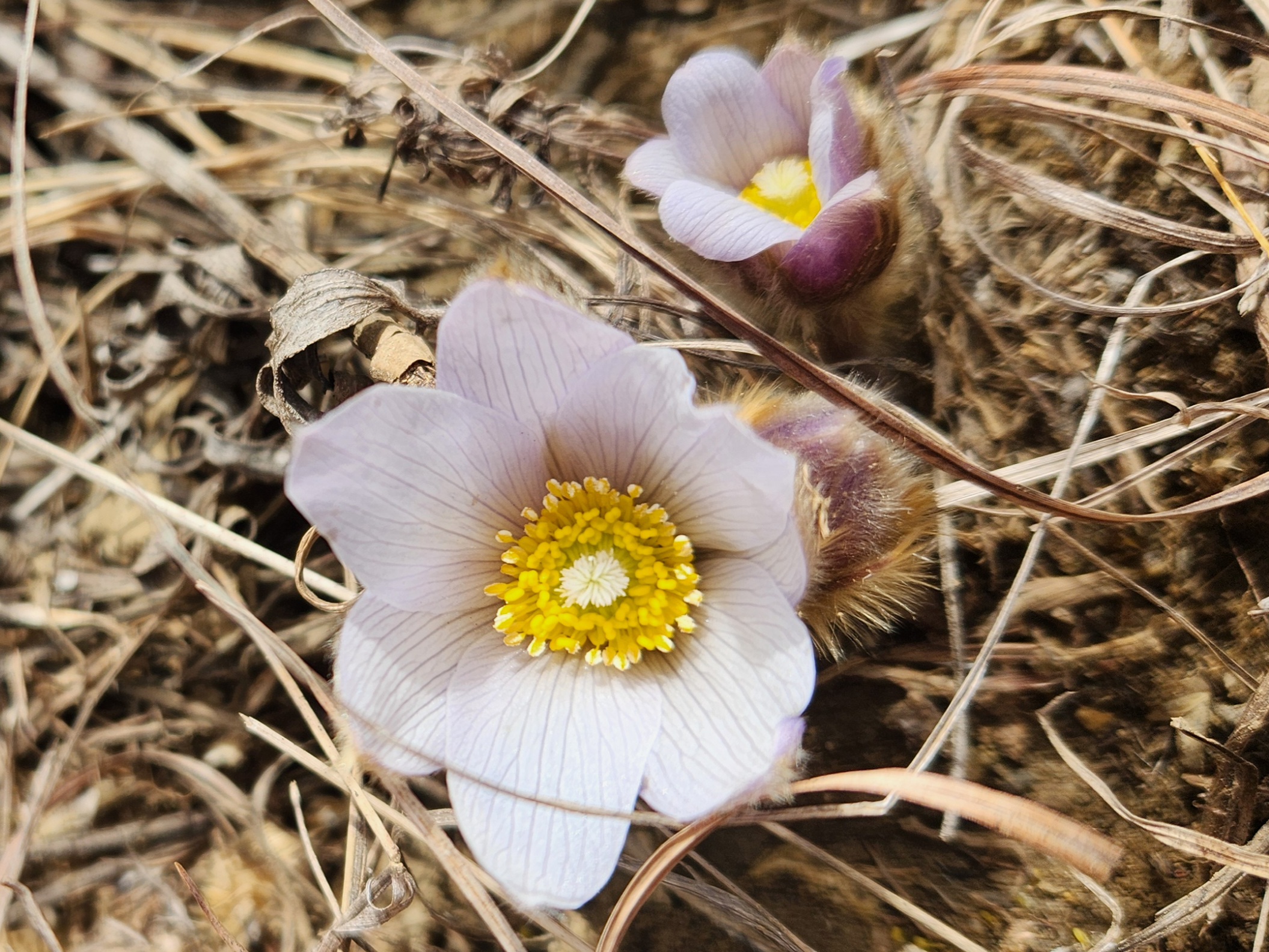
As I started up the ridge, I noticed a pair of tiny, fuzzy, light lavender pasque flowers poking up through the straw. I couldn’t believe my eyes at first. They were smaller than I expected—more delicate. The beautiful, delicate-looking wildflowers didn’t seem capable of withstanding early spring in Iowa, where the elements are harsh and extreme weather conditions fluctuate rapidly. They were also beautiful and unique, unlike any other native wildflower I can think of.

A pair of pasque flowers at Glacial Hills

Pasque flower on ridge at Glacial Hills
This was about as excited as I have ever found myself in a prairie, and what I remember most looking back was how quiet it was. The last time I was up there, you could hear insects, birds, and of course wind, which seems inescapable sometimes in the hills. Just silence and a feeling of satisfaction and relief to have found what my first major target of the year—and maybe ever—so early in the spring. I found three more small clusters/pairs before heading back, satisfied and relieved to have found my biggest target to date so early in the spring. After the setback at Martin Access, Friday the 13th turned out to be my lucky day.
More finds at Waterman Prairie
The following days brought snow, and I considered trudging my way back up there to get a picture of pasque flowers covered in snow, which would look better than the ones I got that day.
It’s not easy to get good pictures of these flowers—at least the type I like to take. I spend a lot of time in scenic prairies and try to get picturesque backdrops behind wildflowers whenever I can, but it doesn’t work as well with pasque flowers because they rarely exceed four or five inches in height. I even tried lying on borderline frozen ground. It’s just not easy to get anything other than the surrounding grass as a backdrop.
The following Friday, March 25, I finally got a chance to visit Waterman Prairie. Of the two spots Bruce provided, I chose the steeper one that had the best view—a ridge that overlooks the Dog Creek Valley. I had been here before and decided to walk the property line up to the top of the ridge and work my way down to the road.

I wasn’t there five minutes when I noticed several pasque flowers near some old, burnt cedar skeletons—victims of controlled burns used by conservation workers to keep the cedars at bay and stimulate growth by tapping into the seed bank lying just beneath the gravelly soil.


There were more further down the ridge, and now there were signs of other wildflowers, too. There were the first downy, veiny leaves of narrow-leaved purple coneflower poking up. A cluster of wild roses that seems curiously high up the ridge is turning green, and there are others here, too, most too early in development to even hope to identify.
Up high on Five Ridge Prairie
The following day, March 26, I found myself on Highway 12 at the base of the Plymouth County Loess Hills late on a workday. That rarely happens. With 25 minutes to burn, I decided to hike up the steep bluff at Five Ridge Prairie to access the bluff where a single camping cabin sits high above an oxbow on the Big Sioux River far below.

Yucca at Five Ridge Prairie
This is a strenuous hike by Iowa standards. There’s even a switchback on the short, steep trail at the halfway point that sends hikers up toward the cabin. But there aren’t many places anywhere in Iowa with a better view. On my way up, I saw yucca and leadplant, a dormant purple locoweed, which I thought was a penstemon until someone corrected me.
Near the top, maybe 20 yards north of the cabin, a lone pasque flower sprouted right on the edge of the trail—almost as if it were planted there purposely. This time, I was actually able to get a decent backdrop looking down the trail toward the distant Broken Kettle Grasslands. I was thrilled to find pasque flowers on consecutive days, and these were my first in the Loess Hills in many years.


A closer look
I tried again the next day, again at Waterman. This time I focused my attention on the other spot Bruce had suggested. This hike took me toward the Hanging Valley, a unique geological feature left over from the end of the last ice age when the Little Sioux River shifted course on its way to its new mouth on the Missouri River, leaving this old remnant channel high and dry on a hillside above the valley today.
I spent about a half hour looking around while a farmer worked a nearby field. I left without finding any pasque flowers, but it’s a lovely area with an incredible view. There are no bad hikes in Waterman Prairie.
Dozens of pasque flowers in the McCormack area
That evening, I noticed that a friend of Bruce and mine, Denise Steffen, had found loads of pasque flowers in the McCormack area. She said the roads were fine, and I was fortunate to be in the area the following day, so I stopped by for a while to look around. There were more pasque flowers here than all other spots combined and then some. I lost track after a couple of dozen, and spent the rest of the visit admiring an incredibly rare prairie.


McCormack sits on an esker that was created when a massive river of meltwater flowed above the area and eventually deposited a massive slope of gravel and irregular stones. If there is one prairie I would recommend that most closely characterizes what the area would have looked like before settlement, it would probably be McCormack. It’s an incredible place that I’ve visited since and will again soon once the rough and dotted blazing star blooms later this month.

Esker view at McCormack
I took a bit of a break from prairies altogether as April began and I shifted my focus solely toward spring ephemerals. I even came back to Martins Access for snow trillium after receiving a tip from a local. The gates were still closed, so I wasn’t able to look for pasque flowers, anyway.

Snow trillium blooming at Martins Access
Dog Creek Park
As the weeks passed, I shifted my focus back to prairie wildflowers. Still, now it was ground plums, hoary and fringed puccoon, false dandelion, and purple locoweed in the hill prairies and wild strawberry blossoms, wood betony, violet wood sorrel in the flatter, dark-soil prairies to the east. May is when things really begin to come to life in Iowa’s prairies.

Ground plum at Dog Creek
Dog Creek Park in the O’Brien County Glacial Hills is an incredible remnant prairie in a fairly popular park. I made a huge mistake the previous summer by skipping out on Dog Creek until November, when I found a shockingly diverse and healthy remnant prairie had all gone to seed before I visited. Missing out on the entire wildflower season at Dog Creek ended up being my biggest prairie-related regret of 2025.
I was bound and determined to prevent that from happening again by visiting Dog Creek early and often. On April 23, I visited the prairie bluffs on the north side of the lake and found hoary puccoon, bastard toadflax, fringed puccoon, blue-eyed grass, and ground plum. I was surprised by the diversity here, but remembered that Bruce mentioned that there had been pasque flowers on one of the bluffs on the other side of the lake, but cedars had since overrun it.
I noticed right away that there had been noticeable cedar and brush removal on a slope overlooking the lake, so I decided to come back to visit the south side the next afternoon. I found everything I found the day before, but this time there were pasque flowers, too, and they were there by the dozens, but most had already finished blooming. I found large clusters of the fuzzy, anemone-looking leaves, but nothing in bloom and no seed heads until I noticed a tall, thin specimen that was past its peak but still standing. Still, I was able to get a pretty decent shot with the lake as a backdrop.


Pasque leaves after the flowers finished blooming
I wonder how many I missed, though. That ridge had to have looked incredible had I visited just a week earlier. I’ll be back next year, and I won’t miss out again.
Back to Martins Access
The following week, I got word from a local that the gates into Martins Access were finally open for the year, so I would finally be able to access the prairie.
Martins Access may well be the best place to look for wildflowers in northwest Iowa. The oak forest is an outstanding spot for spring ephemerals, which I found out a couple of weeks earlier when I parked at the North Gate and hiked about a mile or so into the preserve. I didn’t even have to leave the road to see bloodroot, trout lilies, Dutchman’s breeches, and countless snow trillium.
I see wooded areas all over northwest Iowa throughout a given week. The majority of these woody tracts are actually just prairies that have become overgrown with trees. I don’t consider these to be forests because they lack the spring ephemerals and woodland wildflowers that inhabit true forests like the one at Martins Access. If you removed the cedars, dogwoods, and plum thickets and put fire to the Earth at Dog Creek, for example, the burns would keep woody encroachment in check and tap into the dormant prairie seed bank, potentially spawning a variety of prairie wildflowers.
At Martins Access, the woods are full of columbine, Jacob’s ladder and Virginia waterleaf. But there are a handful of steep, healthy remnant prairie bluffs that contain the greatest variety that I had encountered to that point this spring. There was hoary puccoon, prairie alumroot, meadow anemone, golden Alexander, blue-eyed grass, field pussytoes, prairie violet, ground plum, bastard toadflax, false dandelion, and one of my most memorable finds to date, Carolina anemone—a beautiful anemone ranging in shade from snow white to royal blue, opening fully during evening hours and low-light conditions. These are quite rare in this area.

Carolina anemone at Martins Access

I nearly forgot about the pasque flowers when I scoped out the final rounded, prairie-draped slope. There I found several blooming, and the first pasque seedheads I had seen, which reminded me of a spider spun from a spiderweb.


Pasque seedhead
I did not anticipate that the majority of my pasque flower sightings would be in the glacial instead of the local Loess Hills. I visited the Heendah Hills State Preserve, Stone State Park, and the adjoining Heendah Hills and Stone Park Wildlife Management Areas, the Mount Talbot Preserve, the Broken Kettle Grasslands, the Riverside Bluffs Preserve and various Sioux City-area urban Loess Hills prairies—multiple trips in most cases. But Five Ridge Prairie proved to be the only place in the Loess Hills where I found them.
By June, I had been to dozens of prairies and found countless wildflowers all over northwest Iowa. My sights were set toward summer wildflowers, and pasque flowers were the furthest thing from my mind when I discovered some remnant prairie bluffs above Baker Park in Sergeant Bluff. I had no idea that there were fairly high-quality prairies in the greater Sioux City Southern Hills.
I spent an hour or so looking around these hills. I had never been there before, yet it seemed very familiar to me. The leadplant, scarlet gauras, prairie turnips, and purple locoweed were exactly where I expected them. It was very hot and humid. There were insects, especially bees, drifting back and forth between summer wildflowers. There were goldfinches, raptors, dickcissels, and other familiar prairie birds. On my way back, I scanned a steep hillside and found a green comet milkweed.

Green comet milkweed in the Southern Hills Area
As I crouched down to take a picture, I noticed a wispy pasque flower seed head swaying in the wind. It was the last sign of any pasque flowers that I noticed for the year.

I love all wildflower seasons, but there’s something special about the first spring wildflowers of the year. Those first wildflowers are unique specialists in a sense that they require very specific conditions to thrive in a rapidly changing environment. It’s tough to recreate those conditions in a reconstructed prairie.
Pasque flower season is over now, but I will be hunting for them again next year. I’m sure they’ve been found at the Little-Bit-of-Prairie Wildlife Area before, but I will visit Telford Prairie instead.
2 Comments
The First Stirring
Love your search for the Pasque James!
Prairie Painter Thu 13 Aug 8:28 PM
Besides being a lovely vicarious journey through western Iowa...
…this essay also highlights the special value of Iowa’s surviving prairie remnants. Like many Iowa prairie enthusiasts, I’ve had the opportunity to compare reconstructed prairies with remnant prairies, and good remnants really are irreplaceable. The best reconstructions (and I wish there were more of them) are getting better. But Iowa prairie remnants, with their special species and biodiversity, deserve much more protection and good management, and that includes far more removal of trees and shrubs than many are getting now. Thank you, James Enright.
PrairieFan Fri 14 Aug 1:46 PM