
Steve Corbin is emeritus professor of marketing at the University of Northern Iowa and a contributing columnist to 246 newspapers and 48 social media platforms in 45 states, who receives no remuneration, funding, or endorsement from any for-profit business, nonprofit organization, political action committee, or political party.
During the first seventeen months of President Trump’s second term of office, he is responsible for the U.S. government using taxpayer money to purchase equity stakes in fourteen private and fourteen publicly held companies. Over 250 years of U.S. history, this is—by far— the most significant change in American economic policy.
The Cato Institute, a conservative think tank, characterized Trump’s economic environment as state capitalism and a stepping stone toward what they refer to as “creeping socialism.” In an August 28, 2025 report, Cato argued that “Trump’s state capitalism – a hybrid between socialism and capitalism – won’t make America great again.”
The practice of the U.S. government holding ownership in firms creates conflict of interest between the government’s role as a regulator and a shareholder. It could also lead to politicization of corporate decision-making. Additionally, it has raised concerns about the executive branch trying to “pick winners.”
To determine whether Trump’s economic-related policies signal a shift toward state capitalism or socialism, we must compare his actions to modern-day presidential history and the underlying political dynamics.
1980s-2000 economic assistance
From the 1980s to the year 2000, Presidents Ronald Reagan, George H.W. Bush, and Bill Clinton were reluctant to engage in any form of direct ownership of any company. The first of two exceptions occurred in 1987 when America faced technology competition from Japan. To address this issue, the Reagan administration helped fund a public-private research consortium (SEMATECH) and the government did not take any stock ownership.
Next, in 1989, the George H.W. Bush administration helped create the Resolution Trust Corporation to help manage and liquidate 747 failed and insolvent savings and loan associations.
2001-2016 presidential era
During the 2008 financial crisis, the George W. Bush and Barack Obama administrations used the Troubled Asset Relief Program (TARP) to take equity stakes in major banks, automakers, and insurance companies. This was structured explicitly as a temporary bailout, and the government liquidated the stakes as soon as the respective markets stabilized.
2021-2024 industrial policy
President Joe Biden’s administration invoked the CHIPS and Science Act (which had bipartisan support) and the Inflation Reduction Act (passed solely with Democratic votes) to subsidizes to semiconductor and green energy manufacturers. The funds were structured as grants, tax credit and loans versus direct stock ownership.
2025-present
After Trump returned to the White House, his administration shifted America from temporary emergency industry bailouts to a proactive form of state intervention and “creeping socialism.” Using taxpayer funds, the administration has expanded its portfolio to include stakes in 28 companies.
Privately owned companies with US economic ownership
Here is a list of privately owned companies, private subsidiaries, or private joint-enterprise structures in which the Trump 2.0 administration has used taxpayer supported funds to acquire a financial stake:
- USA Rare Earth
- Vulcan Elements
- ReElement Technologies
- Atlantic Alumina Company, LLC
- L3Harris Technologies – Missile Solutions Unit
- Westinghouse Electric Corporation
- Quantinuum
- PsiQuantum
- Atom Computing
- Quantum Technology Solutions
- Anderon
- xLight Inc.
- Diraq
- Crucible Metals, LLC
Ownership in publicly held companies
The six semiconductor and advanced tech firms with a USA direct equity stake (stock symbol is noted) are:
- Intel Corporation (INTC)
- IBM (IBM)
- GlobalFoundries Inc. (GFS)
- Analog Devices, Inc. (ADI)
- Coherent Corporation (COHR)
- MACOM Technology Solutions Holdings (MTSI)
America now has share in these quantum computing firms:
- Rigetti Computing, Inc. (RGTI)
- D-Wave Quantum Inc. (QBTS)
- Infleqtion (INFQ).
Here’s the U.S. stockholding in the minerals and automotive supply chain area:
- 5% ownership in Lithium Americas Corporation (LAC)
- 10% capital stock in Trilogy Metals Inc. (TMQ)
- 15% stake in MP Materials Corporation (MP)
There are two other uniquely structured companies with US ownership:
- direct equity stake of up to 20% to help Westinghouse Electric Company build a multi-billion-dollar network of domestic nuclear reactors, and
- a “Golden Share” of US Steel Corporation (X), giving the executive branch direct corporate governance rights and a seat on the corporate board.
Taxpayer alert and Congressional oversight
No one can refute the fact that Trump’s current administration has pivoted toward a state-directed economic environment. There are two things Americans and congress need to reflect upon. First, a December 2025 YouGov/Economist poll of U.S. adults found capitalism remains the overwhelming preferred economic system; only 21 percent prefer socialism.
Secondly, many countries have struggled and been harmed by state capitalism because it often leads to corruption, inefficiency and poorly managed resources. Well-known examples include Algeria, Brazil, China, India, the Soviet Union, and Venezuela—nations the U.S. should avoid emulating.
The right-wing Cato Institute’s observation that Trump has created state capitalism and a stepping stone toward socialism is alarming. America’s economic policy from 1776 until 2025 was quite rewarding; we’re now in dangerous territory.
Congress’s passive stance during Trump’s economic upheaval brings to mind Plato’s famous adage: “silence gives consent.” A return to rigorous, bipartisan congressional oversight is long overdue.
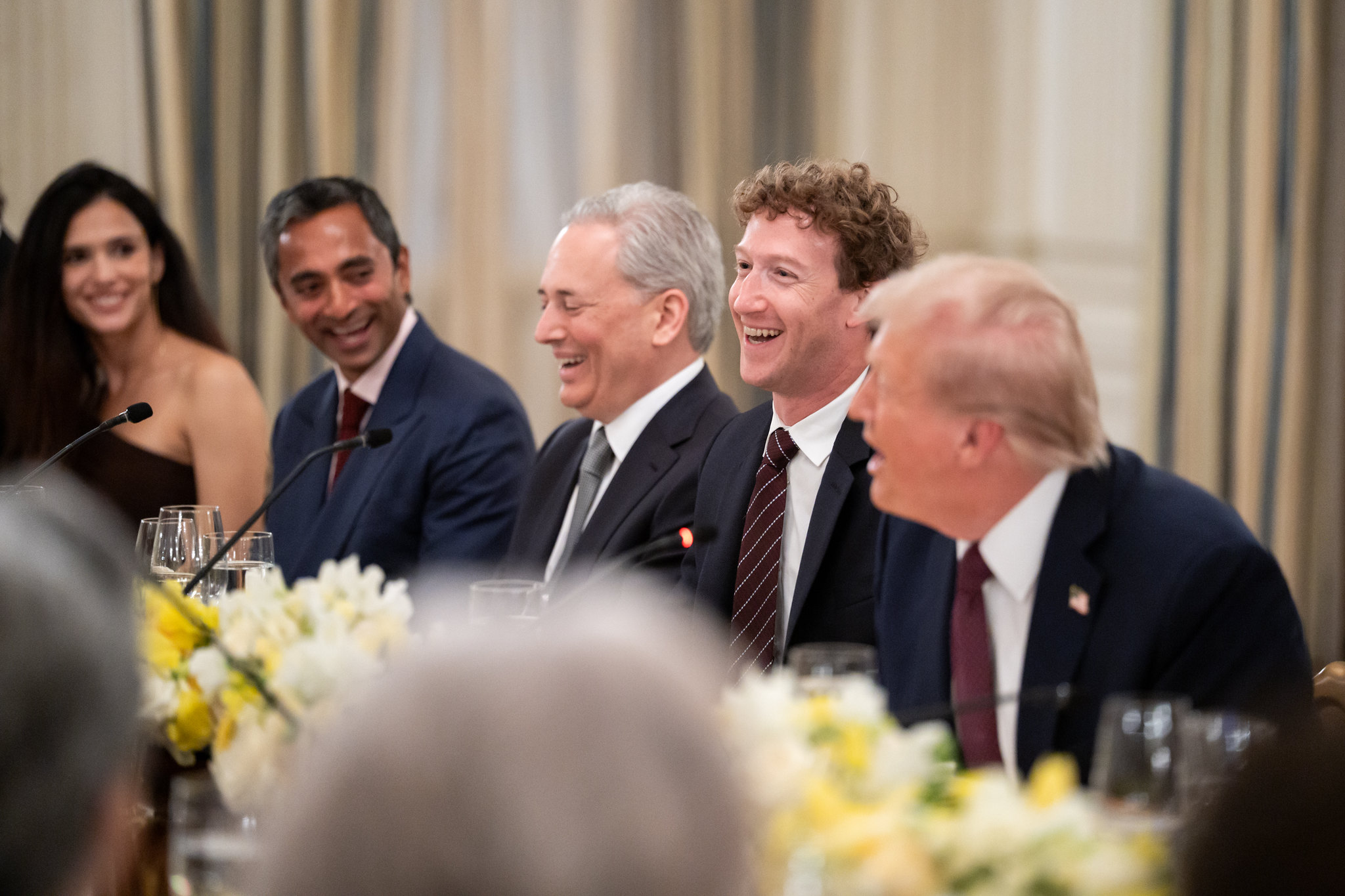
Top image is an official White House photo by Andrea Hanks of a dinner for business and technology leaders at the White House on September 4, 2025. From left: pharmaceutical executive Nathalie Dompé, venture capitalist and founder of Social Capital Chamath Palihapitiya, White House “AI and Crypto Czar” David Sacks, Meta CEO Mark Zuckerberg, President Donald Trump, First Lady Melania Trump.

Photo showing more of the group at the White House dinner, which also included OpenAI CEO Sam Altman, Google co-founder Sergey Brin, Open AI President Greg Brockman, Oracle CEO Safra Catz, Apple CEO Tim Cook, Microsoft Chairman and CEO Satya Nadella, Alphabet, Inc., and Google CEO Sundar Pichai, and AMD Chair and CEO Lisa Su.
