
Rick Morain is the former publisher and owner of the Jefferson Herald, for which he writes a regular column. This essay first appeared on Substack.
If the Confederate States of America had succeeded in winning, or negotiating, its independence from the United States of America in the Civil War, this year it would be celebrating its 165th birthday. The Confederacy declared itself a new nation on February 4, 1861.
As a young kid I unconsciously confused the words “confederate” and “counterfeit.” To me at that time, the two were interchangeable. The South was a fake nation, in my mind, so either word worked.
In the final analysis I was sort of right. But for four years after its birth in 1861, the Confederacy fought valiantly on land and sea against the USA. The Confederacy’s ultimate defeat, from the North’s greater strength in armed men, industrial and economic superiority, and international approval, does not invalidate Southern determination to defend its society and culture, which of course included slavery.
Had it succeeded in creating itself as a separate nation, the South would have celebrated its centennial of independence in 1961, the year the United States inaugurated John F. Kennedy as its 35th president. If the Confederacy had still existed by then, what it would have been like is a parlor game rich in what-ifs.
For instance:
—How long would slavery have continued to exist in the Confederacy? With the USA having banned chattel slavery in 1865, and no constitutional requirements remaining to return escaped slaves from the North to the South, like the Fugitive Slave Act, how successful would Southerners have been in keeping black people home for forced labor?
—How many foreign nations would have recognized the Confederacy as a legitimate government? All major European nations had abolished slavery in their homelands and empires by the end of the 19th century.
—Who would have governed the short-grass prairie and mountain territories west of Texas and the Missouri River? Would they, and the states they eventually became, be slave or free?
—What would post-war relations between the Confederacy and the USA have been like? Would the South have been able to survive as an independent nation, with its own defense forces, its own economy, without some kind of partnership with the North? The U.S. Army occupied and governed the South for twelve years after the war ended; would the South have been able to do it alone without Northern support?
During the war, various important leaders on both sides sought reconciliation instead of total military surrender. In the North, many so-called Peace Democrats pushed for an end to hostilities without forcing an end to slavery. That faction, pejoratively called Copperheads, successfully nominated U.S. General George McClellan as Democratic Party’s 1864 presidential candidate.
At the outset of the war in 1861, President Abraham Lincoln was not committed to ending slavery. His primary goal was preservation of the Union. He indicated that if that could be done while allowing slavery to exist, he would accept it.
But the “radical” wing of the Republican Party, which dominated Congress, insisted on abolition. And by 1864, following decisive Northern victories at Gettysburg, Vicksburg, and elsewhere, Lincoln came to believe that an end to slavery was essential to a unified nation.
In February 1865, just two months before Lee surrendered to Grant at Appomattox Court House, Virginia, Lincoln met for negotiation discussions with Confederate government officials at Hampton Roads, about 200 miles to the east. Lincoln offered terms well short of punishment, but the South would have been required to rejoin the Union as a first requirement, with other issues left for later.
The Southerners said no, unwilling to risk what might happen to slavery, so nothing came of the negotiations. Lee surrendered eight weeks later
Today we Northerners revere Lincoln for freeing the slaves. He deserves the accolade. But his Number One goal, even as the war drew to a close, was to preserve the nation in its entirety, Southern states included.
That goal likely parallels the primary reason that 32 students of one of the first schools in Greene County, in the Rippey area, shelved their books when the Civil War broke out in 1861 and, led by two of their teachers, enlisted in the U.S. Army. Eleven of them died in service.
The Greene County High School history class taught by Dena Boyd, encouraged by a committee of local history-minded Greene Countians, for months has immersed itself in that glorious story.
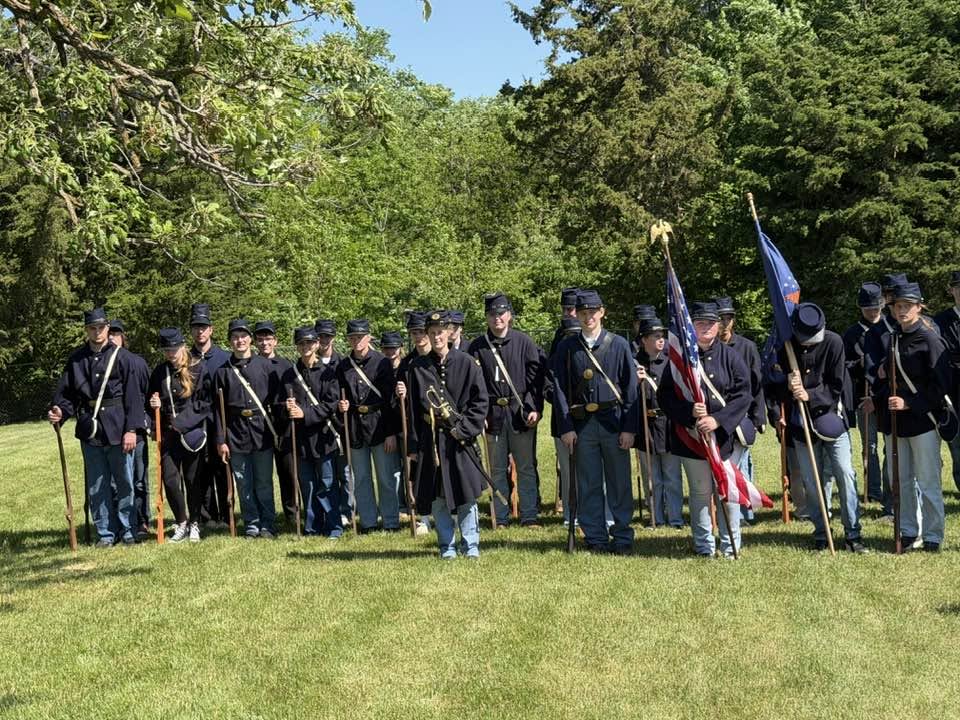
They’ve assumed the role of avatars of the Schoolboy Soldiers, dressed themselves in Civil War uniform reproductions, marched in summer parades, and worked to fund two sizable obelisk-type monuments to commemorate their student forebears. And this November they will enjoy a high school play in the Schoolboy Soldiers’ honor, written by a professional Iowa playwright. (Go to the Iowa Boy Chuck Offenburger website for excellent reads about the entire project here and here.)
It’s more than likely that the driving purpose for the enlistment of the prairie students near Rippey, like Abraham Lincoln’s main goal, was their desire to keep the Union together.
Another major reason, no doubt, was the resentment that Northern working men held against slavery. In addition to moral opposition, farmers especially saw slave labor as unfair economic competition. Farm families on newly broken prairie soil near Rippey would certainly have shared that opinion.
Put the two reasons together—patriotism and a dislike of slavery—and the Schoolboy Soldiers had plenty of motivation to enlist in the North’s cause.
No other state, North or South, sent a higher percentage of its men between the ages of 15 and 40 to fight in the Civil War than did Iowa.
The Schoolboy Soldiers of Rippey, their Iowa comrades in arms, and Abraham Lincoln shared a love for a free America. No better reason to share the pride in our history.
Top image: Rippey Schoolboy Soldiers at the Memorial Day celebration at Old Rippey Cemetery. Photo was first published on May 25, 2026 on the Facebook page for the Greene County Historical Society.