
One of my best scoops wasn’t related to Iowa politics or state government. It came out of the 1996 Russian presidential election, and it happened 30 years ago today.
Covering a presidential election in Moscow
During the 1990s, I would not have guessed that I would ever devote my professional life to covering Iowa politics. I landed my first writing job in 1995, working at the Prague-based Open Media Research Institute. Robert Orttung and I were hired to cover Russian domestic politics, including campaigns and elections and parliamentary happenings.
My OMRI colleagues and I did not call ourselves journalists. Our job title was “research analyst.” Most days we were not reporting the news first-hand. We consumed vast quantities of Russian news reports (wire services, newspaper articles, radio and TV broadcasts) and synthesized them in concise, English-language stories. The idea was that people reading our digests would not miss any newsworthy event or interview connected to Russian politics.
We lived in Prague and traveled to Russia only occasionally. I went to Moscow for three weeks during the early part of the 1995 parliamentary campaign, then traded places with Robert Orttung a few weeks before that election. For the presidential campaign, he took the first shift in Moscow, then I came for about six weeks, which included the first round of the election and the runoff between President Boris Yeltsin and Communist Party leader Gennadii Zyuganov.
YouTube did not exist, and most of our readers did not have access to Russian television networks. So part of our job was to describe and analyze how candidates and political parties were appealing to voters. We translated excerpts from printed campaign literature and videos aired during the free television time all candidates received. We also described their pitches in paid TV or radio ads.
One of my beats was the Russian media. I was particularly interested in how rival outlets covered the same news events. In 1995 the state television networks and the main private network had reported on the war in Chechnya very differently. In contrast, almost the entire Russian media (private as well as state-owned) fell in line behind Yeltsin during the 1996 presidential campaign. Journalists who remembered the Soviet period feared censorship would return if Zyuganov became president. In May and June 1996, I often wrote about how news coverage was slanted toward Yeltsin.
Because my colleagues and I mostly worked from Prague, and because we were not approaching the political news in the same way as Moscow correspondents for other western media outlets, OMRI did not get us credentialed as journalists in Russia. We traveled there on work visas, but it wasn’t worth the trouble to apply for a media credential that we might use for only a few weeks a year. We didn’t need accreditation to show up at a campaign rally or round table discussion about the election. We didn’t need to attend events restricted to credentialed journalists, since we could do our analysis based on the Russian media reports.
A bombshell endorsement for the Communist
No candidate received 50 percent of the vote in the first round of the presidential election on June 16. The top two candidates received the same amount of free air time on state television before the runoff, set for July 3. Like some other European countries, Russia had a “blackout” period—no campaigning on television the day before an election. So the last free air time slots for Yeltsin and Zyuganov were scheduled for the evening of July 1.
Most candidates used their TV time either to deliver a pre-recorded monologue or to air a video including biographical information and clips from some campaign rallies. The Communist videos tended to be boring. But in late June, Zyuganov’s campaign announced that the film-maker Stanislav Govorukhin would deliver a monologue during Zyuganov’s final free prime-time slot on nationwide Russian Public Television (Channel 1).
Govorukhin was a superstar actor and director. I can’t think of any American with comparable stature, who not only makes popular films, but also is a respected intellectual figure. Govorukhin was neither a dissident during the Soviet period nor a tool of the regime. His 1990 documentary “Tak zhit’ nel’zya” (“We can’t live this way” or “This is no way to live”) was a smash hit of the Gorbachev era. It shone a light on some social problems that were taboo subjects in the Soviet media.

Stanislav Govorukhin in 2008, from a photograph taken by Yevgenia Davydova, available via Wikimedia Commons
While many of his contemporaries were aligned with pro-Yeltsin “democratic” reformers, Govorukhin dabbled in nationalist politics during the early post-Soviet period. Still, almost the entire Russian cultural elite backed Yeltsin’s re-election in 1996, even those who had sharply criticized his economic policies and the war in Chechnya. They didn’t want Communists back in charge.
So it was a major news story when Govorukhin endorsed Zyuganov for president.
Two newsworthy angles converge
Like many others, I was eagerly anticipating Govorukhin’s monologue on Zyuganov’s behalf. I planted myself in front of the television on the evening of July 1, VCR rolling so I could write a full transcript later for one of OMRI’s presidential election reports. But Channel 1 replayed a five-minute Zyuganov video I had recorded a few days earlier.
The next day I learned the Communists had tried to purchase five extra minutes of air time. The network claimed the payment didn’t come through, so instead of airing Govorukhin’s ten-minute clip, they had no choice but to re-run a five-minute spot, which had been submitted the previous week.
Zyuganov’s campaign screamed censorship, with good reason. They insisted they had paid for the extra time. I believed them. Anyway, even if there had been some problem with the payment, as a matter of fairness, Channel 1 should have run the ad and sought to collect the money later. They had other commercials in heavy rotation, which were ostensibly neutral messages encouraging Russians to vote, but were in fact aimed at boosting Yeltsin’s chances to win the runoff.
Russian and western media reported Zyuagnov’s allegations and denials from state television executives. Whether Channel 1 bosses made an honest mistake or played a dirty trick, there was no way to remedy the error. Airing Govorukhin’s video on July 2 would have been illegal, because of the blackout period.
Two of my prime research interests converged in this story: how candidates presented themselves to voters, and how state television was biased toward Yeltsin. I was already curious about the case Govorukhin would make for electing a Communist. Now I became determined to find out what he had said that was considered too dangerous to broadcast on Channel 1.
In pursuit of the censored video
While working for OMRI in Moscow, I did most of my writing in an apartment with no internet connection. I filed my stories in the Radio Free Europe/Radio Liberty bureau. On July 2, I asked the journalists working for RFE/RL’s Russian service if any of them knew how to get hold of this Govorukhin video. No one had a copy or knew of anyone who did.
At the Yeltsin campaign’s press center on election night, I asked a bunch of reporters if they knew what was in the censored video. No one had seen it. According to one rumor, Govorukhin had talked about Yeltsin’s supposedly poor health. The president had hardly been seen in public since June 16, but Russian media were saying little about his absence.
Starting the day after the election, I tried to get a copy of this video. I didn’t bother contacting Channel 1. I figured my best chance was reaching out to the Communists.
But remember, I was a research analyst based in Prague, not a journalist with a lot of experience in Moscow. Although I’d been immersed in Russian domestic politics for more than a year, I had essentially no contacts among Russian politicians. I was cold-calling the Communist Party headquarters and its office in the parliament, leaving messages when no one answered the phone.
Whoever listened to the messages would have had no idea who I was, since I did all of my writing in English for a specialist audience. It was unlikely any of them had heard of the Open Media Research Institute. Actually, that was probably for the best, since OMRI was funded by George Soros’ Open Society Institute. Soros was hated in Communist circles for having supported various dissident groups (the Solidarity movement in Poland, Charter 77 in Czechoslovakia) before the collapse of the Soviet Union and allied regimes.
At this point, it started to work in my favor that I was not a journalist. As far as I could tell, no one else was chasing this story. Russian journalists were not interested in reporting what Govorukhin tried to tell a national audience, possibly because the censorship underscored how massively the Russian media had been in the tank for Yeltsin.
The western reporters had filed stories on July 2 about state television refusing to run Zyuganov’s final campaign video. Now they had more important news to cover, like whom Yeltsin would appoint to his cabinet. My colleagues Robert Orttung, Scott Parrish, and Peter Rutland were writing up those stories for OMRI, leaving me free to pursue my obsession.
A lucky break
I don’t remember how many times I called the various phone numbers I could find for Communist offices. Finally, two days before I was due to fly back to Prague, I got through to a woman who worked for the Communist faction in the parliament.
I introduced myself and explained that I was interested in telling our readers what Stanislav Govorukhin had wanted to say to the people of Russia. She told me I could meet with a member of parliament the following day to watch the video. I wish I could remember the man’s name. He was not a high-profile politician, just a back-bencher. Probably his name is in a notebook tucked away in one of my boxes.
Having been to the parliament building only a few times, I didn’t have a good sense of how long it would take to get there on public transit. Not wanting to screw up my opportunity by being late, I set off way earlier than I needed to. I signed in as a visitor, because I didn’t have the accreditation to sign in as a journalist. Visitors were only supposed to be in certain areas of the State Duma building, and there was a limit on how long you could stay, either 60 or 90 minutes if I recall correctly. I wasn’t worried about any of that, because this was Yeltsin’s Russia. People were not sticklers for details.
To kill time before my meeting, I went to the press room and chatted with a couple of people, I think including Floriana Fossato, an Italian journalist who worked for Radio Free Europe/Radio Liberty.
Then I went to this Communist State Duma deputy’s office, in a part of the building where regular visitors weren’t supposed to go. I wasn’t concerned anyone would check my pass. Indeed, no one checked my pass.
The Communist was alone. He stood up to shake my hand as I thanked him for meeting with me. He sat behind his desk and I took a chair, pen and notebook in hand, ready to write down as much as I could from the Govorukhin video. If I were lucky, maybe he would show it to me more than once, so I could take better notes.
The man said, “I didn’t bring my cassette player today.” I looked around and realized there was no television in his office. I looked back at him. He wasn’t smiling. I was not prepared for this at all.
Landing the scoop
I tried to think on my feet. I didn’t speak Russian nearly as well as I could understand it, but I managed to say something like, that’s too bad, I was really hoping to be able to tell our readers what Stanislav Govorukhin had said. I know a lot of people would want to hear his message to voters, why they should support Gennadii Zyuganov for president, what the authorities refused to play on Channel 1.
He said something like, well, I have the tape with me. I can let you borrow it if you promise to bring it back tomorrow.
Now I was really excited. This was even better! I could take the tape back to my apartment and watch it as many times as needed to get a complete and accurate transcript. I assured him, I will definitely return your tape tomorrow. The truth was, I was going to be on a plane to Prague the next morning. But I had every intention of keeping my promise by asking a friend to return the video for me. I wasn’t planning to steal it.
He gave me the video. I thanked him and put it in my bag, along with my notebook. I didn’t think to ask for a note authorizing me to borrow the tape. (Amateur hour.)
As I made my way back to the entrance, I was walking on air. I could not believe I had a copy of this video. We wrote lots of original analysis at OMRI, but breaking news was a new experience for me. This was going to be an exclusive on an important story related to the presidential election.
I ran into a journalist acquaintance in a hallway, and we talked for a while. By now I was way past the time limit for people on a visitor’s pass. I wasn’t worried anyone would hassle me. This was Yeltsin’s Russia.
On my way out of the parliament building, just a few steps from the door, a guard put his hand on my arm and said, “Devushka” (young lady).
A moment of panic
I’d been walking on air, but in a split second I came crashing back to earth. All of a sudden I realized I was a foreigner, doing the work of a journalist without the proper accreditation. I had spent too long in the building for someone on a visitor’s pass. I had gone to an area where I was not authorized to be.
I had nothing in writing showing that I was allowed to borrow this video. No eyewitness had seen the man give me permission to take it.
If this Communist set me up (knowing that I worked for a Soros-funded institute), and the guard searched my bag, very bad things could happen. As in, “American arrested while impersonating a journalist and trying to steal property from the parliament building.”
Hoping my face didn’t reveal how panicked I felt, I looked at the guard. He asked for my phone number.
It took a second or two for that to sink in. I have never felt so relieved to have a stranger try to pick me up. I smiled and said I’m sorry, I don’t live here, I live in the Czech Republic, I am going back there tomorrow. The guard let me leave without searching my bag.
A formative event in my thinking
As soon as I got back to the apartment, I set to work transcribing the monologue. Contrary to the rumors, Govorukhin said little about the president’s health. His remarks were a rambling mess. (I’ve enclosed the full text below.) Zyuganov’s team should have whittled it down to a cogent, five-minute case against Yeltsin. Though who knows, maybe Channel 1 would have found some other pretext not to broadcast the video.
My friend and OMRI colleague Natasha Gurushina came over to help me translate the few lines I couldn’t understand. Then I headed for RFE/RL’s bureau to file my story. Someone there transferred the tape onto another cassette, so I could bring a copy back to show colleagues in Prague. I left the original with a friend, who made sure it was returned to the parliament building the next day.
I have no idea whether any of the Communists ever saw the final OMRI special report on the race, containing my best scoop from the decade I spent writing about Russian politics.
The 1996 Russian presidential election shaped my views about political news coverage. The subsequent fallout for the media became the focus of my doctoral dissertation and many articles about the reassertion of state power over the Russian media during Yeltsin’s presidency and the early Vladimir Putin years.
No one could have predicted in 1996 that Putin would be president of Russia one day. But it was easy to foresee that after friendly news coverage helped an unpopular, ailing president win a second term, whoever came to power after Yeltsin would seek to harness the media in pursuit of their political goals.
It’s been more than two decades since I wrote professionally about Russia. I still think often about those times, especially given the troubling changes in U.S. media. Here, as in Yeltsin’s day, oligarchs and large corporations have acquired many influential news outlets. As I observed in my “past life,” corporate media owners or shareholders proceeded to throw their weight around, hoping to stay on good terms with the administration. New bosses have made editorial changes, sometimes holding back stories, canceling shows, replacing editors and producers, or firing journalists who criticized the authorities.
Thirty years ago, censoring a film-maker’s case for a Communist may have looked like the right choice. Many people in Russia’s journalism community understandably viewed Yeltsin as the lesser of two evils. But deploying the media to assist the president had long-term consequences for Russia. I hope we don’t look back on these times as a similar turning point for American journalism.
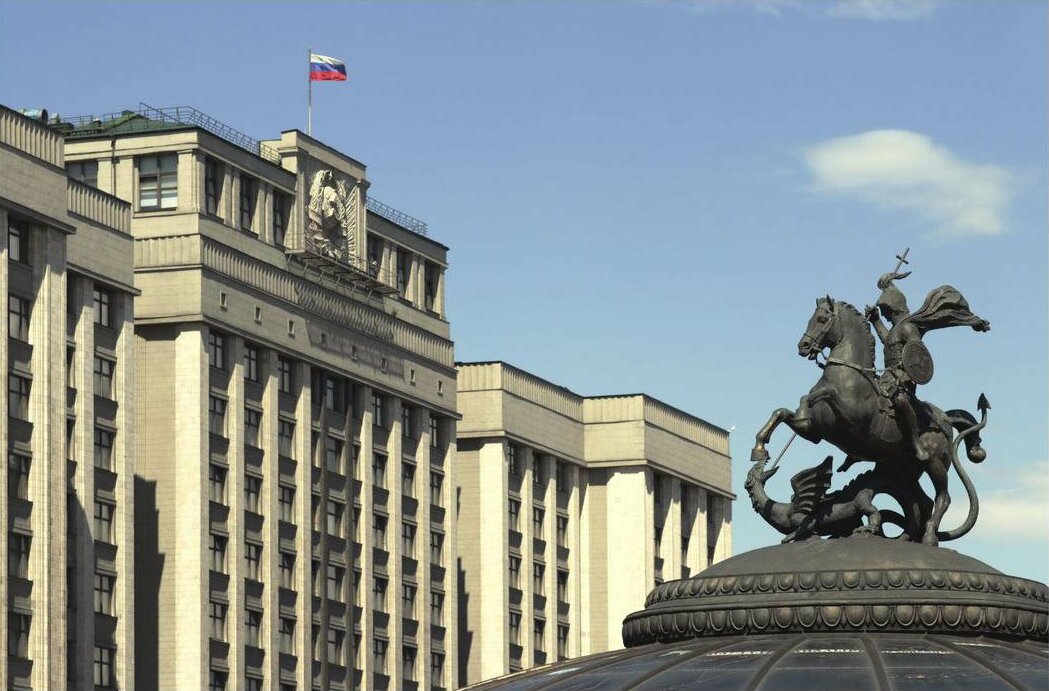
Top photo of the Russian parliament (State Duma) building in Moscow was taken in 2013, courtesy of the Russian government website duma.gov.ru, licensed under the Creative Commons Attribution 4.0 International License and available via Wikimedia Commons.
Full text of Stanislav Govorukhin’s censored monologue, which should have aired on Russian Public Television on July 1, 1996
Translated by Laura Belin, with assistance from Natasha Gurushina
First published as a special report: OMRI RUSSIAN PRESIDENTIAL ELECTION SURVEY on July 10, 1996
Let’s look at the real–the real, not the chewed over, lackey’s results of the first round of voting [on 16 June]. An enormous territory voted for Yeltsin: Kamchatka, Chukotka, the Far North, an enormous but sparsely populated territory. Today we can say firmly that all of Russia, especially working, honest Russia, voted to replace the criminal authorities: Siberia, the Caucasus, the densely populated South, central Russia, the black earth region. The dozen most criminal cities voted for Yeltsin.
Moreover, there was a pattern: the more criminal the city, the higher Yeltsin’s rating there. Three megapolises were for Yeltsin, the three most criminal cities in Russia: Yekaterinburg, St. Petersburg, and Moscow, the capital of the criminal world. We can say definitely that all the swindlers in the Russian Federation voted for the current authorities. The Butyrskaya Prison [in Moscow] for criminals who are awaiting trial was unanimously for Yeltsin. The island of Cyprus, where “new Russians” now live, there are thousands of off-shore companies there, through which tens of billions of dollars are taken to the West.
On Cyprus they deserted the beaches, they stood beneath the scorching sun to vote, God forbid that these authorities, who are so convenient for them, be replaced.
Chechen [rebel] fighters were for Yeltsin. [Rebel commander Zelimkhan] Yandarbiev himself admitted that if he had voted, he would have voted for Yeltsin. Indeed–who armed them? Who led them every time away from near the final assault of Russian troops? Who now will not agree with the fundamental conclusion of the parliamentary Commission on Chechnya [which Govorukhin chaired in 1995]? The main culprit in the tragedy in Chechnya is the current president of Russia.
Of course, a large part of the creative intelligentsia or elites, as they like to call themselves, went to vote embracing the swindlers. People will tell me, you are also part of this creative elite. No, no, spare me from that honor, I announced to the whole country openly in October 1993 [when the parliament was forcibly disbanded], through the newspaper Izvestiya, that I was leaving the Union of Filmmakers. The union became an inveterate liar, wagged its tail for the authorities. It betrayed its viewers, its voters. For the Russian intelligentsia it was always a matter of honor to defend the oppressed, the robbed, the doomed. To crowd around the throne was considered shameful. Better to shoot oneself than to lick the backside of authorities. Today everything is the other way around. And not just the other way around, but now [the intelligentsia is] hand in hand with swindlers. It turns out they have the same taste. [They make] the same choice. The same president suits both groups.
Was there falsification? Hmm, the case in Tatarstan is in court. Those l remember that on the evening of 16 June, Zyuganov had 51% in Tatarstan, Yeltsin had 29%. Imagine how [Tatar President] Mintimer Shaimiev must have panicked; what will he tell the Kremlin? By the evening of 17 June, Zyuganov had only 42% and Yeltsin 34%, and so on. In the end, Yeltsin won [in Tatarstan].
And this unusual burst of voter activity on the evening of 16 June. I came to my polling station at about 9:00 in the evening, and about 49% had voted. Across Russia, turnout was about 56%. An hour and a half later, they announced that more than 70% of the electorate had voted in Russia. On the evening of 16 June, you saw people waiting in line at polling stations. Where did this unexpected spurt [of voters] come from?
By the way, it brought victory to Yeltsin.
Chechnya was for Yeltsin. Russians in Chechnya, betrayed and deceived by the president a hundred times, voted for the person who betrayed them. Chechens whom he bombed voted for Yeltsin. Relatives of those killed–for Yeltsin. I have been in Chechnya many times, and I know that that cannot be. There were some cases when rebel fighters came and threatened people–we’ll burn you if you don’t vote the right way [for Yeltsin]–but [the official election results] just cannot be.
This is a diagram of the movement of election results upward. [Govorukhin holds up piece of paper and points to words and arrows drawn on it.] From the polling station, the election results are entered into a machine called the automated system “Vybory.” From there they go to FAPSI [the Federal Agency for Government Communications and Information]. Here a certain procedure is followed: a diskette is taken from one machine to another. By the way, one could replace it with a different diskette; no [election] observers are present at this stage.
The same procedure is followed at the Situation Center. Here a big information delay takes place, for the Situation Center is directly connected to the Presidential Security Service and to the President Hotel where the Yeltsin headquarters are. Again, there are no observers here. The staff of the Situation Center was selected very carefully. So both these services, the Presidential Security Service and the Yeltsin headquarters, have the ability to check the election results and influence them. If here [Govorukhin points to Situation Center on diagram] there are no observers from both candidates or the Central Electoral Commission, then the election in no way can be considered honest. [Govorukhin sets down paper]
Now look, despite all of this, the gap between the two candidates [in the first round] was only 3%. So one more great effort is needed, for it is necessary to win with a large gap so that no falsification could help [Yeltsin].
We already have fallen behind the civilized countries in everything. We lead only in mortality, in theft, in crime, and in extolling the leader. [The well-known anti-communist journalist Aleksandr] Minkin is right: we have surpassed even North Korea. They and their Kim Il Sung have a long way to go to catch up.
And so much filth is poured on Zyuganov. “If Zyuganov wins, they will ban books, people will be deported from the country.” These scoundrels– don’t they know? They know perfectly well we exiled people from the country under the Yeltsins, when every party obkom had its Yeltsin. Power was held by Yeltsins, Yakovlevs, Shevardnadzes, and others.
“If Zyuganov wins, there will be lines for sausage.” They attribute all their own mistakes to their opponent. Under Yeltsin there were lines for sausage. Remember the immortal [Gorbachev-era hardliner Yegor] Ligachev, remember how he said, “Boris, you are wrong. You made your whole oblast live on coupons.” So Sverdlovsk Oblast, which was led by the obkom secretary Yeltsin, in those days lived worse than its neighbors, definitely worse than Omsk Oblast, Tomsk Oblast, Novosibirsk Oblast. He couldn’t even govern an oblast, and today he leads the country. You can see the results.
And what will happen after the election if Yeltsin wins? Have you thought about this? Trillions of rubles spent on the president’s campaign. They have carried bags of money to the regions to buy voters. You saw the trail recently. On 19 June, two people carried away a box of hard currency from the government building. Half a million dollars–more precisely, $538,000. You said something about battling corruption.
Conversations are circulating among the people that the government has set about fighting corruption. Do you take this kind of palace intrigue to be a fight against corruption? Two people illegally carried off money that was taken away from children, pensioners, soldiers, miners.
Oh, by the way, just today I received a telegram. [Govorukhin grabs another piece of paper, puts on his glasses and begins to read.] From a friend of mine in Vorkuta. Dear Stanislav Sergeevich, we don’t have enough to eat, they don’t pay our salaries, holiday pay from May and June has not been paid, how can we rest?” [Puts down telegram and takes off glasses.] By the way, newspapers are writing that miners will vote for Yeltsin.
That money [the $538,000] in those boxes would be enough for 10 mines. And look what happened. The people who carried it off, who committed an illegal act, have been set free, and those [in the security services] who entirely lawfully detained them have been removed from their posts. That’s what you call a fight against corruption.
I appeal to those who plan to vote for Yeltsin. Before you put the ballot in the box, think: did you make that choice yourself, or were you forced into it? Twenty-three hours and 50 minutes a day, the new Kim Il Sung is extolled on all the channels, and his opponent is spit upon. Anybody’s brain could disintegrate from [such propaganda].
Remember, remember that in February of this year, Yeltsin’s popularity rating was 6% to 8%. Today it’s 35%. A rating is not like bamboo in the tropics. It doesn’t grow that fast. That means it has been boosted by shameless propaganda. Like a balloon. It flies up like a balloon, and I am sure that immediately after the election, Yeltsin’s rating will fall back down to where it was, 6% to 8%. For he won’t be able to fulfill even one of his promises. He has no money, everything was put into the presidential campaign. He doesn’t have a team–he gave up the people most loyal to him. He doesn’t even have physical strength.
So, make your choice.
3 Comments
Whoa
Amazing….. simply amazing……
BettScott Thu 9 Jul 4:23 PM
What a story!
Thanks for sharing, Laura!
PrairieFan Sun 12 Jul 10:04 PM
Bravo, brilliant young Ms. Belin!
In those days, I followed your OMRI reporting and became one of your earliest fans. I’m surely glad that guard let you pass with the possibly purloined videotape. Boring as its message might have been, the voters should have been allowed to hear Zyuganov’s surrogate.
A few years earlier, in the late 1980s, I hosted a Soviet UN official on a visit to the Iowa capitol—in the heartland of “Real America.” In the Rotunda he read aloud the motto on our seal, then threw wide his arms and exclaimed, “It’s a shrine to glasnost!” Then he declared himself an honorary Iowan.
Now it’s US journalism on the ropes, and now here you are, a fearless Research Analyst from inside our own State Duma. Thanks for all you do.
Iowapeacechief Sat 25 Jul 3:36 PM