Kristie Brown is a homeschooling mom who has dedicated her life to creating a better world for her children and future generations. Self‑taught in languages, cooking, sewing, gardening, and more, she has spent countless hours in independent study. She believes children are the foundation of tomorrow, and it is her calling to give them opportunities and a life richer than those who came before us.
In the summer of 1995, we were having a family get-together at my grandparents’ house on Walker Street in Des Moines, Iowa. I was five years old, playing outside, but I could still hear all the adults talking about my grandparents’ neighbor to the right of their home. It was a woman who was unusual and kept to herself. She had a beautiful Victorian home, but what captivated me was hiding behind it. I could see all the wildflowers peeking through her backyard fence.
The adults debated calling the city on her for having such a wild yard and said she must have bugs and rodents in her home. I did not agree with them, but being five, I knew to keep my mouth shut when the adults were talking. I remember seeing all the life in the yard. The purple cone flowers and the dozens of butterflies sparked my imagination. I was the only one in the neighborhood who admired the yard.
Until recently, I didn’t realize how much this particular moment in my life would affect me as an adult. I was consumed with envy, and I wanted to live there with her.

My sister and I at my grandparents’ house in 1995
I got married extremely young, and wherever my husband and I lived, we had a small garden of some sort. From 2018 to 2022, we lived in a tiny house that my husband built so he could go back to college in Orlando, Florida. We lived at Circle Pond Tiny Community with the owner, Debbie Caneen, for a short while.
Debbie won the 2019 Sustainable Business Award for the development of Circle Pond Tiny Home Community. Her community garden inspired me to want to make one in the future.
During the COVID-19 pandemic in 2020, we lived at Florida Camp Inn, where I dug deeper into educating myself on plants with all my free time during lockdown. My gardening skills at this point were starting to be known by all my friends and family.


Our tiny house where we lived during COVID, and our garden
By May of 2022, we were tired of living in a less than 400 sq ft house. We were ready to buy our first home. We bought the opposite of our tiny house and purchased a large Victorian home from Bob and Pam Durrwacher. Bob is a certified Master Gardener and spent 25 years, from 1997 to 2022, landscaping the yard into an intentional native landscape. The home was perfect inside and out.

Bob Durrwachter and my husband Christopher Brown standing in front of our house on 400 Ferguson Street
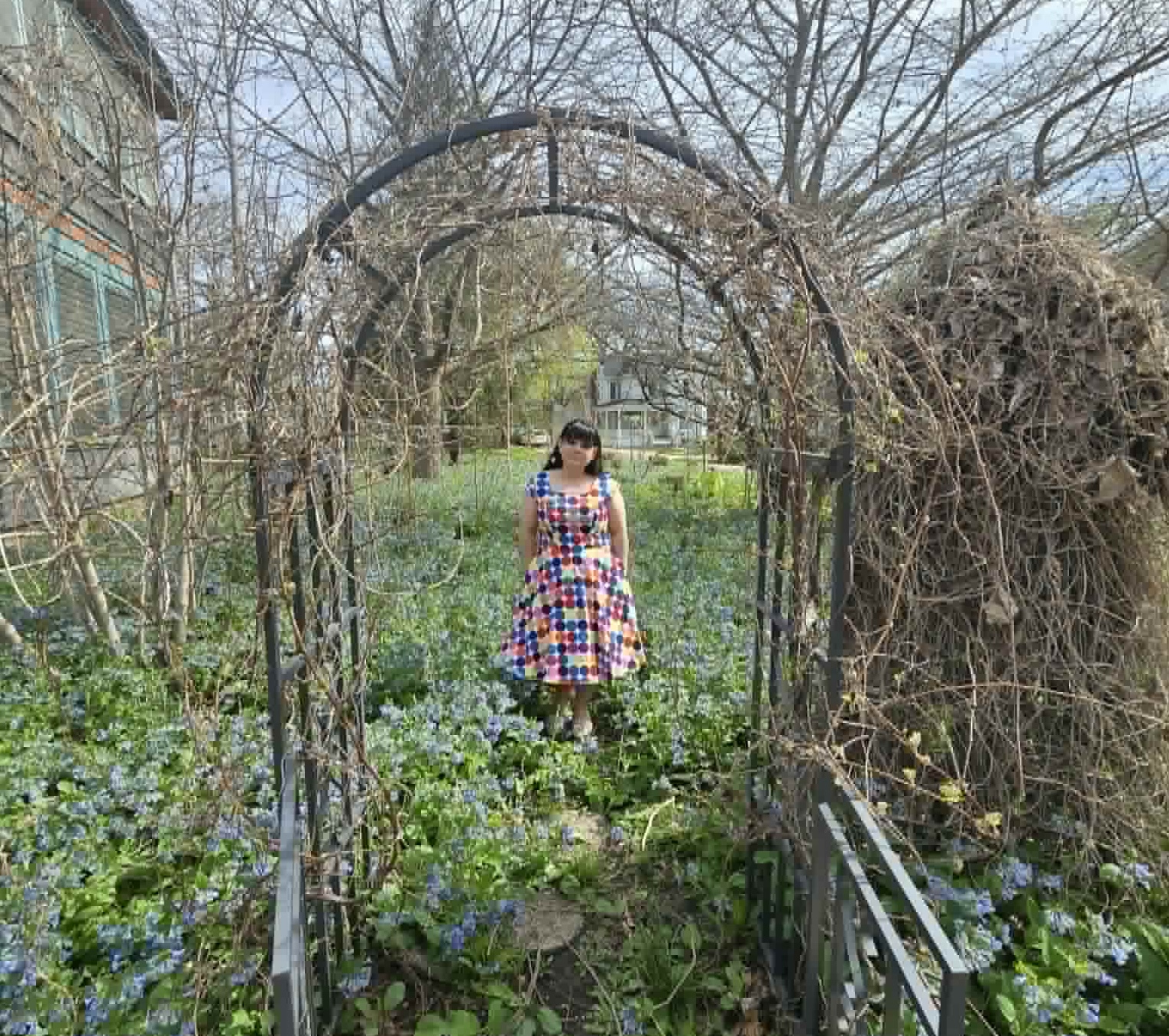
Over the past four years of living in our new home, I have spent many hours maintaining, researching, documenting, and frolicking around the native landscape because, let’s be honest, who doesn’t love to frolic in a yard full of Virginia bluebells?
Bob had set the yard up to have different native plants bloom throughout the spring, summer, and fall. In the spring, the whole yard is filled with Virginia bluebells, tulips, bloodroot flowers, bleeding hearts, snake heads, iris, and more. Tons of visitors come just to see the yard bloom in spring.

Kristie Brown in the Virginia bluebells
From late March to early June, our yard is in full bloom; then the plants die down for the next stage of flowers and native plants to blossom. From June to July, our yard is extremely green, and to some people it might look like a jungle, but what people don’t understand is that the yard is transforming for the next season.


Our yard in the Spring
The first year, I would receive so many comments that “Bob did a better job,” or “when Bob had the house, he did this or that.” It was frustrating to hear all the neighbors never give me any credit for the hard work I was doing. They would love to accept all the free produce I gave them from the yard and not lend a helping hand or an ounce of support. I understood that to my neighbors, I was a much younger individual without Bob’s knowledge, but I was always eager to lend a helping hand and give tours of the yard.
Each passing year since we purchased the house, the city has come out to tell us the neighbors have complained again about the yard. This situation left me bitter about our neighbors, and for a while, I had a heavy heart of sadness. Why did we even move here?


Produce we picked for our neighbors to enjoy
I had shut myself off from my neighbors and community after the second year of living in the house. I did not want to give another ounce of myself to people who did not put any effort into my family. What my community didn’t know about us, I wanted to shout, but I was afraid no one would listen, so I kept our family to ourselves.
The code enforcer would come out every summer and walk with my husband, discussing plants and how to keep maintaining the right of way. We had a great relationship with him and worked well together. We would take photographs with timestamps to prove our hard work and keep the city happy.
On June 18, 2026, a new Charles City code enforcer came out to our house and handed me the notice. When I asked what areas needed to be addressed, the notice stated “nuisance conditions arising from the growth of weeds and grass over six inches in height and volunteer trees within the city right of way.”
He advised the whole area. We had argued back and forth for a short amount of time on native plants, which he repeatedly just kept calling weeds. He struck us as uninformed about native landscaping and lacking the previous code officer’s knowledge. During our conversation, he mentioned that the city could pursue action against our whole yard and not just the right-of-way. To him, the plants appeared to be weeds.
I want to clarify that our yard is a maintained native landscape, and while some native plants can resemble weeds to someone unfamiliar with them, they are intentionally planted and regularly cared for.

Our yard in the summertime
My husband and I decided to exercise our rights. We requested an appeal with the city council.
For almost three weeks, while we were waiting for our meeting, I tossed and turned at night. I felt sick to my stomach that I might have to cut down so many native plants and homes for pollinators. I could not let this happen.
I started by calling the previous owner, Bob, and explaining the whole situation. I learned Bob had never received one complaint in the whole 25 years he lived there. The problem wasn’t the yard. It was the fact that the community didn’t give us a chance to know us. Bob was extremely involved in the community with the church, the history museum, and more. Our family had other priorities.

Our backyard garden
Bob called the city to discuss the problems. He then suggested to me that I should cut down the plants in the right-of-way, cancel the meeting, and let it fly over. I didn’t understand. Bob had planted all of the plants in the right-of-way. Why would he be okay with destroying them? Why would I do that without even fighting for what I believe in?
Native plants are not classified as weeds unless they are listed on Iowa’s noxious weeds list. Our plants do not fall under the list. I knew if I didn’t stand up for our yard now, the city would come back each year demanding more and more to be cut down. We needed to go to this appeal meeting to show our faces and let the community know who we are and what is actually going on with the house on Ferguson Street.

Our driveway native landscape
I started my research and reached out to an online community, the Iowa wildflower enthusiasts Facebook group. This led me down some different paths on how I was going to present to the city council.
I wanted to get the point across that it’s extremely important to have a native landscape over grass, and the timing could not be better. Central Iowa communities just started having water bans because of nitrate levels being too high, along with flooding issues.
Iowa is heavily promoting native landscaping over traditional turf grass because Iowa is facing a severe, systemic water quality crisis driven by agricultural runoff and urban stormwater. (Check out the Iowa Stormwater Education Partnership’s information on native turf.) Multiple cities, including Altoona, Ankeny, Clive, Coralville, Des Moines, Dubuque, Iowa City, Johnston, Urbandale, Waukee, and Windsor Heights, are offering cost-share and rebate programs that pay residents to convert traditional grass lawns into native landscaping.
The primary driver is nitrate pollution, which has become so intense that local water treatment facilities are struggling to keep drinking water safe, occasionally forcing them to issue mandatory lawn watering bans. Promoting native plants is a strategic move to fix the soil’s natural ability to filter out nitrates and conserve strained water resources.
Converting turf grass into native landscaping addresses these environmental issues. The original Iowa prairie acted as a giant natural sponge. Traditional turf grass has shallow roots only a few inches deep, allowing it to absorb a mere quarter-inch of rain per hour before water runs off.
In contrast, native Iowa plants can filter up to 6 inches of water per hour, preventing stormwater from running off the property and carrying pollutants into local streams. Paradoxically, traditional manicured green lawns are part of the urban runoff problem. Turf grass requires routine additions of chemical fertilizers, weed killers, and heavy watering to stay alive in hot summers. When it rains, urban lawn fertilizers wash into the storm drains, compounding the agricultural nitrate problem. Native plants are genetically adapted to Iowa’s climate; they require zero chemical fertilizers and no supplemental watering once established.

Lilies planted in the right-of-way
This nuisance notice we received from the city helped me find more information about Charles City that I had never heard. I learned about the Salsbury Laboratories, which manufactured veterinary pharmaceuticals and dumped over 6 million cubic feet of chemical sludge into a gravel pit right next to the Cedar River between 1953 and 1977. The primary threat was arsenic, along with unpredictable organic compounds.
Why would we even mention this? The best way to help a river recovering from historic chemical pollution is to stop introducing new problems. Traditional lawns require synthetic pesticides, weed killers, and chemical fertilizers to stay perfectly green. Native plants require zero chemicals. By transitioning to a native yard, you completely eliminate your household’s contribution to the toxic chemical load entering the Cedar River by storm runoff.

The side of our house with a large Virginia Creeper vine
I then reached out to Iowa State University to communicate my problem. I was introduced to Kailey Einspahr, who will be running Floyd’s Master Gardening program. She said our timing was perfect because it had been years since Floyd County had a Master Gardening class. This class would help certify my husband and me with the knowledge we need to maintain our yard. In addition, volunteering in the community for hours will be required to keep the certificate.

Pawpaw fruit from our yard. This native fruit is nicknamed the Midwestern Banana
With all this information, my husband and I were ready for our city council meeting. I brought my speech along with a photo packet of time-stamped evidence of all the hard work and hours we put into our yard. I was shocked that by the end of the discussion, that we had come to an agreement: the native plants could stay as long as we kept the intersection of Ferguson and Iowa streets trimmed down. That was our original agreement, so our family was content.
During the council meeting, our family made promises about what we planned to do to show the city we have a well-planned native landscape pollinating yard—not a neglected yard.
- We have reached out to the Master Gardener Program through Iowa State University and are seeking a master gardener to help classify plants.
- Both of us are signing up for the fall term at Iowa State University to become Master Gardeners. I would highly recommend that any city official doing code enforcement take this course, since their work may require detailed knowledge about native landscapes.
- We agreed to document each season of the native landscape with classifications and time-stamped photos.
- We will maintain native plants in the sidewalk strip.
- We will grow pollinator‑friendly vegetation.
- We will use the area for intentional landscaping.
- We will trim trees in the right‑of‑way.
- We will eliminate volunteer trees and weeds.
- We are seeking for our yard to be certified by the National Wildlife Federation and to receive the Monarch Waystation Certification from Monarch Watch.
On July 3, we got our yard certified by the National Wildlife Federation and Monarch Watch, and we are waiting for our signs to come in the mail. We are also starting blueprints to present to the city to get a permit for a community education box in the front of our yard. It will have free Monarch Waystation brochures, native plant information, free seeds from our yard, and more.

Our current design plan for our Community Education Box
This experience taught me that you can try to hide from your community, but eventually they will come knocking at your door. At one point while I was preparing for the city council meeting, a group of children found me on the sidewalk admiring our purple coneflowers. I could hear them ask their caregiver if they could pick the flowers, but she advised them not to pick flowers unless they had permission.
The kids reminded me of me when I was five years old, staring out at my grandma’s neighbor’s house. Their faces told me everything I needed to know that day: the beauty and wonder of nature.
I cut a flower for every child and held my head high when I taught them about all the wonderful things flowers can do for our pollinators. I did not want to pass on all the negative things that had happened to me. I had broken out of my shell of bitterness and traded it for the love to inspire the next generation of native plant growers.


2 Comments
Thank you, Kristie Brown
It is clear from the photos and narrative that some of this property has plants that are native to all of Iowa or various parts of Iowa. Some of the property has plants not native to Iowa that provide food for pollinators and/or people. To some of us, all of this property is far more interesting and beautiful than a mowed monoculture lawn.
Iowa has been slower to adopt native landscaping than some other states, but native landscaping is fortunately increasing here. And no state needs it more. Iowa ranks fiftieth out of the fifty states in the percentage of original native landscape left. Iowa has less public land than 48 other states, and Iowa water quality is awful. Every square foot of native landscaping that replaces a square foot of monoculture lawn is helping water, soil, air, and wildlife. And for many people, seeing nature, especially in urban settings, reduces tension and increases feelings of well-being and joy.
PrairieFan Fri 10 Jul 2:05 PM
One-by-One or One-plus-One?
I have known several people who choose to have something other than a green moat around their house. They all have stories of Nuisance notice(s). They all seem to think of it as an individual fight. It is not. To start, this is essentially people using friends and family in local government to harass enemies. The tools of DJT at the federal level are entrenched in local systems. It is also freedom of speech. I definitely express my values and beliefs through how I choose to maintain my yard. The Supreme Court has ruled money is speech, yet individuals with property but a low net worth do not have a similar ruling. I have been in physical danger from neighbors who are not Nuisance properties but have a property edge that harbors rodents and trash, others who endanger neighbors with their riding lawn mowers, and even have been physically threatened when I confronted a hired company’s employee who was blowing leaves into my yard after I had spent hours the previous day manually raking up the leaves on my property. I often feel alone in my neighborhood as I make sure the walkways by my house are clear and pick up trash. Nuisance ordinances are not about safety, or even property values. Instead, they are tools to weed out DEI and other apparently undesirable people.
My own choice is based on environment (e.g., air and noise pollution of power tools and preference for the organic approach) and the joy of being part of nature. I also find it appalling to hear of people starving and facing other means of death as oil supplies are shut off due to fighting. (When Russia invaded Ukraine, I attempted to find information on how much gasoline was used in America lawn care cf. how much Russian oil was imported by the U.S. What I found suggested the quantities were rather even.)
I, too, have some good moments, but I am tired of feeling alone, even though others are doing their own battles.
Outlier21st Fri 10 Jul 5:30 PM