
Kevin Techau is a former United States Attorney for the Northern District of Iowa. He previously served as Director of the Iowa Department of Inspections and Appeals, and later as Commissioner of the Iowa Department of Public Safety. Kevin is an attorney-at-law in Cedar Rapids. Dean Lerner is a former Iowa Assistant Attorney General and former Chief Deputy Secretary of State. He, too, served as Director of the Iowa Department of Inspections and Appeals. Dean is an attorney-at-law in Des Moines.
With the 2026 election approaching, Governor Kim Reynolds and Attorney General Brenna Bird have unveiled a new priority: cracking down on Medicaid fraud. That comes as a big surprise to those of us who know the system and have actually fought Medicaid fraud.
Why such a surprise? Because our governor and attorney general have long disregarded the most effective tools already at their disposal to fulfill their pronounced objective.
The real purpose of their newly created “Medicaid Fraud Elimination Task Force,” chaired by Bird, appears to be generating political headlines rather than meaningful results. And with each task force meeting streamed to the public, they have concocted a pretext for sustained Medicaid fraud political theater.
For decades, Iowa—like every other state—has maintained a Medicaid Fraud Control Unit. Ours is housed within the Department of Inspections, Appeals, and Licensing (DIAL), formerly the Department of Inspections and Appeals.
By law, this specialized unit investigates Medicaid provider fraud, patient abuse, neglect, and the financial exploitation of vulnerable Iowans. It works closely with county attorneys and the U.S. Attorneys’ offices, which prosecute many of the state’s largest Medicaid fraud and health care fraud cases.
One would have expected that during the first meeting of Iowa’s new task force on July 15, the director of DIAL and the director of the Medicaid Fraud Control Unit, both members of the Task Force, would have reminded the attorney general of one simple fact: Iowa already has the legal framework, an established Medicaid Fraud Control Unit, with strong federal, state, and local partnerships needed to combat Medicaid fraud.
If Bird is now serious about combating Medicaid fraud, she should begin by fulfilling the responsibilities already assigned to her under Iowa law. The Iowa False Claims Act provides that “[t]he attorney general shall diligently investigate” violations of the Act and bring appropriate actions. Enacted in 2010, the Iowa False Claims Act remains one of the state’s most effective tools for recovering taxpayer dollars lost through Medicaid fraud.
Rather than chairing a new task force, Bird should aggressively enforce the law she’s already been directed to implement. The Attorney General’s office is required to file public reports on False Claims Act efforts, but recent reports reveal a dearth of action.
One area where the False Claims Act requires immediate pursuit is the quality of care provided by taxpayer-funded, for-profit nursing homes. When facilities accept millions of public dollars and profit while failing to provide legally required care, both taxpayers and vulnerable residents suffer.
Yet in 2024, Bird led a coalition of Republican attorneys general who filed a legal challenge to the federal minimum nursing home staffing standards rule (a rule researched to save thousands of lives). Her opposition to those standards, together with other state policy decisions, has coincided with Iowa experiencing a higher rate of nursing home staffing violations than neighboring states.
Iowa’s Office of State Auditor also plays an essential role in identifying waste, fraud, and abuse. It is difficult to understand why State Auditor Rob Sand was not invited to participate on a Task Force supposedly dedicated to protecting taxpayer dollars—or perhaps it is not difficult to understand at all. Rather than limiting the auditor’s ability to conduct independent oversight, Reynolds and Bird should welcome rigorous audits and public reporting that strengthen accountability throughout Iowa’s Medicaid program.
Further, regarding those whom Reynolds appointed to the task force: instead of seating Iowa’s money making Managed Care Organizations, Iowa should be demanding detailed reports on their fraud detection systems, payment integrity programs, provider audits, and other MCO efforts to prevent improper Medicaid payments. Accountability—not another task force—would protect taxpayers.
Our perspectives come from experience. Kevin Techau served as United States Attorney for the Northern District of Iowa, where he worked alongside the Medicaid Fraud Control Unit and federal investigators to prosecute health care fraud. Earlier, he served as director of the Iowa Department of Inspections and Appeals, overseer of the Medicaid Fraud Control Unit, and later as Commissioner of the Iowa Department of Public Safety.
Dean Lerner served for sixteen years as an Iowa Assistant Attorney General and thereafter, for nearly a decade, as deputy and then director of the Department of Inspections and Appeals. In that role, he too oversaw Iowa’s Medicaid Fraud Control Unit. Later, he served as the Northern District’s Health Care Fraud Specialist.
We know firsthand that Iowa already possesses the legal authority and strong federal, state, and local partnerships needed to effectively combat Medicaid fraud. What’s been missing from the Reynolds administration is a genuine commitment to that effort.
The warning signs have been evident for years. In 2022, the U.S. Health and Human Services Department’s Office of Inspector General issued its multi-year Inspection Report of Iowa’s Medicaid Fraud Control Unit, finding “…that the unit did not maintain staffing levels in accordance with its approved budget, maintained low staffing levels in relation to State Medicaid expenditures, and experienced significant turnover of investigators and high caseloads.”
Medicaid Fraud Control Unit staffing is measured by several criteria: factors include whether it is in line with the unit’s budget, and its relationship to the state’s Medicaid expenditures, turnover, and caseloads. In June 2022, Iowa’s then DIA Director Larry Johnson responded to the OIG Report, stating that Iowa’s nine employees, with two vacant investigator positions, “…are adequate at this time to operate effectively and efficiently.”
In 2024, investigative reporter Clark Kauffman covered a new OIG Report and noted, among other items:
Federal data indicates Iowa’s staffing issue dates back several years. Although Iowa’s unit was approved for 11 employees in the years 2019, 2020 and 2021, it actually employed seven or eight individuals at the end of each of those years. Nearly all of the staff vacancies during that time consisted of investigator positions, the inspector general reported, noting that while the budget had allowed for seven investigators, only four were employed there at the end of each fiscal year.
The inspector general also found that during the three-year period, six investigators had left the unit. Four of them were employed there only a short time – one week to 15 months – and two of those four didn’t complete the six-month probationary period.
Even if all of the vacant positions were filled, the inspector general reported, the Iowa unit’s staffing levels remained low compared to all other fraud-control units in the nation.
In 2025, according to the National Association of Medicaid Fraud Control Units, Iowa spent just $1.3 million on its ten-person fraud unit while overseeing a Medicaid program exceeding $8.7 billion. Arkansas, with a similarly sized Medicaid program, invested approximately $3.9 million in its 23-person fraud unit. Kansas employed sixteen staff members and spent approximately $2.2 million to oversee its Medicaid program of roughly $6.5 billion.
It doesn’t take a task force to know that proper staffing will yield maximum results. Iowa’s excuses are just that, excuses.
Medicaid Fraud Control Units investigate providers who bill for services never performed, create phantom patients, up-code claims, perform unnecessary procedures, commit pharmacy and home health fraud, engage in kickback schemes, or abuse and neglect vulnerable Medicaid recipients. Cases are developed through whistleblowers, patients, employees, audits, sophisticated data analytics, and referrals from state and federal agencies—not by another executive order from the governor creating a task force.
Investing in Medicaid Fraud Control Unit staff is one of the best bargains in government. For every 25 cents Iowa invests in those efforts, the federal government contributes 75 cents. Nationally, Medicaid Fraud Control Units recover roughly three to four or five dollars for every taxpayer dollar invested. Few public investments generate a better return.
If our honorable governor and attorney general are serious about protecting taxpayers and vulnerable Iowans, the task force should read this article and meet one more time to adopt the following recommendations.
- Fully fund Iowa’s Medicaid Fraud Control Unit with sufficient numbers of highly qualified investigators and staff.
- Aggressively enforce the Iowa False Claims Act.
- Modernize investigative technology and data analytics.
- Restore and promote a rigorous statewide Medicaid Fraud Hotline.
- Empower—rather than sideline—the state auditor and other independent oversight agencies.
The task force could then disband without further grandstanding.
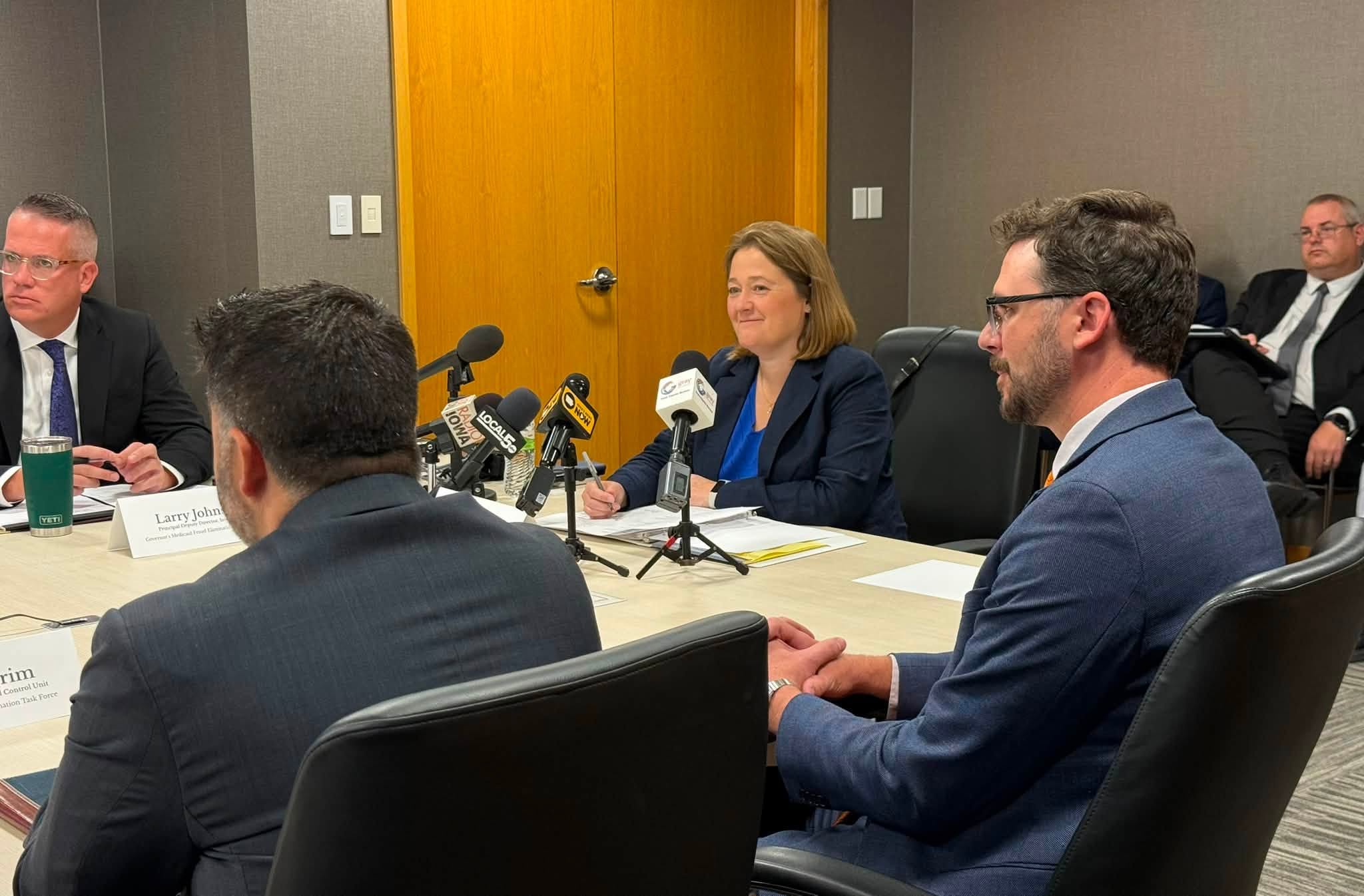
Top image: Attorney General Brenna Bird presides over the first meeting of the Medicaid Fraud Elimination Task Force on July 15. Photo originally published on the Facebook page of the Iowa Attorney General’s office.
2 Comments
In Republicanland fraud is committed only
By Democrats, immigrants and people of color. Republicans, like nursing home operators and insurance companies, are “hounded” by investigators (which is why we don’t need them, and “shackled” by red tape, which is why regulations should not be enforced.
The media (this site and those you cite aside) laps it up and they know more people watch tv news or read Gannett or Lee papers than look at bleedingheartland.com.
Iowan since 2020 Mon 3 Aug 9:02 PM
I watched a bit
of a Senate hearing today on Medicaid/fraud.
Senator Whitehouse, as he so often does, explained clearly enough for any schmuck to understand what this current Republican propaganda campaign is about.
The number of people exposed to the propaganda campaign will be far greater than will see Whitehouse or other Dems explain the con so clearly and truthfully.
Give the GOP credit. They’re good at this. And they have been for a long time.
Same old, same old.
It’s a shame.
And just one of many.
Fly_Fly__Fly_Away Tue 4 Aug 3:46 PM