
Nature nerd Emily Bredthauer took the pictures enclosed below in August and September. (It’s better not to be too specific about the location of rare wildflowers.)
I am of the opinion that Indigenous people should be celebrated every day. I am constantly full of gratitude for the people who have cared for the earth, plants, water, and wildlife that I enjoy here in Iowa. In celebration of this Indigenous Peoples’ Day, I’d like to share some wisdom from one of my favorite Indigenous authors, Robin Wall Kimmerer: “In indigenous ways of knowing, it is understood that each living being has a particular role to play. Every being is endowed with certain gifts, its own intelligence, its own spirit, its own story.”
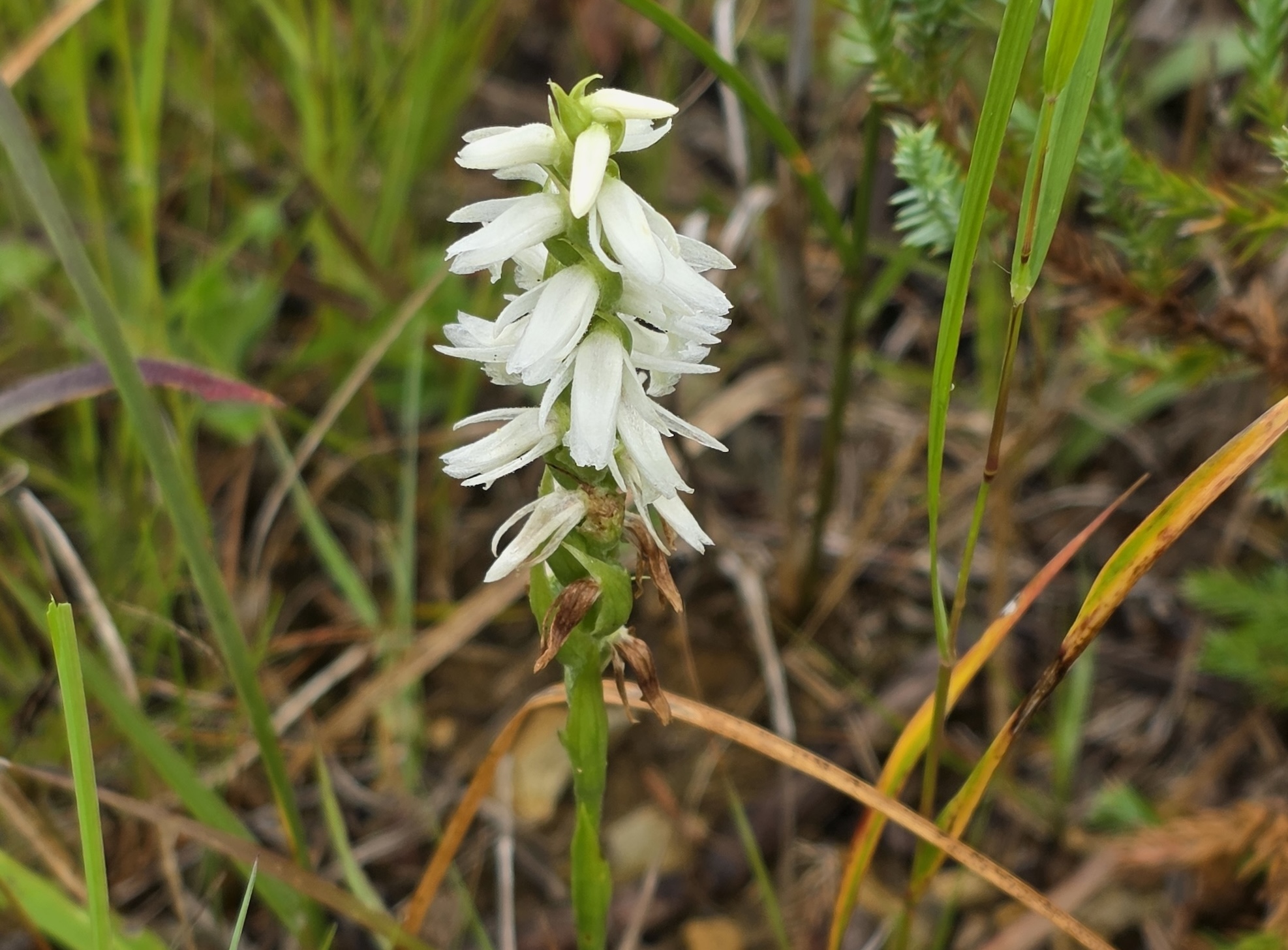
This essay will introduce Great Plains’ Ladies’ Tresses (Spiranthes magnicamporum) and share some of this plant’s gifts and story.
My first sighting of S. magnicamporum at the tail end of August was a total surprise. A spiral of white caught my eye.

Minnesota Wildflowers describes the inflorescence:
Flowers are closely intertwined in 3 rows, spiraling up a 1 to 4 inch spike with up to 48 blossoms, typically 3 to 4 flowers in 1 cycle of the spiral. The petals and sepals are white except for a tinge of yellow on the lower lip, up to ½ inch long, opening out creating a winged trumpet like appearance. The end of the lower lip unfurls down like a ruffled tongue while the 2 narrow lateral sepals flare out and up. often above the flower. The side and upper petals overlap creating a narrow lance-like hood curled up at the tips. The green bracts are oval, curling around the ovary before tapering to a sharp tip above the flower.


I visually searched the base of the plant for leaves to help determine which species of Spiranthes this beauty belonged to. The lack of leaves helped to confirm the ID. The Great Plains variety is similar in appearance to Nodding Ladies’ Tresses (Spiranthes cernua), but its leaves typically wither away prior to blooming.


Minnesota Wildflowers describes: “Basal leaves are long and slender, up to 5½ inches long, ½ inch wide and wilt away around 2 weeks before the flowers appear. The stem is stiffly erect with 4 to 6 sheath-like bracts that wrap the stem, the tips over lapping the base of the bract above.

When I got home and consulted Orchids in Your Pocket – A Guide to the Native Orchids of Iowa by Bill Witt, I read that “The plants are often tall and vigorous, and the blossoms delight with a fragrance likened to vanilla and roses with a dash of cinnamon.” I realized that in all my excitement to see another native Iowa orchid, I had forgotten to smell it.
My regret drove me to visit the following week to get the olfactory experience. One of Great Plains’ Ladies Tresses unique gifts is a lovely scent that is no doubt intoxicating to its pollinators. I would describe the scent as clean and fresh with a hint of sweetness. What a joy it is to be present in the moment, smelling a flower.
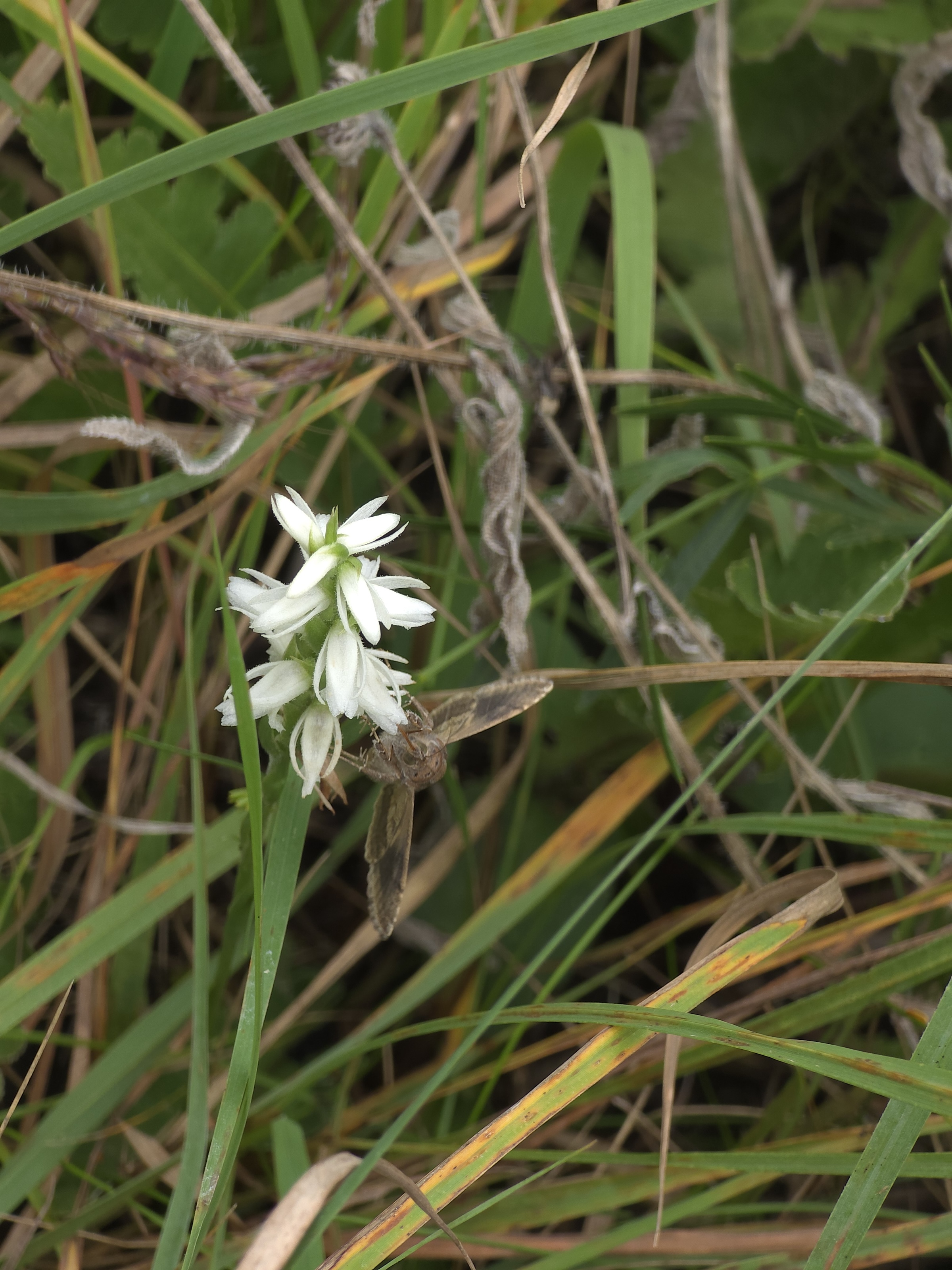
Moth nectaring
In late September, I visited Jasper County on a nice sunny day between rainstorms. I was blessed by the sight and scent of a now familiar friend.
This plant was playing the role of hunting ground for this Northern Crab Spider sharing its gift with the ecosystem.


I hope the reader has enjoyed getting to know the spirit and gifts of Great Plains’ Ladies Tresses. I hope you get to see (and smell) S. magnicamporum in person. I hope that the insight of Indigenous authors and botanists will inspire you to get to know the story of the living beings that surround you.
A piece of wisdom from Robin Wall Kimmerer that I carry with me daily: “Paying attention is a form of reciprocity with the living world, receiving the gifts with open eyes and open heart.” It reminds me to stop and smell the flowers and take the time to enjoy the gifts of the life around me. I am grateful for Indigenous knowledge today and every day.


