Katie Byerly of Cerro Gordo County is also known as Iowa Prairie Girl on YouTube.
Have you ever been on a nature walk and gotten yourself into a jam? Maybe that desire to find that one rare wildflower, or maybe just a plant you’ve never seen before, has now gotten you into a position you’re not sure how to get out of?
No? Not an adventurous plant geek? Then how about a hike to a hidden waterfall or mountain vista view? A tipped canoe? A flat bike tire? I would hope you have some type of nature adventure story you can relate to. This is my story of my wetland excursion that didn’t end as planned, but was oh, so worth the trip.
Hidden between two neighborhoods in my town is a slough. To be exact, its name is Buffalo Slough. Buffalo Slough is protected by the Nature Conservancy. Inside this 80-acre wetland is a channel fen—a special peat-filled wetland habitat that is the home to rare plants and insects. I very badly wanted to visit this wildflower haven, but there was a problem: Buffalo Slough is not easy to find.
According to the Nature Conservancy website: “Buffalo Slough was donated to the Conservancy in 1993 by Lucille Minott, whose late husband was deeply interested in nature and conservation.”

According to my husband, Bill, a life-long resident of our town and duck hunter, Mr. Minott was an avid duck hunter. Bill recalls as a child attending a BBQ in the Minott’s backyard—or more likely, as duck hunters call them, a “duck feed.” The donated slough was behind the previously owned Minott’s backyard.
The Nature Conservancy website indicates that access to the slough is across private property, and one should ask the property owner for permission to cross through their backyard. However, they don’t tell you where this access is. My husband knew the road Buffalo Slough was behind but did not remember the actual house from the gathering 50 years ago.
Somewhere I had read there was a small yard sign indicating the slough’s location. We both drove this road many times that summer looking for a sign. We didn’t find one.
I sent an email to the Nature Conservancy of Iowa to express my interest in visiting the fen. I see now I should have started there in the first place, as you need permission not only from the land owner, but also from the conservancy. A very nice email reply stated I should enter the slough from the east side. I had been looking on the west side.
Entrance to Buffalo Slough from the east is through the local neighborhood golf course. The email included a map of the slough and instructions that I should check in with the golf course staff in the club house. The Nature Conservancy staff member also instructed me (in case I didn’t know) to wear clothing and footwear for a muddy experience and to let him know if I found anything really good during my visit.
So on a very lovely August summer morning, dressed in my grubby gardening/slough walking clothes and plastic velcro strapped on sandals, I headed to the golf course. Map in hand, I presented myself to the staff member at the golf course desk. “Oh, are you with the conservancy?” I was asked. “They were just here yesterday.”
“No,” I explained. “I just want to see the wildflowers that grow in Buffalo Slough.” She looked at me like I was a little crazed but hollered across the club house room, “Hey, Joe, can you give this lady a ride to Swamp road?”
A ride? I wasn’t expecting a ride. My driver and I looked at my slough map. He thought he knew exactly where to take me. We stepped outside to his golf cart. What I wasn’t expecting on this beautiful August morning was that I had planned my wildflower hunting excursion on the same morning as a ladies’ golf tournament. There were a hundred women all dressed in cute golfing outfits all getting ready to start the tournament.
I was recognized. “Katie! Are you here to play golf?” These ladies knew me better than that. Motioning my hand over my wetland, wildflower hunting getup, I let them know I was here to hunt wildflowers. “Oh, of course, you are,” they laughed. And with that my driver and I were off to Swamp road.
Swamp road is a short, gravel dip on the cart path between two golfing holes. It is basically a bridge to get golfers through the slough. My driver parked in this divot the length of three golf carts and announced we had arrived. I looked to both sides and was greeted by walls of Jewelweed. And I mean walls – 5 feet tall and thick. In addition, it was growing in ankle to calf deep water. This couldn’t be the spot.

Jewelweed
I thanked my driver then waited for him to drive away. I wasn’t going to step off the road into water and an impassable mass of Jewelweed. Double checking the map, I decided the direction I should take. Hugging the edge of the tree line along the greens, I hoped the lady golfers would be oblivious to this oddly dressed individual sneaking through.
Fortunately, I soon stumbled across a trail leading into the woods. It looked to be more than just a deer trail. It also looked like it had been recently traveled and was headed right down into the slough. I took the trail.
It didn’t take long for the trees along the trail to turn into cattails. It was obvious now that this trail had been walked yesterday as the tall grasses were bent and trampled. I had to be in the right spot. Certainly, fancy dressed golfers wouldn’t go this far for lost balls.
Unsure what a trail through a slough might consist of, I was pleased to find a walkable trail. Yes, my feet were getting wet, but I had expected that. I’m not sure what made the trail through the slough an easy walk. Thinking back perhaps it was clumps of plants. I know I wasn’t sinking into muck, and I was happy about that. The cattail lined trail was the width of one person. If you stepped off the trail, you would not only be in water but in the razor-sharp cattails leaves.
The trail came to a narrw current of running water. There were rocks on both sides of this pretty little stream. It was an easy step from the north rocks to the south rocks. This adventure was really starting to be fun. This is also when I started noticing wetland wildflowers peeking out from the thick cattails. Hog peanut and Marsh bellflowers on their vines were searching for sunlight between the stiff, erect leaves of the cattails.

Hog peanut

Marsh bellflower
Up next was a dry mound covered with short grasses and a small tree just big enough to provide shade. This mound appeared to be a gathering site for either a few deer or a few conservancy team members. As I continued on, I noted the cattails were becoming fewer. In this thinning, Swamp betony started to show itself.

Swamp betony

Bellflower and Swamp betony
And then it happened! I must not have been previously aware of the cloud coverage. Because as I stepped through the remaining cattails onto the fen, I swear, the clouds parted at the same time and sunshine shone down upon this miraculous wildflower haven. I know without a shadow of a doubt that I stood there in my grubby, fen hunting clothes, my arms spread wide and an elated smile on my face taking in this amazing view. I laughed out loud.

Turtleheads (in foreground) and Joe-Pye weed
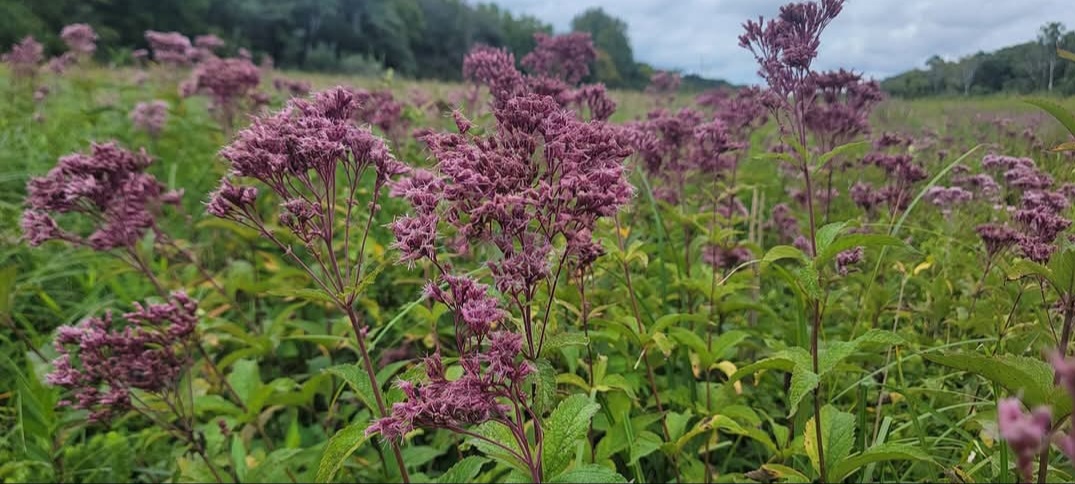
If one could describe a fen like a woodland, in layers, I would describe it this way: Joe-Pye weed made up the canopy. Five to six feet tall plants blanketed the fen with its flat-topped purple flower heads. Thousands of pinkish purple disk flowers open with stringy styles waving in the breeze luring in pollinators.

Oh, the pollinators! This was one of those times I kicked myself for not learning my insects. The fen was alive with pollinators. Butterflies, skippers and moths floated over the fen like a drifting mist. Some perched themselves ever so gently on the flowers, holding steady against the breeze, all the while sipping nature’s sweet nectar. Others hovered, wings beating, going plant to plant as if in a hungry competition to get the prize. Bees of all sizes, covered in pollen, zipping from one flower’s landing pad to the next, feasting as they wiggle in and out of tubular shaped flowers. Their constant humming drowned out the laughter of golfers.
I was able to identify the orange Monarch look alike: Viceroy butterfly.

The next tier of the wildflower heaven contained the plant I was here to see: White turtleheads! It was sheer dumb luck that this adventure happened when the turtleheads were in full bloom. The dense spikes were packed thick with white flowers, some with lobes just barely flared and some still held tightly closed. At the top of the inflorescence spike sat the waxy, light green, flower beds waiting their turns to open. Turtleheads are the host plants to the Baltimore checkerspot. I did not see one.


Along with the White turtleheads this wildflower layer also held the vibrant blue spikes of Great blue lobelias and the castle-like towers of Blue vervains.

Great blue lobelia

Blue vervain (with turtleheads in background)
Common boneset, with its bright white disk flowers and distinct opposite hairy leaves surrounding the equally hairy stem, shared this space with Flat-topped asters whose white ray petals haphazardly surround a pale yet almost golden center disk.

Common boneset

Flat-topped asters
Sadly, the pink-purple spikes of the invasive Purple loosestrife also occupied this space.

Purple loosestrife
The next lower layer of wildflowers contained small, secretive Blue skullcaps and the fun button centered flowers of Broadleaf arrowheads.


Two views of Blue skullcap
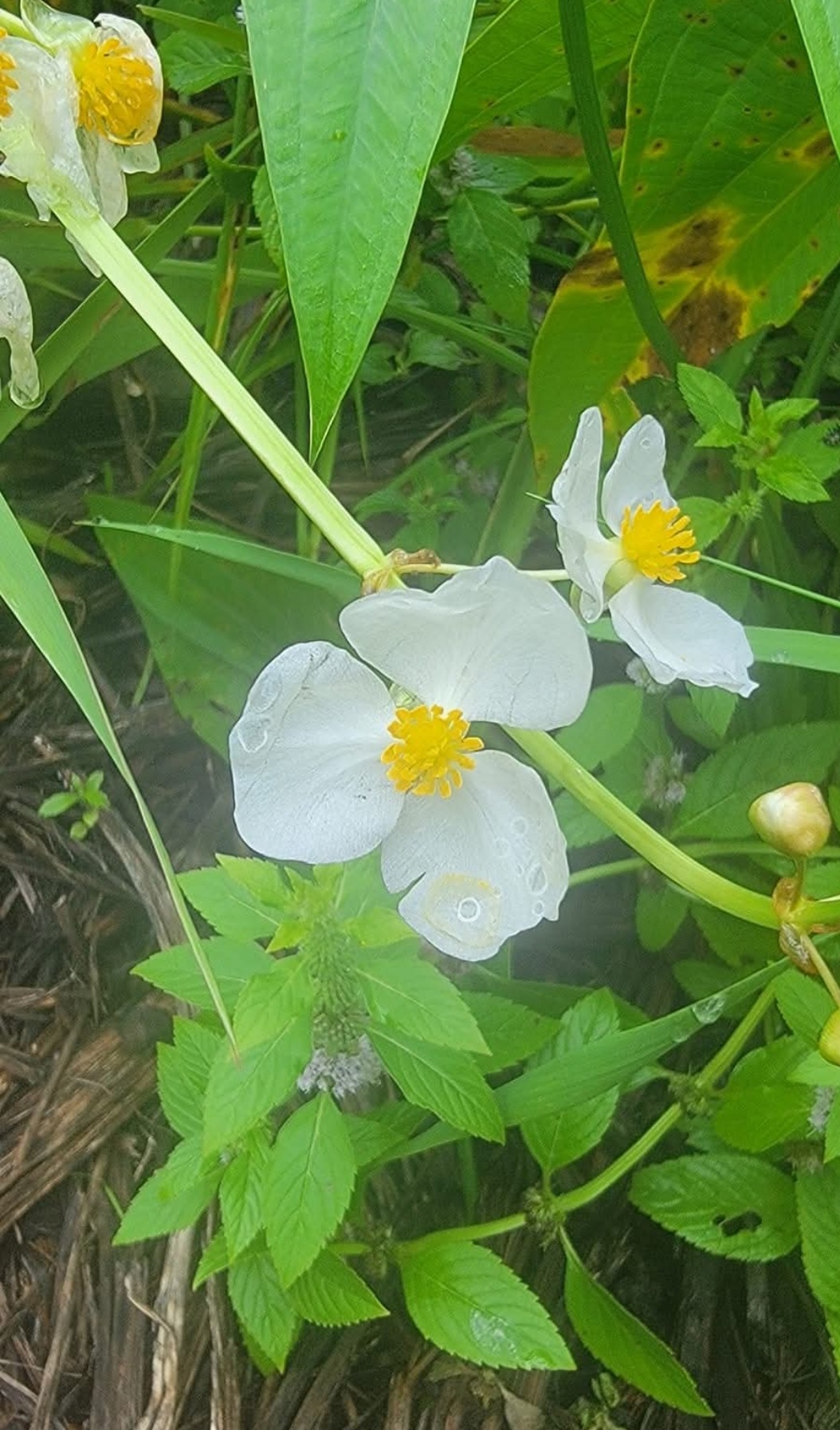
Arrowhead
Wild mint with its whorl of tubular flowers grew next to a very golden yet short goldenrod. Perhaps Swamp goldenrod.
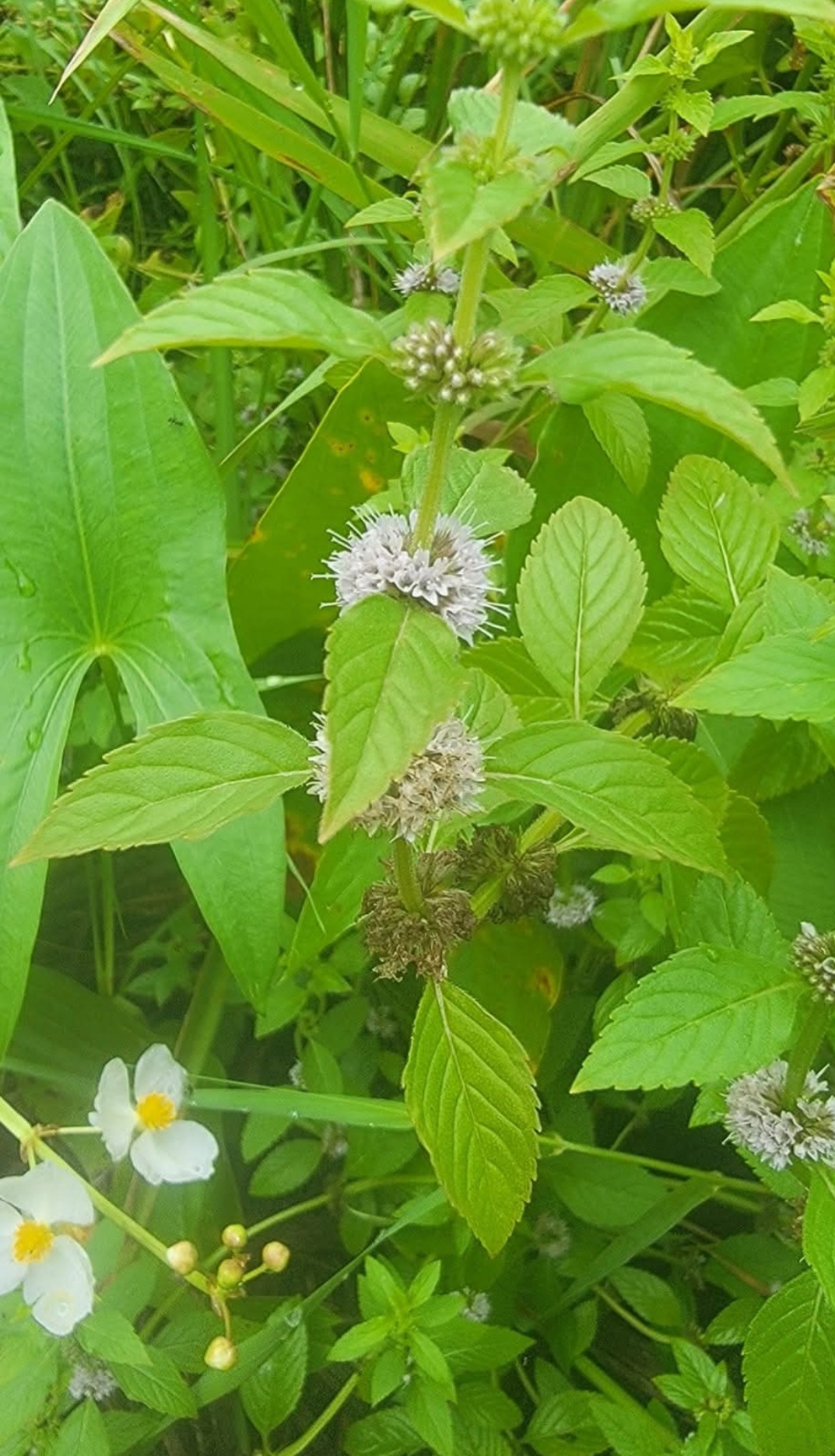
Wild mint


Two views of goldenrod
It was at this time that I felt the need to share my great joy. I phoned my husband. “I found it! I’m having the time of my life!” I exclaimed. My husband was happy for me but quickly got back to business. . . “I’m in town and headed to the grocery store – need anything?”
I spent the next 20 minutes wandering around the fen snapping pictures and just taking it all in. Towards the back or south side of the fen, I noted a powerline running east to west and could see that this went to the neighborhood on the east side of the fen. The neighborhood I had searched for the fen’s entrance. Believing I had seen everything I could, I turned around to follow the trail back to the golf course. I was dreading walking through the golf course back to my truck parked at the club house. . . . past what would feel like thousands of lady golfers.
This is where my mishap starts. . . where was the trail back? I could hear the golfers. I could see the trees where the trail began from the greens. I could even see the top of that small tree in the slough. Was this opening in the cattails it? No, that trail ended with a wall of cattails.
I doubled back and tried another opening. It was another dead end. I attempted three or four times to find the trail to the small tree. After those unsuccessful tries, I decided I would just try to reach the woods. But stepping off what trail I had meant stepping into water and gunk and each step closer to the trees led to deeper water and thicker muck. If you’ve ever been in muck, you know what was happening to my sandals. I had to reach into the mire and pull my sandal out with my foot, or I would be barefoot soon.
I was in a slough jam. Even if I did wade to the trees, I was now not only covered thigh-high with marsh sludge, but my arms and legs were scratched raw from the sharp cattail leaves. I decided I could go back to the power line and exit the slough on the east side. However, that would mean walking blocks through a neighborhood looking like a monster from the deep lagoon.
I called my husband. “I’m stuck! I’m standing in water and can’t find my way out of the slough to the golf course. Can you pick me up on North Carolina avenue?”
Corn spider on boneset leaf – the one insect that didn’t fly away from me:

Not knowing where I would come out on the street, my husband knew to look for me somewhere in that vicinity. And that’s where he found me, sitting on the curb covered in mud, cut-up, even bleeding a little, but happy as an adventurer reaching a high summit.
Since that time, I have knocked on that homeowner’s door and have obtained permission to walk across their yard to the slough anytime I want. I’ve been back a few times, and I have found entering and exiting Buffalo Slough a lot simpler—but certainly not as adventurous.


