
Phil Montag is a Des Moines area activist and serves on the board of the Iowa Unity Coalition.
Listening to Zach Lahn on the Iowa gubernatorial campaign trail for the past year has been quite a show. To his credit, from the beginning he has put ecology, sustainable agriculture, and water quality front and center in ways that I wish politicians would do more often.
After watching Randy Feenstra and Adam Steen trying to out-Trump each other and race to the bottom of banal human depravity and white grievance, part of me was happy to see Lahn win the Republican primary.

Zach Lahn celebrates with supporters on primary election night (photo first published on his campaign’s Facebook page)
Not that I believed he had any core guiding principles towards conservation or water protection. I knew Feenstra was a wholly owned subsidiary of corporate agribusiness and their favorite son. I also knew Lahn’s history with the conservative group Americans For Prosperity, funded through the Koch brothers network.
Starting in the summer of 2014, Lahn worked as Montana state director for Americans for Prosperity. In that role, he led the charge in trying to convince Montanans to reject Medicaid expansion. Running for Iowa governor in 2026, he has recreated himself in the image of his pollsters or focus groups. (Lahn’s campaign spent more than $130,000 on polling before the primary, according to his campaign finance disclosures.)
Before the primary, he didn’t tiptoe around worrying if talking about cancer rates or CAFO pollution would upset the Big Ag big money boys. No doubt Lahn’s data research was showing him the same thing Democratic research teams were seeing: voters really like clean water and really hate cancer. Who knew?
Lahn’s case against environmental protection
While Zach Lahn worked in Montana, the main focus for Americans For Prosperity was stopping Medicaid expansion. He has been unwavering over the years in his commitment to making health care less accessible to the economically disadvantaged.
However, I did find a guest column Lahn wrote, which the Kalispel, Montana newspaper The Daily Interlake published on August 23, 2014. In that piece, he warned Montana voters that environmental protections would harm the economy, and he was dismissive about the work of the U.S. Environmental Protection Agency.
Some quotes from that column directly counter the central theme of Lahn’s 2026 campaign. Here’s the first paragraph: “The Environmental Protection Agency delivered a blunt message to Montanans this summer: We’re willing to sacrifice your economy for symbolic, and misleading, environmental policies.”
That set the tone for the whole diatribe: that new EPA mandates and regulations on coal and water pollution would threaten the economic well being of Montana.
The last paragraph contains perhaps the most offensive quote, denying that clean water regulations do anything helpful: “Together, both of these regulations will only harm our economy and eliminate many of our jobs. Yet the EPA has made it clear: That’s an acceptable price to pay for the false appearance of environmental progress.”
Here’s another passage where Lahn claims that there are no benefits from environmental protections: “The EPA assured us these regulations would be environmentally beneficial and economically painless, but Montanans are starting to find out that they’re actually all pain and no gain. No wonder our state is increasingly opposed to them.”
Lahn also asserted that survey results shifted when voters were told that regulations provide “no recognizable environmental benefits.”
Just look at the carbon dioxide regulation. In a recent survey of registered Montana voters by the American Energy Alliance, participants were asked at the outset whether they supported the regulation: 57 percent were for it, compared to 38 percent opposed. But when then presented with the consequences of this new regulation — more Washington control of our economy, lost jobs, and no recognizable environmental benefits — that majority support flipped to majority opposition.
The same column appeared a few days later in The Missoulan, Montana’s second-largest newspaper. (That version is paywalled.)
Two takeaways from Lahn’s warnings against protecting Montana’s water
There was a dramatic shift from Captain of Industry Zach Lahn of 2014 to Captain Planet Zach Lahn of 2026.

Lahn speaks to supporters outside his Belle Plaine home on June 1, 2026 (photo first published on his campaign’s Facebook page)
Lahn has had a total transformation on conservation, regenerative agriculture, and water protection, and it has been breathtaking to watch.
For a recent example, see this October 1 post in The Daily Signal, a conservative pseudo-news outlet created by the Heritage Foundation. (It now operates independently.) The piece describes Lahn as a “regenerative farmer” seeking “to solve the water and cancer crisis, protect family farms, improve public education, and build a state where Iowans want to stay for generations.”
Candidate Lahn’s tough talk of taking on corporate agribusiness in defense of Mother Earth and family farms goes back to his campaign launch speech in November 2025. That day, he vowed to “break up these monopolies, defend family farms, and demand accountability from corporations that harm our people.”
During a podcast interview in March 2026, Lahn talked more about taking on the monopolistic agribusiness forces dominating our politics. He quoted Thomas Jefferson on the dangers of “the aristocracy of our moneyed corporations,” and even took a veiled swipe at Ronald Reagan: “And in the 80s, we really took our eye off the ball. Now, we’re facing the repercussions of that.”
Another banger of a quote from the born-again hippie-farmer version of Lahn is from The Prairie Farm podcast, recorded last December. Starting around the 36:30 mark: “I’ve talked a bit in spiritual terms here, and I often look at this in the sense of, I think that there’s been this religion of economic thinking that’s taken over many people. And what I mean by this is our ancestors did not come here to be capitalists.”
Speaking on The Iowa Podcast on April 1, Lahn advocated for breaking up Big Ag and said he wasn’t concerned that his stance would cost him support and donations from big money ag interests.
Second big takeaway:
Zach Lahn doesn’t take long to switch statehood heritage and identity
Lahn sometimes mentions that he moved to Ankeny (a suburb of Des Moines) in 2013. He worked as a campaign manager for Congressional candidate Matt Schultz before the Republican primary on June 3, 2014. According to Federal Election Commission data, Lahn was paid full salary for the entire month of June 2014.

He filed a $434.37 mileage reimbursement on June 4, so it’s safe to assume he was on the ground in Iowa until at least election day—likely longer to finish paperwork, clean up and check out of the rented office space, and wrap everything up with Schultz’s campaign.
Yet in the op-ed Lahn published in August 2014, he referred to Montana as “our state” six times.
- Paragraph 3: “No wonder our state is increasingly opposed to them.”
- Paragraph 6″ “These cuts will deeply hurt our state“
- Paragraph 9: The EPA mandate “will do next to nothing for the environment while disproportionately harming our state’s economy”
- Paragraph 11: “Washington might even be able to regulate every square inch of our state — rain, after all, creates temporary water flows.”
- Paragraph 12: “Not only will this add regulatory burdens for our state’s 28,000-plus farms and ranches, it will also reduce property values by restricting future development. This is particularly worrisome since agriculture is our state’s leading industry, adding over $4 billion to the economy per year.”
Let’s be generous and assume Lahn moved to Montana on June 4, the day after the Iowa’s primary election. It only took 84 days for him to start referring to Montana as “our state” in the newspapers.
While identifying as a Montana citizen and resident after less than three months may seem misleading and exaggerated, consider that Lahn changed his voter registration address to Belle Plaine, Iowa in October 2024.
He is hoping to be elected governor of Iowa less than 750 days after establishing residency here. Even after launching his campaign for governor, Lahn made frequent trips back to Wichita, Kansas, where his family lives.
The ideological contrast is striking. The 2014 Zach Lahn was a rising conservative star trying to win the trust of the Koch brothers and other establishment Republican donors. The 2026 Zach Lahn aspires to be Iowa governor, knowing he wouldn’t have the support of the Farm Bureau and Big Ag lobby. This gifted and seasoned political operative had the instinct and the polling data to know that reinventing himself as a sixth-generation Iowa farmer, a regenerative farmer, gave him a path to victory.
Whether it’s his 85-day transition from Iowan to Montanan in 2014, or his latest transition from Wichita businessman to Iowan, or his flip-flop on conservation, water quality, and taking on corporate agribusiness, Lahn has repeatedly shown he will do what’s best for Zach first.
Whether you side with 2014 Zach Lahn, 2026 Zach Lahn, or somewhere in between—I think everyone can agree that integrity matters.
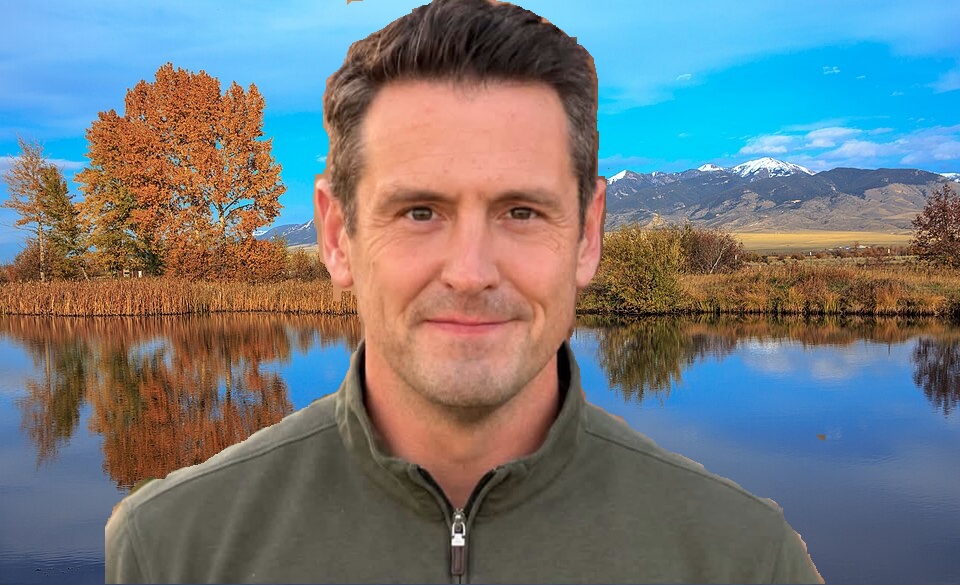
Top image: Campaign photo of Zach Lahn superimposed on Murray Foubister‘s photo of fall colors on Highway 287 near Madison, Montana, licensed under the Creative Commons Attribution-Share Alike 2.0 Generic license and available via Wikimedia Commons.