
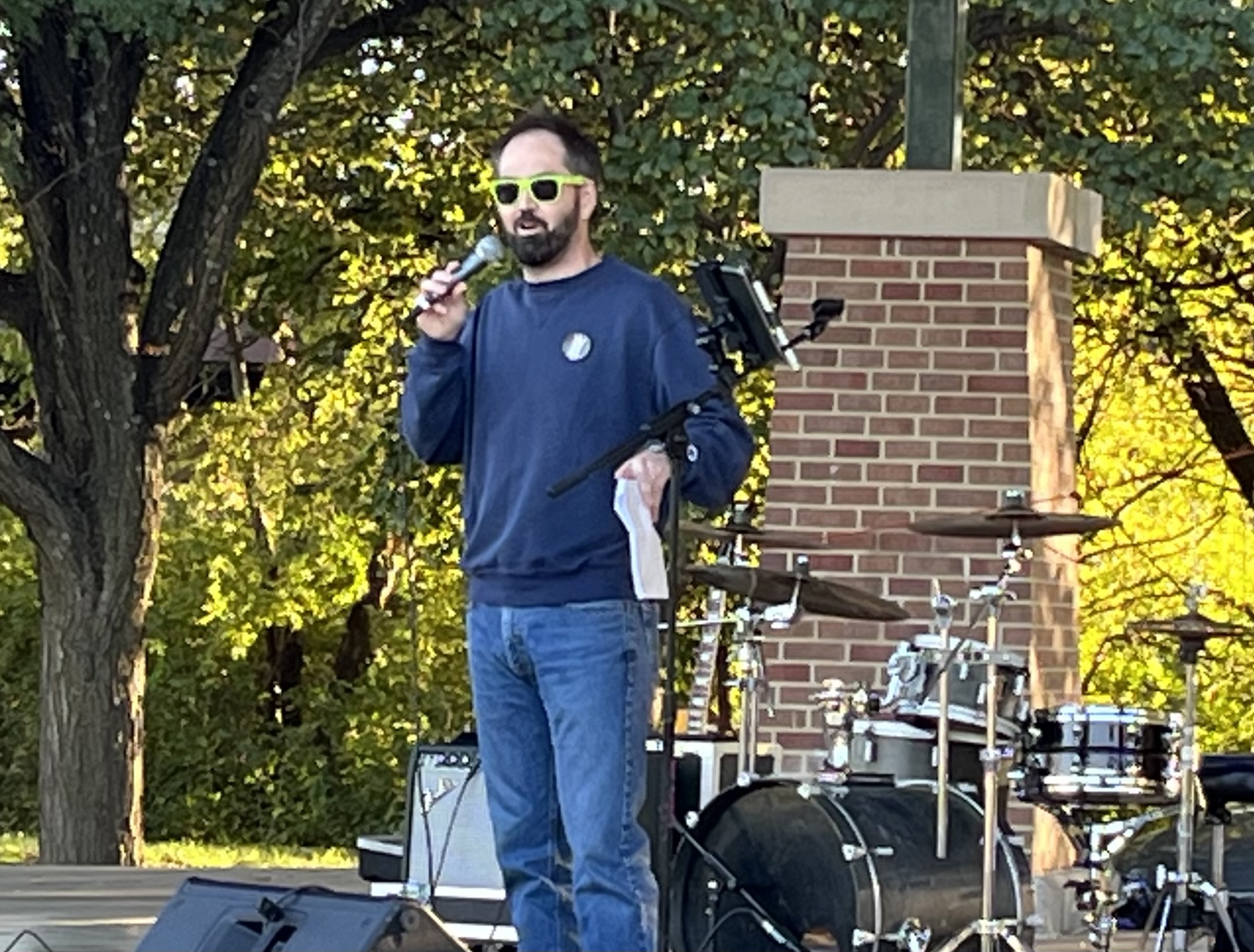
Joey Norris is a small business owner and Democratic volunteer in Red Oak. This is the prepared version of remarks he delivered at the No Kings: Vote Early rally in Windsor Heights on October 17, 2026. Bleeding Heartland covered his prosecution for felony election misconduct, his trial, and his acquittal here.
1. The lesson
There is a lesson being taught in this country right now.
It’s being taught in the White House and in statehouses, in courtrooms and county basements. It is a simple lesson, and it goes like this:
Don’t ask.
Don’t ask where the money went. Don’t ask who wrote the rule. Don’t ask why the rules apply to you and not to them. Sit down. Be grateful. Stay quiet.
But, we were taught a different lesson as kids.
Read the instructions. If you don’t understand, ask. Do the job right, even when it’s harder or slower. And leave things better than you found them.
I took that lesson seriously. And the State of Iowa charged me with a felony for it.
I want to tell you how that happened, quickly. Because my story isn’t really about me. It’s a small, clear window into something much bigger: what happens when power stops answering to the people it’s supposed to serve.
2. What happened to me
In 2024, I volunteered on Montgomery County’s absentee ballot board. No training ahead of time, just a PDF. So I printed it, highlighted it, tabbed it, bound it, and carried it into the courthouse.
The only copy in the room.
In the first hour, I watched experienced members read voters’ names on the affidavit envelopes and then immediately pull the ballots out to inspect them. The guidebook makes it clear: that’s a no-no. No one should be able to link a ballot to a specific voter. That’s the secret ballot.
I pointed out the error. “That’s how we’ve always done it.” I asked again. “We’re too old to remember how anyone voted, anyways.” Finally, they changed the procedure.
I was right.
A damaged ballot was headed for the trash. I found the rule to duplicate it, and that vote counted. A straight-ticket Republican ballot. I’m a Democrat. I used to chair Montgomery County’s party. I didn’t care whose vote it was. I wanted it counted.
I was right.
Then came the rejected ballots: ten-ish voters with a fixable problem, like a missing signature. They could still be counted if someone reached them before the polls closed. The status quo had us wait until the end of the day. I asked to start calling them now. “That’s not how we do it.” I opened my binder to the page that lets observers report those names. “We’re not doing that right now.”
Politely. Persistently. Why are we not counting every vote?
And the auditor held up her hand and counted down at me.
Five. Four. Three. Two. One.
Like I was a child.
Then she called the sheriff. Four deputies came into to that basement. I stood up, said, “It was my honor to serve,” and walked out.
The voters weren’t contacted until after 6:00 PM that night. Seven ballots never counted.
Ninety minutes later, I filed a complaint with Paul Pate’s Secretary of State’s office and asked for an investigation. Nobody answered. For twenty months, silence.
Then, this July, I was setting lintels on my old house in Red Oak when a deputy called. Attorney General Brenna Bird had recommended I be arrested. I finished setting those lintels, and then I drove to the jail, still covered in mortar, and surrendered myself.
First-degree election misconduct. A felony. Up to five years in prison. Fingerprints. A mug shot. Circulation on the county arrest list.
Last week, a unanimous jury of my neighbors found me not guilty.
I’m grateful to every one of them.
A jury worked. But the system nearly didn’t. And I want to talk about the system.
3. This isn’t about me
Here’s what I learned in that basement, and in that jail cell, and in that courtroom.
There are two sets of rules in this country.
If you’re a volunteer who reads the rulebook out loud, you get a felony charge and a mug shot.
If you’re powerful and well connected, the rules bend. Charges disappear. Investigations go quiet. Pardons arrive.
One set of rules for the few. Another set of rules for the rest of us.
And here’s the second thing I learned. Justice in America has a price tag.
My defense cost me in more ways than the tens of thousand dollars spent. I’m lucky. I run a small business. I have family who showed up. I had a top tier lawyer.
But think about the single mom working two jobs. Think about the retiree on a fixed income. Think about the kid who just turned eighteen and signed up to work the polls because it seemed like a good thing to do.
What happens when the phone rings for them? What happens when Brenna Bird decides to come after them?
They might not be able to write that check. They might not be able to weather that storm. So they plead to something they didn’t do, just to make it stop. They go quiet. And they never volunteer again.
That’s not just an unfortunate outcome. That’s the point.
You don’t have to convict everyone. You just have to frighten the next person. Charge one volunteer, and a hundred others decide it’s not worth the trouble.
That’s how the authoritarian shift actually works. It doesn’t arrive with tanks in the street. It arrives with “That’s not how we do it.” It arrives with a five-finger countdown. With a complaint nobody answers. With a felony filed by people who never asked for your side.
It arrives quietly, in a basement, and it teaches one lesson: don’t ask.
The same thing happens with money. When wealth is concentrated in a few hands, it stops answering to anyone. It writes the rules, hires the lobbyists, and tells the rest of us to be grateful for scraps.
The top 1 percent owns more wealth than the bottom 93 percent. One man owns more wealth than the bottom 52 percent of American households – nearly 165 million people.
Now think about what an election is.
In an election, a billionaire and a bricklayer each get one vote. It is the one place left in American life where the many still outnumber the privileged few.
That’s exactly why the counting room matters. And that’s exactly why the people counting your vote have to be free to ask questions.
4. It is a choice
Here is the truth we must carry forward: none of this is inevitable. It is a choice.
The auditor told a court that she was “just reporting it as an incident.” She didn’t think it was a crime.
The deputy who charged me testified that his case file starts with an email from Attorney General Brenna Bird’s office, and that they were “just going [by] what was recommended by the AG’s Office.”
So let’s be clear about whose choices these were.
It was a choice to collect statements from the auditor’s list of witnesses and never ask for mine.
It was a choice to wait twenty months, then file a felony charge three and a half months before an election.
It was a choice to use a law so vague no court has ever defined it, a law that turns “hinder” into a weapon for whoever holds the pen.
And it was a choice to spend taxpayer money taking that case all the way to a jury.
After the verdict, Brenna Bird said she has the responsibility “to ensure Iowa’s elections are secure.”
So I ask, as Laura Belin with the Bleeding Heartland asks: exactly “Which laws were upheld by trying to turn an election worker’s sincere efforts into a class D felony?”
When a few people in power decide who gets prosecuted and who gets a pass, that’s a choice. When they write the rules for themselves and enforce them on the rest of us, that’s a choice. When they tell us inequality is just how the world works, that’s a choice too.
But if punishing questions is a choice, protecting them can be a choice.
If inequality is a choice, then fairness can be a choice.
5. What we do now
We cannot just wait until the next election. We cannot count on a savior to appear on our ballot.
We are the leaders we’ve been waiting for.
The power is in our hands: our voices, our votes, our wallets, and our time.
Ask questions. Out loud. At the school board. At the county supervisors. At the town hall. In the counting room. Every time someone says “That’s not how we do it,” ask why. A question is not a crime, and the only way to keep it that way is to keep asking questions.
Volunteer anyway. Sign up to work the polls. Sign up to be an observer. Bring the rulebook. They are counting on us to stay home. Don’t.
Call your representatives. Go to 5calls.org and make it a habit. Tell Iowa’s legislature to fix this stupid law: require a bad purpose before anyone is charged, and say plainly that questioning an official is not a crime. Tell Attorney General Brenna Bird to find someone else to pick on, Iowa’s people are sick of her bullshit.
Organize. Join a group like Indivisible, or start one. Power concentrates when we’re isolated. It breaks when we’re organized.
Use your wallet. The oligarchs count on our dollars as much as our silence. Spend them on your neighbors, not the barons.
Protect each other. I had a lawyer who fought for me and family and friends who filled that courtroom. Not everyone does. When someone in your community gets that phone call, show up. That’s Iowa Nice, that’s what everyday courage looks like, and it’s stronger than any of those cold and timid souls who would keep us silent.
6. The choice before us
The morning I got that phone call, I was setting lintels: the stone beams over a window that carry all the weight above them. Nobody notices a lintel. You only notice when it fails.
I went back to that house the day after the verdict. The lintels had held. The work continues.
This country is held up the same way. Not by billionaires. Not by attorneys general. But by ordinary people doing slow, careful, unglamorous work. Poll workers. Teachers. Nurses. Bricklayers. People who read the instructions and ask the question. We carry the weight. And they are betting we’ll get tired of carrying it.
So the choice before us is clear.
Let us decide, right here and right now, that a question is not a crime. Let us refuse the lesson they’re teaching, and teach them instead our lesson. Let us leave this state and this country better than we found it.
Nobody gets to be king of our elections. Not in the counting room. Not in Brenna Bird’s office. Not in the White House.
Say it with me, loudly and without hesitation, today, tomorrow, and for all the generations to come:
NO KINGS!
NO KINGS!
NO KINGS!