# Commentary


Fort Dodge police video case wrapped in important legal principles

Randy Evans is executive director of the Iowa Freedom of Information Council, a nonpartisan, nonprofit organization that promotes openness and transparency in Iowa’s state and local governments. He can be reached at DMRevans2810@gmail.com. This essay first appeared on his Substack newsletter, Stray Thoughts

It was Christmas Eve. The gifts were laid beneath the Christmas tree at the home of Merlin and Nelda Powers in Urbandale.

But the family’s holiday celebration ended abruptly that day in 1968 when the Powers’ 10-year-old daughter Pamela disappeared from the YMCA in downtown Des Moines while the family attended her brother’s wrestling meet.

Two days passed before the family received the horrible answer to their “where is Pamela” question. Police located the girl’s body in a roadside ditch just off Interstate Highway 80 near Mitchellville.

Continue Reading...

"These billionaires don't have a clue"

John and Terri Hale own the The Hale Group, an Ankeny-based advocacy firm focused on older Iowans. Reach them at terriandjohnhale@gmail.com

Frustrated. Angry. Scared.

That’s how many older Iowans and Iowans with disabilities feel about the economic realities of their lives.

They are struggling to pay the bills. They’re frustrated about the rising cost of living. And they’re worried about the future.

We’ve heard from them at recent forums in the Quad Cities, Des Moines, and Ankeny, in conversations with friends and acquaintances, and in social media messages.

They’ve given us an earful. The key takeaways:

Continue Reading...

Venezuela: Into the unknown

Rick Morain is the former publisher and owner of the Jefferson Herald, for which he writes a regular column. This essay first appeared on Substack.

A few days ago a team effort by U.S. military, intelligence, and law enforcement personnel seized Venezuelan strongman Nicolás Maduro and his wife Cilia Flores, and took them into American custody. The move has overwhelmed the news cycle across America, and much of the world as well.

The couple, now arraigned and in federal detention in Brooklyn, New York, will be tried in federal court on charges involving narcoterrorism conspiracy, cocaine importation, high-powered weapons possession, bribery, and fomenting kidnappings and murders.

There’s way too much involved here to unpack fully in a column like this one. The challenge is to drill down to the incident’s essential significance: Why did it happen? What important events led up to it? And what is it likely to mean for the people of Venezuela and their resources?

Continue Reading...

Time to investigate decades of FBI, DOJ inaction on Jeffrey Epstein

Steve Corbin is emeritus professor of marketing at the University of Northern Iowa and a contributing columnist to 246 newspapers and 48 social media platforms in 45 states, who receives no remuneration, funding, or endorsement from any for-profit business, nonprofit organization, political action committee, or political party. 

Maria Farmer reported her sexual assault by Jeffrey Epstein and Ghislaine Maxwell to the New York Police Department and the FBI on August 29, 1996. Ms. Farmer contacted the FBI as advised by the police. On September 3, 1996, the FBI identified the case as “child pornography,” since naked or semi-naked hard copy pictures existed.

Files including Farmer’s 1996 complaint were not required to be made public until late 2025. President Donald Trump signed the Epstein Files Transparency Act into law on November 19. The law required that all files be released by December 19. But under the leadership of U.S. Attorney General Pam Bondi, the Department of Justice (DOJ) failed to release 100 percent of the files.

Continue Reading...

Predictions for Under the Golden Dome

Bruce Lear lives in Sioux City and has been connected to Iowa’s public schools for 38 years. He taught for eleven years and represented educators as an Iowa State Education Association regional director for 27 years until retiring. He can be reached at BruceLear2419@gmail.com 

The digital clock silently clicks 3:01 a.m. Her eyes flash open. She’s a teacher and she knows 3:01 isn’t awake time especially when 27 pairs of third grade eyes will be staring at her in a few hours. Her mind reviews every lesson rewriting in her mind. Then she begins to worry about her career choice. Will it get easier? How do I balance family with school?

She hopes her school can hire more teachers, reduce paperwork, meetings, and maybe agree to a raise above insurance increase. But money is tight. She needs more time to prepare so her teaching bag isn’t filled to the brim at home. She prays she’ll be allowed to be creative because that’s the joy of teaching. She’s exhausted by interference. 

Her last thought before drifting off to a dreamy sun-soaked beach is a hope Iowa legislators will stop punching down on her profession.

Continue Reading...

Does Iowa's updated bottle bill serve Iowans—or beverage distributors?

Linda Schreiber writes commentary on selected legislative issues.

For more than four decades, Iowa’s Bottle Bill stood as a national model: simple, effective, and popular. It reduced litter, boosted recycling, and put responsibility where it belonged—on producers and consumers. The 2022 update weakened those goals while reducing public accountability.

In 2019, Iowa State University professor Dr. Dermot Hayes recommended adjusting the five-cent deposit enacted in 1979 for inflation, roughly 17 cents at the time. A survey showed 88 percent of Iowans supported the Bottle Bill. Advocates, including the League of Women Voters and the Sierra Club, urged lawmakers to strengthen the program, improve redemption access, and preserve public benefits.

Iowa lawmakers chose a different path.

Continue Reading...

When power demands compliance, not justice

Xavier Carrigan is a Democratic candidate in Iowa’s third Congressional district.

For many Americans, foreign policy feels distant. Something that happens elsewhere, debated by experts and pundits, far removed from daily life.

But what the United States has done in Venezuela, and what it is now demanding in the aftermath, should concern anyone who believes power ought to have limits.

By launching a military strike in Caracas and forcibly removing Venezuela’s head of state, the U.S. crossed more than a geopolitical line. It established a precedent. One that says sovereignty is conditional, international law is negotiable, and accountability depends less on principle than on alignment.

Continue Reading...

Sunshine delayed is sunshine denied

Randy Evans is executive director of the Iowa Freedom of Information Council, a nonpartisan, nonprofit organization that promotes openness and transparency in Iowa’s state and local governments. He can be reached at DMRevans2810@gmail.com. This essay first appeared on his Substack newsletter, Stray Thoughts

Days removed from the winter solstice, when Iowa’s nights are the longest, we have another example of the absence of sunshine in Iowa government. And this example shows why the state legislature has much to do about openness and accountability when it convenes on January 12.

A recent court decision with ties to the collapse in May 2023 of an apartment building in Davenport highlights the urgent need for legislative action. The case involves more than the public’s right to know, considering that three people died in the collapse and rescue workers needed to amputate a survivor’s leg to free her from the rubble.

Continue Reading...

Public interests and property rights: The pipeline looms for Iowa lawmakers

Dr. Emily Boevers is a Readlyn farm kid, mother of three, and physician practicing in Iowa. This essay first appeared in the Waverly Democrat.

Property “ownership” is surprisingly complicated. Since feudal times when all land belonged to kings, to global wars that claimed land by force and displaced native populations, to modern concepts about private deeds, covenants and easements—property rights are nuanced. The law bundles the privileges of land ownership as a right to exclude others from a space, to protect or to exploit property for one’s own benefit, to pass it on to heirs and to not have it unlawfully taken or damaged. Enforcement of the rights that come with land title are an honored, but dynamic, legal tradition.

Today, limited options exist to legally seize, use or redistribute property owned by another. Zoning laws are one example of limitations on property use. Voluntary easements grant another the opportunity to use one’s property for limited purposes. Eminent domain allows the non-consensual taking of private land so long as landowners are justly compensated and public good is served.

It is likely through enforcement of eminent domain that the carbon-capture pipeline will ultimately wind its way through Iowa. In June 2024 the Iowa Utilities Board (since renamed the Iowa Utilities Commission) determined that the project qualified as “public use.” The board members concluded that the pipeline’s potential public benefits outweighed private and public costs. Therefore, landowners who do not sign voluntary easements for Summit Carbon Solutions’ pipeline could still be subject to non-consensual use.

Continue Reading...

The admirables from 2025

Rick Morain is the former publisher and owner of the Jefferson Herald, for which he writes a regular column. This essay first appeared on Substack, in two parts.

The American writer James Agee, together with photographer Walker Evans, in 1941 released Let Us Now Praise Famous Men, a book documenting the lives of impoverished Southern sharecroppers during the Depression.

The title is an apt referent for the subjects of this column: men and women whom I admire for what they have done for other human beings, this year and/or in past years. They aren’t all necessarily famous, but they deserve to be. Others certainly earn my admiration as well, but putting together my year-end list, it’s hard for me not include ten of them up front.

The envelopes please, in no particular order:

Continue Reading...

"A strong message": Four takeaways from Renee Hardman's big win

West Des Moines City Council member Renee Hardman won big in the December 30 special election to represent Iowa Senate district 16. Unofficial results show the Democrat defeated Republican Lucas Loftin by 7,341 votes to 2,930 (71.4 percent to 28.5 percent), a margin of about 43 points in a district Kamala Harris carried by about 17 points in 2024.

Hardman will make history as the first Black woman to serve in the Iowa Senate. Her win also means Democrats will hold seventeen of the 50 Iowa Senate seats during the 2026 legislative session, depriving Republicans of the two-thirds supermajority needed to confirm Governor Kim Reynolds’ nominees without any Democratic support.

In an emotional speech to supporters after results were in, Hardman acknowledged the late State Senator Claire Celsi, a personal friend who had managed her first city council race in 2017. “Claire led with courage, she loved this community fiercely. […] We will continue the work she cared about so deeply. We will honor her legacy, and we won’t give up the fight for a better Iowa.” The victory party was at Tavern II, a West Des Moines restaurant where Celsi regularly held her own campaign events.

The outcome was not a surprise, given the partisan lean of Senate district 16 and a massive ground game that gave Democrats a substantial lead in early votes banked.

Still, we can learn a few lessons from the lopsided special election result.

Continue Reading...

A new year’s resolution for Congress: Vote for Iowans, not billionaires

Jenny Turner is a speech language pathologist who lives in West Des Moines. She is the board president of Iowa Citizens for Community Improvement and a member of the Fighting Oligarchy leadership team. This column first appeared in the Marshalltown Times-Republican.

I became a widow at age 38 when my son was 7. Solo parenting is hard, but thanks to the Affordable Care Act I’ve been able to work part-time from home in a way that makes our lives work pretty well.

In January, my health insurance premiums will jump 79 percent, from $191 to $342 per month.

For a lot of single mothers, that difference is their grocery budget for the month. This price hike is because of Republican inaction. Our representatives in Congress—Zach Nunn (IA-03), Ashley Hinson (IA-02), Mariannette Miller-Meeks (IA-01), and Randy Feenstra (IA-04)—have known these increases were coming for months, but chose to do nothing to prevent them.

Continue Reading...

Wendy Wintersteen fell short of what ISU needed

David Elbert is a former business editor and columnist for the Des Moines Register. He now writes about local history for DSM Magzine. A version of the following column appeared first in the Des Moines Register.

Wendy Wintersteen is retiring after eight years as the first female president of Iowa State University.

As a native of Ames and a graduate of Iowa State, I should be proud. But I’m not. In retrospect, I probably I expected too much from her.

Before Wintersteen took over the top job at ISU, she was dean of ISU’s highly regarded College of Agriculture. She was, I might add, the first Iowa State president with an agricultural background since 1926 when Raymond Pearson left to become president of the University of Maryland. 

Continue Reading...

Who decides what students must think? Iowa's universities and public trust

Wayne Ford is the executive director of Wayne Ford Equity Impact Institute and co-Director of the Brown and Black Forums of America. He is a former member of the Iowa legislature (1997 through 2010) and the founder and former executive director of Urban Dreams.

I. Iowa’s educational DNA: Civic purpose before ideology

Iowa’s public university system was not built to advance a single ideology, party, or doctrine. It was built to serve the public good. From its early commitment to the Union during the Civil War—when Iowa sent one of the highest per-capita numbers of soldiers to fight for the North—to its later embrace of land-grant education, Iowa has historically understood education as a civic responsibility rather than a political instrument. That tradition placed learning, inquiry, and social mobility at the center of public life.

Iowa’s universities have contributed nationally in ways that transcend partisan categories. Iowa State University became a center of early computing innovation that helped lay groundwork for the modern digital economy. The ACT college entrance exam—long a national standard—was founded in Iowa as a neutral tool to measure academic readiness, not political alignment. The Iowa Writers’ Workshop at the University of Iowa gained international recognition by elevating creative excellence across backgrounds and viewpoints, shaping generations of writers without imposing ideological litmus tests.

These achievements were grounded in intellectual openness, not enforced consensus.

Continue Reading...

Iowa Senate district 16 preview: Renee Hardman vs. Lucas Loftin

Voters in Iowa Senate district 16 will elect a successor to State Senator Claire Celsi on December 30. The stakes are high: this election will determine whether Republicans regain their 34-16 supermajority in the chamber for the 2026 legislative session. With a two-thirds majority, Republicans could confirm Governor Kim Reynolds’ nominees with no Democratic support.

If West Des Moines City Council member Renee Hardman keeps this seat in the blue column, the Republican majority in the chamber will return to 33-17, meaning Democrats could block some of the governor’s worst appointees. Either way, the winner will serve out the remainder of Celsi’s term.

Hardman is favored over Republican Lucas Loftin in this suburban area. But as we’ve seen this year in Iowa, anything can happen in a low-turnout special election. And it’s hard to think of a date primed for lower turnout than the Tuesday between Christmas and New Year’s Day.

Continue Reading...

Altruism, preventable deaths, and unnecessary ballrooms

John Kearney is a retired philosophy professor who taught at Saint Joseph’s University in Philadelphia, Pennsylvania. He has lived in Waterloo, Iowa for the past eight years.

On January 13, 1982, a Boeing 737 took off from Washington National Airport. About one minute later, it struck the 14th Street bridge and plunged into the Potomac River. The flight crew and more than 70 passengers perished. One of the passengers, Priscilla Tirado, could be seen flailing around in the icy waters. A bystander on the shoreline, Lenny Skutnik, a Congressional Budget Office employee, responded to her desperate screams for help, pulled off his coat and shoes, jumped into the river, and saved her life. Two weeks later, President Ronald Reagan hailed Skutnik as a hero in his State of the Union address.

A less publicized story is that of Senator Cory Booker, who, while serving as mayor of Newark, New Jersey in 2012, risked his life by running into a burning, smoke-infested building and saving the life of a neighbor.

Why do individuals like Skutnik and Booker engage in such extraordinary acts of altruism?

Continue Reading...

Josh Turek: Top draft pick

Chuck Isenhart is an investigative reporter, photographer, and recovering Iowa state legislator offering research, analysis, education, and public affairs advocacy at his Substack newsletter Iowa Public Policy Dude, where this essay first appeared.

In Iowa, Council Bluffs and Dubuque, where I live, have a lot in common.

Council Bluffs is on the Missouri River. Dubuque is on the Mississippi River. Both rivers are prone to flooding. Dubuque’s population is 59,000. Council Bluffs is about 63,000.

Council Bluffs has the Loess Hills. Dubuque has the bluffs of the Driftless. Both are known for their blue-collar industrial heritage with immigrant, working-class populations. Both are crisscrossed by railroads. Both have a strong emphasis on historic preservation and cultural institutions. Our chambers of commerce host first-class legislative receptions.

Continue Reading...

The real lessons Democrats should learn from the fractured GOP coalition

Ralph Rosenberg served in the Iowa legislature from 1981 through 1994 and was director of the Iowa Civil Rights Commission from 2003 through 2010. A version of this essay first appeared on Substack.

The political landscape is full of what many Democrats view as signs of hope: a Democrat won Miami’s mayoral race, Indiana’s state Senate rejected mid-cycle gerrymandering, and in Tennessee’s seventh District, a Trump +22 cushion collapsed into single digits—what observers called a “stress fracture on a main beam.”

Add to that viral clips of an exhausted-looking president, negative polling numbers, and systemic problems at agencies like the FBI, and you can see why people opposed to Donald Trump and his policies are feeling optimistic.

But don’t get too confident about long-term impact. Beneath these celebratory headlines lies a dangerous form of “strategic negligence.”

Continue Reading...
Hurling a hoagie

Kurt Meyer writes a weekly column for the Nora Springs – Rockford Register and the Substack newsletter Showing Up, where this essay first appeared. He served as chair of the executive committee (the equivalent of board chair) of Americans for Democratic Action, America’s most experienced liberal organization.

Last month, my sister and I stood looking at a low-lying, long-neglected wire fence we knew well as children. It’s the “creek fence,” (pronounced “crick”) and often we were tasked with catapulting organic detritus, like chicken bones, over the fence, into nature.

The two of us recalled six decades ago, when a younger brother, maybe age four, remained in the car while Mom reentered the house to fetch a forgotten item. Evidently, the car wasn’t in “park” and began rolling slowly down a slight decline toward the creek fence, after which the descent becomes quite abrupt. Gaining momentum, the car hit the fence; magically, miraculously, rusty wires held… God with us.

My transition: This fence is a bit like our country’s jurisprudence system, prompting me to write about the federal employee who threw a sandwich at a Customs and Border Protection agent.

Continue Reading...

There is no room for silencing dissenters

Randy Evans is executive director of the Iowa Freedom of Information Council, a nonpartisan, nonprofit organization that promotes openness and transparency in Iowa’s state and local governments. He can be reached at DMRevans2810@gmail.com. This essay first appeared on his Substack newsletter, Stray Thoughts

What makes freedom of speech so difficult to understand and accept?

That question came up during a recent discussion at the Des Moines Valley Friends Meeting. The Friends invited me to speak at the gathering that coincided with the 50th anniversary of the December 15, 1975 bombing of the Friends meeting house and the adjacent American Friends Service Committee building at 42nd Street and Grand Avenue in Des Moines.

Police never located the bomber, so no criminal charges were filed. Consensus remains that someone planted the explosives who disliked the Quakers’ and AFSC’s opposition to the Vietnam war, their support of non-violence, and their humanitarian relief efforts in Vietnam after the war.

I reminded the audience of what Mary Autenrieth of Paullina, the chair of the AFSC’s regional policy board 50 years ago, told The Des Moines Register then: “I expect in a nation where open disagreement is encouraged, there are some who disagree with us. But I would expect that they would not use violence in answer.”

Continue Reading...

On soup, freedom, and heritage in the heartland

greg wickenkamp is a lifelong Iowan.

Republican legislators recently created the University of Iowa’s Center for Intellectual Freedom to advance an agenda around a particular conception of American Heritage. The “freedom” it advances has a specific meaning.

Freedom can, of course, mean different things. Freedom for people to earn a decent living, for example, is different from the freedom to exploit workers or the freedom to stand in line at a soup kitchen. The freedom for a trans child to simply exist unencumbered is different from the “freedom” of teachers and peers to deadname and bully that child. The former results in a more healthy and vibrant society. The latter can result, as Iowans tragically demonstrated, in death.

Continue Reading...
Do rural Iowans even care about themselves?

Jason Benell lives in Des Moines with his wife and two children. He is a combat veteran, former city council candidate, and president of Iowa Atheists and Freethinkers. This essay first appeared on his Substack newsletter, The Odd Man Out.

A little over a year ago I wrote a piece called “America Needs Farmers, Just Not Their Politics.” It is probably one of my most read pieces, which somewhat broke containment before I even had a space of my own on Substack. I felt like it was a worthwhile endeavor to check back in, since I wrote that piece before the 2024 election.

We’ve had a year to see how the active rural voting parts of our state, alongside the big agricultural entities like the Iowa Farm Bureau and Iowa Soybean Association, would handle the increased turmoil in a Trump administration.

Continue Reading...

Intellectual freedom means exploring all ideas

Bruce Lear lives in Sioux City and has been connected to Iowa’s public schools for 38 years. He taught for eleven years and represented educators as an Iowa State Education Association regional director for 27 years until retiring. He can be reached at BruceLear2419@gmail.com 

The dictionary definition of intellectual freedom is, “The fundamental right to seek, receive, and impart information and ideas from all viewpoints without restriction, censorship and fear.” That’s the goal of almost all liberal arts public universities in the country.

But politicians on the right have long contended universities are drowning innocent students in liberal think tanks. During the last legislative session, the majority party played lifeguard to save those students.

They created a new Center for Intellectual Freedom housed at the University of Iowa, but managed directly by the Board of Regents and active in all three public universities. It’s no coincidence it’s housed in Iowa City, long considered the epicenter of liberalism in Iowa.

Continue Reading...
Flying the state budget on one engine

Jon Muller is a semi-retired policy analyst and entrepreneur who previously was a tax analyst and revenue forecaster for Iowa’s Revenue Estimating Conference.

Iowa Republicans appear to be budgeting on pure hope. And that’s probably the only tool they have. That hope appears to be misplaced.

State government is piecing together a budget, but it’s like flying a plane with one engine gone. This piece is an effort to estimate how far they can fly the plane before it crashes.

The three-member Revenue Estimating Conference (REC) left the estimates largely unchanged at its December 11 meeting, with an additional $23 million for the current fiscal year and an extra $105 million for the budget they’ll appropriate next session.

Normally, that would be pretty good news. The state government historically worked on the premise that future expected appropriations could be funded with future expected revenues. Even when the income tax cutting regime got its foothold in the mid-1990s, both the legislative and executive branches used five-year forecasts of revenues and expenditures to make sure the long-term forecast was at least theoretically reasonable. There’s nothing inherently wrong with using reserves to fund tax cuts in the short run, if it’s reasonable to believe future revenue increases are sufficient to fund them.

I sincerely doubt the state government uses this approach anymore. Because they have committed fiscal malpractice the likes of which I have never seen in Iowa.

Continue Reading...
We can't take a chance on IA-03

Francis Boggus is an experienced community development professional in rural Iowa communities and former Democratic State Central Committee member from Council Bluffs, now living in Des Moines. He has endorsed Jennifer Konfrst for Congress. 

Recently, a friend who’s deciding whom to support in Iowa’s Democratic primaries sent me this video from the Des Moines Register’s “Storytellers Project” series in 2023. In the video, State Senator Sarah Trone Garriot (who is now running for Congress in Iowa’s third district) describes the first wedding she performed to marry a pair of Satanists.

I’ll be clear: I have no personal issue with Satanists. Like many other Iowans, I believe their First Amendment rights should be protected just like anyone else’s. I am no stranger to marriages that might be looked down upon—I was in an interracial marriage in the 1980s, and one of my daughters is married to a woman. Marriage equality across race, religion, and sexuality must be protected.

What bothers me is the tone Trone Garriott used when talking about working class people, whether they be in West Virginia or Iowa.

Continue Reading...

Markets confirm climate crisis

AJ Jones is a writer and creator of art, expressing herself across different mediums. She embraces her neurodivergence as a unique way to view the world in hopes of creating a better future. She first published this essay on her Substack newsletter, Blue Dot Thoughts.

I recently saw an Instagram video highlighting NASA scientist Dr. Kate Marvel, who had been trying to convince her conservative father about climate change. She explained that he finally came around, not because of her data or research, but because capitalism is saying it’s real.

Every insurance company has climate scientists on staff and insurance companies are all pricing in climate risk. There is no financial incentive for them to do that if it wasn’t real. If it wasn’t real another insurance company could come along, undercut the market and offer insurance at much cheaper rates, but they don’t do that because they know that it’s real.

Her father finally conceded, “Well, if capitalism says it’s real, it’s real.”

Continue Reading...

Iowans don't want recycled bad health care ideas for Christmas

Sue Dinsdale is the Executive Director of Iowa Citizen Action Network and the State Lead for Health Care for America NOW.

Millions of Americans are struggling with the high cost of services and goods this holiday season, as politicians in Congress seem stuck in the past rather than looking out for our future. The Affordable Care Act was passed fifteen years ago and has been fully in effect for more than a decade. Despite its proven track record and majority support for the law, here we are again.

There’s no better example than the current health care affordability crisis. It’s not new, but the fight is coming to a head as Republicans in Congress continue to refuse to extend the premium tax credits that millions of people depend on for Affordable Care Act marketplace coverage. Failure to extend the credits could cause 4 million people to drop their health insurance, while millions more would pay double, triple, or more to keep their coverage. 

Continue Reading...

Why I support Josh Turek for Senate

William R. Staplin is a former scientist specializing in utilizing molecular biology techniques to investigate RNA plant and animal viruses, research and development of vaccines to protect against infectious viruses; husband to Ruth A. Staplin; father to two independently minded young college students; cancer and spinal cord disability survivor; supporter of girls and women’s equal rights, reproductive rights, bodily autonomy and healthcare; supporter of reclaiming LGTBQIA+ civil rights and liberties; supporter of Black and Brown Lives Matter; full-time greyhound owner and walking companion to Tailgater. 

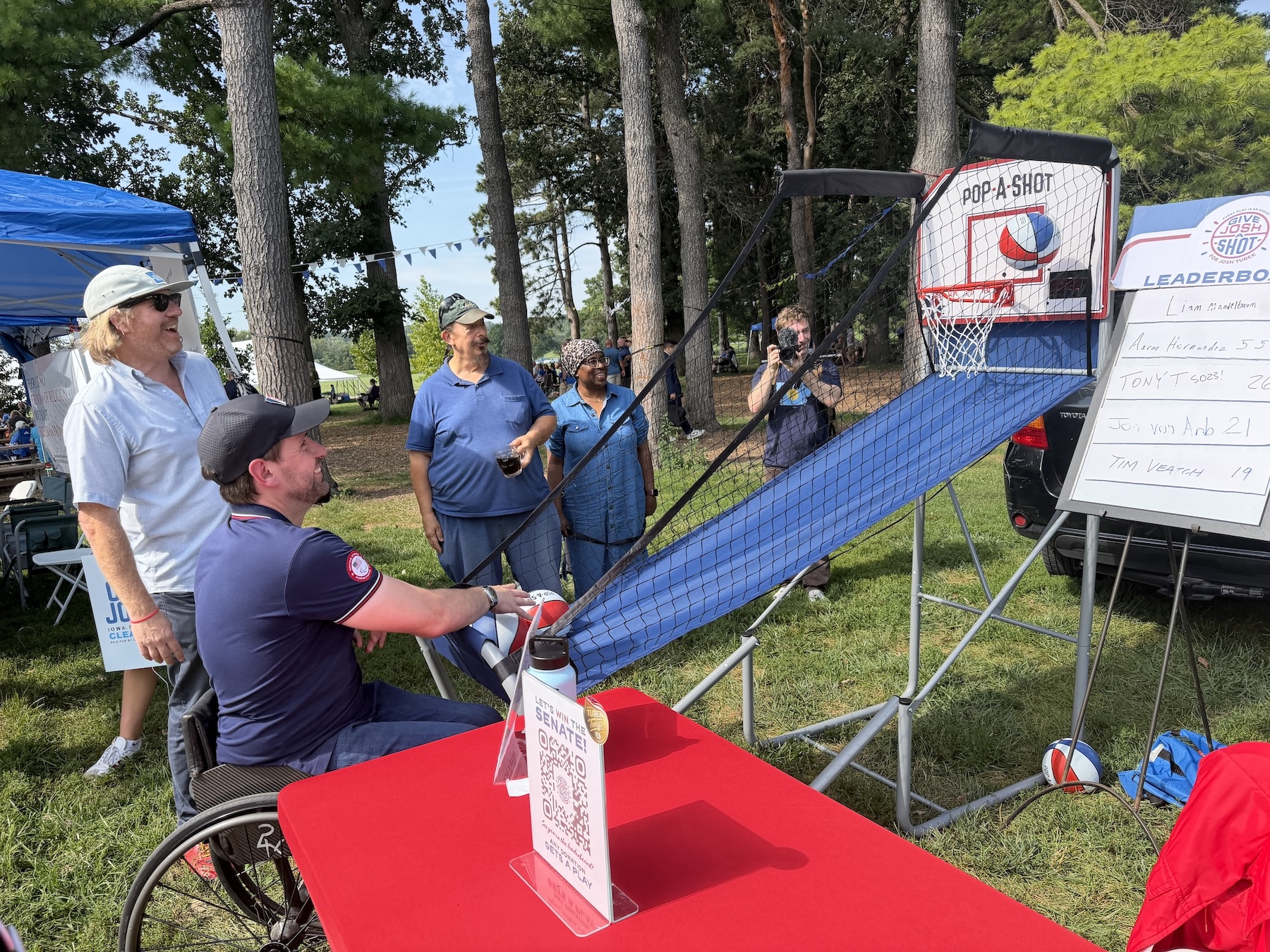
This fall, my wife Ruth and I attended a meet and greet fundraiser for State Representative Josh Turek “4” Iowa. Four was Josh’s jersey number as an elite athlete and member of the Men’s Paralympic Wheelchair Basketball Team. He’s now seeking the Democratic nomination for U.S. Senate. (Marine veteran Nathan Sage and State Senator Zach Wahls are the other Democratic contenders.)

It was also important to me as a person of disability and my wife to attend. I wanted to personally meet this former professional wheelchair basketball player, disability advocate, and Iowa House member from Council Bluffs.

Continue Reading...

Miller-Meeks no longer registered to vote in IA-01

Sarah Watson had the scoop for the Quad-City Times: U.S. Representative Mariannette Miller-Meeks no longer officially lives in Scott County, or anywhere in Iowa’s first Congressional district. In July 2025, she changed her voter registration back to the Ottumwa home she shares with her husband.

Aspiring candidates and campaign strategists could learn a lot from how Miller-Meeks has handled questions surrounding her residency over the past four years. It’s hard to believe an experienced politician could botch this issue so badly.

Continue Reading...

Understanding the structural pressures that will shape Iowa from 2026 to 2050

Wayne Ford is the executive director of Wayne Ford Equity Impact Institute and co-Director of the Brown and Black Forums of America. He is a former member of the Iowa legislature and the founder and former executive director of Urban Dreams.

INTRODUCTION: A STATE IN TRANSITION

For nearly half a century, Iowans have approached our future with optimism, hard work, and a deep commitment to community. But as we enter the next 25 years—from 2026 through 2050—the forces shaping Iowa are fundamentally different from anything in our past. These forces are structural, interconnected, and accelerating. They affect every sector of our society: our schools, our health care systems, our farmland, our water, our workforce, our economy, and the very makeup of our communities.

For decades, states like Iowa have relied on annual budgeting to shape priorities. But a one-year budget cannot capture pressures that unfold over decades. Nor can it measure the true economic cost of challenges such as rural hospital closures, workforce shortages, mental health crises, water contamination, demographic decline, artificial intelligence, or the shifting global market for agriculture.

To prepare for the next generation, Iowa must adopt a broader lens—one that helps leaders understand where the state is headed, not only where the budget is today.

Continue Reading...

Banning books is dangerous

Bruce Lear lives in Sioux City and has been connected to Iowa’s public schools for 38 years. He taught for eleven years and represented educators as an Iowa State Education Association regional director for 27 years until retiring. He can be reached at BruceLear2419@gmail.com 

There’s a scene in the 1974 movie Longest Yard, which I’ve always remembered. The prison warden forces Burt Reynolds, an incarcerated former professional football player, to organize a football team to play the guards.

In the huddle, Reynolds tells the offensive line to let a hated guard through. As the guard blitzes, the line parts and Reynolds hurls a pass into the guard’s groin.

The prisoners huddle, and Reynolds calls the same play: “Let’s do it again.” They do. The guard leaves the game in agony clutching his groin. 

Republican State Representative Skyler Wheeler, who chairs the House Education Committee, is signaling he may call the same play during the next Iowa legislative session that was called this year.

Continue Reading...
How Democrats can win the Iowa secretary of agriculture race

Matt Russell is a farmer, political writer, and progressive ag and rural leader. He has published work in the New York Times, TIME, AgInsider, Civil Eats, and many state and local publications. He co-owns Coyote Run Farm with his husband Patrick Standley in rural Lacona, Iowa. A version of this essay first appeared on his Substack newsletter, Growing New Leaders: Perspectives from Coyote Run Farm.

Iowans will have some outstanding Democratic candidates to vote for in 2026. A Democratic candidate for secretary of agriculture is not yet among them, but could be soon.

Chris Jones has announced an exploratory committee and plans to decide whether to run in January. You can read Laura Belin’s interview with him here. Jones, who has a PhD in analytical chemistry, is a longtime advocate for cleaner water. He’s a sharp critic of how the agriculture industry has contributed to the pollution but avoided taking enough (if any) responsibility for dirty water.

Until election day 2024, I had planned to run for Iowa secretary of agriculture in 2026. My plan was to stay in my appointment at USDA with the Biden-Harris Administration until this fall. I’d hoped Christina Bohannan would win in Iowa’s first Congressional district, and as only one or two Democratic members of the Iowa delegation, I’d work with her to identify a great candidate to offer to the Harris-Walz Administration to be the next State Executive Director of the Iowa Farm Service Agency.

Continue Reading...

Miller-Meeks touts praise from Trump in taxpayer-funded ads

“Good job you did! Great job,” President Donald Trump says to U.S. Representative Mariannette Miller-Meeks in a 30-second commercial that has reached thousands of Iowans on the radio or social media platforms over the past month.

The three-term Republican did not place the ads through her campaign committee, which had accumulated more than $2.6 million cash on hand as of September 30.

Instead, Miller-Meeks—considered one of the country’s most vulnerable House Republicans—has used taxpayer funds to share Trump’s praise with Iowans.

Bleeding Heartland’s review of data from Facebook’s ad library and Federal Communications Commission files suggest that Miller-Meeks’ Congressional office has spent at least $10,000 to run this spot. (Several other taxpayer-funded radio ads have also been in rotation this fall.)

If the 2024 campaign is any indication, Miller-Meeks may spend much more from her Congressional office budget in the coming months, as she seeks to shore up her appeal with conservatives before another competitive primary election in Iowa’s first district.

Continue Reading...
Iowa helping Trump administration build national citizen registry

Ed Tibbetts, a longtime reporter and editor in the Quad-Cities, is the publisher of the Along the Mississippi newsletter, where this article first appeared. Find more of his work at edtibbetts.substack.com.

Attorney General Brenna Bird buried the news. I can understand why.

No self-respecting right-winger would want to be seen backing a centralized citizen registry in Washington, DC.

For as long as I can remember, conservatives were in the vanguard of opposing such big government excesses. Yet, here is Iowa’s attorney general—along with Secretary of State Paul Pate—actually helping to build what some critics are likening to a super database for Big Brother.

Continue Reading...

Politicians do nothing as Social Security cliff approaches

Rick Morain is the former publisher and owner of the Jefferson Herald, for which he writes a regular column. This essay first appeared on Substack.

What will you be doing in the year 2033?

If you’ll still be younger than 67 years of age, there are innumerable answers. But if you’re 67 or older by then, chances are the number one item on your mind will be how in heaven’s name you’re going to make ends meet.

That’s because 2033 is now the year the Social Security and Medicare trustees calculate the trust fund will go bust. Incoming revenues will drop below what the fund needs to make its payouts.

Continue Reading...

Why Sarah Trone Garriott is the right choice to win back IA-03

Peggy Huppert is a retired nonprofit executive who has been active in Democratic politics as a volunteer for campaigns ranging from school board to President since 1984.

As Democrats in Iowa’s third Congressional district, we all share the same goal in 2026: defeating U.S. Representative Zach Nunn and flipping this seat so we can put a real check on the chaos in Washington. That’s why the independent Change Research poll, conducted in late October, should be a wake-up call and a roadmap.

That poll found State Senator Sarah Trone Garriott leads Zach Nunn 53 percent to 40 percent in a general election matchup. That’s not a moral victory or a tie. That’s a clear, solid lead against an incumbent in one of the most competitive districts in the country.

Even more important is who the poll finds is putting Sarah ahead.

Continue Reading...

Liberty for one drug lord, death sentences for others

Randy Evans is executive director of the Iowa Freedom of Information Council, a nonpartisan, nonprofit organization that promotes openness and transparency in Iowa’s state and local governments. He can be reached at DMRevans2810@gmail.com. This essay first appeared on his Substack newsletter, Stray Thoughts

There seems to be a lack of consistency—if not outright contradictions—in President Donald Trump’s approach to drug trafficking into the United States.

Recent news headlines bear out the disconnect between what the president says and what he does.

One thing is certain: Donald Trump’s mixed messaging illustrates our nation’s lack of a coherent federal strategy for dealing with the scourge of illicit drugs.

See what you think about these questions of death and liberty.

Continue Reading...

Public school teachers' plates are overflowing

Bruce Lear lives in Sioux City and has been connected to Iowa’s public schools for 38 years. He taught for eleven years and represented educators as an Iowa State Education Association regional director for 27 years until retiring. He can be reached at BruceLear2419@gmail.com 

We’ve probably all seen Mr. Overflowing Plate in the buffet line. He can’t make a choice, so he chooses everything. As he returns to his table, he leaves a trail of onion rings, and pizza slices in his wake. His plate is too small, and his appetite too big. 

Now, imagine that overflowing plate is filled with items he didn’t choose, and even dislikes—while those in the buffet line hurl insults and second-guess the forced choices tumbling from his plate.

The plates of public school teachers are overflowing. It’s causing serious heartburn, leading to burnout.

Continue Reading...

Talking turkey: Healthy Kids Iowa fed fewer kids than Summer EBT

Chuck Isenhart is an investigative reporter, photographer, and recovering Iowa state legislator offering research, analysis, education, and public affairs advocacy at his Substack newsletter Iowa Public Policy Dude, where this essay first appeared.

Thanksgiving is one day in the year that no one in the United States should go hungry. Ya think? If you don’t agree with that, you probably are not reading this post.

While Iowa’s Governor Kim Reynolds pardoned Tailfeathers and Wing-ding the turkeys this week, it’s worth noting that she and others in the majority party who consent to her schemes don’t mind depriving people of food access other times of year.

No, I am not related to Debbie Downer, who spoiled Thanksgiving dinner. However, now that I have gathered some evidence, this holiday seems an appropriate time to point out that the governor’s Healthy Kids Iowa summer food “pilot” program for school children did exactly that—deprived kids of food.

Continue Reading...

School district owes explanation for this goodbye gift

Randy Evans is executive director of the Iowa Freedom of Information Council, a nonpartisan, nonprofit organization that promotes openness and transparency in Iowa’s state and local governments. He can be reached at DMRevans2810@gmail.com. This essay first appeared on his Substack newsletter, Stray Thoughts

While the text of the Iowa Constitution lacks the prominence of that adopted by our nation’s Founders, people from Ackley to Zwingle and points in between should track down a copy and give it a read. 

Buried away in the document Iowa voters adopted in 1857, they will find Article III, Section 31, or what has come to be known as the public purpose requirement. That section says, in essence, that state and local governments are barred from spending public money unless there is a public purpose for those expenditures.

My public-school education tells me that section prohibits the use of taxpayer money to continue to pay someone for work after their performance ends unless the government entity provides justification of the public purpose served by those payments.

Where I come from, going-away gifts do not serve a public purpose. And this brings me to the Des Moines Public Schools and recent news headlines.

Continue Reading...
Page 1 Page 2 Page 3 Page 232