
Bruce Lear lives in Sioux City and has been connected to Iowa’s public schools for 38 years. He taught for eleven years and represented educators as an Iowa State Education Association regional director for 27 years until retiring. He can be reached at BruceLear2419@gmail.com
A few years ago, we visited Northern Ireland. During our trip, we repeatedly heard the Biblical phrase “The time of trouble,” describing the Protestants/Catholic war. This descriptor needed little elaboration, because those who said it lived it.
While our last couple snowbird months in Florida this year don’t compare to 30 years of brutal violence, they did introduce us to the seventh circle of Hell: health care and insurance coverage in the U.S.
It was “Our time of trouble.”
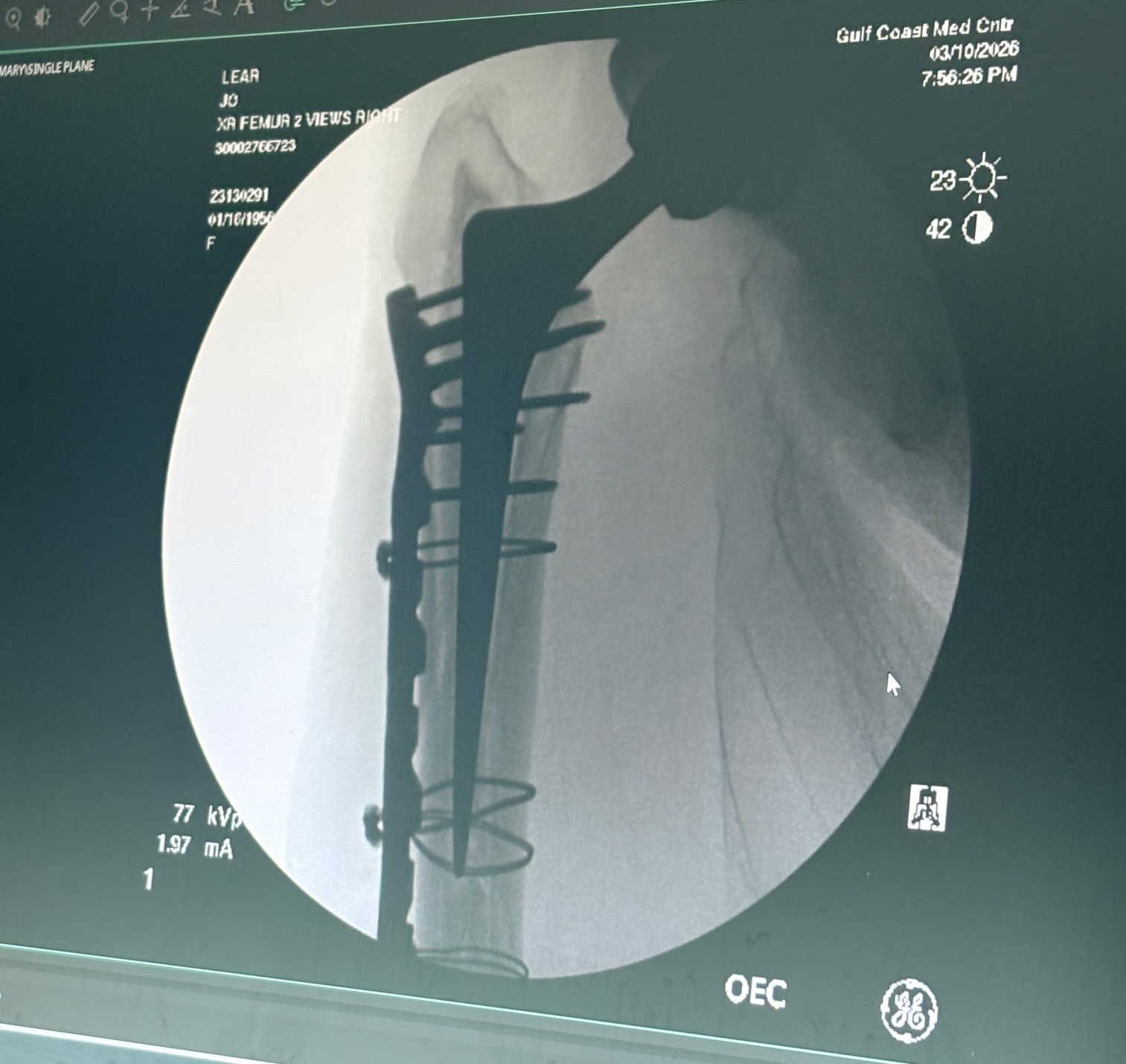
It began March 9, on a sun-drenched pickleball court in Bonita Springs, Florida. My wife Jo always said, “I’ll never play pickleball. After all, I have two artificial hips and I’m 70.” But a kind pickleball-evangelist persuaded her to pick up a racket to take one lesson. It was a painful one. It resulted in a shattered femur, a painful ambulance ride, 49 staples, 24 days in the hospital and rehab, with no weight bearing for six weeks on her right leg.
The ambulance took her to a major trauma hospital, and she joined 149 other emergencies waiting in the ER. After x-rays, we were crammed into hall space. Eventually a young female doctor rushed by with x-rays and announced, “You have a bad break.” Since a leg should never be at that weird of an angle, we didn’t really need MD confirmation.
We thought a bad break might mean a good room. It didn’t. But every time we felt sorry for ourselves, we looked around at the other 149 souls worse off and waiting in pain.
It’s no secret the South is invaded by thousands of Yankees looking to escape snow and cold from December to May. That means Florida is even older than Iowa. A trauma hospital is a magnet for old people accidents.
Seven and a half hours later, we finally got a room. We were told Jo’s surgery would be early the next morning. But morning morphed into 6:20 at night after we waited in pre-op for three and a half hours.
The hospital personnel were true professionals, but the American health care system is in critical condition. Urban hospitals are overcrowded, understaffed, with medical care dictated by insurance companies. Rural hospitals are smaller but still tangled in the same bureaucracy where survival is difficult.
Doctors recommended a care center for rehabilitation after dismissal from the hospital. Finding a bed was a challenge. Getting insurance to authorize care was an even bigger one. After the hospital said she was good to go, it took another four days for insurance to give the nod.
Once we arrived at the care center, the next challenge was getting to stay. Even though insurance covers up to 20 days, it forces you to appeal its arbitrary decision to stop coverage after seven days. We did. We won with two key pieces of evidence: the 49 staples and a non-weight bearing right leg.
Jo had an appointment with the orthopedic surgeon’s office so he could remove the staples. A few hours before the appointment, the office called and said we needed pre-authorization from her primary physician in Sioux City because her insurance is an HMO. It isn’t, except in Florida. After several loud phone conversations, insurance finally called the doctor and cleared it up.
Unfortunately, “Our time of trouble” is not unique. Millions of Americans are trapped between insurance and health care. But we were fortunate. We had Medicare, a Medicare Advantage plan, and a caring insurance agent.
Unaffordable health care and too costly insurance coverage is a crisis and will continue to be “America’s time of trouble” until politicians find a lasting bipartisan solution. Other countries have found a fix. The U.S. can too, if voters hold our leaders accountable.
2 Comments
Thanks
for the article. I imagine the scenario you described is repeated numerous times a day all over the country. I have friends battling cancer who have fought (and still are fighting) with insurance about care and recovery. It is a sad situation and our representatives in Congress (and in Des Moines), are more concerned with fighting culture wars.
bodacious Sat 18 Apr 9:02 AM
Sympathies to both of you, Bruce...
…and ouch ouch ouch, that photo is painful even to see.
PrairieFan Sun 19 Apr 2:16 PM