

It’s that time of year: days are getting longer, the weather is getting warmer, and transparency advocates are celebrating open government and freedom of information.
To mark Sunshine Week, I decided to examine how open the Iowa House and Senate are to the public and the news media. I’ll compare how each chamber handles access to proceedings, with some tips on how to follow meetings or debates at every stage of the process.
While the internet has generally made it easier to track the legislature’s work, there’s room to let much more sunshine in. The House and Senate have each adopted some practices the other should follow, and could take inspiration from other states to get Iowans more engaged with lawmakers’ work.
Exempt from Iowa’s sunshine laws
We need to start with the big picture: Iowa’s “sunshine laws” do not apply to the legislature.
The open meetings law (Iowa Code Chapter 21) defines “governmental body” in a way that excludes the legislative branch.
So while many legislative proceedings are open to the public, neither the press nor ordinary Iowans can attend the “caucus” meetings where the most important deliberations happen. Those are the conversations that sometimes keep House or Senate leaders from calling up a bill that was on the tentative debate calendar. Who tanked the bill? What were their objections? That’s not public information.
On its face, the open records law (Iowa Code Chapter 22) defines “government body” in a way that would seem to include the legislature. However, the Iowa Supreme Court ruled in a 1996 case called Dwyer that the Iowa Senate could withhold phone records requested by the Des Moines Register. The majority opinion cited “the constitutionally-granted power of the senate to determine its rules of proceedings.”
I believe the three dissenting justices in Dwyer had the better argument: “Once a statute is lawfully enacted, all; members of society, even legislators, must comply with its provisions. The General Assembly should be required to abide by Iowa Code chapter 22.” Sad to say, that’s not the world we live in.
Legislators can choose to provide records when it suits their purposes. For example, on March 19 Iowa House Republicans released a letter from Wellmark Blue Cross and Blue Shield bashing a proposed Democratic amendment to a bill on health insurance provider taxes.
But you can’t file a public records request seeking all of Wellmark’s recent communications with Iowa House Republicans, the way you could use the open records law to obtain the company’s communications with the governor’s office or executive branch agencies about the same bill.
An informative—but not always user-friendly—website
Even without the benefit of sunshine laws, Iowans can learn a lot about what their state representatives and senators are doing.
The Iowa legislature’s official website contains a ton of information about individual lawmakers, bills or resolutions, floor proceedings, roll call votes, meeting schedules, committee materials, and lobbyists. Finding what you need can be challenging, though.
It’s worth checking out video tutorials created by the Iowa Legislative Services Agency and Drake University Law Library; those are linked here. The ACLU of Iowa has made their own video tutorials to help navigate the site as well.
Access for the media: Advantage House
Any Iowan can come to the capitol to watch legislators at work, but chamber rules give a few extra privileges to journalists.
When space is limited for an important subcommittee meeting or public hearing, reporters are usually able to stand in the crowded room to cover the event. People not working for a news organization may be asked to leave if there’s no seat available. Being there in person is better than listening remotely; journalists can take pictures and recordings, and they may have a chance to speak to legislators after the meeting.
For more than a century, regardless of which party controlled the Iowa legislature, credentialed journalists were able to work from press benches on the House or Senate floor. That access allowed reporters to take better photos or videos, get to know lawmakers, and ask clarifying questions while the chamber was at ease.
The House and Senate closed the benches to reporters in the spring of 2020 and kept them off-limits throughout the 2021 session, citing the COVID-19 pandemic—even though they didn’t require social distancing or masks anywhere in the building.
After entreaties from the Iowa Capitol Press Association, the House allowed some reporters to return, beginning in January 2022. But the Senate never reopened the press bench for its original purpose.
Instead, Senate staff created media workspace (a few tables and electrical outlets) high up in the public galleries on either side of the chamber. The view is obstructed, so you can’t easily communicate with senators or capture high-quality images. In addition, the media desks are not a safe place to leave equipment if you need to step away. Hot or cold air is frequently blasting above where reporters are trying to work.
Democratic leaders in both the House and Senate make themselves available to the press every week. But senior House Republicans are much more accessible to the media than their counterparts in the other chamber.
House Speaker Pat Grassley takes questions from journalists most weeks, usually on Thursdays. Since I obtained credentials in the House, I’ve tried to record these “gaggles” and have uploaded many of them to Bleeding Heartland’s YouTube channel.
Opportunities to question Senate GOP leaders have been rare the last few years. However, that may be changing: Majority Leader Mike Klimesh, who became the top-ranking Senate Republican last September, took media questions on a wide range of topics as the legislature’s “funnel” deadlines approached in February and March of this year. Klimesh also called a handful of press conferences to focus on specific bills (such as property taxes or CO2 pipelines) earlier in the 2026 session.
Watching floor debate: Tilt Senate
Most Iowans can’t attend legislative debates in person. Fortunately, both chambers film floor proceedings and archive the videos online. From the main page of the legislative website, click the “Senate/House” tab to find the live feed or pull up a past recording. Closed captioning is an option.
Readers have periodically asked if there’s a way to search archived video for certain topics or keywords. Not that I know of, unfortunately.
There is a workaround if you know the bill number. For instance, House File 2542 is the criminal sentencing bill that would establish a modified “three strikes” system for repeat offenders. Go to that bill page and click “bill history” near the left side of the screen. Here’s part of what you will find:

You can see the House approved the bill on March 4. Clicking on the word “video” in blue will take you to the page with the archived footage from that day, cued up to the beginning of debate on House File 2542. Just click play.
Both chambers stream and archive audio recordings of floor debate as well as video. In my experience, the Senate audio doesn’t play in every browser, and sometimes doesn’t play at all. The House audio files have been less glitchy for me. I still prefer video because it’s easier to skip to the footage I need, using links from “bill history” pages.
For online viewers, House and Senate debates are equally accessible about 99 percent of the time. I do appreciate a couple of Senate practices. When senators are voting, the camera typically stays on the board that shows who is a yes or no. It looks like this:
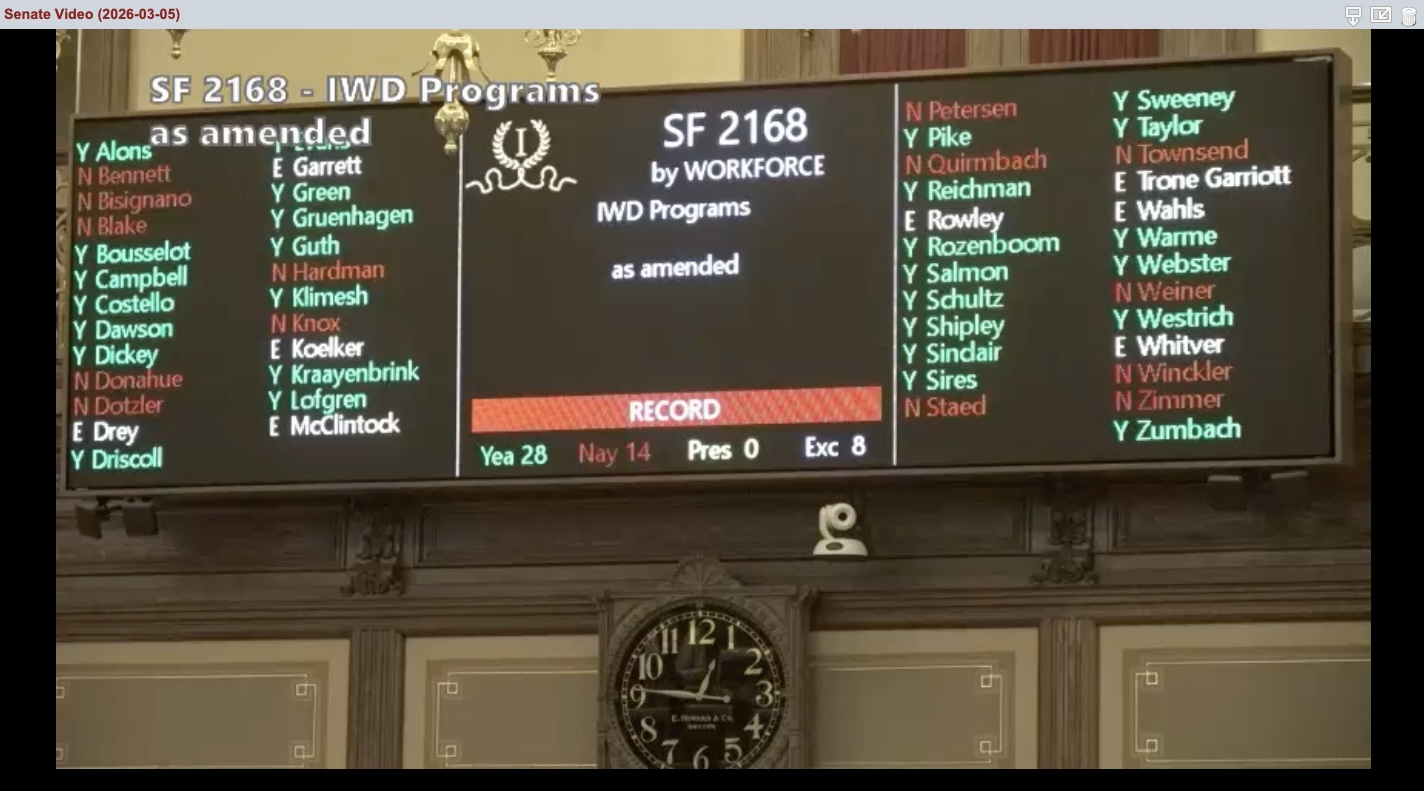
When House members are voting, the video shows the totals for and against, not the board with legislators’ names. Here’s how it looked for the “three strikes” sentencing bill. You can find the roll calls later, but it would be nice to see the names in red or green, in real time.

Another thing I prefer about the Senate: the camera stays on lawmakers giving a point of personal privilege, so you can see the speaker as well as hear their voice.
The House used to show points of privilege that way; here’s an example from 2020. But in recent years, House leaders have instructed the camera operator to pull back to a wide view when someone is giving a point. Whether the representative is speaking about an issue or paying tribute to a former colleague, here’s all you can see during every point of personal privilege.
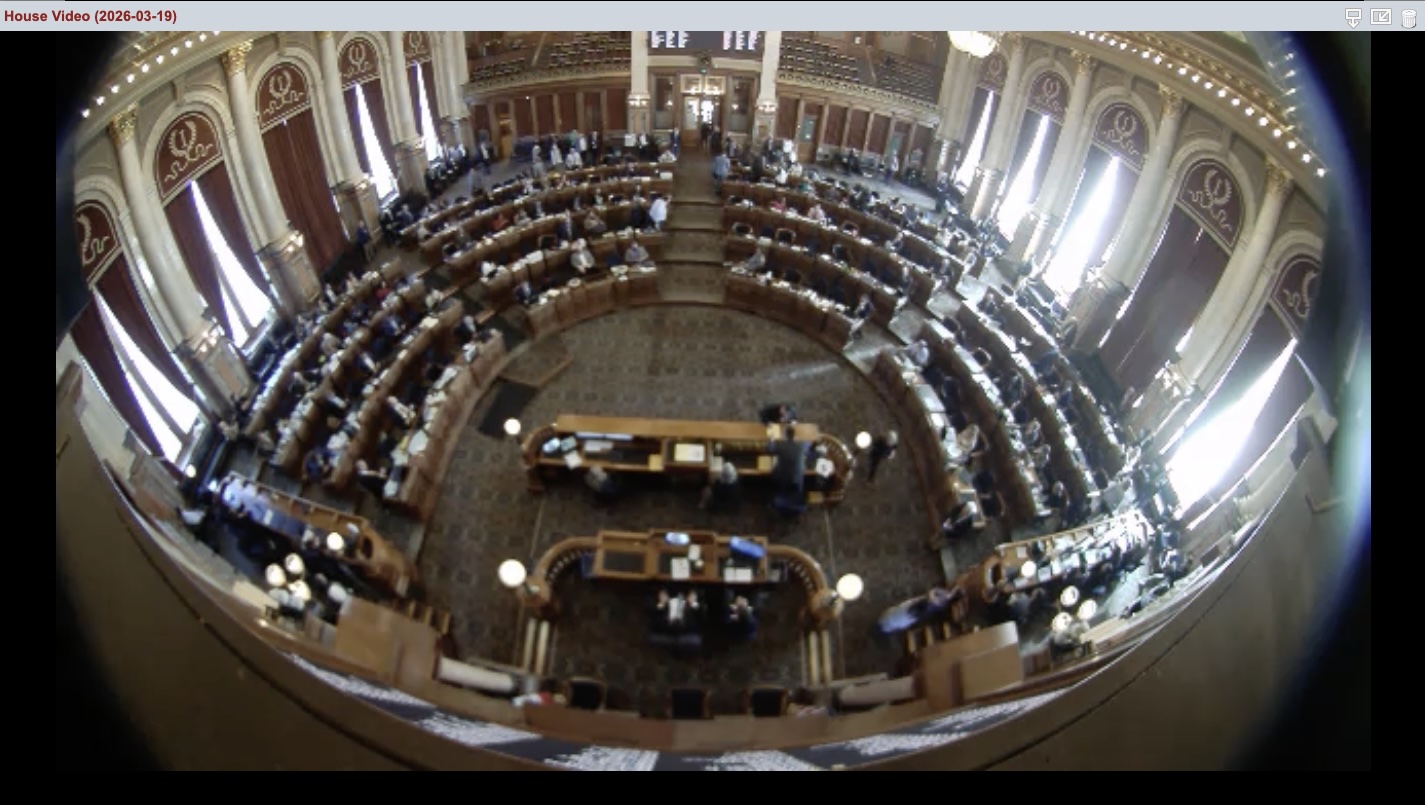
At one of the House speaker’s gaggles in January, I asked Grassley why the camera doesn’t stay on members during points of privilege. He said Republicans have tried to avoid letting floor speeches become a “campaign-style” platform for people who may be considering running for higher office.
It didn’t make sense to me, since representatives can score political points on camera when speaking about bills or amendments during regular floor debate. Or, House Democrats could ask a clerk or colleague to film them giving a point and upload that video to social media, instead of using the official feed.
Archived roll call votes: Advantage House
If you want to know which lawmakers voted for or against certain bills, the legislative website provides a couple of options. You can find the roll call in the House or Senate Journal, if you know which day they debated the measure. From the main page, click the “Legislation” tab, and from that page click on “Senate & House Journals,” near the left.
Alternatively, from the “Legislation” page, click on “Find Legislation” near the left, then “Floor Votes on Bills.” From there you can search for the roll call on a specific bill, or scroll down from the most recent votes to older ones.
I prefer the way the House presents these roll calls, because the pages show each legislator’s party affiliation as well as their surname. Here’s the House roll call for the 2024 bill overhauling Area Education Agencies. Despite the small font, it’s easy to see which nine Republicans crossed the aisle to vote against the bill.

Here’s the Senate roll call on the final version of the same bill.

You can figure out which of the no votes came from Republicans, checking their party affiliation on another page if needed, but that’s an extra step.
Standing committee meetings: Advantage Senate
Space permitting, members of the public or the media can attend any Iowa House or Senate committee meeting in person. You can also tune in remotely to watch live, using WebEx for House panels and this page for Senate committees.
But what if several newsworthy meetings are happening at the same time? Here is the House committee schedule for last week, when there was a rush to advance bills in time for the second “funnel” deadline:

Through the committees page or the schedules page, I can check the agendas to see which bills may be discussed. I may get lucky and be able to attend one committee meeting while representatives on a different panel (scheduled for the same block) are still in caucus. More often than not, I have to choose one or the other and end up missing discussions of important bills.
The House doesn’t archive committee meetings, so if you can’t tune in live, it’s gone. I have heard from readers who were frustrated because they took a break from work, logged into WebEx at the scheduled start time, and ended up stuck in the waiting room while committee members caucused for an hour or more. By the time the meeting convened, they had to get back to work.
The House Journals publish bare bones information about which bills a committee considered and how each member voted. But that’s no substitute for listening to the discussion and hearing the concerns or recommended changes.
The Senate has a better way. All committee meetings are recorded. After the meeting has ended, staff upload the video. You can find it by going to the schedule for that day and clicking the camera icon.

That will take you to a page that looks like this. You can watch through your browser or download the video. It’s common for the parties to be in caucus for a long time, so skip ahead to find the committee discussion.

The House could do something similar. They have cameras in every committee room for live-streaming through WebEx. Staff could upload those videos to an accessible page. Our neighbors to the north have archived decades of Minnesota legislative proceedings.
One other change would enhance the transparency of House and Senate committees. Currently, amendments proposed or adopted at committee meetings are not available online. Clearly those documents exist in digital format. They should be linked on the committee page or in the minutes for the relevant meeting.
Ordinary subcommittee meetings: Advantage Senate
Neither the House nor the Senate archives subcommittee meetings. If you can’t attend in person or watch online in real time, you missed it. When subcommittees on several major bills are scheduled at the same time, you’re out of luck. Since all subcommittees are live-streamed, it shouldn’t be difficult to post the recordings on the legislative website later.
Another problem: both chambers sometimes schedule subcommittees with little notice. It used to be the norm to wait at least 24 hours before holding a subcommittee on a bill. But chamber rules don’t require 24 hours. Occasionally—especially with a controversial bill—the bill will be published one afternoon, and a subcommittee scheduled early the next morning. It’s worth checking the following day’s schedule in the evening, even if you already reviewed it during the afternoon.
Iowans can use WebEx to watch House subcommittees live, but no one viewing online can testify. The only option for those who want to speak for or against the bill is to come to the capitol. That’s not always feasible.
The Senate allows remote participation in subcommittee meetings via Zoom, and people online can comment on the bill after everyone in the room has weighed in. Many times I’ve heard experts from other parts of Iowa (or from other states) give valuable perspective to senators.
Last year, I asked Speaker Grassley whether House leaders would ever consider allowing people to testify remotely at subcommittees, as the Senate does. He touted the “huge technological advancements” Republicans have made since they gained control of the House in 2011.
At the same time, Grassley added, “I think it’s important for us to be here in the building to be a part of the process.” He said he supports “utilizing technology to keep Iowans informed, but also making sure that we maintain the integrity of the process.”
I don’t see how it compromises the process to give people with expertise a voice. Not everyone can spend half a day or more going to and from the statehouse for a subcommittee meeting.
Budget subcommittee meetings: Advantage House
For approximately 50 years, regardless of party control, Iowa House and Senate members convened joint appropriations subcommittees. Many former lawmakers from both parties have told me they learned a tremendous amount about state government operations as agency leaders came to present their funding requests. Another plus: the joint meetings helped members of the House and Senate reach consensus on spending targets earlier in the session.
Senate Republicans stopped participating in the joint subcommittees in 2021. The pandemic was the pretext, but the policy change was never about social distancing. Senate leaders continued to assign members to the appropriations subcommittees, but most of them haven’t met publicly in years. Instead, the subcommittee heads have private conversations with stakeholders about their area of the budget.
Only a small number of GOP senators were serving in the legislature before 2020, so most of the majority caucus doesn’t even know what they’re missing.
The House continues to hold regular budget subcommittee meetings. Documents submitted by agencies are available online, so anyone can download the slides supporting the various department budget requests (a few examples: the Iowa Judicial Branch, Iowa Attorney General’s office, and the Department of Homeland Security and Emergency Management). But you learn more by watching a meeting and hearing the lawmakers question agency leaders.
I’ve appreciated the transparency of the House budget subcommittee meetings and have posted a few of the videos on YouTube. But since I can’t be in three or four places at once, I have to choose: Justice Systems, Health and Human Services, or Education?
If the House archived those recordings, any Iowan would be able to log in and learn more about their own government.
In the comments section, please share your own tips, observations, and suggestions for improving public access to Iowa legislative happenings.
2 Comments
thanks for the overview
Grassley is a master at non-answer answers and I appreciate you noting his bs
“Grassley added, “I think it’s important for us to be here in the building to be a part of the process.” He said he supports “utilizing technology to keep Iowans informed, but also making sure that we maintain the integrity of the process.”
I don’t see how it compromises the process to give people with expertise a voice. Not everyone can spend half a day or more going to and from the statehouse for a subcommittee meeting.”
Always pained to hear some reporters talk about him as a relative moderate, confusing his tone/manner for his agenda.
dirkiniowacity Sun 22 Mar 4:42 PM
"The integrity of the process." Riiiiight.
Given what has happened to the “process” in the Iowa Statehouse during the last ten years, that quote deserves an eyeroll emoji.
PrairieFan Sun 22 Mar 11:21 PM