
Adam Shriver is Director of Wellness and Nutrition at the Harkin Institute for Public Policy and Citizen Engagement. This essay was first published on his Substack newsletter, Canary in a Cornfield.
Earlier in the year, I wrote a response to some of Republican State Senator Ken Rozenboom’s comments in the Senate Agriculture Committee where he made some interesting claims based on his recent trip to the Netherlands. I pointed out that, contrary to his claims, nitrates have been a very serious issue in the Netherlands for decades and that the European Union had a different way of representing nitrate concentration in water, which was the only plausible explanation I could think of for his claim that nitrates levels in Amsterdam were far higher than what we saw in Iowa last summer.
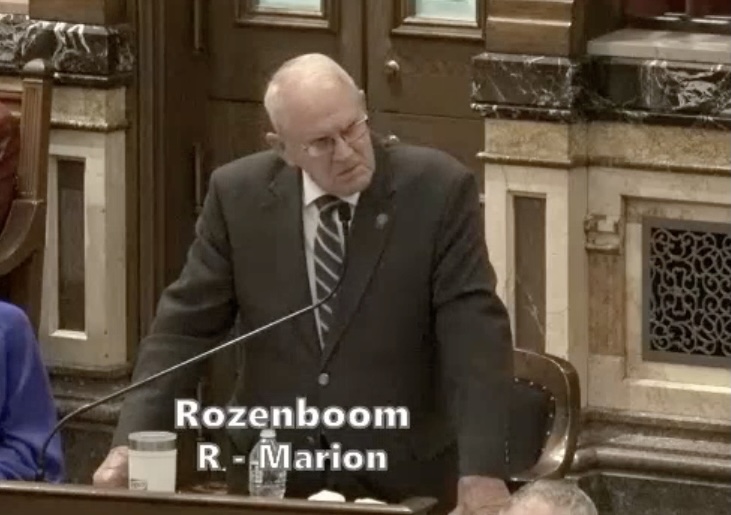
On April 1, Rozenboom delivered some remarks on the Senate floor that indicated more confusion about the science around nitrates. (He may have been triggered by Democratic State Senator Janet Petersen’s comments the previous day; she asked Rozenboom if a bill allowing boats to display blue lights would be the water safety bill the Senate will consider this year.)
Rozenboom claimed the connection between nitrates and cancer is a “myth,” suggested Republicans had been making great progress on Iowa’s water problems since 2017, and said that if you are really worried about nitrates, you should look at the amount of nitrates in spinach.
You can find the full video of his comments and the responses at this link but I’ve pulled out the relevant sections. Here’s the first relevant clip:
Regarding the claim that the connection between nitrates and cancer is a “myth,” I would encourage people to read the recently released report from the Iowa Environmental Council and the Harkin Institute on Environmental Risk Factors And Iowa’s Cancer Crisis, particularly section 3, which meticulously documents numerous studies showing a connection between nitrates in drinking water and higher cancer risks.
Of course, I also have to suggest listening to my interview with Professor Thor Halderson, who chaired the scientific committee for the Denmark Ministry of the Environment. That committee recommended lowering Denmark’s nitrate standards (which are similar to ours) by a factor of 10 because of the risk of colorectal cancers. Professor Halderson does a wonderful job describing their methodology and why the committee gave particular credence to a study that looked at more than 1.2 million people, with very precise numbers for nitrate levels in the water.
Rozenboom cited the amount of money spent by the government as the primary evidence for how much progress is supposedly being made on the issue. That seems to be the norm for the current leadership in the Iowa legislature.
However, as Harkin Institute Senior Fellow John Norris pointed out in our recent report, the approach where “current policies measure success by how much money is spent on deployment of edge-of-field practices, not by clean water achieved” is not working when you look at the actual water quality in Iowa. As Norris writes, we need to switch to an approach where we “measure actual water quality outcomes, not just program participation.”
In fairness, Rozenboom did cite some additional statistics about cover crops, saturated buffers, and wetlands. However, those statistics can be misleading, since recent studies have found that, “of more than 3,200 Iowa farmers surveyed, about 20 percent who planted cover crops abandoned the practice a few years after adoption” and that “only 6.6 percent of cover crop users plant them consistently; nearly 30 percent are ‘intermittent adopters.’”
Measuring positive field practices and land use changes is great, but we also need to pay attention to changes in the other direction! So the extent to which these policies can be counted as unambiguous “wins” seems to be an open question.
Regardless, the central point remains: Iowa’s water quality problems are getting worse, not better, as the Central Iowa Source Water Resource Assessment Report showed. If current leadership want to claim that we’re living in their version of utopia, that’s their right, but they shouldn’t be surprised if not many Iowans choose to follow them.
And finally, the most jaw-dropping claim Rozenboom made was the following:
the last point that’s made here, and this is always rich to me, if you’re concerned about nitrates, I suggest you check out the nitrate levels in spinach […]
The senator was attacking the scientific credentials of medical doctor and State Representative Austin Baeth, an Iowa House Democrat who’s been doing an excellent job explaining the issues on social media. But Rozenboom needs to do a better job looking at the science around nitrates. It’s widely known that nitrates in water have a very different impact than nitrates in fruits and vegetables that we consume, because the latter contain antioxidants that mitigate the effects of the nitrates.
Quoting our report with the Iowa Environmental Council:
Experts believe that the source of nitrate is critical to determining its transformations in the body. When consumed with antioxidants, such as vitamin C found in fruits and vegetables, nitrate is more likely to be converted into beneficial, heart-healthy nitrogen oxides rather than nitrosamines. In contrast, foods high in added nitrates but low in antioxidants, such as cured meat, have a greater potential to form nitrosamines in the body (IARC, 2010; Karwowska & Kononiuk, 2020; Chazelas et al., 2022; Bowles et al., 2024)
If this is the science the current leadership is relying on to set their policies, it seems unlikely that Iowa will be addressing our cancer crisis anytime soon!
But on a more hopeful note, I’ll leave you with these excellent, extremely measured and diplomatic comments from Senator Janet Petersen, who has been very consistent about following the science. More of that please!
Update: Baeth posted a couple of solid responses to Rozenboom’s criticisms on Instagram, including challenging the senator to a public debate!
5 Comments
Senator Ken Rozenboom keeps getting re-elected over and over.
Sympathies to the residents of his district who don’t vote for him and do understand science.
PrairieFan Fri 10 Apr 1:48 AM
Rozenboom is retiring
but can the Democrats win the seat?
Wally Taylor Fri 10 Apr 9:09 AM
No title
Iowa Senate district 19 is a solid red seat–voted for Donald Trump by a two to one margin in 2024. So it’s not realistically within reach. However Democrats do have a solid candidate in Zach Mecham:
https://www.facebook.com/MechamforIowa
Laura Belin Fri 10 Apr 10:02 PM
these people (and their supporters)
aren’t open to debate, don’t care about actual science, and operate out of conspiracy theories and myths on every major issue. Anyone running against them for office here who isn’t pointing that out is part of the problem. They have no good ideas and anytime we have to compromise with them (so it goes in politics sometimes) the results will be worse then they should be.
dirkiniowacity Fri 10 Apr 10:57 AM
This post is a good example of why Iowa needs our environmental NGOs and independent water experts...
…because they are a very important source of hard truths about Iowa water. The edge-of-field practices mentioned above include bioreactors and saturated buffers, which are informally known as “diapers” among some clean-water advocates. Diapers are better for water quality than no diapers. But in spite of glowing Big Ag cropaganda, diapers are absolutely NOT a glorious gold standard for water progress.
PrairieFan Fri 10 Apr 10:15 PM