
Douglas Burns is a fourth-generation Iowa journalist. He is the co-founder of the Western Iowa Journalism Foundation and a member of the Iowa Writers’ Collaborative, where this article first appeared on The Iowa Mercury newsletter. His family operated the Carroll Times Herald for 93 years in Carroll, Iowa where Burns resides.
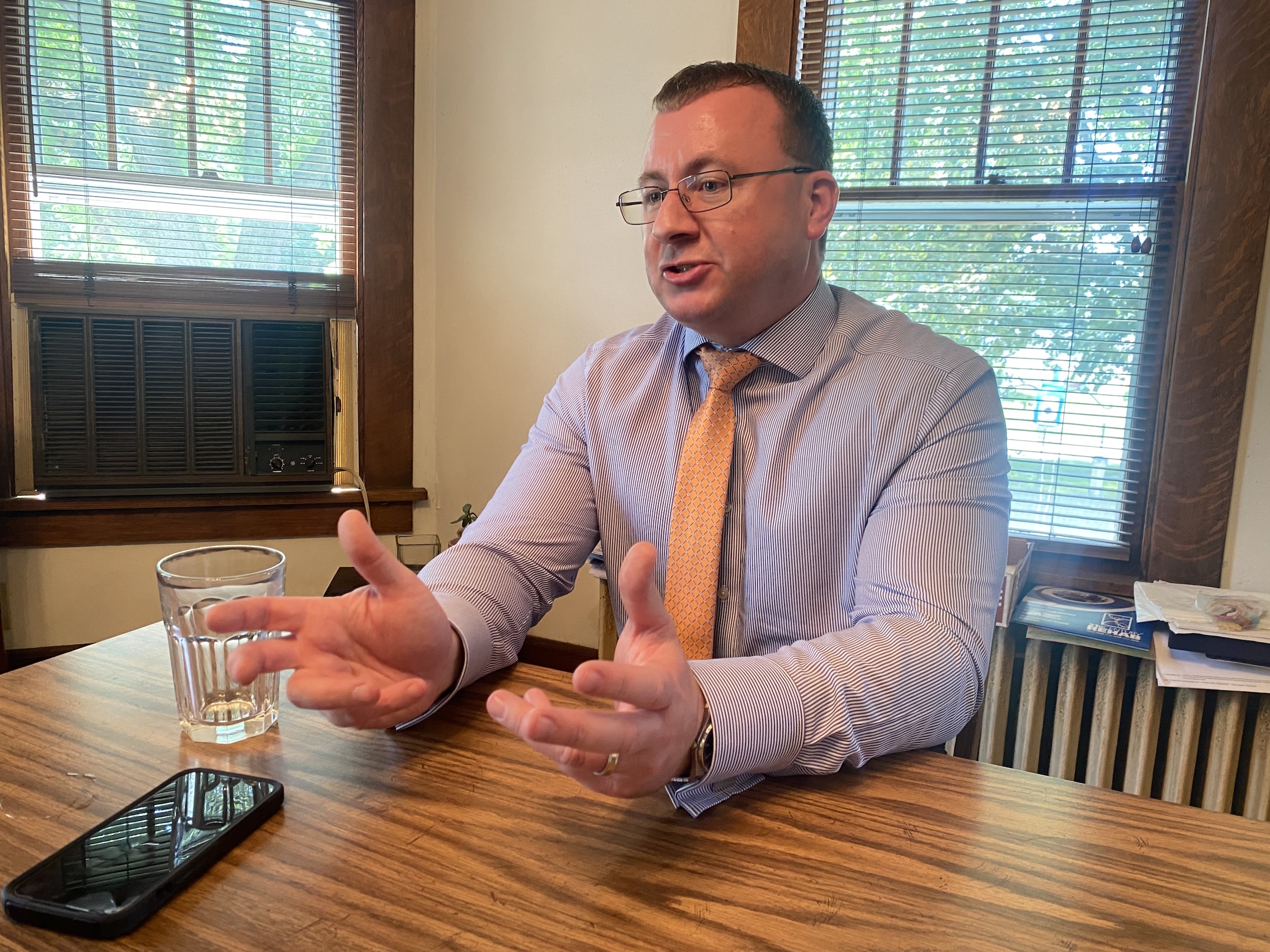
Greene County Attorney Thomas Laehn, the only Libertarian Party candidate ever elected in a partisan contest in Iowa, intends to use the Constitution to break the Democrat-Republican stranglehold on the nation’s government in his race for the U.S. Senate, he said in a wide-ranging, hour-long interview last week in Jefferson.
Laehn, who says the American Republic is now an elective monarchy with oligarchic influences, is a fierce critic of the government use of eminent domain for private-interest carbon-capture pipelines. He thinks abortion should be decided fully at the state level, although Laehn describes himself as “radically” anti-abortion, who if elected at the state level, would support a total abortion ban.
He supports decriminalization of marijuana possession and use, which he says is the first bill he’d introduce in the Senate.
Laehn, 44, of Jefferson, has earned a spot on the ballot this fall in the U.S. Senate race along with Democrat State Rep. Josh Turek of Council Bluffs and Ashley Hinson, a Republican congresswoman from Marion.
Laehn says he is a rarity—a third-party candidate with electoral credibility as the voters of Greene County have elected Laehn twice, in 2018 and 2022. He was unopposed on the ballot.
“A clear majority of Americans would prefer to vote for a third party. So we are the majority,’ Laehn said. “There’s this false narrative being propagated by the two major parties that you have to choose, and if you vote for a third-party candidate, you’re a spoiler. Really what they are saying is if you go into the voting booth and you vote your conscience, you’re going to vote for a losing candidate.”
The fact is in 2018, there were 3,044 Greene County residents who voted for Laehn as county attorney. In 2022, 2,679 did, according to the Greene County Auditor’s Office. He qualified this cycle for the ballot in the U.S. Senate race.
“Without any delusions about my odds I am running to win, my motive is to win,” he said. “If there is any ulterior motive it is to alert the Republic that the ship of state is sinking, and the best thing I can do to draw attention to this is running for office.”
Could he ever run as a Republican?
“If the party was no longer a cult,” Laehn told The Iowa Mercury during a late morning interview over iced teas in a Jefferson home.
“I think that right now the Republican Party is the greater threat to the Republic. If Kamala Harris had been elected, I’d probably be saying the same things,” he said.
Laehn does not think the Democratic Party is a cult —yet.
“But the same tendencies are there,” Laehn said. “When Obama was elected and said the seas will stop rising there is the messianic complex that now surrounds the presidency regardless of who the occupant is. That’s the problem.”
If elected to the Senate, Laehn might caucus with the Democrats — and he might go with the Republicans. He would likely caucus with the opposite party to whoever is the president at the time, Laehn said.
“The Republicans in Congress are more loyal to Trump than they are to their own institution so there are no checks and balances occurring across the branches,” he said. “The same is true if we have a Democratic president. The Democrats in Congress are more loyal to the president (if a Democrat is in the Oval Office) than they are to their own institution.”
A major issue Laehn thinks will form a central pull to his coalition: eminent domain and property rights. Laehn said Iowans — and notably many Republicans — outraged about certain Republicans’ efforts to clear a route for Summit Carbon Solutions pipeline, will find a home with his campaign, even though he is running for federal office, as he’s a strong advocate for property rights.
“That’s definitely what political scientists call a wedge issue that can drive a wedge in the Republican coalition. This pipeline is the biggest boondoggle in the history of our state,” Laehn said. “This is obviously an example of the legislature and the Republicans in the legislature — and in the governor’s office — doing the bidding of their economic elite, oligarchic donors against the overwhelming wishes of the vast majority of the people of Iowa. The legislature is actively obstructing the will of the people.”
Laehn grew up in the northeast Iowa town of Allison, a son of a Lutheran minister. Laehn later converted to Catholicism.
He went on to Drake University, Louisiana State University, the Hebrew University of Jerusalem and eventually to law school at the University of Iowa. Laehn’s wife, Susan, is a political science professor at Iowa Stare University.
“The whole reason I went to law school was to have a path back to rural Iowa because I knew at some point I wanted to start a family,” Laehn said. “I wanted my kids to grow up in a town like Allison.”
“I knew I wanted to do something in public service. I’ve always told people if my goal in life was to make money, I’ve made some very bad decisions.”
One area of expertise for him is in ancient political thought.
“Even when the job market is good there are not many universities looking to hire professors of ancient political theory,” Laehn joked.
He focused on political theory and the Constitution while teaching at McNeese State University in Lake Charles, Louisiana — a place, Laehn said, “where Cajun country meets cowboy country.”
What did he learn about Iowa while living in Louisiana?
“I have yet to find a place better than small town Iowa to raise a family,” he said. “It’s a combination of a sense of community — which you can find in other parts of the country — with a work ethic that’s uniquely Midwestern.”
Is the Midwestern work ethic better than in the South?
“Oh, yes,” Laehn said.
He recalled living through hurricanes in Louisiana and a derecho in Iowa.
“If a tree falls across the road in Lake Charles, Louisiana, the people who live down the road take that as an opportunity to take a week off of work,” Laehn said.
Meanwhile, in Jefferson, Iowa, while he was working at the Courthouse during devastating weather, his neighbors were on the spot for him.
“I get home at 4:40, 5 o’clock and my neighbors have already had their chainsaws out taking down the tree that feel in my yard. That would never happen in Louisiana.”
“Maybe the Southerners have it right. Every home in Louisiana has a pot for making gumbo that can feed 20 people because there is this emphasis on community and family.”
“I’m not saying they are wrong. They might be right. Maybe the fact that I work 70 hours a week as county attorney when I really should be spending time with my family — I am the one who is wrong.”
In the U.S. Senate campaign Laehn’s overarching concern is structural, and it through-lines his talking points and issues. The nation must re-establish separation of powers, he said.
“What’s happened across American history, but what is accelerating now, is the growing concentration of power at the national level, and especially in the White House,” Laehn said.
The watershed for the erosion of the separation of powers, Laehn said, is President Truman in 1950 sending troops to South Korea without congressional authorization.
“Since then, we’ve really seen a shift, such that we’re probably now more akin to an elective monarchy than a Republic,” Laehn said. “Trump is exhibit A. If I were to give the jury trial, the war in Iran is clearly unconstitutional.”
Simply put, Laehn opposes undeclared wars.
“I don’t care who the president is, if he starts invading a country without a declaration of war, he should be impeached and removed,” he said.
Trump violated the Constitution with the war in Iran, but so has every president since Truman, except Carter who involved in the nation in no such engagements, Laehn said.
Similarly, as a matter of Constitutional principle, abortion should be decided at the state level, Laehn said.
“My concern is preserving our constitutional system,” he said. “Part of the problem has been all of these issues have been nationalized. I think Congress has zero authority to regulate abortion, zero.”
“The system is designed to be decentralized because people in Louisiana have very different feelings about abortion than people in New York.”
So even though Laehn considers considers himself “pretty radically pro-life,” he would not be active with that view in the U.S. Senate, leaving the issue to state legislators.
If it were his call at the state level?
“I would ban all abortion,” Laehn said.
He allowed that he may vote for exceptions at times to limit abortions in an incremental fashion.
Laehn said he opposes the core of the federal social safety net in principle. But he would vote to maintain Social Security, Medicare and Medicare, he said.
“They are a settled part of the fabric of American life,” he said.
1 Comment
I checked his campaign website to try to find his views on climate change and the Farm Bill...
…and especially the large role that the Farm Bill plays in keeping Iowa’s water horrible. But I found nothing. Maybe I didn’t look hard enough.
PrairieFan Mon 6 Jul 2:18 PM