
Claudia Silva, an independent writer and concerned citizen, submitted this proposal before the Army detonated 68 containers of lead azide at the Iowa Army Ammunition Plant on November 25.
Sixty-eight drums of degraded lead azide sit in earth-covered magazines at the Iowa Army Ammunition Plant near Middletown. Public documents say the material has recrystallized and become highly sensitive, which makes it dangerous to disturb. The Army now plans a controlled detonation at around 9 a.m. CST on Wednesday, November 25.
I understand the Army is facing a difficult and urgent situation, and that the safety of the people working on site comes first.
But there is a second hazard that is getting far less attention than the first. Destroying the explosive hazard does not, by itself, resolve the lead-contamination hazard. Detonation can destroy the explosive compound, but the lead doesn’t go away. It ends up in whatever residues, debris, dust, soil, and water the treatment produces.
At a November 24 press conference, officials described mitigation added in recent days: two-story sand-filled HESCO barriers around the magazines, with a 28-foot vent opening aimed toward uninhabited plant land; water-tank walls and misters; gel blocks; and tarps and containment screens over the bunkers, topped with AFC-380, a PFAS-free aqueous foam. I welcome anything that reduces how much lead leaves the site.
A vented stack of barriers is not an enclosed system designed to manage blast effects and capture emissions. A vent is meant to let the blast, and whatever it carries, out in a chosen direction. What I have not found in the public record is an engineering evaluation of a remotely assembled, prefabricated enclosure with emissions capture and particulate filtration. On November 24, I submitted a request to Army Joint Munitions Command asking for exactly that evaluation, and I shared the same materials with EPA Region 7 and Earthjustice.
The EPA emergency permit, issued November 13, helps explain why this still matters. It requires the Army to tell the public that “A short-duration airborne lead release will occur.” It cites “technical uncertainty regarding a quantifiable reduction of the lead release produced by planned mitigation measures,” and it states that the modeling on which public notifications will be based is “not necessarily representative of actual conditions.”
What I proposed
I’m a member of the public, not an engineer. These are original concepts I developed. They are not to scale, not approved, and not presented as finished designs. I asked that qualified explosives, structural, and environmental engineers look at them before an irreversible decision is made.
Officials said the drums can’t be safely moved or opened, and that chemical treatment proved to be an unsafe method. That is exactly why I focused on in-place concepts, so the unstable material never has to be handled or moved.
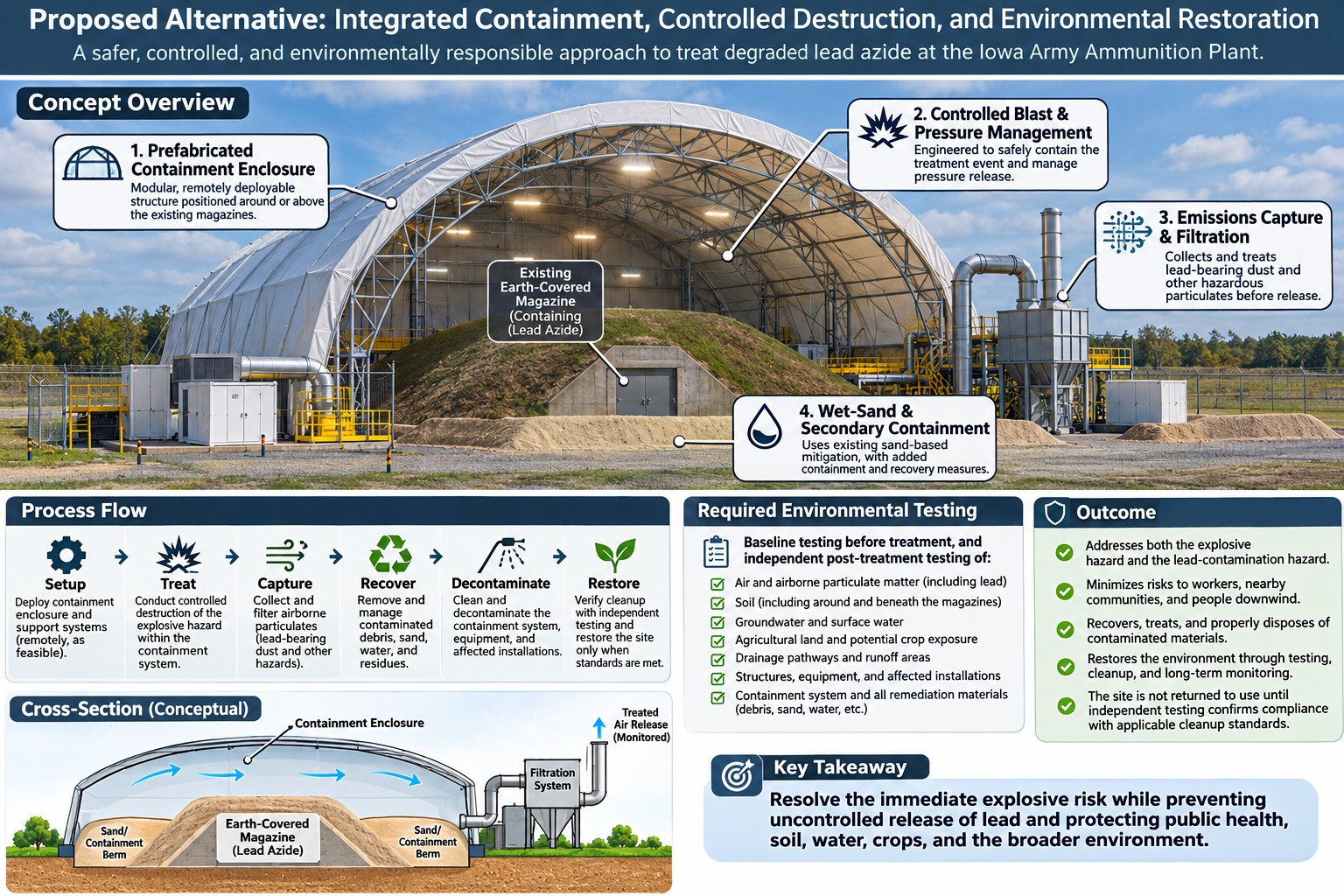
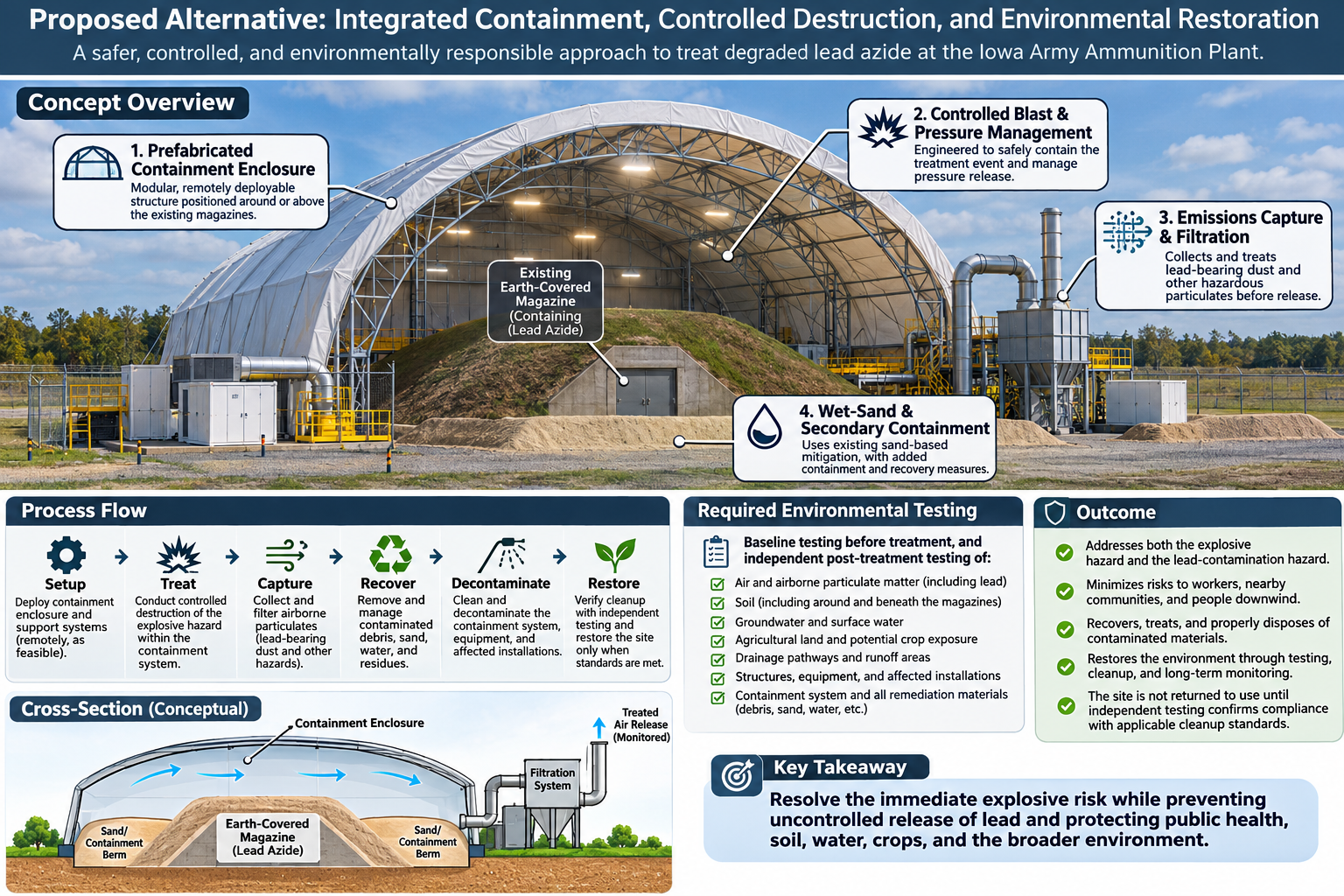
1. An in-place containment canopy or enclosure positioned over the existing magazines.
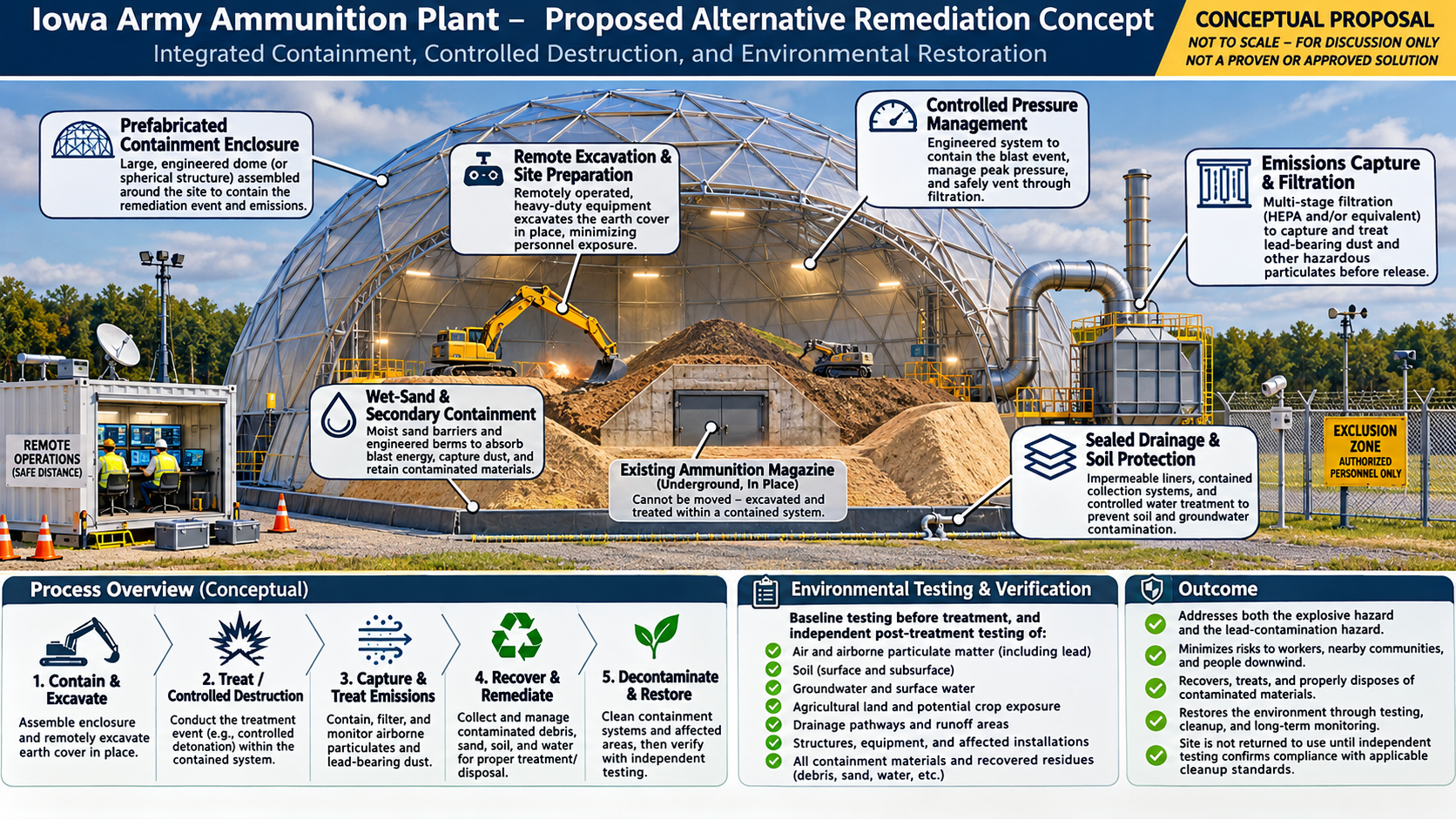
2. A larger spherical or geodesic enclosure, if the material can’t be moved at all.
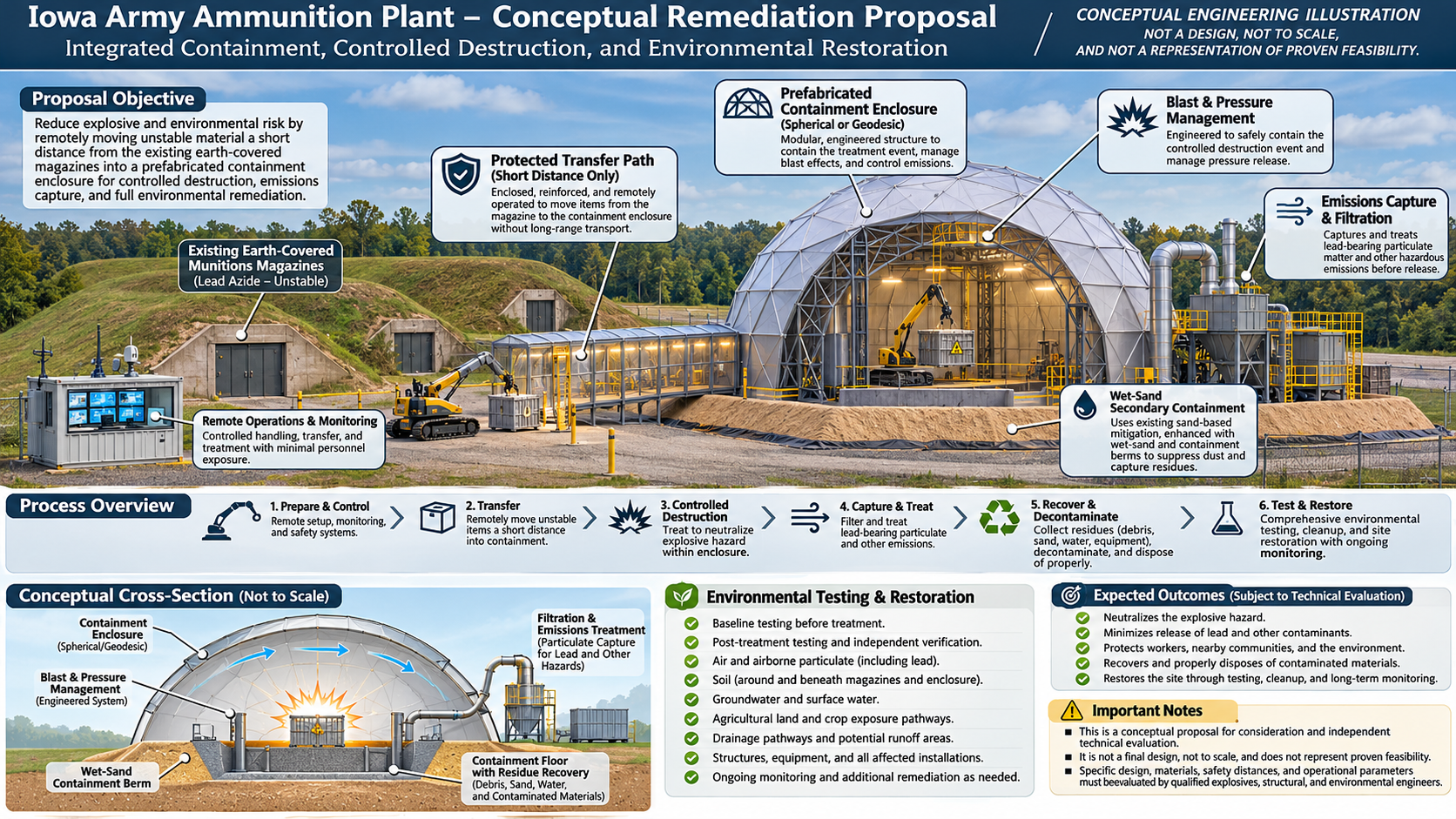
3. A separate, purpose-built containment structure, if a short-distance transfer turns out to be possible.
The idea behind all three is the same: an engineered system for blast management and controlled pressure release, combined with emissions capture and particulate filtration, so lead-bearing dust isn’t scattered across the surrounding land. The existing wet-sand and barrier measures could still be part of it. After the explosive hazard is destroyed, the enclosure would make it possible to recover contaminated debris, sand, and water, and then decontaminate the site.
Testing before and after, not as an afterthought
Whatever method the Army chooses, I’ve asked for baseline testing before treatment and independent testing afterward of the air, soil (including under and around the magazines), groundwater and surface water, farmland and crop exposure pathways, drainage paths, the structures and equipment, and all the recovered residues. The site shouldn’t be declared clear until independent testing shows it meets cleanup standards, with continued monitoring wherever contamination turns up.
The EPA emergency permit requires soil and high-touch surface sampling within 24 hours after the detonation, but only in the higher modeled zone of 100 micrograms per square foot or more, even though public health advisories begin at 5. The permit does not specifically require short-term sampling of crops, livestock feed or water, or private wells. EPA has said it will sample homes, properties, and schools on request and will publish results. That offer matters, as does testing the wider modeled area, including farmland, with independent verification.
I also want to be careful about one point. The exposure maps the Army has published are modeled projections. They show where contamination could go under certain assumptions. They are not confirmed contamination, and that is exactly why real baseline and follow-up testing matters.
Why this matters
There is no known safe blood lead level in children. Lead exposure during pregnancy is linked to miscarriage, preterm birth, low birth weight, and harm to a baby’s developing brain and nervous system. In children, it can cause learning and behavioral problems, slowed growth, hearing and speech problems, and lower IQ. The people downwind, the farms, and the water in this part of Iowa all deserve to be part of the decision.
What I’ve asked for
I’ve asked Army leadership to direct an independent, multidisciplinary engineering assessment of the containment concept; to evaluate whether remote containment, pressure management, and emissions capture could reduce environmental harm; to make sure all lead-bearing residues are recovered and managed; to require baseline and post-treatment testing with independent verification of cleanup; and to make the assessments and monitoring results public to the fullest extent the law allows.
My goal wasn’t to obstruct an urgent safety response. It’s to make sure every serious option is evaluated before an irreversible decision is made, and that the lead hazard gets the same urgency as the explosive one. Resolving one dangerous situation shouldn’t create another.
My full letter to the Army, the three concept illustrations, and my environmental addendum are posted below.
Army Appeal Letter
November 24, 2026
Dear U.S. Army Joint Munitions Command and Iowa Army Ammunition Plant Leadership,
URGENT REQUEST FOR IMMEDIATE REVIEW AND ALTERNATIVE SOLUTION
I am writing to express serious concerns regarding the proposed treatment of degraded lead azide at the Iowa Army Ammunition Plant near Middletown, Iowa. I respectfully request that Army leadership consider an additional containment and environmental remediation concept before proceeding with an irreversible open-detonation decision.
Public documents indicate that the material has recrystallized and become highly sensitive, creating serious risks if it is disturbed. I understand that the Army is responsible for addressing this dangerous situation and that the safety of personnel is a primary concern.
However, destroying the explosive hazard does not, by itself, resolve the lead-contamination hazard. The Army’s responsibility must extend beyond eliminating the immediate explosive threat to protecting personnel, surrounding communities, agricultural land, water resources, and the environment from the consequences of the treatment itself.
The Army has proposed open detonation with sand-based mitigation. Other approaches, including chemical treatment and conventional construction, have also been considered. However, I have not found a public engineering evaluation of a remotely assembled, prefabricated containment system designed to manage blast effects and control emissions.
I respectfully request that Army leadership direct an independent evaluation of this possibility by qualified explosives, structural, and environmental engineers.
PROPOSED ALTERNATIVE: INTEGRATED CONTAINMENT, CONTROLLED DESTRUCTION, AND ENVIRONMENTAL RESTORATION
I would like to propose that an additional remediation concept be independently evaluated.
Rather than relying exclusively on open detonation and external sand barriers, I propose investigating a prefabricated, remotely deployable containment canopy or enclosure that could be positioned around or above the existing earth-covered magazines, without requiring direct handling or transportation of the unstable material.
The concept would incorporate an engineered system for blast management and controlled pressure release, integrated with appropriate emissions capture and particulate filtration. The objective would be to contain the consequences of the treatment event as much as technically feasible, while preventing uncontrolled dispersal of lead-bearing dust and other hazardous residues.
Existing wet-sand and barrier mitigation measures could be evaluated as complementary components of this approach.
Following controlled destruction of the explosive hazard, the containment system would facilitate the recovery of contaminated debris, sand, water, and other residues, followed by internal decontamination and comprehensive remediation of the affected structures and surrounding environment.
I recognize that lead itself cannot be destroyed through detonation. The explosive compound may be destroyed, but the lead remains in whatever residues, debris, dust, soil, water, or other materials are generated.
Therefore, capturing, recovering, and properly managing lead-bearing contamination must be an integral part of the treatment strategy.
COMPREHENSIVE ENVIRONMENTAL TESTING AND RESTORATION
Environmental restoration must be an integral part of the treatment strategy, not an afterthought.
Baseline testing must establish existing conditions before treatment, followed by independent post-treatment testing of:
• Ambient air and airborne particulate matter, including lead-bearing dust.
• Soil, including the areas surrounding and beneath the magazines.
• Groundwater and surface water.
• Agricultural land and potential crop exposure pathways.
• Drainage pathways and areas where contaminated runoff or deposited material could accumulate.
• Structures, magazines, equipment, temporary containment infrastructure, and all materials used during remediation.
• Recovered debris, sand, water, and other treatment residues.
The temporary containment infrastructure and all materials used during remediation must also be evaluated and decontaminated or appropriately disposed of.
Contaminated soil, debris, sand, water, equipment, and installations must be recovered, decontaminated, treated, or disposed of through approved processes.
The site should not be considered cleared or returned to use until independent testing demonstrates compliance with applicable environmental cleanup standards. Continued monitoring and additional remediation must be required wherever contamination is identified.
PUBLIC HEALTH AND ENVIRONMENTAL RESPONSIBILITY
The health of Americans is at stake. Lead exposure presents serious and well-documented health risks, particularly for pregnant women, developing babies, and children.
Lead exposure during pregnancy is associated with increased risks of miscarriage, preterm birth, low birth weight, and harm to fetal brain, kidney, and nervous system development.
In children, lead exposure can cause damage to the brain and nervous system, slowed growth and development, learning and behavioral difficulties, hearing and speech problems, and reduced IQ.
There is no known safe blood lead level in children. Even relatively low levels of exposure can be harmful.
The potential release of lead-bearing particulate matter into the surrounding environment raises concerns that extend beyond the immediate treatment event. Soil, crops, water, air, agricultural land, and communities downwind must all be considered when evaluating the consequences of this decision.
The Army has a responsibility to protect the public and the environment while addressing the immediate explosive hazard. Resolving one dangerous situation should not create another.
REQUEST FOR IMMEDIATE ACTION
Please do not proceed with an irreversible action without first giving reasonable alternative containment and remediation concepts a thorough, independent technical evaluation.
I recognize that the Army is facing a difficult and urgent situation. However, an open detonation should not become the default solution simply because a dangerous material has been left in an unstable condition for an extended period.
This situation requires a carefully evaluated response, not a reaction that addresses only the immediate explosive hazard while potentially transferring the consequences to workers, nearby communities, agricultural land, water resources, and the environment.
I am not presenting my proposed containment concept as an established engineering solution. I recognize that it requires substantial technical evaluation, particularly regarding structural integrity, pressure management, installation safety, and emissions control. I am asking that it receive serious, independent consideration before an irreversible decision is made.
I respectfully request that Army leadership:
1. Direct an independent multidisciplinary engineering assessment of the proposed prefabricated containment concept.
2. Evaluate whether remotely deployable containment, controlled pressure management, and emissions capture could reduce environmental consequences.
3. Ensure that the treatment plan addresses the recovery and proper management of all lead-bearing residues.
4. Establish comprehensive baseline and post-treatment environmental testing.
5. Require independent verification of cleanup before affected areas are declared safe or returned to use.
6. Make the engineering assessments, environmental monitoring results, and remediation requirements available to the public to the fullest extent permitted by law.
My intention is not to obstruct an urgent safety response. It is to ask that the Army choose an approach that protects its personnel, nearby communities, people downwind, and the environment, both immediately and over the long term.
Please ensure that this correspondence reaches the appropriate installation commander, Joint Munitions Command leadership, and the Army officials responsible for the technical and environmental decisions concerning this material.
Thank you for your time and consideration.
Sincerely,
Proposed Containment Alternatives for Independent Evaluation
Iowa Army Ammunition Plant (IAAAP), Middletown, Iowa: degraded lead azide
Submitted by Claudia Perez Silva, November 24, 2026
These are original conceptual proposals I developed. They are not existing or published engineering designs, not to scale, and not approved, and they are submitted solely for independent evaluation by qualified explosives, structural, and environmental engineers. Destroying the explosive hazard does not, by itself, resolve the lead-contamination hazard.
THE THREE CONCEPTS (SEE ATTACHED ILLUSTRATIONS)
1. In-place containment canopy or enclosure over the existing earth-covered magazines.
2. A larger spherical or geodesic containment enclosure, if the material cannot be moved.
3. A separate, purpose-built containment structure for a possible short-distance transfer.
PROPOSED ALTERNATIVE: INTEGRATED CONTAINMENT, CONTROLLED DESTRUCTION, AND ENVIRONMENTAL RESTORATION
I would like to propose that an additional remediation concept be independently evaluated.
Rather than relying exclusively on open detonation and external sand barriers, I propose investigating a prefabricated, remotely deployable containment canopy or enclosure that could be positioned around or above the existing earth-covered magazines, without requiring direct handling or transportation of the unstable material.
The concept would incorporate an engineered system for blast management and controlled pressure release, integrated with appropriate emissions capture and particulate filtration. The objective would be to contain the consequences of the treatment event as much as technically feasible, while preventing uncontrolled dispersal of lead-bearing dust and other hazardous residues.
Existing wet-sand and barrier mitigation measures could be evaluated as complementary components of this approach.
Following controlled destruction of the explosive hazard, the containment system would facilitate the recovery of contaminated debris, sand, water, and other residues, followed by internal decontamination and comprehensive remediation of the affected structures and surrounding environment.
I recognize that lead itself cannot be destroyed through detonation. The explosive compound may be destroyed, but the lead remains in whatever residues, debris, dust, soil, water, or other materials are generated.
Therefore, capturing, recovering, and properly managing lead-bearing contamination must be an integral part of the treatment strategy.
COMPREHENSIVE ENVIRONMENTAL TESTING AND RESTORATION
Environmental restoration must be an integral part of the treatment strategy, not an afterthought.
Baseline testing must establish existing conditions before treatment, followed by independent post-treatment testing of:
• Ambient air and airborne particulate matter, including lead-bearing dust.
• Soil, including the areas surrounding and beneath the magazines.
• Groundwater and surface water.
• Agricultural land and potential crop exposure pathways.
• Drainage pathways and areas where contaminated runoff or deposited material could accumulate.
• Structures, magazines, equipment, temporary containment infrastructure, and all materials used during remediation.
• Recovered debris, sand, water, and other treatment residues.
The temporary containment infrastructure and all materials used during remediation must also be evaluated and decontaminated or appropriately disposed of.
Contaminated soil, debris, sand, water, equipment, and installations must be recovered, decontaminated, treated, or disposed of through approved processes.
The site should not be considered cleared or returned to use until independent testing demonstrates compliance with applicable environmental cleanup standards. Continued monitoring and additional remediation must be required wherever contamination is identified.
REQUESTED ACTIONS
I am not presenting my proposed containment concept as an established engineering solution. I recognize that it requires substantial technical evaluation, particularly regarding structural integrity, pressure management, installation safety, and emissions control. I am asking that it receive serious, independent consideration before an irreversible decision is made.
I respectfully request that Army leadership:
1. Direct an independent multidisciplinary engineering assessment of the proposed prefabricated containment concept.
2. Evaluate whether remotely deployable containment, controlled pressure management, and emissions capture could reduce environmental consequences.
3. Ensure that the treatment plan addresses the recovery and proper management of all lead-bearing residues.
4. Establish comprehensive baseline and post-treatment environmental testing.
5. Require independent verification of cleanup before affected areas are declared safe or returned to use.
6. Make the engineering assessments, environmental monitoring results, and remediation requirements available to the public to the fullest extent permitted by law.
Concept 1: In place containment
Concept 2: Excavation containment
Concept 3: Transfer containment
SUPPLEMENTAL ENVIRONMENTAL ADDENDUM
Long-Term Impacts on Natural Resources, Crops, Livestock, and Agricultural Pathways
Iowa Army Ammunition Plant – Degraded Lead Azide Remediation
November 24, 2026
This addendum supplements prior correspondence requesting independent evaluation of containment alternatives. It addresses long-term environmental and agricultural concerns that must be considered regardless of the treatment method selected.
Environmental restoration must be integral to the treatment decision, not deferred as an optional later step. It should include baseline testing and independent post-treatment verification of appropriate air, soil, groundwater, surface water, sediment, and residue samples. Sampling should address the magazines and subsurface areas, surrounding land, drainage pathways, agricultural land, relevant structures, temporary containment, recovered debris, sand, water, residues, and any other areas identified by monitoring or dispersion analysis.
Contaminated materials should be recovered, characterized, decontaminated, treated, or disposed of through approved processes. The affected area should not be declared cleared or returned to use until independent testing demonstrates that applicable cleanup standards have been met. Continued monitoring and additional remediation should be required wherever results warrant it.
Potential receptors and pathways to evaluate include workers, nearby communities, downwind residents, farms, crops, pasture, hay, silage, grain storage, livestock, animal feed, private wells, public water systems, rivers, streams, wetlands, parks, wildlife, and downstream communities.
REGIONAL AND INTERSTATE AGRICULTURE / FOOD-CHAIN CONCERNS
Agencies should assess potential pathways involving agricultural soil, crops, pasture, hay, silage, feed storage, livestock watering points, private wells, irrigation, animal ingestion of soil/feed/water, and runoff into farms and watersheds.
Iowa agricultural products can enter regional, interstate, and international supply chains. Depending on the commodity and confirmed pathway, routes may include grain elevators, feed mills, ethanol and other processors, rail and river terminals, livestock markets, feedlots, slaughter facilities, and food processors. If contamination is confirmed, agencies should use risk-based traceability to identify affected fields or lots, relevant production periods, feed sources, livestock movements, and destinations. Neighboring states and relevant federal agencies should coordinate when evidence indicates cross-border pathways.
This is preparedness and traceability planning, not a claim that products are contaminated. No blanket recall or product restriction should be inferred from modeled exposure alone.
Lead cannot be destroyed by detonation. Any treatment that generates airborne particulate, residual dust, or contaminated runoff must include capture, recovery, and proper management of lead-bearing materials to protect soil, water, crops, livestock, and downstream food systems.
Please forward this addendum to environmental, agricultural, and public-health specialists for independent review alongside the containment concepts.