
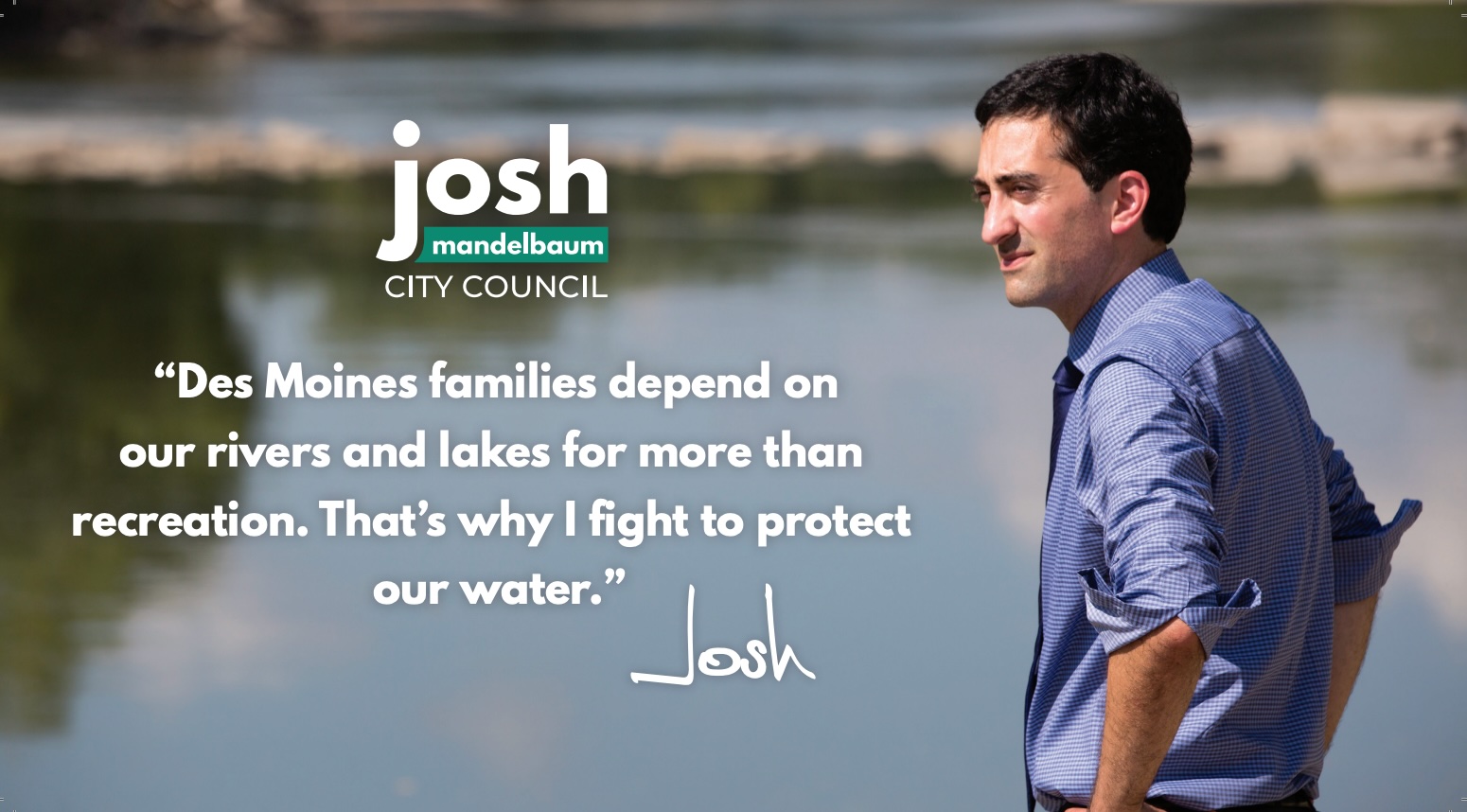
Josh Mandelbaum represents Ward 3 on the Des Moines City Council.
Iowa has the 2nd highest cancer rate of any state in the country, and our cancer rates are increasing. Iowa’s cancer rates have been going up while the United States on the whole is experiencing declining cancer rates. This makes Iowa an outlier.
The question is what makes Iowa an outlier, and what can we do about it?
The Iowa Environmental Council (IEC) and the Harkin Institute attempt to answer that question with their new report “Environmental Risk Factors and Iowa’s Cancer Crisis.” The report looked at peer-reviewed research and found that environmental exposures to nitrate, pesticides, radon and PFAs are all associated with increased cancer risks. The executive summary noted that:
- All of the most common cancers in Iowa (breast, prostate, lung, colorectal, and skin melanoma) have associations with environmental risk factors (pesticides, nitrate, PFAS, and radon).
- In Iowa, thirteen of the sixteen cancer sites identified in the report as connected to pesticides, nitrate, PFAS, and radon exceeded the U.S. incidence rate in the most recent five-year period (2017 – 2021).
- Of the adult cancers identified as associated with these environmental risk factors, eleven of the fifteen cancer types are increasing in the total Iowa population.
- For people under 50 in Iowa, six of 10 cancer types associated with pesticides, nitrate, PFAS, and radon are increasing.
The report makes clear that environmental factors play a role in Iowa’s cancer crisis. That’s the bad news. The good news is that just like with behavioral factors, we are not helpless in addressing environmental factors associated with increased cancer. We all can be part of advocating for solutions.
We should have a Cancer Agenda for Council. First, I have asked Mayor Boesen to invite the Iowa Environmental Council and Harkin Institute to present on their cancer study at a Council work session. Understanding an issue is the first step to addressing it. Second, I have identified three initial areas (I hope my colleagues have additional ideas) for Council to advocate to have an impact on cancer in Iowa:
- Support action to improve water quality – The Des Moines and Raccoon Rivers, the source of drinking water for Des Moines residents, are in the top 1 percent of rivers in the country for nitrate concentration. Last summer, high levels of nitrate pollution stressed Central Iowa Water Works ability to treat the water and remove pollution in order to meet the Safe Drinking Water Act standard for nitrates leading to the metro’s first ever lawn watering ban. For much of the year, nitrate levels in finished water have just under the 10 mg/L Safe Drinking Water Standard. The IEC/Harkin Institute Report highlighted that a growing body of evidence shows that nitrate levels far below the EPA standard are associated with increased risks of cancer, including colorectal, ovarian, bladder, thyroid, and prostate cancer. We need action on water quality, and every elected official should be calling for meaningful action to address this problem. The Council should make addressing water quality a standing part of our legislative agenda. There are multiple policies that we could support – the Harkin Institute identifies a number of them in this report. As the legislative session wraps up, we should join in calling for the legislature to fund the water quality monitoring system.
- Address radon in rental properties – Iowa has some of the highest radon levels in the country. Radon is the second leading cause of lung cancer in Iowa after smoking. The legislature is currently considering requirements for radon mitigation in all new construction homes. Most home buyers request a radon test and mitigation during the sale of existing homes. This leaves a gap for rental homes. We should require radon testing, and if necessary mitigation, as a condition of obtaining a rental certificate under the city’s rental property ordinance.
- Advocate for a local option tobacco tax – Tobacco use is one of the most significant behavioral causes of cancer. Increasing tobacco taxes is one of the most effective policy tools for reducing tobacco usage. Increasing tobacco taxes prevent youth from starting smoking, lead to adults quitting smoking, and provide valuable revenue for health initiatives. A local option tobacco tax could be dedicated towards addiction and homelessness services – services that don’t currently have dedicated funding.
If we are going to address our state’s cancer crisis, elected officials at every level of government will need to engage. It’s time for the Council to have a Cancer agenda.
Editor’s note from Laura Belin: Here’s a copy of the full report by the Iowa Environmental Council and Harkin Institute: Environmental Risk Factors and Iowa’s Cancer Crisis
4 Comments
Good move
The more times where these issues are noted and addressed, the more our legislature’s inaction is accentuated. Keep up the good work.
MantenoLorax Tue 28 Apr 12:31 PM
MantenoLorax, you are right.
And as one distant dream, I hope that one day, Iowa will take a serious look at the full extent and impacts of ag chemical drift. Reports on the “Investigate Midwest” website indicate that drift is a serious multifaceted problem. The current controllers of Iowa state government seem to have the same basic attitude toward ag chem drift that they have toward ag water pollution. They don’t want to know and they want other Iowans to share the bliss of ignorance.
PrairieFan Tue 28 Apr 10:06 PM
And it's not just cancer...
…the very same problems raising Iowan’s cancer chances are also adversely affecting our health in myriad other ways.
Key Health Impacts Beyond Cancer
Respiratory Illnesses: Air pollution and pollutants cause asthma, chronic obstructive pulmonary disease (COPD), and chronic inflammation.
Cardiovascular Disease: Environmental pollutants, including fine particulate matter, contribute to heart disease and premature death.
Endocrine and Metabolic Disorders: Endocrine-disrupting chemicals and environmental toxins interfere with hormones, causing obesity, reproductive issues, and diabetes.
Just to point out a few.
MantenoLorax Wed 29 Apr 11:16 AM
Thanks again, MantenoLorax
Raise your hands, Iowans who don’t want to get cancer but are fine with getting cardiovascular disease and diabetes. That’s what I thought.
Also, to go wild-eyed radical, humans aren’t the only animals in Iowa. The neonicotinoid pesticides that are spread across this state every spring via coated corn and soybean seeds are far more toxic to bees and other insect pollinators than DDT. And there is growing evidence that chronic low-level neonic exposure isn’t good for human health, either. One example of many.
PrairieFan Wed 29 Apr 4:12 PM