Leland Searles has had a long interest in birding and wildflowers. He combines that with over fifteen years as a consultant in ecological assessment and restoration, along with graduate studies in environmental and psychological anthropology. His recent writing addresses some facet of ecology, often with awareness of social interests and power that shape our regard for the environment.
Triosteum: “having three pits [seeds] as hard as bone.” This genus of plants in the Caprifoliaceae family has six species, with three in North America and three in East Asia. Two occur in the Midwest: Orangefruit Horse Gentian (Triosteum aurantiacum), and Late Horse Gentian, Feverwort, or Tinker’s Weed (Triosteum perfoliatum, from the appearance of the stem perforating the leaves). In my experience, the last is the more common in Iowa.
Orangefruit Horse Gentian (Triosteum aurantiacum), showing that the leaf bases barely touch at the stem. It is found naturally in Iowa, although I photographed this plant near Trumansburg, Lake Cayuga Watershed, New York.

These three species also are known as Wild Coffee because their hard seeds may be roasted and brewed as a coffee-like drink, but the roots also have medicinal uses because they contain alkaloids similar to those in bindweeds, morningglories, dogbanes, and some fungi. In the same family are Coralberry and Snowberry, invasive teasels, native and nonnative honeysuckles, and valerians.
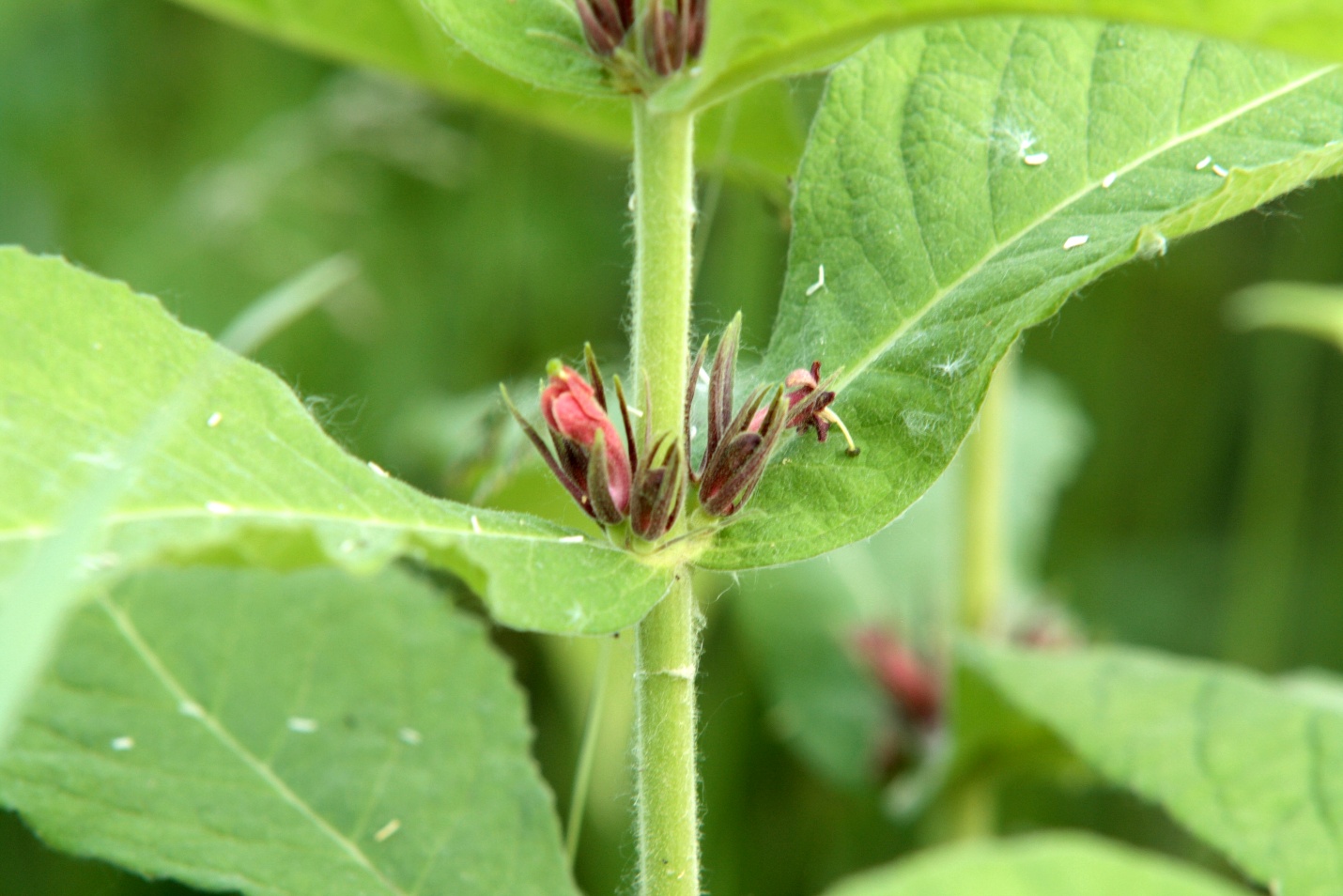
Flowers of Late Horse Gentian (Triosteum perfoliatum) in the angles or axils of the leaves. The leaf bases suggest Triosteum aurantiacum, and some plants are difficult to assign to one species or another. Also take note of the typical fuzzy stems.

My first recognition of this plant came in the early 1980s, at my former in-laws’ farm in Greene County. A single plant grew next to the fencerow on the north edge of a wooded ravine.
The plant was a mystery: opposite leaves that joined around the stem; small flowers in the angles of the leaves and stems; and an obovate shape, that is, wider toward the tip than the base. (Bur Oak leaves are also obovate.) The plant was fuzzy.
I had to look this one up, probably in my Peterson’s guide to wildflowers, which was my main plant guide at the time. It confirmed the features that had caught my eye, and it made brief mention of the use of the seeds (“berries”) for a brewed, coffee-like drink. Unfortunately, I’ve never found enough plants or seeds to be comfortable with harvesting them, so I’ve never made the “coffee.”
Notice how each pair of opposite leaves is oriented at 90 degrees from the pair above or below it. This is an eye-catching distinction that few other opposite-leaved plants share. This is the same plant as the one immediately above.

The plants grow singly or in a scattering of several, generally in open woods and along wooded edges. They are perennials, one to four feet in height.
It is a delight to find Horse gentians because they are uncommon, maybe because of their preference for the right amount of sunlight in woods or transitional areas between woods and another ecosystem.
For more on the ecology of Iowa, visit my Substack by searching for @homeonearth or using my name.
Sources:
Peterson and McKinney, Field Guide to Wildflowers of Northeastern and North-Central North America. Original edition; several revisions have appeared since this one.
Steyermark, Flora of Missouri, volume 2.
Wikipedia entry on Triosteum genus
1 Comment
It's nice to see Horse Gentian on Wildflower Wednesday.
Seeing a Horse Gentian plant, or a photo, always reminds me of the book MIRACLE UNDER THE OAKS: THE REVIVAL OF NATURE IN AMERICA by William K. Stevens. It’s the story of the rediscovery of the lost/forgotten oak savanna ecosystem, a story that started about fifty years ago. The book is largely an ecological detective story featuring “ordinary” people who care about nature. The action is centered in the Chicago region, but other places are in the book too, including Iowa. Triosteum perfoliatum is included as a classic oak savanna species. Thank you, Leland Searle.
PrairieFan Thu 14 May 12:48 AM