
Herb Strentz was dean of the Drake School of Journalism from 1975 to 1988 and professor there until retirement in 2004. He was executive secretary of the Iowa Freedom of Information Council from its founding in 1976 to 2000.
How fitting and ironic it is that—as we mark the 250th anniversary of the July 4th celebration of the birth of our nation—we also will mark the 250th anniversary of the opening lines of Thomas Paine’s rallying cry: “These are the times that try men’s souls.”
The reality in “these…times” of 2026 is that we can no longer have decent classroom, living room, or barroom discussions about who was, is or shall be the worst president in the nation’s history.
Donald J. Trump sweeps the field.
Trump’s second term cabinet — thanks in part to the supporting votes of Iowa U.S. Senators Chuck Grassley and Joni Ernst — warrants an equally low ranking among centuries of presidential cabinets.
Further, Iowa’s six-member congressional delegation is devoted to Trump. U.S. Representative Randy Feenstra, seeking the Republican nomination for governor, boasts that he is a “Trump Conservative.” Feenstra wants voters to know he’s not one of those responsible, public-spirited conservatives like Bob Ray or Arthur Neu or Mary Louise Smith.
Make it loud and clear, Feenstra is a TRUMP CONSERVATIVE.
In our constitutional system of checks and balances, the failure of Congress to hold Trump in check is compounded by the U.S. Supreme Court’s failure to rein in Trump. The court has even given him more free license for more lawless actions.
Trump flouts lower court rulings against him. The conservative Supreme Court justices (including three of his own appointees) typically overturn those rulings.
And let’s not forget that in the 2024 election, 77,284,118 voters (49.8 percent of the electorate) put Trump in office to wield the unbridled powers he brandishes today.
Let’s take the perpetrators in one by one — Trump, the Supreme Court, Congress and the voters.
No “last straw” for Donald Trump
Trying to list one or two failings of Trump is like looking for one straw to best illustrate fields of haystacks.
In terms of immediate costs and bloodshed, Trump’s war against Iran is but one straw.
So far the war has cost the U.S. up to $50 billion, and thousands of lives have been lost in nations suffering under Trump’s arrogance.
If, in time, two events occur — (1) the Strait of Hormuz is reopened and (2) Iran backs away from its nuclear program— Trump will take all the credit for his shrewdness in sacrificing the lives others to achieve these goals.
But those two events could have been avoided in the first place if Trump had not killed an international agreement framed more than ten years ago.
Historian Heather Cox Richardson, following up on a Wall Street Journal article, noted that in 2015: “President Barack Obama’s team, along with China, France, Germany, Russia, and the United Kingdom had achieved both of those goals with the 2015 Joint Comprehensive Plan of Action (JCPOA) Trump tore up in 2018.”
Eight years later, with his war underway, the Wall Street Journal reported that Trump brags he will produce a far better “deal” than the cost-free JCPOA.
As for another aspect of Trump’s fear-driven domestic and global wars on terror, there is little or no mention about how many future terrorists were created when U.S. misdirected missiles killed more than 100 Iranian school girls, among the 170 lost when the missiles hit their school. Trump initially blamed Iran for the missile strike. Investigations showed otherwise.
Unfortunately, there is no last straw when it comes to Trump using the White House for his family’s personal financial gain, and for revenge upon those who challenge or fault him.
Supreme Court majority in Trump’s pocket
The Supreme Court’s “shadow docket” for emergency motions allows the Court to issue edicts without full briefings, oral arguments or explanation. On issues ranging from dismantling the Department of Education to banning transgender people from serving in the military, the conservative majority has used the shadow docket to protect Trump.
Federal trial judges across the ideological spectrum— to their credit — have repeatedly blocked the president’s actions by Trump, only for the Supreme Court to halt those rulings with little or no explanation.
Adam Bonica at Stanford University sees the Supreme Court as being at war with its own judiciary. He wrote in June 2025,
The Supreme Court is now in open conflict with the lower courts over cases involving the Trump administration. Since May, federal district courts have ruled against the administration 94.3% of the time. The Supreme Court, however, has flipped that outcome, siding with the administration in 93.7% of its cases (15 out of 16).
And from Georgetown University professor Steve Vladeck: “In the first 20 weeks of Trump’s second term, the administration sought emergency action by the Court 19 times — the same number of requests made by the Biden administration over four years.”
The court’s rulings largely favor Trump even when the shadow docket is not used. Conservative justices have granted Trump even more leeway by ruling the president cannot be prosecuted for any official acts, and by overturning civil rights protections recognized by previous courts.
Congress, with the focus on Grassley
Iowa’s senior senator has been a key player in making the courts and Congress less effective checks on the executive branch. Grassley has been in the Senate for 45 years now, since 1981. For 30 of those years, 1985 to 2015, he shared Iowa representation with Democratic Senator Tom Harkin, giving Iowa a remarkable record of bipartisanship.
Grassley has served on the Senate Judiciary Committee since 1981, chairing the panel from 2015 to 2019, and again from 2025 to the present. Over the past decade, Grassley has been widely criticized for his work on that committee.
Here are capsule summaries of three comments with links for further reading:
• Kris Kolesnick served on Grassley’s staff for nineteen years as senior counselor and director of investigations. He offered his perspective, in a June 2023 commentary for The Hill. Excerpt from “Chuck Grassley needs to get his oversight focus back”:
There was a time when Sen. Chuck Grassley (R-Iowa) was a heavyweight in congressional oversight circles. His defense reform campaign during the Reagan administration was legendary. He led an effort to halt the unprecedented Reagan defense budget buildup in the 1980s, and left a trail of legislative structural reforms to ensure that the fight against defense fraud and waste would continue. In the 1990s, he led a congressional effort to clean up the FBI crime lab scandal. […] He got real, practical, long-term results. […]
All of that is a distant memory. Today, forty-some years later, there’s a new Chuck Grassley. […] fellow travelers in oversight circles have asked me: What has happened to Grassley? Why has he become so unrecognizably political in his oversight?
• Carl Tobias of the University of Richmond Law School wrote a 2019 article for the Iowa Law Review, which contrasted the Senate Judiciary Committee’s work on nominations during the last two years of the Obama administration and the first two years under Trump.
Grassley strictly held the Obama nominations to numerous court rules but “in profound contrast…jettisoned, changed or deemphasized” similar conventions in considering Trump nominations.” A Bleeding Heartland post from 2020 discussed the Tobias article more fully.
• Rick Morain, former owner and publisher of the Jefferson Herald, added more to the sorry records of the pro-Trump Congress and pro-Trump Supreme Court. In an April 2025 Bleeding Heartland post, he covered Grassley’s remarks about his committee’s refusal to give Supreme Court nominee Merrick Garland a hearing in 2016. President Obama had nominated Garland to fill the Supreme Court vacancy created by the death of Justice Antonin Scalia.
After years of defending the refusal as well-established Senate protocol and history, Grassley confessed at a town hall meeting that it was all politics: “when you have a president of one party and a Senate of the other party, and it’s getting close to a presidential election, the Senate doesn’t approve that.”
Morain kindly did not suggest Grassley lied, saying instead that the senator was “wrong. I don’t know if he said it because he was misinformed, or because he was trying to justify his action.”
To cap it off, Bleeding Heartland editor Laura Belin observed in a May 3 column that Grassley refuses to say unequivocally that Joe Biden won the 2020 election. Many Republicans in Congress and Trump appointees don’t acknowledge the obvious, for fear of upsetting the president. “Grassley has been part of that problem for years,” Belin wrote.
Despite Grassley’s loyalty, subservience, or cowardice on other matters, Trump has clashed with the senator for maintaining the Judiciary Committee’s “blue slip” tradition. He even shared comments that derided Grassley as “sneaky” and a “RINO” (Republican In Name Only). Grassley said last summer, “I was offended by what the president said and I’m disappointed that it would result in personal insults.”
And how about the voters?
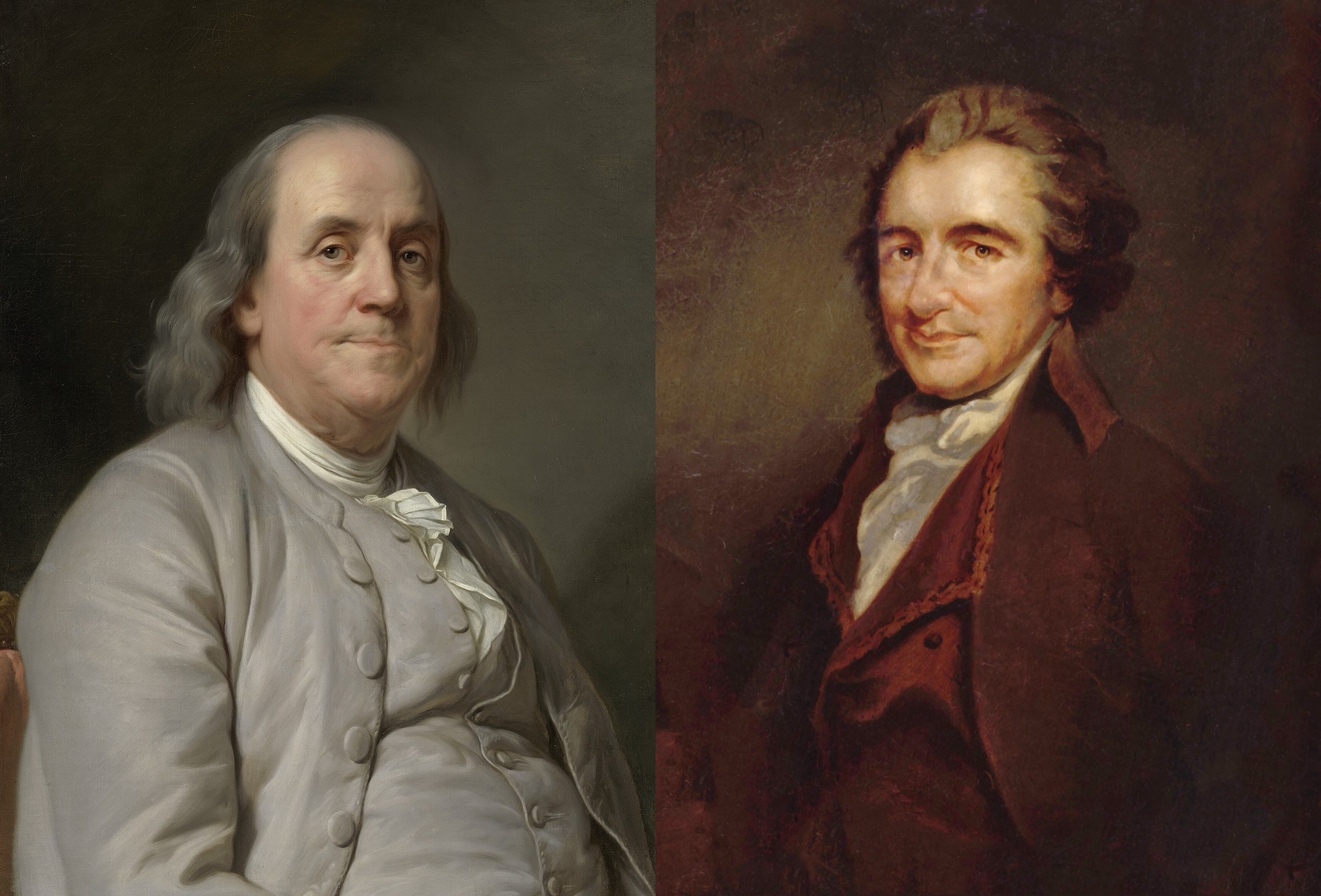
Instead of stressing the importance of the 2026 elections in getting our democracy back on track, let’s consider what Benjamin Franklin and Tom Paine had to say centuries ago.
For Franklin, it was his answer to a question about whether the 1787 constitutional convention had given the people, a republic or a monarchy. Franklin replied, “A republic if you can keep it.”
I thought we had answered the point— “If you can keep it”— well enough in subsequent centuries. Now it is clear, as Franklin likely intended, that the question must be addressed every election and often every day in our political lives.
Reassurance and marching orders come again from Paine:
Tyranny, like hell, is not easily conquered; yet we have this consolation with us, that the harder the conflict, the more glorious the triumph. What we obtain too cheap, we esteem too lightly: it is dearness only that gives every thing its value. Heaven knows how to put a proper price upon its goods; and it would be strange indeed if so celestial an article as FREEDOM should not be highly rated.
Top images: Portrait of Benjamin Franklin by Joseph Duplessis, 1778, available via Wikimedia Commons. Thomas Paine, copy by Auguste Millière around 1876, after an engraving by William Sharp, after George Romney in 1792, available via Wikimedia Commons.