
Dan Piller was a business reporter for more than four decades, working for the Des Moines Register and the Fort Worth Star-Telegram. He covered the oil and gas industry while in Texas and was the Register’s agriculture reporter before his retirement in 2013. He lives in Ankeny.
A visitor to Iowa’s two largest university campuses might see the expanded football stadiums complete with private luxury suites whose games attract billion-dollar television contracts, gleaming indoor practice facilities and athlete residences, dining halls and training centers that would rival a fine resort. And they might well wonder why anyone would think Congress needs to pass a “Protect College Sports Act.”
It turns out that college sports needs to be saved from itself. The culprit is that old bogey; money.
Why some want Congress involved with college sports
The 69 universities in the so-called “power conferences” that call themselves “big time” apparently don’t have a clue about how to govern themselves, despite their location on campuses that hold what are supposedly our best minds. Where private, for profit professional sports have endured their various crises with strongmen commissioners, college sports long has long been run by parochial, oligarchical interests that have resisted central control.
How else to explain how Senator Ted Cruz of Texas, a Republican not known for deep thinking, turned out to be the point person for what has been a futile effort to pass a bill reordering college sports before the recent Congressional recess. Congress will try again in September, but as is the case with the Farm Bill, any legislation that can make it through the regional political weeds of college sports would have to be considered a major upset.
In a nutshell, the problem is this: A flood of multi-billion dollar television contracts and a boom in postseason events in both football and basketball has given the regional-based conferences of the big schools more money than they can intelligently spend while what has passed for a central authority, the National Collegiate Athletic Association (NCAA) has lost much of its power at the hands of the courts.
To make things worse (for the big universities, at least), courts have freed college “student athletes” from their longstanding peonage, and those heroes now can command salaries and bonuses at what has long been unpaid “amateur” athletics.

University of Iowa star player Caitlin Clark shoots a basket during a December 6, 2023 game against Iowa State (Photo credit: MKC-T, Wikimedia Commons)

If less than happy, athletes can now – imagine this – transfer at will from one university to another just like their fellow non-student athletes.
We’re living in an era when college football coaches can command salaries as high as $10 million annually (at a time when university staff and professors are being laid off because of dwindling public support for Higher Education) and quarterbacks can attract bonuses of up to $5 million before they even set foot on campus. Even college coaches and athletic directors whose political philosophies have seemingly been taken from John Wayne are demanding that Congress “do something” before the money-choked college sports monster eats itself.
Iowa and Iowa State have different interests
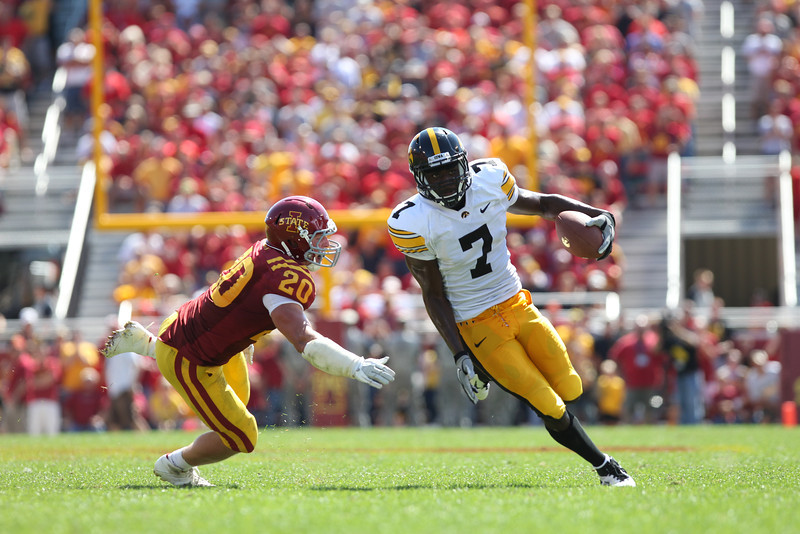
Iowa sits at the symbolic hinge of the struggle to unite college athletics. The University of Iowa rests comfortably in the Big Ten Conference and thus shares in the richest TV contract in college sports. That contract generates a conference payout of just a hair under $80 million for each of its 18-member schools (the reality that the Big Ten Conference can have 18 members is another sign of the loopiness of 21st century college sports).
Iowa State University in Ames receives a payout from its 16-member Big 12 Conference that is about half of what Iowa gets from the Big Ten. The lower payout is the result of the Big 12’s smaller-value TV contract that stems from its less populated geographical footprint in the western prairies.
(The chicken from the lower payout came home to roost on Iowa State last December when Matt Campbell, the most successful football coach in ISU’s history, abruptly jumped to the more moneyed pastures of the Big Ten at Penn State to the widespread dismay of Cyclone fans who had enjoyed Campbell’s turnaround of ISU’s longtime bottom-feeder football program.)
Iowa State and its well-heeled supporters, who are many of the same fat-cats who finance politicians, would like things to be more socialistically equal. The Big Ten and Iowa wants to preserve the status quo and would prefer the have-lesses to just accept their lower status.
If that reminds you of the way things work nationally in the economy and politics these days, then you have achieved the beginning of wisdom about big-time intercollegiate athletics.
What’s in the “Protect College Sports Act of 2026”
The bipartisan bill that Cruz and Democratic Senator Maria Cantwell of Washington produced was a hodgepodge rivaling any of those “Christmas Tree” proposals, with amendments piled on amendments.

U.S. Senator Maria Cantwell speaks at an event at the Russell Senate Office Building on May 12, 2026; U.S. Senator Ted Cruz is on the left. Photo credit: NASA/Aubrey Gemignani
Athletes’ pay would be capped at a total of just under $60 million per school. Athletes could transfer just once without a one-year suspension. Conference expansion is capped at 19, just above the now-18 member Big Ten that long has kept a light on for resolutely-independent Notre Dame. Television revenue could be (but not mandated) shared, a proposal met with a not-in-your-life response from the two big bears of college sports, the Big Ten and Southeastern (SEC) conferences that currently have the most lucrative TV deals.
Women, justifiably worried that men would repeat their historic habit and take all of the goodies, got a $5 million per school earmark for their sports. Culture warriors made sure the new national legislation didn’t override state laws banning transgender athletes from women’s locker rooms and playing fields.
Universities, predictably, took care of themselves by carefully wording the bill to protect them from antitrust prosecutions or suggestions that paid athletes are employees, with resulting vulnerability to worker’s compensation in case of injuries. One of the least edifying images of college sports has been the would-be superstar who came to a campus thinking it a way station to a lucrative professional career, limping away shorn of his sports prowess and possessing less than a useful education.
Alas, the salvation of college sports was delayed by the late-session jam up as Congress wrestled with issues like paying for the Iranian war, another (failed) attempt at a Farm Bill, a futile trip around legalized hemp and Todd Blanche’s demotion from being Trump’s personal lawyer to Attorney General of the United States. Congress will take up college sports when it returns in mid-September, just as college football fans speed up their breathing and blood pressures for a new season.
As things stand now, history suggests that “reformers” not get their hopes up.
The rise of athletic conferences
When big state and Land Grant universities began attracting enthusiasm and crowds for football in the last decade of the 19th century, the need for regularly scheduled games caused them to form “conferences” of like-sized and minded schools that could be connected by America’s now-finished railroad network.
Universities from Iowa and Minnesota east to Ohio formed the Big Ten Conference. Schools from Iowa and Nebraska south to Oklahoma organized what became, eventually, the Big Eight Conference. Similar conferences formed in the Old Confederacy from Florida to Louisiana to become the Southeastern Conference (SEC); from Georgia to Maryland to form the Atlantic Coast Conference; in Texas and Arkansas to form the Southwest Conference and along the Pacific Coast to create what became the Pac-12.
Led by Harvard and Yale, the Ivy League in the northeast decided after World War I to retreat into academic elitism and leave the big moneymaking to the State U conferences. Notre Dame successfully created a brand to become virtually a conference unto itself with its nationwide Catholic following and, in recent years, its own television deal. Notre Dame has repeatedly ignored overtures from the Big Ten to hold onto its independent status in football, not surprising for an institution representing a church that counts its traditions and doctrines in the centuries rather than years.
For decades well past the mid-20th century, conferences confined themselves to their original purpose of scheduling and holding championships. The closest thing to a central governing body was the formation of the National Collegiate Athletic Association (NCAA) in 1906 at the instigation of President Theodore Roosevelt after several college players were killed or seriously injured by the unregulated violence of early football.
By the mid-20th century, the NCAA had acquired a couple of new tasks beyond its original purpose of player safety. One was to enforce amateur rules against cash payments to recruits or athletes beyond the conventional scholarship, room and board compensations. The other was to negotiate a national contract for that new novelty; television.
By the early 1960s the “NCAA Game of the Week” on one of the national networks became a major Saturday afternoon attraction. TV also fed the growing popularity of the four major bowl games on New Year’s Day, and the nation learned to recover from its hangovers by watching the Cotton, Sugar, Orange and Rose Bowls. The outcome of those games, generally pitting conference champions (and independent Notre Dame, if the Irish had a decent team), led to a “consensus” national college football champion.
The NCAA used its television carrot also as a club to enforce recruiting and payment bans. Rulebreakers found themselves barred from TV and bowl game appearances, with resulting loss of revenue and exposure. The NCAA had an added carrot with a stick; the growing popularity of its national basketball tournament in March, the organization and proceeds of which (unlike the football bowl games) it controlled completely. By the end of the 1970s, the NCAA generally enforced order in college sports but was not loved for what many saw as its big government-style nit-picking and selective rule enforcement.
How we got here
Then, the U.S. Supreme Court ruled in 1984 that the NCAA’s television contracts were an illegal monopoly. The timing was fortuitous; the three major broadcast networks were being joined by cable-TV newcomers such as ESPN and Fox, both needing “product” to fill their sports airways. As the NCAA’s TV contracts ran out in the late 1980s and early 90s, the conferences stepped up to fill the TV contracting void. In short order, conferences found themselves judged not just for the quality and color of their competitive play, but for the size and demographics of their TV markets.
The Big Ten and SEC were possessed of enough major urban TV markets to generate rich contracts, which assured the University of Iowa’s athletic future. But the Big Eight Conference in the more sparsely populated tornado alley west of the Mississippi River was not. The Big Eight thus formed a defensive union with four Texas universities fleeing from the self-destructed Southwest Conference. That brought the lucrative Texas TV market into an expanded Big 12 Conference that seemingly assured Iowa State a big-time college sports future.
But TV demanded more from the colleges than humdrum Games of the Week. So, we got “Championship Saturday” in early December to decide conference championships that season ticketholders might have thought were determined by regular games in September through November. The TV panjandrums also dreamed up a “College Football Playoff” that has expanded from its original four teams to now 12, with ratings-building 24-team playoff on the horizon. The expansion mimics how “March Madness” of the NCAA’s basketball tournament became a billion dollar TV attraction by enlarging from its original 16-team format to 32 and eventually 64 schools.
The CFP, predictably, has put the New Year’s Day bowl games into get-aboard-or-get-lost dilemma by making them mere preliminaries to a big championship game on a Monday Night in early January. (Monday is the safest spot in January, as pro football playoffs took over weekends after New Year’s.) The CFP, predictably, has been dominated by the giants from the Big Ten and SEC. It also hasn’t achieved TV ratings anywhere near what America’s professional football colossus, the Super Bowl, gets on a Sunday afternoon in early February.
Still, the money spigot continues to pour out to colleges and may, if anything, become larger as the streaming services like Netflix, Prime, Hulu, etc. horn in on the action with their own multibillion dollar bids.
Has all that money brought happiness? Coaches with set-for-life contracts and 18-year-old millionaires may think so. So might TV executives who can enjoy their vacations in the Hamptons after sewing up a half-decade worth of college “games of the century.”
But conference commissioners and university athletic directors have lived lives of quiet desperation for two decades.
The demise of some conferences and the doomsday scenario
Iowa State’s Big 12 Conference is instructive. Since 2010 the Big 12 has suffered the defections of big money programs at Nebraska to the Big Ten, and Missouri, Oklahoma, Texas and Texas A&M to the SEC. Pacific Coast mainstays USC, UCLA, Oregon and Washington, their eyes also on that huge Big Ten TV pot, have improbably defected to the Chicago-based Big Ten, guaranteeing that traditionally Midwestern conference an even more lucrative TV future but destroying the old Pac-12.
Even the Big Ten and SEC, seemingly secure in their monied fortresses, eye each other warily. The Doomsday Scenario that keeps athletic directors awake at night would be the behind-the-backs formation of what is called a “Super Conference” of three dozen or so elite programs drawn from all conferences with national appeals in both football and basketball, the only college sports that turn positive revenue flows. (Universities are still too high-minded to use the word “profit.”)
College sports would thus imitate baseball, football, basketball and hockey by limiting themselves to bigger urban markets in large population states.
The Protect College Sports Act has put what it thinks would be guardrails to protect against such a calamity, but time and again the courts have ruled such restrictions illegal.
Sports fans in Iowa, where there are no major league professional sports teams, have been content to watch the pros on TV and spend their ticket money on what are considered big-time college sports played in Ames and Iowa City. Take that away and the result could be the kind of political reaction that could prove costly to the subsidies and tax benefits that accrue to major league sports and their urban homes.
The SEC’s motto of “It Just Means More” has never been truer of the 69 universities that want to remain “big time.”
3 Comments
Another Failing American Institution
It seems it’s almost getting to the point where the schools should just lease the university name and all athletic facilities to the highest bidder.
Of course there’s one stakeholder that all the commissioners, athletic directors, coaches, broadcast stations – and now politicians – really have no concern for . . . the fans.
It can be hard to keep up with all the comings and goings of the players, who can now be free agents every year.
As Jerry Seinfeld once said, “You’re rooting for clothes when you get right down to it… it’s laundry we’re rooting for screaming about laundry here.”
Bill Bumgarner Sun 6 Sep 11:51 AM
As a side note...
I’ve never followed sports. But I do follow the warm public-relations-and-misleading-cropaganda embraces that unite the U of I football program and the Iowa Farm Bureau. Given the huge political role played by the IFB in enabling and perpetuating Big Ag’s awful impacts on Iowa’s environment, yuck.
PrairieFan Mon 7 Sep 12:06 PM
if players get capped why not coaches
If I understand the proposed law correctly I see it as a boon for basketball only schools. They have the same salary cap but they don’t have to spend a dime on football. Yes, they would have trouble raising the max but ithey don’t have to. Half or two thirds the money should give them a decisive edge. I could see smaller programs going down a class or shutting their football doors to concentrate their fire power. I’m biased but I actually think it would be funny to see big schools dominate the football playoffs only to disappear during March Madness. Also, to see an athlete be capped at a million dollars while he plays for a coach that is making 6 million dollars doesn’t seem right. Things sure have changed. I am old enough to remember when Nebraska was a big deal but then they went into the Big Ten and disappeared.
mlg Mon 7 Sep 5:29 PM