
Rick Morain is the former publisher and owner of the Jefferson Herald, for which he writes a regular column. This essay first appeared on Substack.
One fist of iron, the other of steel
If the right one don’t get you then the left one will
—from “Sixteen Tons” as sung by Tennessee Ernie Ford
——————————
That’s the challenge the Boundary Waters Canoe Area Wilderness faces today along the Minnesota-Ontario border. The pristine area, the largest U.S. designated wilderness region east of the Rocky Mountains and north of the Everglades, with two million acres of forest and lakes, is threatened on two fronts, one of them unavoidable and the other entirely manmade.
The unavoidable danger is the forest fires that are currently ravaging western Ontario and northern Minnesota, including wilderness within the Boundary Waters. More than 73,000 acres in the area have burned so far, and as of this past weekend, some of the blazes are still uncontrolled. Other fires continue to devastate many more forest acres in Ontario to the north and west of the Boundary Waters.
Lightning has sparked most of the fires, as hot, dry weather continues across the area. It’s nobody’s fault. We can’t yet control lightning.
But President Donald Trump doesn’t see it that way. He blames the nation of Canada for the thick, choking smoke that blanketed much of America’s Midwest and East.
Last month he posted on his Truth Social site: “We are holding Canada responsible for the fact that they are not maintaining their Forests, and Brush therein, and the United States is being invaded by filthy, polluted, and unhealthy air, the quality of which is dangerous, and totally unacceptable!”
His post harangued Canada for “Willful Negligence,” costing the U.S. “billions of dollars.” Recovery of the pollution cost, he said, “must of necessity be added to the TARIFFS Canada is currently paying.”
If anyone in the United States knows about blowing smoke, it’s Donald Trump. But not the kind generated by the 139-plus active forest fires in the Ontario wilderness.
Trump castigates Canada for not sprucing up its vast forested areas by clearing away brush.
That is just ridiculous. Anyone who has paddled a canoe through the Boundary Waters and portaged its rough trails knows the impossibility of clearing the brush out of the region’s vast, mostly impenetrable forests. Brush clearing is a valid fire prevention tactic in smaller, more open park venues. It’s not doable in the dense northern Minnesota and Ontario forests. Period.
Over a two-day period in July, some 13,000 lightning strikes occurred in the Boundary Waters area around Ely, Minnesota, a gateway community to the wilderness area. Some of the resulting fires that started on the U.S. side of the border spread into Canada. To my knowledge, the Canadian government has not threatened to sue America or raise its tariff rates on the U.S. as a result.
Canadian and American firefighters have traditionally cooperated to fight fires in the region, on both sides of the border. In 2023 Canada and the U.S. signed a memorandum of understanding that provided for reciprocal aid in fighting forest fires, regardless of their specific location. Anything wrong with that?
Fire is an unavoidable threat to the Boundary Waters. But over time, vegetation regenerates in burned-over territory, and the forests come back. It’s a natural process.
Trees can come back. However, pristine water cannot. Enter the manmade threat.
Antofagasta PLC is a Chilean-based conglomerate, controlled by billionaire Jean-Paul Luksic Fontbona. Antofagasta Minerals is a subsidiary thereof. It in turn has a subsidiary—Twin Metals LLC—which wants to open a sulfide-based copper-nickel mine just five miles upstream from the Boundary Waters, on the shores of Birch Lake and the South Kawishiwi River.
Mine developers have plans to operate the proposed mine for the next 25 years, mining 20,000 tons of ore per day. The mine would dry-store the mine’s tailings (leftover slag) above ground.
Chemical leakage into the Boundary Waters lakes and rivers would be irreversible. The pollution would last way into the future.
The Boundary Waters is the nation’s most visited wilderness area.
The mine proposal has a long and checkered history. Leases held by the company were terminated by the Obama Administration, then restored by the first Trump Administration. President Joe Biden’s Interior and Agriculture Departments reviewed the lease renewals in 2021, and in 2023 ordered a 20-year moratorium on mining in 225,000 acres of forest upstream from the Boundary Waters, blocking the proposed Twin Metals mine.
But after Trump’s return to the presidency, his administration promptly set out to reverse the Biden ban. Congress voted to do just that. In January of 2026 the House voted 214 to 208 for the reversal, and in April the Senate followed suit, 50 to 49.
The votes were overwhelmingly partisan, with Republicans for and Democrats against. All four Iowa House members and both Senate members from Iowa, all Republicans, voted to reverse Biden’s ban and grant permission for the mine to proceed.
Had the Iowans voted no, the mine proposal would not have succeeded.
The battle is not over. Bills have been proposed in both Washington, DC, and Minnesota to halt action on the mine project, and several lawsuits against it have been filed.
But in the meantime, between fire and exploitation, the Boundary Waters area is under threat. For those of us who have a lifetime of memories from paddling its gorgeous wilderness lakes, the threats are all too real.
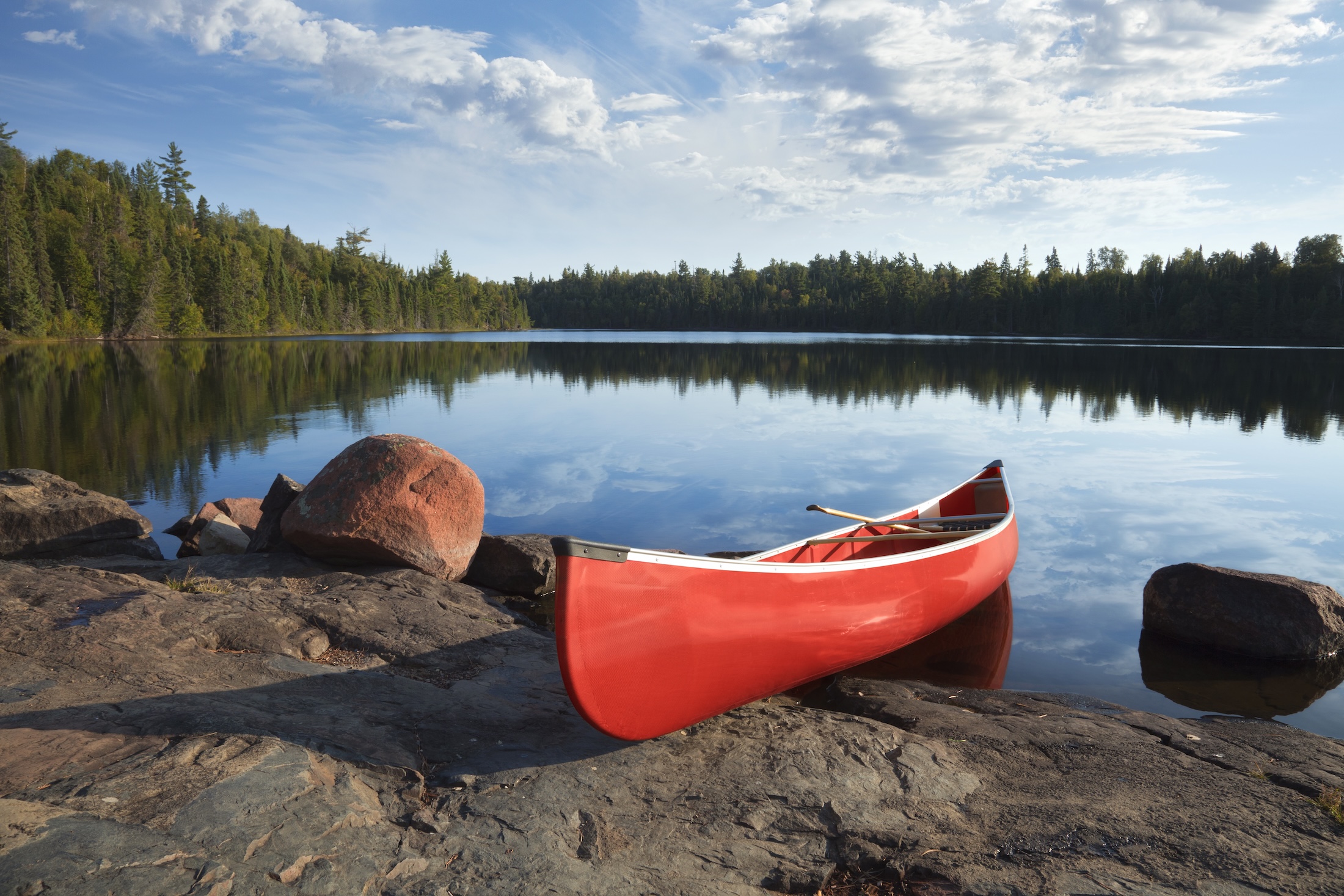
Top image of canoe on a lake in the Boundary Waters of Minnesota is by Dan Thornberg, available via Shutterstock.
2 Comments
Thanks for this good post.
The Boundary Waters fires are connected to climate change. That part of the world is increasingly experiencing flash droughts, heat waves, and severe-tree-damage-causing spruce-budworm outbreaks. All of those are climate-change related and all of them help cause lightning-sparked fires to spread very rapidly, even explosively. That part of the world traditionally had fires mostly in the spring and the autumn. Summer fires are now surging.
Humans are causing climate change. We’re entirely on the hook for that horrible mine proposal, but we are partly on the hook for the fires as well.
PrairieFan Mon 10 Aug 1:42 PM
Prairie Fan is right.
Climate change is real and it’s here. But the Boundary Waters has endured multiple attacks. The law books are full of court decisions over the last 50+ years, regarding proposed developments like the mine in this article, to even allowing motorized vessels on the lakes.
Wally Taylor Tue 11 Aug 10:54 AM