
Former Des Moines Register assistant sports editor Ira Lacher writes about the games and business of sports for various newspapers and magazines.
“Are you not entertained? Are you not entertained? Is this not why you are here?”
The quote is from the 2000 film Gladiator, which followed a deposed Roman nobleman’s quest to avenge the executions of his wife and children. But it could easily be applied to the modern gladiator sport: American football, which brought in about $14.5 billion in revenue in 2025.
According to recent polling, Americans consider football our most popular sport by almost a 2-to-1 margin over baseball. Regular-season NFL games averaged 18.7 million viewers in 2025. By contrast, the top non-NFL telecast last year, a typical episode of the CBS series Tracker, averaged a mere 11 million.
Those who have examined the sport academically understand that unlike gladiator contests, football is hardly a death dealer: Only one NFL player, Chuck Hughes, of the Detroit Lions, died during a game, in 1971.
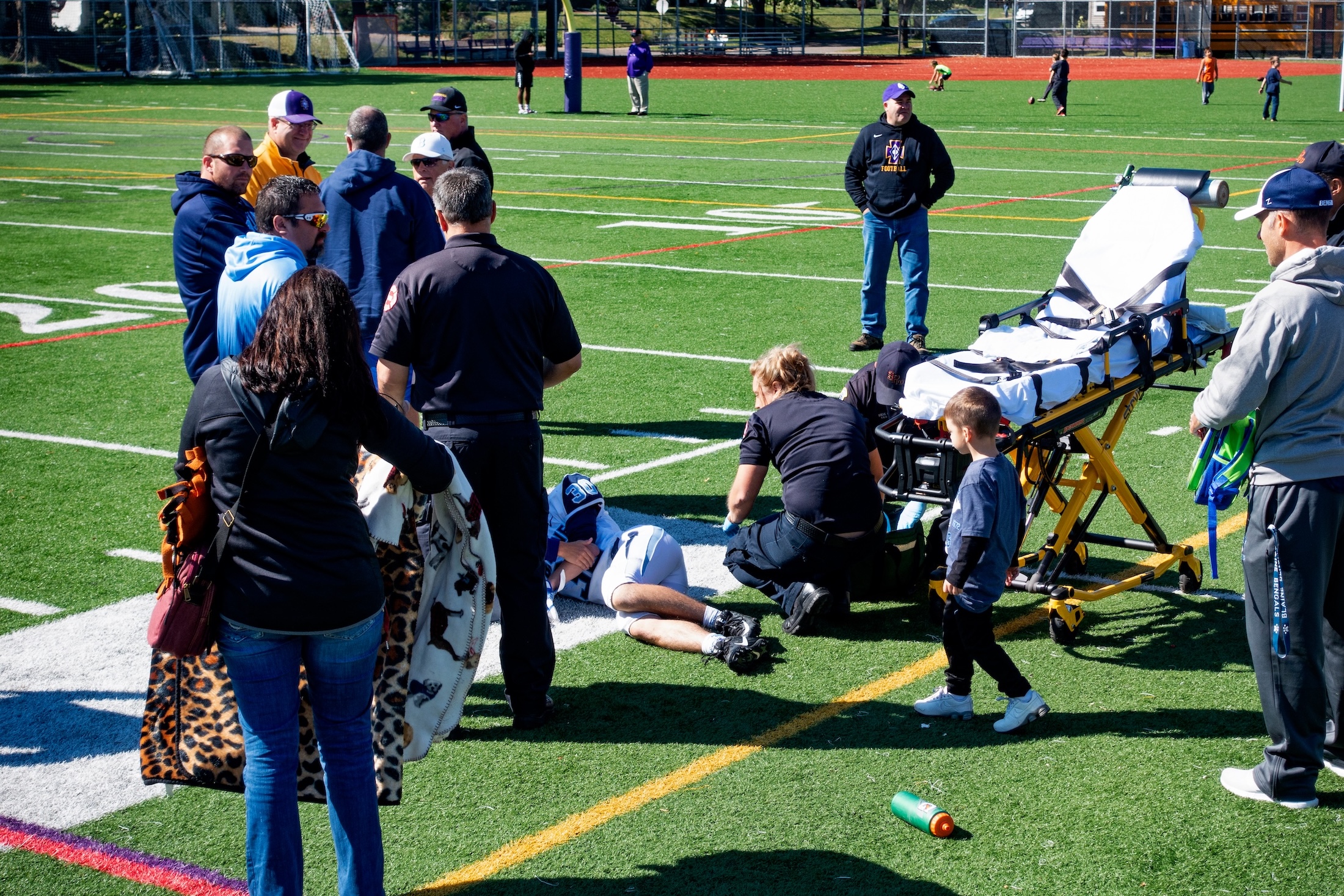
But players get hurt. Seriously hurt.
“In football, there’s a 100-percent chance of injury,” Tywan Martin, an associate professor of kinesiology at the University of Miami, told the school’s media center in 2023. “[B]ased on conversations I’ve had with people in the health care system, with trainers, etc., the human body wasn’t made for this,” Martin added.
Now, we know football kills.
Besides the plethora of concussions, and injuries to shoulders, knees, and various sprains common to football players on every level, is the life-threatening affliction of chronic traumatic encephalopathy (CTE). “It causes the death of nerve cells in the brain, known as degeneration,” the Mayo Clinic notes. It can lead to memory loss, personality changes, trouble with walking or balance, and suicidal thoughts.
Notable players who have been diagnosed, after their deaths, include Aaron Hernandez, Ken Stabler, and Frank Gifford, as well as Junior Seau, who took his own life. The latest study, peer reviewed and published in the authoritative journal BMJ and released August 24, found that CTE-related death was four times as prevalent in former NFL players than in the general population.
“There may be no industry that does so much damage to its workers,” John Branch, who has reported on CTE for The New York Times, wrote in a news analysis for the paper.
Like many workplaces, the NFL has a union. Most unions advocate strongly for the safety of their members. But the NFL Players Association (NFLPA) seemed to adopt the attitude of “remain calm … all is well.”
“We understand that studies like this can create concern for you and your loved ones. At the same time, they should not diminish hope,” the NFLPA said in an email to present and former members, according to USA Today, which published it. It went on:
“According to Dr. Daniel Daneshvar, one of the lead researchers on the study, ‘Many of the symptoms associated with CTE are treatable with the right care.’ He stressed that ‘While we don’t have a cure yet, we have seen improvements in players who receive care from doctors specializing in neurodegenerative disease and who know how to treat athletes. No one should walk away thinking there’s nothing they can do.’”
In other words, keep calm, carry on, and die. Which is what football players continue to do.
Steve Almond, who, in 2014 wrote a book explaining why he quit watching football after 40 years, attributed Americans’ continued adulation of the sport despite its obvious mortal dangers to a “suitcase of rationalizations.”
“There is a sort of great bargain, this sort of dirty deal of capitalism,” Almond told Branch in the Times article. “We all know that there’s a slaughterhouse, but we also love the bacon cheeseburger. So we don’t really focus too much on the slaughterhouse.”
As of August 26, the NFL hadn’t responded directly to the study. It has continued to tout what it says are proactive player safety improvements such as rules changes and equipment innovations, including the soft-shell guardian cap.
But like the U.S. tobacco industry, which was well aware of the dangers of smoking for years before being exposed, the NFL has been aware of the cause-and-effect relationship between football and CTE for ten years. During a U.S. House roundtable discussion about concussions on March 14, 2016, Jeff Miller, then and now a league executive, responded to a question from Illinois Congresswoman Jan Schakowsky about whether the NFL believed such a relationship existed. “The answer to that question is certainly yes,” Miller said.
As America approaches the new football season, for high schoolers, collegians, and the NFL, there is little to expect that Almond’s suitcase of rationalizations threatens to burst at the seams. No one seems to want to tamper with a 14-billion-dollar juggernaut.
But there is precedent. When the U.S. government ordered warnings to be placed on cigarette packs in 1965, the U.S. tobacco industry hauled in $8 billion — more than $86 billion in today’s dollars, or six times what the NFL brings in today. An estimated 70 million Americans, about 40 percent of the U.S. population, were smokers then. Today, that figure has fallen to an estimated 25 million, less than 10 percent, thanks largely to decades-long, continuous antismoking campaigns.
Will that happen with football? There are hopeful signs. According to the Aspen Institute, tackle football participation declined by 7 percent from 2014–2024. At that rate, it will take several generations before “Mothers, don’t let your babies grow up to be football players” becomes a mantra in American homes.
But that’s a lot of bacon cheeseburgers. And slaughterhouses.
Top photo of medics with mobile gurney treating injured football player in 2018 is by Steve Skjold, available via Shutterstock.