
“He had an amazing ability to stay focused on what was important,” John Norris remembered at a March 7 gathering for Iowans who were involved with Reverend Jesse Jackson’s 1988 presidential campaign.
The group came to the Machinists’ Hall in Des Moines to swap stories before watching a livestream of Jackson’s “Homegoing Celebration of Life” at Rainbow PUSH in Chicago.
I was deeply moved by what I heard during the hour-long event. My full recording is at the end of this post. Here are some highlights.
“It was the easiest campaign I’ve ever worked on”
As Jackson’s state director and first hire in the pivotal caucus state, Norris was “blessed to have a front seat” to the campaign. He has a lot of experience as a staffer or strategist for Democratic candidates. But Jackson’s “was the easiest campaign I’ve ever worked on,” he said.

John Norris speaks to fellow Jackson fans (photo by Dave Leshtz)
Usually one of the biggest challenges for staffers is generating interest in your candidate, Norris explained. The opposite was true for this campaign: they needed to make sure the room would be big enough for everyone who wanted to hear the reverend speak. Not having to worry about building a crowd “was an incredible gift to a campaign staff.”
The candidate would visit high schools, and even in northwest Iowa—the most heavily Republican part of the state—parents would show up as well as students. Jackson would urge kids not to do drugs, and lead them in “I am somebody” and “Keep hope alive.” Norris said he was “so grateful” to be there for those “magical moments.”
“My favorite political event of all time”
While most presidential candidates set up a campaign headquarters in the Des Moines metro area, Jackson opted to run his caucus effort out of the small town of Greenfield (Adair County). The well-known activist Dixon Terry farmed in the area. He had met Jackson at the 1984 Democratic National Convention, and later advised him on rural issues.
Norris argued that Jackson’s “political genius” was underrated. Many people credited Norris for locating the headquarters in Greenfield, possibly because he was from the southwest Iowa town of Red Oak. But “That was all Jesse’s idea.” He didn’t want the national reporters to visit an office in downtown Des Moines. He wanted them to see “all the volunteers we had” and “the movement in rural Iowa behind his campaign.”
Susie Olesen remembered Jackson coming to Greenfield on Superbowl Sunday in 1987—weeks before Norris was hired. She and her husband Willard thought it was a bad idea, because no one would go out in the cold for a political event while the Superbowl was on TV. But they were wrong: the United Methodist Church “was packed.”
Afterwards a group went to local attorney Jay Howe’s house. That’s when Jackson said he thought he’d put his headquarters in Greenfield. (Howe became one of the campaign’s Iowa co-chairs, along with civil rights icon Evelyn Davis of Des Moines.)

From left: Willard Olesen, Susie Olesen, and Donn Stanley on March 7 (photo by Dave Leshtz)
Willard Olesen was “star struck” at that first meeting at Howe’s house. He’d overheard someone mention a planned visit to Dixon Terry’s farm the following morning. So when it got late, he told the reverend he should get some rest because he was going to milk a cow in the morning.
Jackson looked at him and said, “Mr. Willard, I ain’t gonna milk no cow in the morning.”
He was wrong, of course. The instant classic photo by John Gaps of the Associated Press appeared in every major newspaper in the country.
Norris said the official campaign launch in Greenfield in the fall of 1987 remains his “favorite political event of all time.” He described it this way at the 35th reunion for the Jackson campaign in 2023:
The high school band marched with the Jackson ’88 parade from the town square to the 4H Fairgrounds. Jesse rode in a convertible. The Future Farmers of America stood alongside the road with a “Welcome Home Jesse” sign. At the fairgrounds we had a huge circus tent where the Boy Scouts led the Pledge of Allegiance. We had a gospel choir from Waterloo, the Teamsters Blue Grass Band, and a reggae band. The Pork Producers provided pork burgers. Can you imagine that happening today?
The warm reception in Greenfield empowered Jackson’s Iowa team to tell that story around the state. This candidate could appeal to farmers and others outside urban areas.
“We had to raise the money in Iowa”
Jackson’s national staff, based in Chicago, didn’t see the reaction he was getting at his early Iowa events. They “weren’t believers” in the Iowa strategy, Norris remembered. So the local staff had to raise the money to run the Iowa caucus campaign. That was “unheard of.”
Other presidential candidates were funneling their national money into Iowa. According to Norris, the Michael Dukakis campaign was flying staff into Omaha or Moline or Minneapolis, or hiring staff to do caucus-related work from other locations, so it didn’t count against the capped spending in Iowa.
(I didn’t know that in those days, the Federal Election Commission enforced state-level spending limits for presidential campaigns, based on the voting-age population and the cost of living. For Iowa, the limit in 1988 was $775,217.60.)
Norris laughed as he remembered, “They’re blowing the ceiling off the spending cap, and we’re passing the hat at churches.”
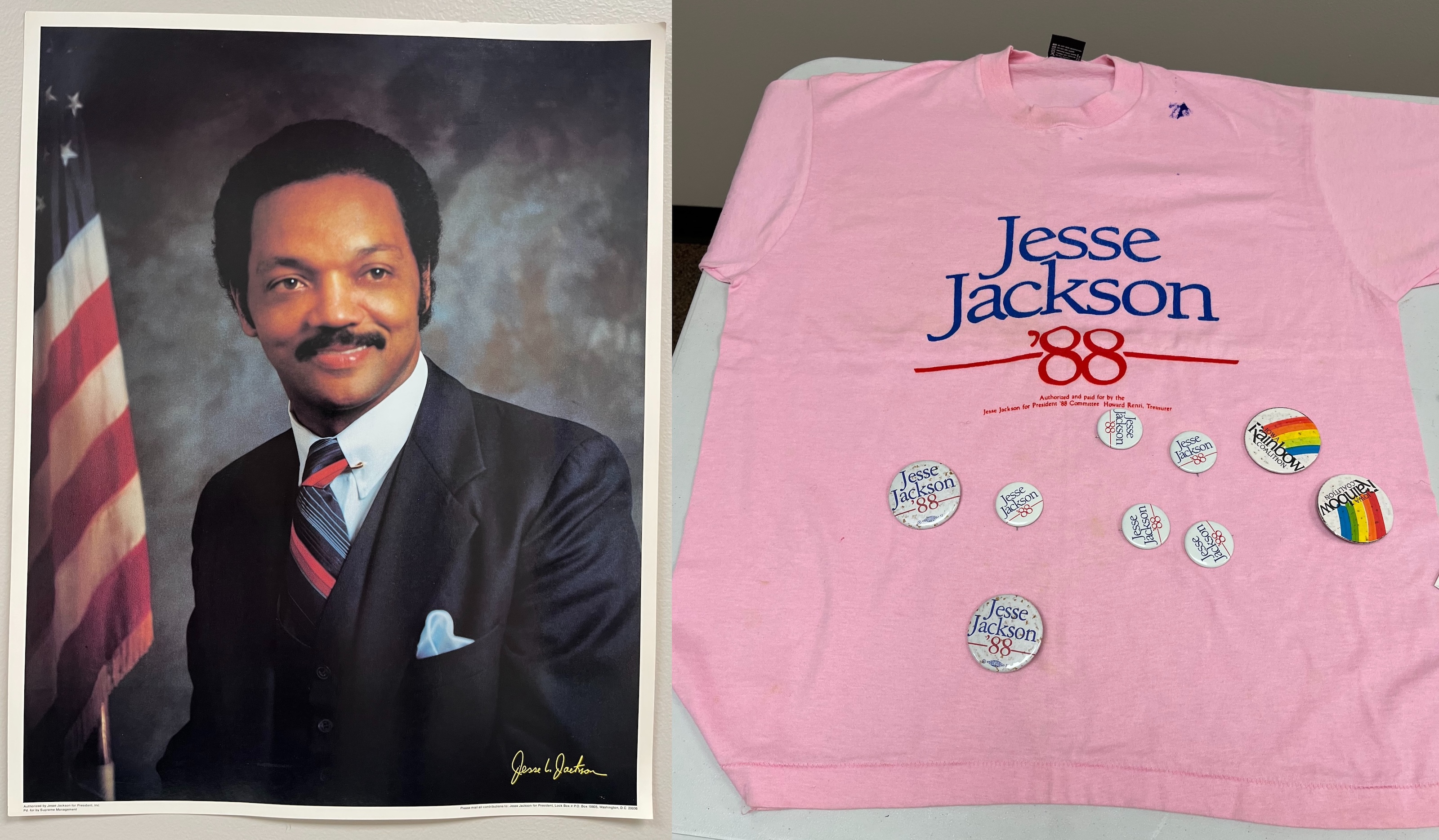
They found a vendor to make some buttons and discovered that people would buy anything with Jackson’s name on it. Buttons or t-shirts would sell out quickly. They raised a lot of money by selling these campaign items in other states.

Some of the campaign buttons Norris brought to the March 7 event (photo by Al Womble)

“Just say Jesse” shirt with buttons (photo by Al Womble)

Pink Jesse Jackson ’88 shirt with buttons (photo by Laura Belin)

Norris brought some “Run Jesse Run” albums featuring Lou Rawls and other performers (photo by Laura Belin)
“It made us stronger”
Reflecting on those days, Norris sees “some value in having to scrap” and find non-traditional sources of funding. He believes “it made us stronger.”
There were some challenges, though. The Iowa Democratic Party used to raise money by selling hundreds of Jefferson-Jackson dinner tickets to presidential campaigns. Jackson’s team didn’t have the funds for that. Norris ended up negotiating with Bruce Babbitt’s team for the Babbitt campaign to buy a large block of tickets. They gave the Jackson campaign half of their allotment.
At the dinner, “We had half as many as anybody else had,” but “we made ten times the noise.” Jackson’s speech helped their momentum going into the last stretch of the campaign.
After spending most of 1987 “passing the bucket” to raise money, Norris said, things started to change around October. Jackson’s political consultant Jerry Austin realized what was happening and understood the importance of doing well in Iowa. National funds started coming in to hire more staff. They could even afford to go up on television before the caucuses.
Norris told me the influx of money “actually came at the right time, because it forced us for about six months to just build a largely volunteer-driven operation.” Then when they had money to spend, it brought a new level of energy. Because Jackson was activating many voters who hadn’t participated in the Iowa caucuses before, the campaign printed up a “how to caucus” pamphlet and organized trainings all over the state.
Norris still believes that if the Jackson campaign had spent even a fourth of what the Dukakis team invested in Iowa, they could have placed third in the caucuses, ahead of Dukakis. Then it would have been “a whole different national primary.”
Even the fourth-place finish in Iowa was important, showing people “It’s okay to support Jesse.” That contributed to Jackson’s strong performance in other states, winning eleven primaries and caucuses, most notably Michigan.
“Tell them you’re a realist with high ideals”
Dave Leshtz of Iowa City started working on the campaign in the spring of 1987. Last month, he recalled things the reverend said “that ring truer than ever for me.” Jackson would talk about electing candidates “from the courthouse to the White House.” He would say, “A good rural policy is a good urban policy.”
One conversation was particularly meaningful. Leshtz told Jackson about the skeptical people he encountered while organizing in Johnson County. They would say it’s unrealistic to support Jesse Jackson in such a white state. What should he tell those who thought he was a foolish idealist?
“Tell them you’re a realist with high ideals,” Jackson said. Leshtz has “remembered that my entire life.”

From left: Carl McPherson, Dave Leshtz, Miriam Tyson (photo provided by Dave Leshtz)
Norris remembered they used to call those people the “Jesse, but” crowd, because so many Iowans (especially in Johnson County) would say “I like Jesse, but…” The staff would respond, “If you like him, you don’t need a but! Just go with your heart. You don’t have to be a political analyst on this thing.”
“The chicken-and-biscuit circuit”
Willard Olesen was able to take quite a bit of time off from his work as an attorney to help Jackson’s campaign. He would drive, carry luggage, deal with reporters, handle advance work, or any other job the candidate needed doing.

Willard Olesen telling stories (photo by Al Womble)
Olesen occasionally traveled with Jackson to other states. He recalled a visit to Concord, New Hampshire. They were snowed in at their hotel and couldn’t get to whatever event was scheduled for that day.
Jackson decided to spend the morning getting his message out to Iowans through small-town radio. Olesen called many stations. He’d ask to speak to the news director and would explain that Reverend Jackson was available to talk. He’d try to throw in local references. For instance, when Jackson got on the phone with the news director for KJAN radio, he would say something like, “How’s everything in Atlantic, Iowa? I understand you Trojans are going to play the Harlan Cyclones Tuesday night.”
That same snowy morning in New Hampshire, Jackson was displeased with a long Washington Post article about the Dukakis campaign, which only included a paragraph or two about his own campaign. He asked “Dr. Olesen” (as he often called him) to get the newspaper’s editor Ben Bradlee on the phone.
Olesen didn’t have any contacts at the Post, but he called the number he found on their copy of the newspaper. Somehow he was able to get a receptionist to put him through to Bradlee and handed the phone to Jackson. He heard the reverend say, “I’m a little tired of you covering the filet mignon circuit. Come out to Iowa and see what I’m doing on the chicken-and-biscuit circuit.”
“He embraced everybody”
Miriam Tyson, a longtime labor leader in Waterloo, led the Rainbow Push coalition in Iowa. “It was so much fun to be around Reverend Jackson.”
She recalled hosting Jackson several times. Once, his advance team called to ask if she wanted him to come to Waterloo. She said yes, “but he has to be gone by five o’clock.” She had tickets to a Janet Jackson concert that evening in Ames and didn’t want to be late.

Miriam Tyson reminiscing (photo by Al Womble)
The Waterloo event went well, but so many people came out to Sullivan Park, it was a challenge to get Jackson out in time for Tyson to make her concert.
She emphasized that Jackson “wasn’t just a politician. And what I loved about him was, he embraced everybody. He didn’t care if you were Black, white, purple. He didn’t care if you came from a metropolitan area, or if you came from rural. And I loved that about him. Because he embraced everyone.”
For Tyson, the people who supported the 1988 campaign were “like a family. And we could do anything.”
“He lived that every single day”
The attendees mostly shared happy memories at the gathering in Des Moines, but Leshtz brought up one troubling moment. In the “Iowa caucus memoir” he wrote for Bleeding Heartland after Jackson passed away, Leshtz described it this way:
After an event at a hotel in Cedar Rapids, Norris and I were in a van picking up Reverend Jackson at the front entrance. As we pulled into the circle driveway, Jackson was pacing in the big lit-up doorway of the hotel. He got in the van without a word. Usually, he was exuberant after a successful event, but this time he seemed angry. We were only a few seconds late, I thought to myself – it shouldn’t be that big of a deal. Finally, Jackson turned to Norris and said, “Don’t ever leave me exposed like that.”
I looked back at the front of the hotel. Sure enough, the brightly lit double doors provided a perfect frame for an assassin’s bullet. It drove home to me the ever-present danger that Rev. Jackson lived with, and the awesome courage it took to face that ever-present danger nearly every single day.
Norris remembered the incident, which he described as “eye-opening” for a “couple of white guys” from Iowa. They realized Jackson “lived that every single day.”
They never made that mistake again.
“So human and real”
For Susie Olesen, the things Jackson did that affected her most deeply “weren’t very grand. They were just so human and real.” She recalled a winter day when she and a friend were staffing a sign-up table in Des Moines, where Jackson was speaking to the Businesswomen of America conference.
The reverend always, always, always invited the people who did the labor to the room. And he said to these women from all over America who were really successful, “You know, you’re here because somebody here made your bed. And somebody here fixed your breakfast.”
Jackson reminded his audience that those working people “took the early bus downtown.”
After a lightning strike cut Dixon Terry’s life short in 1989, Jackson came to his friend’s memorial service in Greenfield. It made a lasting impression on those who witnessed it. The New York Times reported at that time, ”’We will make sure you do not lose your farm,’ Mr. Jackson told Ms. [Linda] Terry from the altar. ‘Your children will be educated. We have an obligation to Dixon.”’ Linda Terry was also present at the March 7 event in Des Moines, though she did not speak.
Echoing Tyson’s remarks, Norris said Jackson “loved everybody” and recounted several anecdotes that showed the candidate’s “gracious, caring” side.
Carl McPherson, who was Iowa’s long-term care ombudsman when he first met Jackson during the 1980s, recalled how attentively the reverend listened and absorbed information, even when surrounded by distractions.
Listening to all of these stories, one thing puzzled me: why did people quote Jackson calling his staffers “Dr. Norris” and “Dr. Olesen”? Neither man is a doctor.
Before Norris left the Machinists’ Hall, I asked about the moniker. He laughed. “He just liked to call us that.” Even at the 2023 reunion in Chicago, Jackson greeted him as “Dr. Norris.”
But why? “I don’t know,” Norris said. “He had a way of making you feel valued. […] It was part of what made you love him.”
Laura Belin’s full video of the “Iowa Celebrates Jesse Jackson” event on March 7, 2026 at the Machinists’ Hall in Des Moines.
There is some background noise beginning around the 38:00 mark, as a television in the room played the live-stream of Jackson’s funeral service. After the main event ended, John Norris answered a few of Laura’s questions, starting around the 58:00 mark.
3 Comments
Back when it was truly the Iowa Caucus
Lots of fond memories from the 1984 & 1988 Iowa Caucuses. I was a county chair for Gary Hart both times and met Rev. Jackson a few times on the campaign trial. He was a dynamic speaker and campaigner and knew how to work a crowd. Attended the “JJ Dinner” both of these campaign cycles as it was a fabulous event. Iowa used to set the “gold standard” on how to run a caucus and was the envy of the national media. Felt that Jackson having the headquarters in Greenfield(home of film “Cold Turkey”) was a stroke of genius.
ModerateDem Sun 5 Apr 9:00 AM
What a great write-up
I was so fortunate to be able to volunteer full-time for Paul Simon’s Iowa campaign that summer of 1987 before going off to college.
These stories from the campaign trail brought up a lot of happy and hilarious memories for me. After eight long years of Reagan, and the bad farm economy, there were fired-up Dems all over the state, in every small town. Lots of events in main street cafes and farmers’ machine sheds.
On the Simon campaign we were mostly focused on Gephardt and Dukakis. I had totally forgotten that Jackson came in fourth in the Iowa Caucus.
C. K. Hartman Fri 10 Apr 3:30 AM
No title
Good to hear from you!
There was so much energy for Democrats in Iowa in 1987 and 1988. If anyone is wondering how bad the farm crisis was, I recommend looking at the 1988 presidential election results by county. It still blows my mind that Dukakis won so many rural counties.
Laura Belin Fri 10 Apr 10:05 PM