Bruce Morrison is a working artist and photographer living with his wife Georgeann in rural southeast O’Brien County, Iowa. Bruce works from his studio/gallery–a renovated late 1920s brooding house/sheep barn. You can follow Morrison on his artist blog, Prairie Hill Farm Studio, or visit his website at Morrison’s studio.
Iowa’s Western Echinacea
For many years I have become familiar with the Narrow-leaved Purple Coneflower (Echinacea angustifolia), sometimes just referred to as Narrow-leaved Echinacea. In our northwest corner and the entire western edge of Iowa, this is the most common native Echinacea species.
The BONAP’s North American Plant Atlas (NAPA) shows it as stretching as far as from western Iowa and Minnesota, all the way to Montana, Wyoming, the Dakotas, down through Nebraska, Oklahoma, Colorado, Texas, and into New Mexico.

Lets first take a look at E. angustifolia‘s cousins here in the state and do a little clarification and wildflower house cleaning. I’ve witnessed a lot of confusion both in the field and online with Iowa’s “Purple Coneflowers.” Sometimes more than a quick glance is needed, but there are some easy ways (for the lay person) to make proper identification. (All our Echinacea species are perennial.)
For any visual clues with different Purple Coneflowers, each species’ leaf and ray structures are simple clues; I’d also add “plant height” there too. And one also could have used their “location” many years ago, but not so much now—more recent introduced distribution has changed things a bit.
Echinaceas are familiar to nearly everyone, and they’ve been adapted and hybridized for use in gardening for many years. The familiar tall stem with the reddish brown head and a flurry of purple rays (petals) are almost a flower garden staple. But the most commonly planted garden variety is only native in extreme southeast Iowa. That is the common Purple Coneflower (E. purperea) as seen below with a nectaring Monarch Butterfly.

The other commonly known native species is the Pale Purple Coneflower (E. pallida), this one is likely the widest ranging native Echinacea in Iowa; most common from Iowa’s eastern border through two thirds of the state westward. In recent years E. pallida has been introduced throughout the state in areas it was not previously recorded historically.
A major player in E. pallida‘s introduction further west in Iowa, has been through the Integrated Roadside Vegetation Management program through the University of Northern Iowa. The program is designed “to assist Iowa counties and cities in establishing sustainable, low-maintenance native prairie vegetation along roadways to control erosion, improve water quality, and enhance wildlife habitat.”
Here is a Pale Purple Coneflower from a planting done by O’Brien County (where we live) some 20 years ago, along our gravel roadside.

Our Narrow-leaved Echinacea is a short plant – rarely over 18-20 inches tall here, but may get to be around 24″ or slightly more elsewhere. The Pale Purple Coneflower is much taller and somewhat lanky to my eyes; over 3 feet tall here in our ditches and where it has made an incursion into our south pasture (bird introduction I presume). The garden variety Purple Coneflower (E. purpurea) is taller than the Pale purple cousin. We’ve got some along the back of our barn that are nearly chest high.
I’ll post some comparative photos below, illustrating the leaf structure of each of these.
You’ll note the E. purpurea is roughly toothed and ovate, while the E. pallida and E. angustifolia are both lancelate and untoothed – the E. pallida “much” longer – almost 18″ in our example from our ditch and pasture, and just barely ovate in it’s mid structure.
Our local native Narrow-leaved Echinacea leaf is only about 8″ at best. These are leaves I’ve taken from the base of the plants, as they are the longest/largest examples.
One thing I noted when harvesting the largest leaves from the base of these plants – the Narrow-leaved Echinacea and the Pale Purple Coneflower leaves have a slight fold to them—like you see on Maximillian Sunflower leaves. I had to press these overnight to take the example shots as they wouldn’t lay flat. The “regular” Purple Coneflower (E. purpurea) lower plant leaves don’t exhibit this trait.

The flowering heads of each Iowa Echinacea are roughly the same size.
The rays are fairly characteristic and an easier visual clue if not taken too hastily. Our Narrow-leaved Echinacea rays do eventually droop and curl a bit as the blossom matures, but absolutely nothing like the almost spaghetti string appearance (my words) of the very long and narrow fallen rays of the Pale Purple Coneflower. The regular Purple Coneflower (E. purpurea) has the heaviest ray structure and does droop modestly as the flower matures.
All vary in coloration from the heavier intense purple (most common to E. purpurea) and all variations in between, to what could almost be called white on older blossoms. I do find our Narrow-leaved Echinacea averages a niche of purple to pink – sort of mid range in coloration. Whether that is just normal here in our pasture’s soil, or if it’s the average everywhere, I don’t know.

A profile of the two most common natives – E. pallida and E. angustifolia show the marked difference in ray droop and appearance. Mature blossoms of the E. purpurea would be similar to the E. angustifolia except for the size and number of rays.
Both illustrations (the one above and the one below) also show the marked rays dimension – E. pallida = very narrow and almost extreme length and “stringy” appearance. E. angustifolia = shorter length and similar profile as E. purpurea, and less numerous rays.

Our Narrow-leaved Echinacea has hairy/rough leaves and stems. Leaves are mostly basal, with widely spaced stem leaves—alternately attached on the lower half of the stem. The lower leaves are long and narrow, up to 8 inches long and ½ to 1 inch wide – on long stalks, becoming smaller and stalkless as they ascend the stem. Leaf edges are toothless with 3 distinct veins along the length. The following images also show that slight folding characteristic mentioned earlier.


Looking at our pasture’s Narrow-leaved Echinacea, many different stages are seen here as far as the heads and rays forming and actually drooping. But don’t let that “droop” fool you—these rays are very short compared to its Pale Purple Coneflower cousin. Always make note of the plant’s height and leaf size we mentioned before.


This clump of E. angustifolia is quite short, 18 inches when this image was taken. The leaves are barely 8 inches at their longest – another real good indication that we’re looking at E. angustifolia.

There is only one flower at the end of the stiff hairy stem. The flowers have 15 to 20 pink to light purple rays (petals), that are 0.75 – 1.5 inches long and 0.25 to 0.33 inch wide. Rays have three notches at their tips, and grow out and up, drooping down and curving under with maturity. The center is a large reddish brown disk, round to conical in shape; this is covered with small reddish brown disk flowers with yellow pollen.
You can see these small reddish brown disk flowers with yellow pollen in the following images.


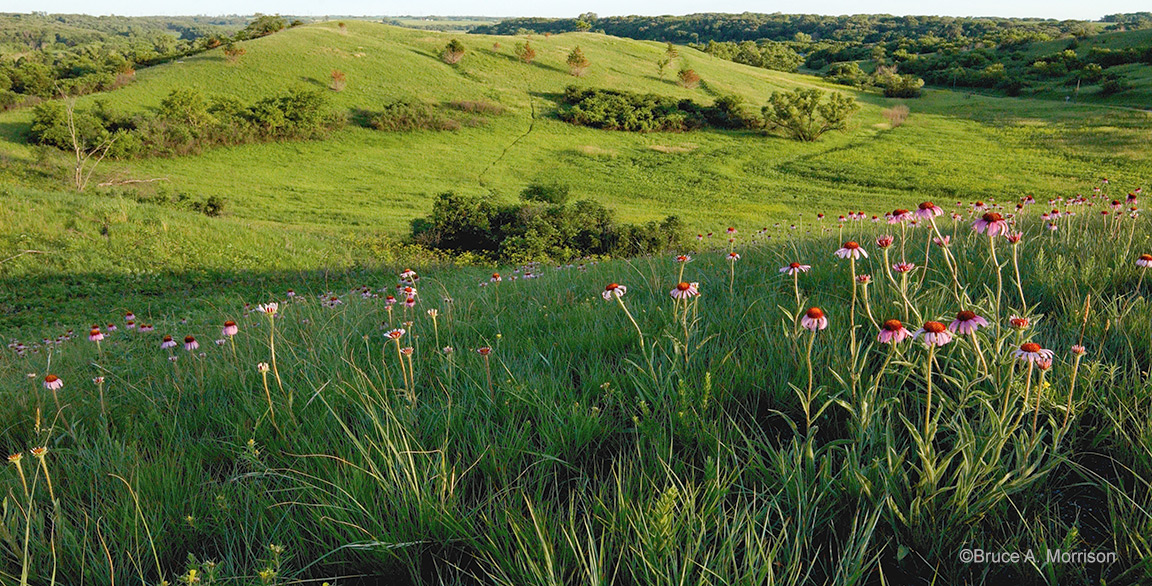
The Narrow-leaved Echinacea here in southeast O’Brien County start blooming in mid to late June. Those here seem to prefer upland prairie, drier sites. Most of ours are on the edges, tops, and sides of the gravel esker that makes up our north pasture. And on top of the gravel hillside in our south pasture as well. They are quite common south of us on state and county preserves like the Waterman Prairie Complex and the McCormack area. It is the most common Echinacea in Iowa’s western counties and in the Loess Hills.


The cylindrical to oval shaped disks dry quite hard in mid to late fall. When we do harvest the seed for ourselves, we always leave a good deal on the stiff stems for the birds; they are coveted by all types of sparrows and goldfinches, through the late fall and winter months.
What we do harvest ourselves is used for over-seeding areas that are recovering from decades of over grazing before we arrived here. I find the dried cones difficult to break apart and will often just toss them around whole and intact. Many times in early spring, when I inspect an over-seeded area, I’ll find them with their progeny, indicating successful germination.

Some curious tidbits regarding Echinacea have become known through their medicinal properties or uses, such as E. angustifolia‘s use by the Plains Indians for relief from tooth aches and even bee stings and snakebites! It was also a known remedy for sore throats. Apparently chewing the roots could numb the mouth and throat, giving relief from pain. And other medicinal properties must exist as you can find extracts of Echinacea in many herbal medicines and supplements to this day.
“Echinacea” – is derived from the Greek word “echinos” which means “hedgehog” or “sea urchin”, an obvious reference to the plant’s flower head. “Angustifolia‘ is actually Latin rather than Greek. It directly translates to “narrow leaf”, combining the Latin word angustus – meaning “narrow” or “constricted”, and folium – meaning “leaf”.


But no matter how you look at it – Narrow-leaved Purple Coneflower is a keeper. A beauty by any standards in western Iowa!
A Prairie Moment – Narrow-leaved Coneflower (Echinacea angustifolia)
Editor’s note: Subscribe to Bruce Morrison’s YouTube channel to see more “Prairie Moment” videos.
3 Comments
Thank you, Bruce
Besides featuring beautiful photos, this post is the easiest handiest guide to separating these species that I have seen. I will remember it.
As an aside, I remember when the Integrated Roadside Vegetation Management Program began in Iowa. I’ve always appreciated the IRVMP and have helped the IRVMP in my county. However, I wish all county IRVMPs had been able to start and continue with a commitment to trying hard to plant, in each county, only species native to that county. Better funding could have helped.
And I really wish I hadn’t seen nice roadside plantings fall victim to farm spray drift. I’ve seen good plantings with twenty-plus blooming species dwindle down to one or two. Most Iowans have no idea how much drifting spray there is in Iowa, or how much damage it does. Iowa Big Ag should be grateful for that ignorance.
PrairieFan Thu 16 Jul 10:41 PM
Thank you Prairie fan
I well remember the IRVM first coming to O’Brien County and speaking at the community college. It was a great idea and still is, but yes, the follow-through and funding is life blood to this and countless other programs and initiatives.
We are so aware of over spray and drift here – lost our acreage’s “homestead” Red Pine to dicamba drift back in 2018. Virtually everything in the yards and gardens ‘cupped” and lost leaves…the old pine dropped 60% of its needles within 24 hours. We are all held hostage to it.
Prairie Painter Fri 17 Jul 9:31 AM
Prairie Painter
So sorry. I’ll remember your story.
PrairieFan Sat 18 Jul 12:00 AM