
Diane Porter of Fairfield first published this post in late August on My Gaia, an email newsletter “about getting to know nature” and “giving her a helping hand in our own backyards.” Diane also maintains the Birdwatching Dot Com website and bird blog.
My garden has been a golden extravaganza this summer. Masses of Partridge Peas (Chamaecrista fasciculata) planted themselves with the seeds that fell from last year’s plants. For a couple of months, they have bloomed with enthusiasm and with no help from me.
And they’ve been mobbed with bumblebees.

The Partridge Pea patch
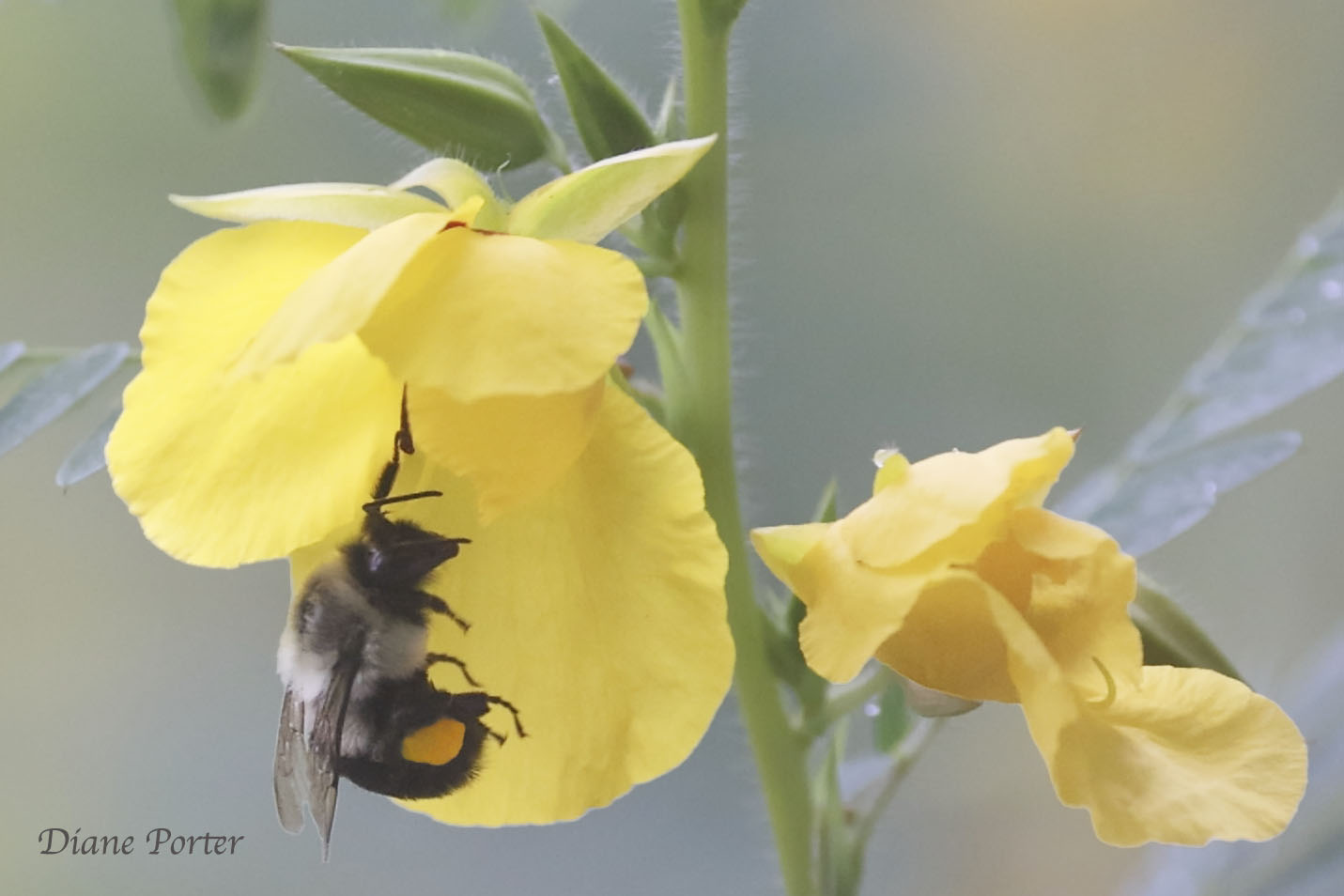
When a bumblebee lands on a yellow blossom, the flower nods its head under the weight. Sometimes the bee finds herself hanging on from below.

Bumblebee on Partridge Pea blossom
Often she dangles down by one front leg, with her other five legs waving around wildly. When I first saw this happen, I wondered if the bee might be trapped, with a foot caught in the flower somehow.

Bumblebee hanging by one foot under the flower
However, she detaches after a few seconds. She flies on to another blossom, and then another and another, with passionate focus.
Between blossoms, she may hover for a few moments, legs gesticulating. I took a slow-motion movie in the hope of discovering the meaning of all that leg motion. At 1/4 normal speed, the video revealed that the bee was brushing her legs over her body and head.
Video by Diane Porter
I wondered if she was sweeping up pollen from her body. When she patted at the loads of pollen on her hind legs, she seemed to be packing the pollen.
I had not yet actually seen her collect any pollen. However, looking closely at a magnified photo, I could just make out a fine powder covering her body. The bee was not removing the pollen by licking, sucking, or grabbing it. She was vibrating it out of the center of the flower and letting it drift onto her body. If you’re viewing on a large screen, you might see pollen dust on the bee:

She raked it up with her legs and secured it in those two yellow pollen baskets.
Partridge Pea anthers
A bee often hangs on by the red, purple, or black structures that emerge from the flower’s center. These are the anthers, the floral structures which produce pollen. Partridge Pea anthers look like little tubes or straps.

Some Partridge Pea anthers are bright red. Others are purple or black.
It is not immediately obvious how the bumblebees get the pollen out. Even under a microscope, I can’t see any pollen. It’s concealed entirely inside the tubular anthers, and it does not fall out by itself.
However, a bumblebee can vibrate it out, by buzz pollination. The bee activates her flight muscles while keeping the wings still. The center part of her body, the thorax, vibrates, and the vibration jiggles the pollen free.
Partridge Peas, along with many other flowering plants, keep their pollen inside anthers that open only when stimulated by buzz pollination. Certain bees, including bumblebees, can do it. Honeybees cannot buzz-pollinate.
If you’re close to bumblebees at work among Partridge Peas, you can hear the buzz pollination. It’s different from the buzzing of flight. It sounds tinny, higher pitched, and quieter.
Here are ten seconds of a bumblebee buzz pollinating Partridge Peas. First you hear the normal buzz of the bee in flight. When she lands on a flower, the sound changes as she stops moving her wings and vibrates her body. (You may need to turn up your speaker volume.)
Video by Diane Porter
The anthers
Each Partridge Pea blossom has ten anthers. Under the microscope, a line appears along the side of each anther, like the satin stripe down the seam of tuxedo trousers. I expected to see pollen coming out along those lines, but no gap allows any pollen to escape.
At the outer tip of the anther is an opening, or rather two openings, like the snout of a pig. These openings are the pollen’s escape hatches. They are the pores through which the bee vibrates out the pollen.

The ten anthers, magnified

Tip of an anther, under higher magnification
Partridge Pea reputedly is particular about what frequencies persuade it to release its pollen. I tried shaking a few flowers by hand and had no results whatever. Then I tried vibrating a flower with the handle of an electric toothbrush. That didn’t release the pollen either.
Just to make sure that pollen was truly inside, I carefully sliced through an anther under the microscope. And yes, it did contain pollen. The pollen is so fine it’s almost invisible, and it’s difficult to separate one grain visually from another. Here are two microscope views of a split anther revealing hidden pollen:


Once when the light was just right, I actually saw fine grains of pollen blowing away from a flower where a bumblebee was working. Her body must have interrupted only a fraction of the total. She caught some of it, though, probably to take back to her colony, where the pollen would help feed the developing larvae.
In the process, she pollinated the Partridge Peas. The bee colony got fed, and the plants got their chance to make seeds.

Partridge Peas coming up all over