
Katie Byerly of Cerro Gordo County is also known as Iowa Prairie Girl on YouTube.
In spite of its tall, straight stature (between 2-5 feet tall), Prairie dogbane (Apocynum cannabinum), also known as Indian hemp, is often overlooked.
I really like Prairie dogbane. I often say out loud, “Oh, look, Prairie dogbane!” Sometimes I’m pointing it out to others. But more likely I’m just saying it to myself—and probably to the plant itself. I feel the plant needs to know it’s appreciated.

A lone Prairie dogbane in a country ditch in Cerro Gordo County
With its tiny white flowers, Prairie dogbane is not a showy wildflower. I like its waxy round leaves and waxy purple stem. I like how it stands along a fence row or in a poorly drained ditch, along the side of a woodland or beside a body of water, or even in the middle of a wet prairie.

Another image of a lone Prairie dogbane in my prairie. This is a low spot in the prairie and will puddle after a heavy rain.

The opposite growing leaves on Prairie dogbane are oval, with a pointed tip. They narrow and are rounded at the base. According to the Minnesota Wildflowers website, the leaves can grow up to 6 inches long and 2 ½ inches wide. The leaves generally point up.

“Leaf venation is pinnate,” writes the Illinois Wildflowers website. Pinnate means “feather-like.” You can easily see the white, creamy pinnate veins in this image.

“When petioles are present, they are up to ¼” long, light green, and glabrous; otherwise, the leaves are sessile,” writes Illinois Wildflowers. “Petioles” are commonly known as stalks. “Glabrous” means smooth, hair-free. “Sessile” means having no stalk.
This image shows a group of stalkless lower leaves around the equally smooth purple plant stem. The stem may start out a light green, turning a deep purple red or even glaucous (a dull grayish green/blue color).

Because of its round, smooth edged, oval leaves, Prairie dogbane is often confused with Common milkweed. And just like milkweed, dogbane leaves and stems “contain a milky latex that is bitter-tasting and toxic.” Due to its bitter taste, mammals usually avoid eating this plant. Apparently somewhere in human history, someone saw a dog eat dogbane and the poor creature died.
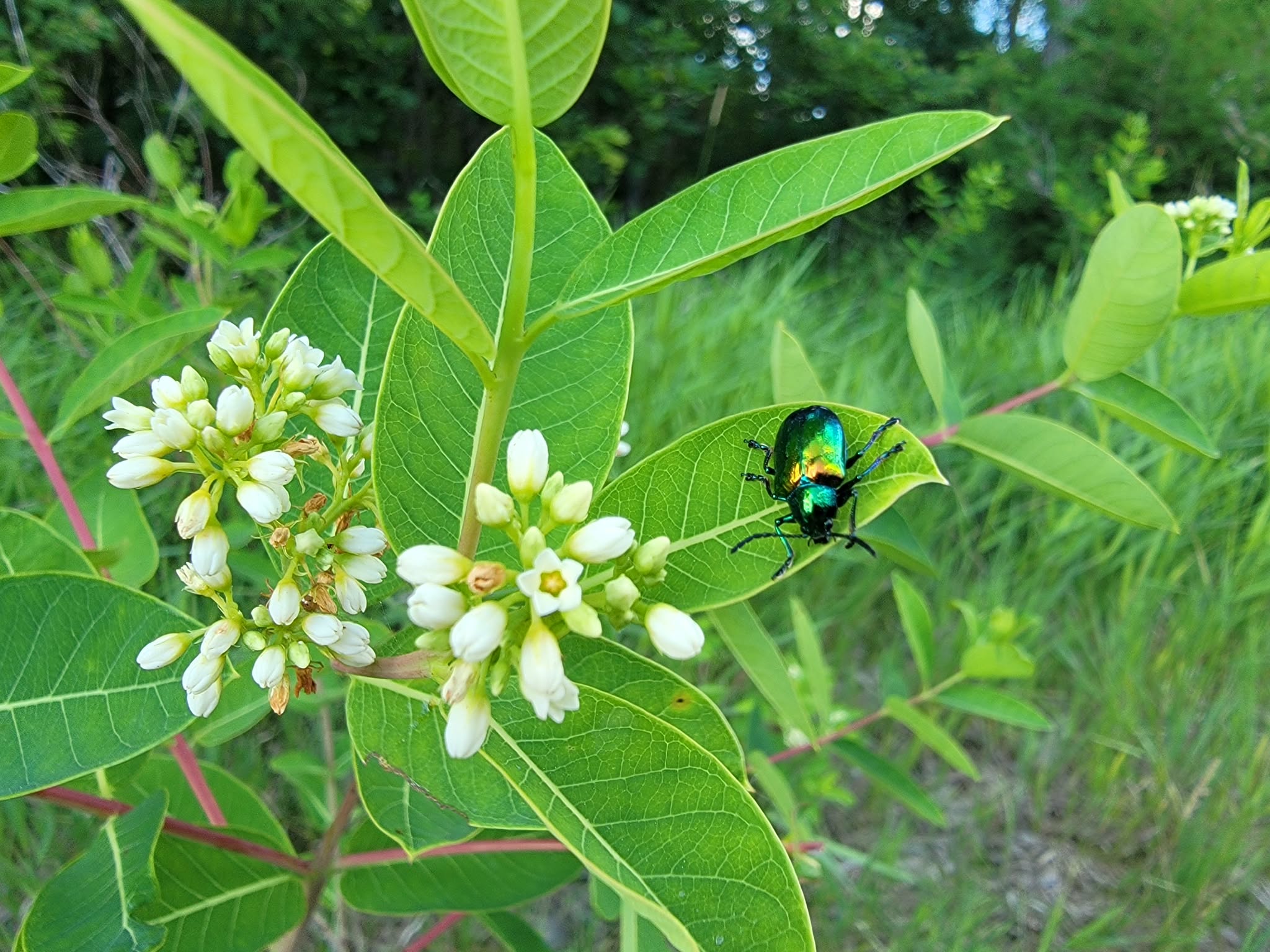
The tiny flowers of Prairie dogbane have five white to greenish-white petals. These petals often flare out creating lovely little bells.

In Iowa, Prairie dogbane blooms from June through August. These flower images were taken at the end of June in northern Iowa, Cerro Gordo County.


Minnesota Wildflowers notes, “One plant usually has several clusters, at the top of the plant and at the end of branching stems in the upper part of the plant. The center, terminal flowers in the cluster open first. The clusters start out round then spread out to a broader, more flattened cluster.”
This image was taken on July 19:

Like milkweed plants, Prairie dogbane develops follicle seed pods. Follicle pods, when ripe and dry, open on one side to release their seeds. Prairie dogbane’s fruit is long and slender (4-8 inches long). Again like milkweed, the brown seeds have white fluffy tails (also called coma, silk, or floss) that assist them with floating in the wind or water.
Many small bees and flies, as well as butterflies and skippers, visit the tiny flowers of Prairie dogbane, but the Dogbane beetle is most associated with this species. This colorful and shiny beetle feeds exclusively on dogbane and milkweed. Just like the Monarch butterfly, the toxins from these plants make the insect distasteful to its predators.


The other name for this plant is Indian hemp. Native Americans used the strong, silky fibers from the stems to make cordage. They used these threads to make rope, netting, fishing line, bow strings, baskets, and more.


I started by saying how I like Prairie dogbane’s waxy leaves and stem, but I can’t think of anything I don’t like about this plant. It can spread aggressively through its underground rhizomes, especially in wet areas.
I’ll close here with the only image I have of Prairie Dog with Prairie dogbane. “Hey, Prairie! Look Prairie dogbane!”

Check out my Iowa Prairie Girl YouTube video about Prairie dogbane:
1 Comment
The beetle is so beautiful...
…but is also unfortunately a reminder of the serious insect decline in the Upper Midwest. I’ve been watching Iowa insects for almost five decades, and have raised monarch butterflies for longer than that. Searching for monarch eggs and early-instar caterpillars long ago took me into a lot of Iowa road ditches, vacant lots, pastures, and uncultivated corners of farmland (with owner permission). I saw a lot of Prairie Dogbane, Common Milkweed, and other native plants. And soooo many diverse insects and spiders! I don’t know which is more unnerving, the decline in insects since then (observed by many and confirmed by research), or the relative public indifference to it.
All life is connected and related. We humans share about half our DNA with trees and about 60% with insects. It is not smart for many humans to look at what is happening to insects (and most of nature) and essentially think “Gee, too bad your half of the boat is sinking.”
PrairieFan Thu 23 Jul 10:00 PM