
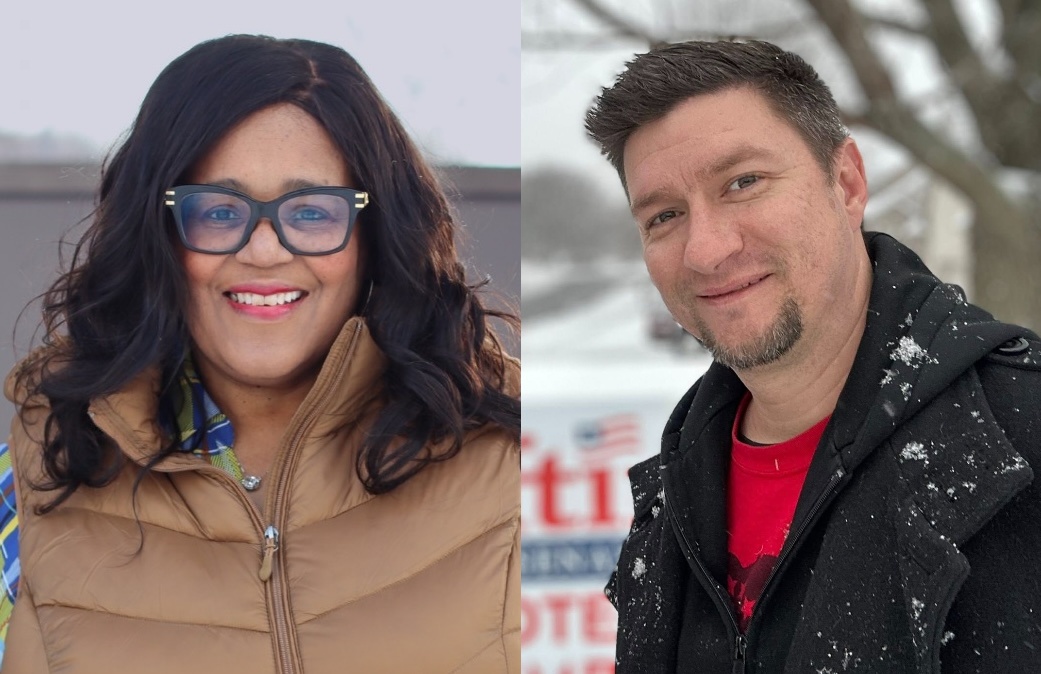
Voters in Iowa Senate district 16 will elect a successor to State Senator Claire Celsi on December 30. The stakes are high: this election will determine whether Republicans regain their 34-16 supermajority in the chamber for the 2026 legislative session. With a two-thirds majority, Republicans could confirm Governor Kim Reynolds’ nominees with no Democratic support.
If West Des Moines City Council member Renee Hardman keeps this seat in the blue column, the Republican majority in the chamber will return to 33-17, meaning Democrats could block some of the governor’s worst appointees. Either way, the winner will serve out the remainder of Celsi’s term.
Hardman is favored over Republican Lucas Loftin in this suburban area. But as we’ve seen this year in Iowa, anything can happen in a low-turnout special election. And it’s hard to think of a date primed for lower turnout than the Tuesday between Christmas and New Year’s Day.
WHY VOTE ON DECEMBER 30?
Normally I would begin an election preview by discussing the political landscape. But we need to talk about timing, because many people have asked me why anyone would schedule an election for December 30. While winter weather could be a problem anytime in November or December, the last week of the year is particularly inconvenient for those who travel over the holidays.
This one’s on Governor Reynolds.
After Claire Celsi passed away on October 6, state law required the governor to announce a special election date within five days of the vacancy arising, “giving not less than forty days’ notice of such election.” Reynolds issued a proclamation on October 9, scheduling the election for December 30.
That’s 82 days’ notice.
The governor could have picked any other Tuesday in December. She had already scheduled a special election in deep-red Iowa House district 7 for December 9 (giving 76 days’ notice on that one).
I share the suspicions of many Democrats that Reynolds chose December 30 because low turnout would improve the GOP’s prospects for an upset in a blue-leaning district.
We’ve seen this movie before. When a vacancy arose in the Iowa Senate district covering Cedar Falls in 2019, Reynolds scheduled the special election for the only Tuesday during the spring break of the University of Northern Iowa and Cedar Falls public schools. It looked like an attempt to make it harder for Democratic-leaning constituencies (students and university or school staff) to vote. If that was the governor’s goal, the tactic didn’t work; Democrat Eric Giddens won that race by double digits.
Returning to the topic at hand: December 30 was a poor choice for another reason too. That date leaves barely enough time for the election to be certified before the Iowa legislature reconvenes on Monday, January 12. Iowa law requires a county board to canvass special election results “no earlier than 1:00 p.m. on the second day after the election.” This Polk County canvass will happen on January 2, since January 1—two days after the election—is a holiday. Then a state board needs to canvass the tally lists within five days. A recount would slow down the process.
If the governor had scheduled the election for late November or earlier in December, there would have been more time to finalize the outcome, to ensure the winner (even of a close race) could be sworn in on the legislature’s opening day.
LONGTIME GOP STRONGHOLD NOW A DEMOCRATIC “POWERHOUSE”
Turning to the political landscape: Iowa Senate district 16 covers part of the western suburbs of Des Moines, including Windsor Heights, the Polk County precincts in West Des Moines and Clive, and one West Des Moines precinct in Dallas County.

For decades, this area voted solidly Republican. I’ve lived in Windsor Heights for most of my life and was never represented by a Democrat in either chamber of the Iowa legislature until 2019. But Democrats have gained ground here over the past 20 years, as in suburbs across the country. The trend accelerated during the Donald Trump era.
The latest official figures indicate that Senate district 16 contains 16,669 registered Democrats, 13,319 Republicans, 14,375 no-party voters, and 447 voters with some other affiliation (mostly Libertarians).
Recent voting history tilts strongly to Democrats. Republicans did not field a candidate against Celsi in 2024; she defeated her Libertarian opponent by a margin of 67.8 percent to 30.7 percent.
Residents of the precincts now part of Senate district 16 preferred Joe Biden to Donald Trump in the 2020 presidential election by 58.6 percent to 39.4 percent. Although Trump’s statewide margin of victory widened from about 8 points in 2020 to 13 points in 2024, he barely moved the needle among Celsi’s constituents. Across Senate district 16, Kamala Harris received 57.7 percent of last year’s presidential vote to 40.5 percent for Trump.
At the October 21 convention to choose a Democratic nominee for the special election, Iowa Senate Minority Leader Janice Weiner described Senate district 16 as “a powerhouse of a district.” She noted that not only do “a lot of good Democrats” live there, the area is home to many Democratic donors.
“A FIGHTER, A FUNDRAISER, AND A FORCE FOR CHANGE”
The room was packed on October 21; the crowd of at least 90 people was the largest I’ve seen at a convention to select a legislative candidate.
Most of the Democratic activists already knew Hardman. First elected to the West Des Moines City Council in 2017, she was nearing the end of her second term and unopposed for re-election in November. She has a high-profile day job as CEO of Lutheran Services in Iowa and previously worked as CEO of Big Brothers Big Sisters of Central Iowa and in senior leadership roles for Broadlawns hospital and Bankers Trust.
Near the entrance, Hardman and her supporters passed out a bio, with highlights from her career, her past and current public service, and some of her other accomplishments (inductee of the Iowa Women’s Hall of Fame, recipient of many awards).
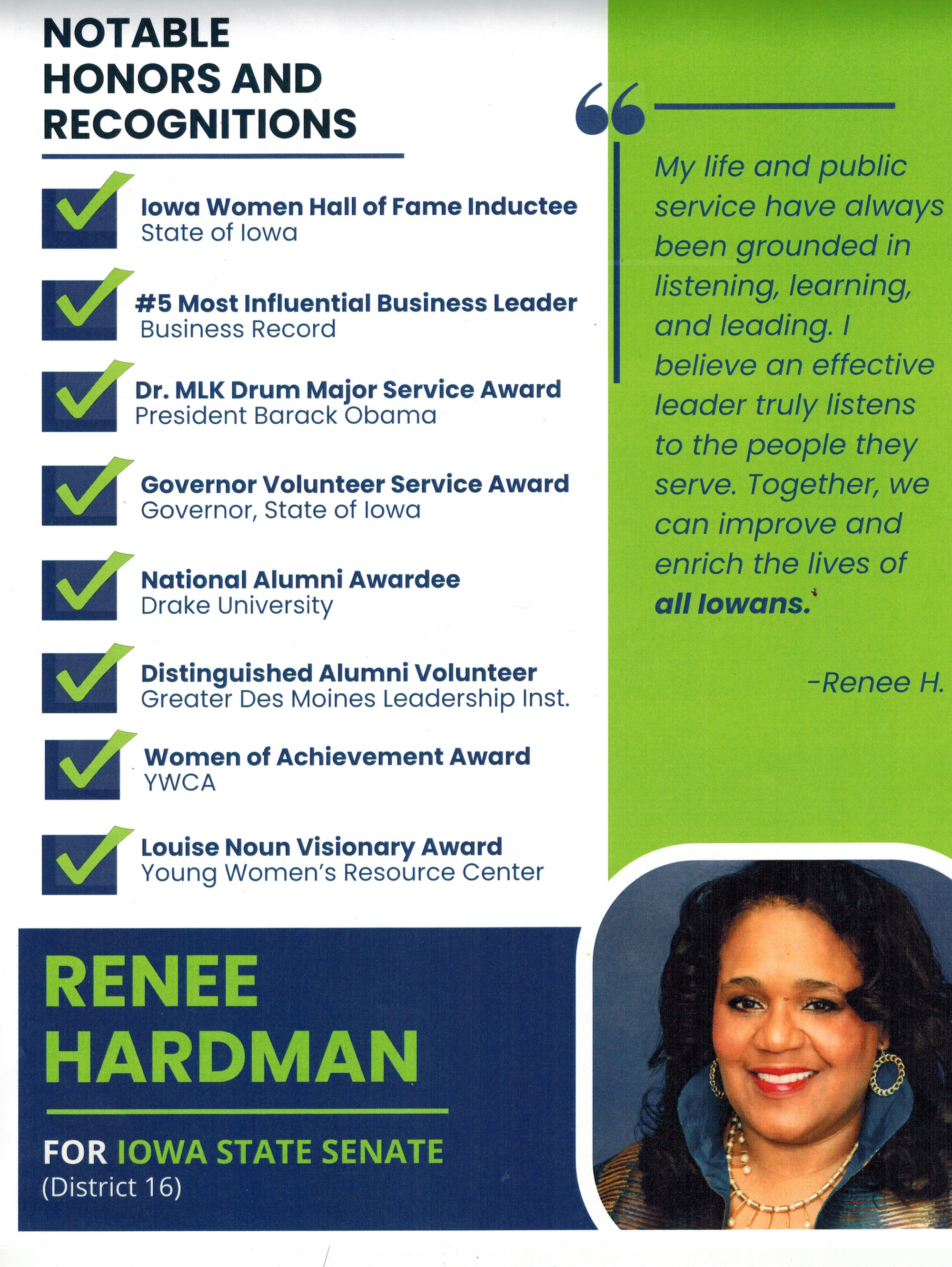
In her speech before delegates voted, Hardman described herself as “a fighter, a fundraiser, and a force for change.”
She told the delegates, “To win this seat you must raise money. I’m a successful fundraiser, and I love it.” She touted her work on the West Des Moines City Council to attract businesses, revitalize neighborhoods, and expand affordable housing. “These are things I’ve done, not what I want to do.”
Five Democrats sought the Senate district 16 nomination, and it took four ballots for Hardman to gain a majority. West Des Moines school board member Mike Andreski was the runner-up.
Hardman fought back tears as she accepted the nomination. She knew Claire Celsi well, because Claire managed her first campaign for city council in 2017. She promised Claire’s mother, Ellen Celsi, to “uphold the values and the fight” her daughter stood for. She thanked the delegates for trusting her to be the candidate who “helps all Democrats, and fight the good fight for all marginalized communities and everyone that needs a voice.”
One important fact Hardman didn’t mention: if elected, she would make history as the first Black woman to serve in the Iowa Senate. Only two Black men (both Democrats) have ever been elected to the chamber: Thomas Mann, Jr. in the 1980s and Izaah Knox in 2022.
Speaking to voters during the campaign, Hardman has emphasized public education and affordability in many areas of life, like housing, child care, and health insurance. She’s a “staunch believer in livable wages.”
Many organizations have endorsed Hardman, including numerous labor unions (Iowa Federation of Labor AFL-CIO, AFSCME Council 61, the Iowa State Education Association, International Brotherhood of Electrical Workers Local 347, Communication Workers of America Local 7102), Planned Parenthood Advocates of Iowa, the Iowa Unity Coalition, and the Iowa Chapter of the National Association of Social Workers.
The Democratic Legislative Campaign Committee, which helps elect Democrats to state legislatures across the country, also spotlighted the race.
“A FAITH-DRIVEN CHRISTIAN CONSERVATIVE”
I didn’t have location details about the Republican nominating convention in advance, so wasn’t able to observe on November 8. Judging by photos the Polk County Republicans posted online, the event was sparsely attended.
As a first-time candidate, Loftin went into the special election campaign with much lower name recognition than Hardman. But he is active in social conservative circles, as a board member of In His Light Ministries, a leader of a homeschooling group in Des Moines, and a board member of Homeschool Iowa.
Loftin’s messaging has leaned on the tried-and-true GOP slogan of “faith, family, freedom.” He has described himself as a “faith-driven Christian conservative.”
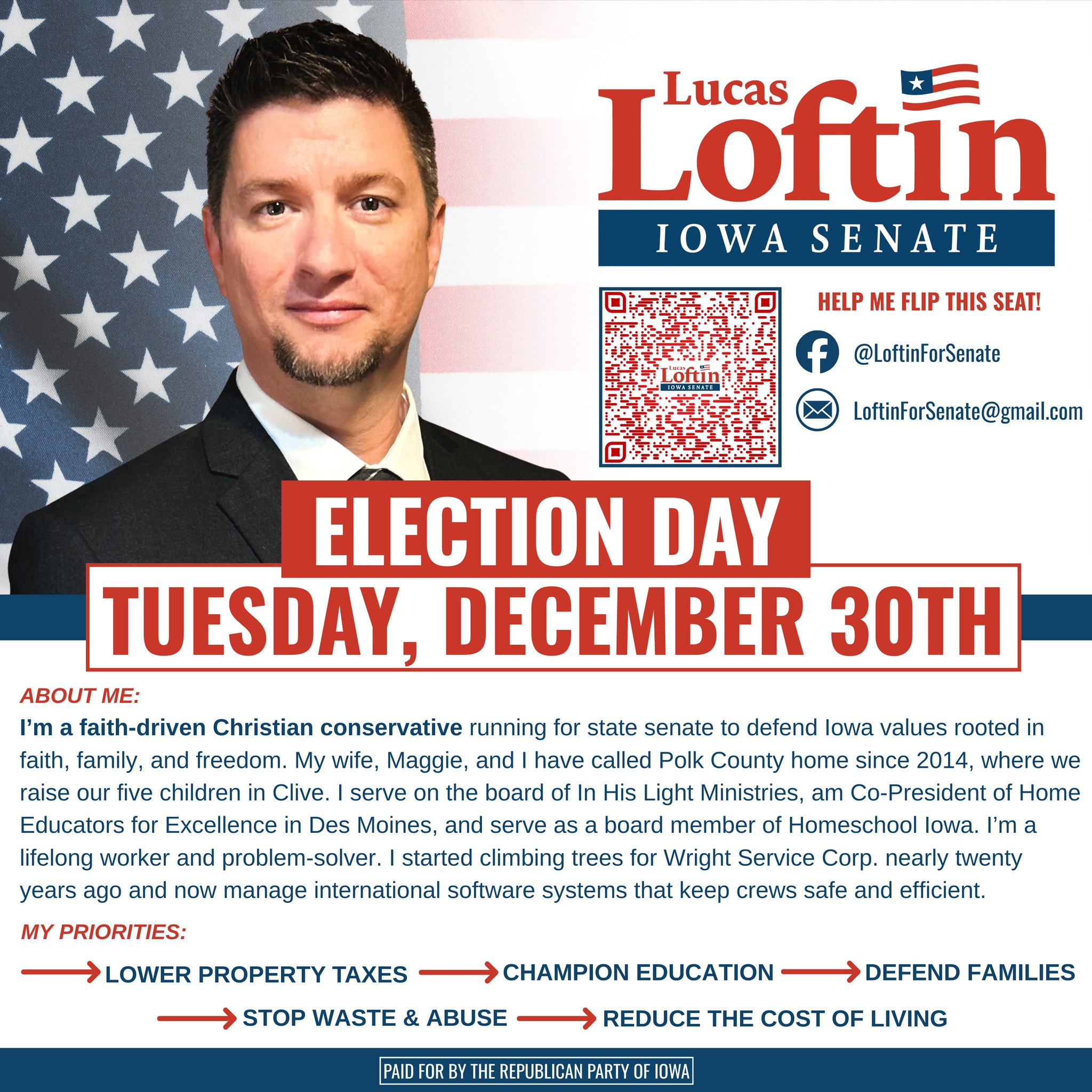
In November interviews with WHO Radio’s Simon Conway and KCCI-TV’s Amanda Rooker, Loftin emphasized “affordability” and called for cutting taxes and reducing the cost of living. He told Rooker he is “just a normal guy that is trying to make ends meet,” feed his family, and pay his mortgage. Some of his social media posts have highlighted those topics:

But Loftin is not shying away from his more controversial views. He spoke vaguely about his religious inspiration during the KCCI interview: “We need people of character, we need people of honor, we need godly people to stand up and rise at opportunities that come around.”
He was more specific when filling out an ivoterguide questionnaire, which he shared on his campaign’s Facebook page. For instance, he wrote, “Every human life is sacred from conception to natural death—no exceptions. […] Rape & incest are horrific; punish the criminal, never the child. My goal: Equal protection for every child, born & unborn.”
In an apparent reference to abortion medications, the most common means used to terminate pregnancies, Loftin wrote, “Chemical abortion drugs should not exist. They are a detriment and blight on society.”
Answering a question about health care, Loftin wrote, “Healthcare is not a right that government must provide. Medicare and Medicaid are unsustainable and must be responsibly phased out. […] Long-term, fully private healthcare is the only moral and fiscal answer.”
For good measure, Loftin supports letting teachers carry guns at school and opposes all vaccine mandates and minimum wage laws. He wrote that he believes “Marriage is one man-one woman,” adding, “No state or court has authority to redefine what God ordained. In Iowa, we protect this biblical truth in law and always will.”
In Republican circles, many share Loftin’s perspective. Groups that have endorsed his campaign include Iowa Right to Life, the Iowa Liberty Network, Stand For Health Freedom (an anti-vaccine group), and the Iowa Firearms Coalition (the state affiliate of the National Rifle Association).
But Loftin’s positions on abortion, marriage equality, phasing out Medicare and Medicaid, and other issues are well outside the mainstream for Senate district 16.
For decades, these suburbs elected moderate Republicans to the Iowa House and Senate. Those lawmakers included Gene Maddox, Janet Metcalf, Mary Kramer, Pat Ward, and Libby Jacobs in the 1990s and 2000s. As the Iowa GOP became more hostile to moderates, successful state House and Senate candidates in this area were conservatives who presented like “country club Republicans” (thinking of former Iowa House members Peter Cownie and Chris Hagenow and former State Senator Charles Schneider).
Although the last pro-choice Republican to serve in the Iowa legislature retired in 2008, many rank and file Republican or GOP-leaning independent voters in the suburbs still believe abortion should be mostly legal. And residents of Senate district 16 greatly value their public schools, routinely approving school bond issues and electing union-backed candidates to the school board.
Granted, I’m not Loftin’s target audience. And winning a low-turnout special election requires energizing your base, not appealing to the middle.
Still, the limited evidence we have from competitive GOP primaries in these suburbs supports my view that Loftin is too extreme for the Senate district 16 electorate.
In 2012, then State Senator Pat Ward (who represented much of the same area) easily defeated primary challenger Jeff Mullen by 58 percent to 42 percent. Mullen was an Evangelical pastor with backing from Christian conservatives like the FAMiLY Leader organization, talk radio host Steve Deace, Iowa Right to Life, then U.S. Representative Michele Bachmann, and Phyllis Schlafly and the Eagle Forum PAC.
Mullen’s campaign attacked Ward on issues including abortion and gay marriage—without success, in a universe of Republican primary voters, more than a decade ago.
More recently, precincts that are part of Senate district 16 voted overwhelmingly for Zach Nunn in the 2022 primary for Iowa’s third Congressional district. Nunn’s competitors in that race were Nicole Hasso and Gary Leffler. Both campaigned as more conservative Republicans.
So from where I’m sitting, Loftin is not a good fit for this district. If similar candidates haven’t won recent GOP primaries, how will this one play with an electorate not dominated by Republicans?
We’ll find out in two days whether my hunch is correct.
“EXCITED” ABOUT A “PRIME OPPORTUNITY”
I want to address a recording that has made the rounds among local Democrats. Speaking at a MAGA Nation Iowa event in West Des Moines on December 2, Loftin said politics had always been a hobby for him, “But when Claire passed away I was keeping my ear kinda to the ground to hear what was going to take place in this district, because I was excited. We had an opportunity. There’s not an incumbent. It’s a prime opportunity to take advantage of flipping this district.”
A short while later, he told the MAGA crowd, “And when Claire passed away this was an excellent opportunity for us to try to flip this seat. And if any of you have been following Claire Celsi’s legacy, her voting record, that is not a legacy that I want to leave to my kids, to your kids, or your grandchildren—at all. So that is why I’m standing up.”
It’s gross to hear anyone (let alone a “godly” person) talk about being “excited” after someone died. The comments upset many who cared about Celsi. One person who heard the recording was Jackie Wellman, a close friend of Claire’s whose home has been the main staging ground for Hardman’s GOTV. Wellman told me the Republican’s comments “were incredibly hurtful not only to me, but completely antithetical to the values of love and respect that Claire fought for, regardless of what party you are a part of.”
After listening to the recording, I reached out to Loftin. He welcomed the opportunity to clarify his remarks, telling me by email,
Let me be unequivocal: Anyone insinuating—or twisting my words to suggest—that I am “excited” about Senator Celsi’s death, or anyone’s death regardless of political differences, is completely misguided and wrong. I reject that interpretation in the strongest possible terms. Her passing is a tragedy, and my family’s prayers are with her family and loved ones.
As you know, political science recognizes an “incumbency advantage,” where sitting officials typically gain a 3–5% edge in vote share simply from holding the office—through name recognition, fundraising, and other structural benefits. An open seat (with no incumbent) removes that built-in edge, creating a truly competitive race. That is what I described as an “exciting” opportunity: the prospect of a level playing field in Senate District 16, where Republicans have a realistic chance to flip a long-held Democratic seat based on ideas, policies, and voter outreach—not personal loss.
I am excited about competing vigorously in a fair election, nothing more.
DEMOCRATS OUTSPENDING REPUBLICANS
Although we don’t yet have a complete picture of spending on this special election campaign, Democrats appear to be investing more than Republicans.
A campaign finance disclosure filed on December 26 shows Loftin had raised just $8,346.18 for his campaign. The Republican Party of Iowa had spent about $11,000 in kind on direct mail, plus a little more than $2,000 on text messages. (The final spending figures could be higher, because the December 26 reports don’t tally funds spent during the last week of the campaign.)
The Hardman campaign’s December 26 filing showed more than $35,000 in contributions. The Iowa Democratic Party spent $33,683.65 in kind on the race: about $17,000 on digital media, just under $9,000 for printing and postage, nearly $7,000 for mail, and another $711 on postcards. My household received several of Hardman’s mailings, along with campaign literature left on the door.
As of December 27, Facebook’s ad library did not show any ads paid for by the Iowa GOP, Loftin’s Senate campaign, or the Polk County Republicans. Loftin and Republican groups have posted many times about early voting, but they haven’t spent money to promote those posts to a wider audience on Facebook.
In contrast, Hardman’s campaign has paid for at least five Facebook ads promoting early voting (some including details on locations and times), plus an ad highlighting the Iowa State Education Association’s support for her campaign, plus an ad featuring supporter Ed Bittle. A Republican activist for many years, Bittle represented West Des Moines, Clive, and Windsor Heights in the Iowa House for two terms during the 1970s. (He was a moderate Republican in those days and became a Democrat during the 2010s.)
Since December 19, the Iowa Democratic Party has been running a negative Facebook ad, depicting “Lucas Loftin in his own words” as “too extreme for our community.” The ad notes that Loftin is “endorsed by Kim Reynolds,” “will abolish Medicaid and Medicare,” and is “anti-choice, even for rape & incest.”
Outside the digital realm, volunteers with the South Side Democrats of Des Moines put up a billboard for Hardman at a major intersection where West Des Moines begins.
DEMOCRATS HAVE A LARGER GROUND GAME
Loftin has been knocking doors with some of his family, church members, and volunteers, and has yard signs around the district. He’s had phone bank and canvassing help from the Capitol Region Republican Women, Iowa Young Republicans, and a few prominent politicians like U.S. Representative Zach Nunn and “Trump tractor guy” Gary Leffler.
But anecdotally, his campaign doesn’t seem to be hitting as many doors as the Democrats. Statewide candidates haven’t dropped in to help.
At the October 21 nominating convention, Polk County Democrats chair Bill Brauch promised that helping elect the Senate district 16 nominee would be the organization’s “top priority.” Since then, the Polk County Democrats have raised awareness about the race across all social media channels, and have recruited many volunteers for phone banks and canvass shifts.
Over the past six weeks, canvassing events have often attracted 20 or more people. Many well-known Democrats helped knock doors: lots of state legislators, U.S. Senate candidates Nathan Sage and Josh Turek, third Congressional district candidates Sarah Trone Garriott, Jennifer Konfrst, and Xavier Carrigan, attorney general candidate Nate Willems, and secretary of state candidate Ryan Peterman. Staffers for some other candidates, like Rob Sand for governor and Zach Wahls for Senate, took on canvassing shifts as well.

Ready to hit the doors on November 23 (State Senator Sarah Trone Garriott is next to Hardman)

State Representative Jennifer Konfrst and others knocked doors in the snow on November 29
Although only one Dallas County precinct is in Senate district 16, the Southeast Dallas County Democrats organized many GOTV shifts for Hardman’s campaign as well.
The candidate spent a lot of time knocking doors in Windsor Heights and Clive, where she is not as well known as in West Des Moines.
A short campaign like this one isn’t about persuasion. Hardman’s team was trying to find reliable Democratic voters and make sure they knew about the election and how to vote. Door knockers targeted some precincts in West Des Moines and Clive in the days leading up to satellite voting opportunities at the West Des Moines public library and Faith Lutheran Church on December 15 and 16.
In addition to canvassing, phone banking, and posting on social media, volunteers wrote hundreds of postcards to voters in Senate district 16.
So far, the parties’ GOTV has produced more votes for Hardman than for Loftin.
DEMOCRATS LEAD IN EARLY VOTES
According to figures the Polk County Elections Office provided to Bleeding Heartland on December 27, registered Democrats have returned 1,889 ballots, Republicans have returned 517 ballots, no-party voters have returned 263 ballots, and voters with some other registration (likely Libertarians) have returned two ballots.
We can’t assume that every Democrat voted for Hardman and every Republican for Loftin, but since both candidates are targeting base supporters, there is probably a strong correlation.
Another 285 Democrats, 99 Republicans, and 47 no-party voters requested absentee ballots that have not yet been returned to the county elections office.
Assuming Hardman leads by around 1,400 in banked votes, is a win guaranteed on December 30? I don’t think so. In recent election cycles, Democratic candidates have often done better with early voters, while Republicans prefer voting on election day.
So Loftin could make up a lot of ground this Tuesday, depending on the total turnout.
I have no clue how large the voter universe will be. Compared to some other legislative districts, Senate district 16 covers a relatively high-income area, with more college-educated adults. Both characteristics correlate with higher turnout. On the other hand, many voters are out of town this week for the holidays, which would point to lower turnout.
Iowa has held five other special legislative elections this year. To get a sense of what might be realistic for Senate district 16, I compared the turnout for those elections to the 2022 general election turnout in those districts. Click the links for more information about those other elections.
- Senate district 35 (January): turnout was about 38 percent of the 2022 midterm level.
- House district 100 (March): turnout was nearly 50 percent of the the 2022 midterm level.
- House district 78 (April): turnout was about 32 percent of the 2022 midterm level. (Worth noting: the Iowa GOP spent nothing on behalf of its nominee here.)
- Senate district 1 (August): turnout was nearly 54 percent of the 2022 midterm level. This race was the most expensive for both parties.
- House district 7 (December): turnout was about 31 percent of the 2022 midterm level.
Certified results from the 2022 general election show 28,742 voters cast a ballot in Senate district 16. Assuming the holiday season keeps voter participation below what we saw in the other special elections (say, 25 percent to 30 percent of the 2022 midterm level), that would still suggest a total voter universe in the range of 7,000 to 8,600.
Only 2,671 ballots have been returned so far, with fewer than 450 absentee ballots outstanding.
So voters could cast thousands more ballots on December 30. With Iowa Republicans known to favor election-day voting, Democrats should not be complacent.
That said, I’ll be surprised if Hardman doesn’t win by a comfortable margin.
Final note: If you live in Senate district 16 and didn’t request an absentee ballot, you can vote in person at the Polk County Elections Office (2309 Euclid Avenue in Des Moines) on Monday, December 29, from 8:00 a.m. to 4:30 p.m, or vote at your precinct’s polling place on December 30 from 7:00 a.m. to 8:00 p.m. Click here for a list of polling places. You will need to bring some form of voter ID, and if you’ve moved since the last time you’ve voted, you’ll need proof of address as well.
If you have an absentee ballot but haven’t returned it yet, do not put in in the mail. The county auditor’s office can’t count any ballots received after 8:00 p.m. on December 30. Voters can hand-deliver completed absentee ballots to the elections office. A secure drop box is available 24 hours a day outside the Polk County building on Euclid.

8 Comments
thanks for the breakdown
really hope folks turn out despite the Go’vs machinations, lot’s of (pardon the pub) Red flags there but the homeschooling is most worrying, hope Dems really start to emphasize women’s rights more (not the least of which is abortion/birth-control access) as we have all of these pushes to wind back the clock on feminist gains including work outside of the home.
https://www.thegazette.com/k/more-iowa-students-are-attending-schools-outside-their-neighborhood-public-school/
dirkiniowacity Sun 28 Dec 11:01 AM
No title
The Polk County Democrats are as organized as I’ve ever seen them. I think they will turn out the voters Renee Hardman needs.
Laura Belin Sun 28 Dec 7:16 PM
It's not surprising that water quality is apparently not important to Lucas Loftin...
…although, since I have neither a smartphone nor Facebook membership, I can’t tell for sure. But I did wade through his answers in that linked right-wing questionnaire, and at the very bottom, Loftin announced that while climate change is really nothing to worry about, he does believe in “true stewardship,” meaning “clean air and water through innovation and markets, not heavy-handed EPA rules that hurt Iowa families.”
I’d say that means a 99% chance that he would do whatever the Iowa Farm Bureau wants, like most other Iowa Republicans. And it’s the Iowa Farm Bureau, many of us water-observers would point out, that has done more than any other single Iowa organization to give Iowans the literally-crappy water we have today.
PrairieFan Sun 28 Dec 5:05 PM
that's good news and thanks to the PCD
I didn’t see this coming:
https://www.thegazette.com/staff-columnists/iowa-republicans-will-lose-with-randy-feenstra/
dirkiniowacity Sun 28 Dec 7:22 PM
No title
A lot of Republicans think Feenstra will lose.
The structure of the Iowa electorate still strongly favors Republicans in any statewide election, though. There are almost 200,000 more registered Republicans than Democrats in Iowa now. In 2022 the gap was much, much smaller.
Laura Belin Mon 29 Dec 9:07 AM
In typical form she mostly was writing another grievance screed against
Democratic positions and trying to make Sand look more progressive then he is but I was still surprised to see her attack on Feenstra, one thing to know it another to make it public.
Do we know why Repugs ended up with such a pathetic candidate, didn’t they have anyone better lined up to replace the Gov?
dirkiniowacity Mon 29 Dec 10:28 AM
Because Althea Cole's op-ed was linked in a comment above...
…I will mention that I was happy to learn that her work will continue to appear in the CEDAR RAPIDS GAZETTE under the new ownership, even though she is no longer a staff columnist. I almost always have disagreements with her columns, and we clearly aren’t on the same part of the political spectrum. But she writes well, and over the past few years, she has occasionally given me something to think about. That is almost never true of the out-of-state right-wing op-eds that appear in the DES MOINES REGISTER.
PrairieFan Mon 29 Dec 11:00 PM
Prairie Fan
Although I suspect that we agree on most everything, I have to respectfully disagree with you about Althea Cole. I try to read her columns and have trouble getting past the second paragraph. My impression is that her only goal is to trigger the libs, not to actually say anything. I don’t read the Des Moines Register, so I can’t compare.
And thanks for your insightful comments on Bleeding Heartland. I really enjoy them.
Wally Taylor Tue 30 Dec 8:36 AM