
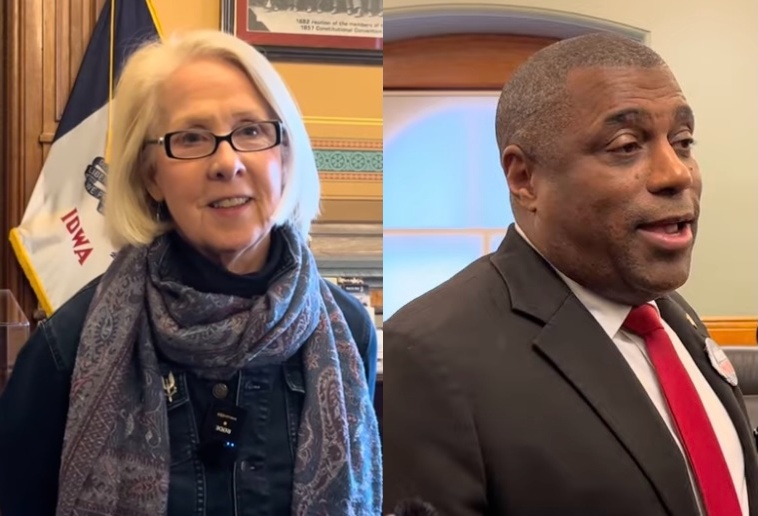
Iowa’s 2026 ballot access controversies lacked the drama of the last midterm election cycle, when one statewide official almost missed the Democratic primary ballot, and a leading candidate for U.S. Senate had to go to the Iowa Supreme Court to keep her candidacy alive.
Still, four candidates failed to qualify for this year’s June 2 primary ballot. Two others had close calls before the State Objection Panel determined they (barely) met the legal standard.
Future candidates, staff, and volunteers can learn from the mistakes that tripped up Julie Stauch, Xavier Carrigan, Jared Gadson, and Eric Pearson, and nearly ended the campaigns of Eddie Andrews and Mike Bousselot.
Why it’s harder to qualify for the Iowa ballot
Ballot access problems are not a new phenomenon in Iowa. Republican Ron Corbett missed the 2018 primary ballot for governor by just eight signatures. The same year, Democratic candidate Theresa Greenfield didn’t qualify for the third Congressional district primary after her campaign manger falsified some signatures, and she couldn’t fill new petitions in time.
But several recent changes to Iowa law have made it harder for statewide and federal candidates to get on the ballot.
Higher signature thresholds
Republicans greatly increased the signature requirements for some offices in a 2021 law that was better known for its many new restrictions on early voting and who can turn in absentee ballots. Candidates for governor or U.S. Senate now need at least 3,500 total signatures from eligible Iowa voters, including at least 100 from residents of at least nineteen counties. Candidates for other statewide offices now need at least 2,500 total signatures, including at least 77 from at least eighteen counties.
Iowa’s signature requirements remain less burdensome than the thresholds in some states. But candidates for statewide offices used to be able to collect a large share of the signatures they needed at off-year Democratic or Republican precinct caucuses. That’s no longer the case.
Less discretion to accept signatures
One of the election bills Republicans approved in 2019 established more reasons that signatures “shall not be counted.” Staff in the Iowa Secretary of State’s office and members of Iowa’s State Objection Panel (the secretary of state, attorney general, and state auditor) used to have more discretion to accept petitions with minor technical defects, like missing information at the top of the page. Now the relevant code section requires whole pages to be disqualified if certain boxes are not checked or fields left blank.
In 2022, Attorney General Tom Miller lost a page of otherwise valid signatures in Mills County because the candidate’s county of residence wasn’t listed in the top section. This year, the Secretary of State’s office did not accept Julie Stauch’s nominating papers as a Democratic candidate for governor because of a similar problem in two counties.
Many would argue that one blank field on a petition shouldn’t end a campaign when thousands of voters wanted to see that candidate on the ballot. For many years, Iowa’s State Objection Panel often decided edge cases in favor of giving voters more options. I wish we still followed a “substantial compliance” standard, but state law doesn’t give officials that flexibility anymore.
My top takeaways from this year’s stumbles and close calls:
1. Start collecting signatures early
Candidates should not wait too long to focus on getting the signatures they will need. Political party meetings or community events (festivals, rallies, parades) are good opportunities to ask people to sign nominating petitions. I have also known candidates who collected dozens of signatures in a day by striking up conversations with strangers in a town square, restaurant, or grocery store parking lot.
Xavier Carrigan, a Democrat running in Iowa’s third Congressional district, fell short on the total number of signatures required (1,726) and the county-level threshold for U.S. House candidates (at least 47 valid signatures from eligible voters in at least half the counties in the district). I knew he was in trouble when I saw him announce town hall meetings with “petition signing available” in ten counties between February 21 and March 11. He submitted his paperwork on March 13, the last day of the filing period.
Appearing before the State Objection Panel on March 24, Carrigan didn’t try to refute the points raised in the challenge to his candidacy. While he did not dispute that he was below the signature threshold, he said his campaign was about helping working class people get to Congress without raising a lot of money. He said his campaign spent less than $3,000 and credited more than 20 volunteers who helped with his petitions. “I am here to show the American people in this country that it can be done, and all it would have taken was a little more effort on my part.”
Plenty of Iowa candidates for Congress or statewide offices have made it onto the ballot without raising much money. This year that group included Travis Terrell (a Democratic contender in IA-01) and all three Democrats running in IA-04 (Dave Dawson, Stephanie Steiner, and Ashley WolfTornabane). The fourth district has 36 counties, so they needed to meet that 47-signature threshold in at least eighteen counties—a higher burden than Carrigan faced in IA-03.
2. Don’t file at the last minute
Iowa law allows candidates to take back their paperwork and resubmit before the filing deadline (in this case 5:00 PM on March 13). But the Secretary of State’s office needs some time to review petitions, so they may not identify problems until a day or two after they receive the papers.
Stauch submitted her nominating petitions on March 12. The following afternoon, staff called to tell her pages had been disqualified in two of the nineteen counties she was relying on to meet the 100-signature requirement. Even one more day would have given her time to drive to the affected counties, collect new signatures, and get back to Des Moines.
I would encourage candidates to file at least a few days (ideally a week) before the deadline.
3. Leave yourself a cushion
Candidates should collect far more signatures than the number required, and should try to meet any county-level hurdles in more than the minimum number of counties. It’s typical for some signatures to be invalid for various reasons: duplicates, incomplete address, wrong county.
Carrigan submitted just 1,731 total signatures when he needed 1,726 to qualify—a recipe for disaster. The challenger identified 91 problematic signatures.
Stauch submitted more than 100 signatures from exactly nineteen counties, meaning that losing any one of them would keep her off the ballot. She was confident she was comfortably over the line in each of those counties. But she didn’t expect to lose whole pages of signatures.
In 2022, Tom Miller’s attorney general campaign needed at least 77 signatures in at least eighteen counties. He attempted to meet that threshold in 21 counties, but for two of those he had collected exactly 77 signatures, and in the other two he had just 80 and 85 signatures. Minor errors brought him below 77 in three of the disputed counties, and he ended up with 78 in Story County, giving him the magic number.
The same year, Senate candidate Abby Finkenauer needed at least 100 signatures in nineteen counties, and her campaign attempted to meet that threshold in 20 counties. But in nine of those, her campaign submitted 120 or fewer signatures. In five of them, the initial total was between 100 and 105. It left her vulnerable to a Republican challenge. Even though the Iowa Supreme Court ruled in her favor, the bad publicity surrounding her ballot access problems contributed to rival candidate Mike Franken’s Democratic primary victory.
State Representative Eddie Andrews, a Republican candidate for governor this year, submitted between 104 and 116 signatures in six counties. He ended up falling below 100 in several of those, but he could afford to lose a few counties. After lengthy deliberations, the State Objection Panel eventually counted 101 valid signatures in Carroll—the nineteenth county Andrews needed.
Republican State Senator Mike Bousselot needed at least 100 valid signatures in Senate district 23, where he is running this year. He filed his papers on March 13 with only 121 signatures. Bousselot should have aimed for 150 or even 200, because he later acknowledged that fifteen of the signatures on his petitions came from voters not living in Senate district 23. That left little margin for error.
4. Understand the rules
Andrews was lucky he managed to submit his paperwork at all. He didn’t know campaigns needed to fasten sheets from the same county together. With minutes left before the 5:00 PM deadline, he and his volunteers were “scrambling” to organize the petitions, Radio Iowa reported.
To avoid losing whole pages of signatures, candidates should fill out every field at the top of each petition: candidate name, county of residence, political party, office sought, and date of the primary election.
Iowa Code states, “All nomination petitions shall be eight and one-half by eleven inches in size and in substantially the form prescribed by the state commissioner of elections.” David Bush, who challenged Andrews’ nominating papers, argued that numerous pages should have been excluded because the campaign used non-standard-sized paper. The State Objection Panel determined on March 24 that signatures on those pages could be counted because the deputy secretary of state had told Andrews he was allowed to use those forms.
Ashley Hunt, communications director for the Iowa Secretary of State’s office, later explained to me via email, “There is Iowa Supreme Court precedent that when a candidate relies in good faith on information from an election official, the candidate should not be penalized for that.”
Andrews lost a number of signatures because voters signed in the “wrong” county. Those mistakes could have been avoided if the candidate or his volunteers had carried around petitions for multiple counties, and ensured that eligible voters signed in the county where they live, not the county where the event was being held.
Iowa Code requires complete street addresses: signatures “shall not be counted” if the voter puts down a post office box or a street name without a house number. Miller lost a number of signatures in Warren County in 2022 because Simpson College students listed their mailing address at the student center, rather than the street address of the dormitory or house where they were living. Candidates and volunteers need to make sure voters who sign put down their full address.
Side note: in 2024, a challenger sought to have independent candidate Lisa Ossian struck from the ballot in an Iowa Senate race because some voters who signed her petitions did not write out the full name of their city. However, the State Objection Panel determined that signatures from “Osky” (Oskaloosa), “Keo” (Keosauqua), or “FF” (Fairfield) could be counted, as long as the rest of the address was complete and valid. Panel members have likewise upheld signatures where Iowa voters used ditto marks (“) to indicate their city of residence was the same as the city on the line immediately above.
5. Know your district lines
As mentioned above, Bousselot’s petitions included fifteen signatures from voters outside the Senate district where he is running this year. He managed to qualify for the GOP primary ballot because he brought evidence to the State Objection Panel showing that other disputed signatures came from existing residences in Senate district 23.
Similar problems cost two legislative candidates their place on this year’s primary ballot. Democrat Jared Gadson needed 50 signatures from eligible voters in House district 75. He only submitted 60 total signatures, and the Secretary of State’s office found seventeen signatures were from voters living outside the district. Republican Eric Pearson needed 100 signatures in Senate district 21. He submitted 138 signatures, but staff found more than 40 of those were from voters outside the district. The State Objection Panel unanimously struck both candidates off the ballot.
In 2022, State Representative Brent Siegrist lost his spot on the primary ballot after he collected some signatures from precincts that were no longer part of his Iowa House district. Fortunately for him, no other GOP candidate filed in his district that year, which meant Republicans could nominate Siegrist at a special district convention over the summer. That path is closed for Gadson and Pearson, because Drew Stensland is on the Democratic primary ballot in House district 75, and John Hollinrake is on the GOP primary ballot in Senate district 21.
Top image of Julie Stauch is from her gaggle with reporters after submitting her nominating papers on March 12. Top image of Eddie Andrews is from his gaggle with reporters on March 25, after the State Objection Panel ruled that he could remain on the ballot.
1 Comment
appreciate these explainers and sorry
you have to deal with know-nothings like this as part of the work
@dexterm.bsky.social
Latest head canon is that Andrews put on a show about rushing in unorganized, but it was all part of a con to invite a challenge and then flip the media narrative with that when his campaign otherwise has been unable to gain traction.
dirkiniowacity Wed 1 Apr 3:16 PM