
Early voting in Iowa starts on Wednesday, October 14 this year. So it’s a good time to run through how Iowans can cast their ballot before November 3.
I’m a strong advocate for voting early. You never know when some family emergency, illness, or work obligation might prevent you from getting to the polls on election day. If you’ve banked your vote ahead of time, last-minute problems won’t keep you from exercising your right.
Voting early can also reduce unsolicited phone calls or knocks at the door as the election approaches. Once you’ve turned in your ballot, there’s no reason for campaigns or political action committees to target you for GOTV.
Who should vote by mail?
I’ve been more cautious about recommending that Iowans vote by mail since 2021, when Republicans created many new barriers to the process. Iowans have less time to receive a ballot, since auditors can’t begin mailing them until 20 days before the election (October 14 this year). Voters have less time to return their ballot, because ballots must arrive at county auditors’ offices by 8:00 pm on election day. (Late-arriving ballots cannot be counted, even if they were postmarked before the election.)
Republicans also banned volunteers or friends from hand-delivering completed absentee ballots for most voters who are worried the U.S. Postal Service might not deliver it on time. Disabled Iowans may designate someone to return their ballot. For other Iowans, only immediate family members or household members may return a completed absentee ballot to the county elections office.
Despite those obstacles, voting by mail is still a good option for anyone who will be out of state from mid-October through November 3 (for instance, college students or snowbirds). It can also be useful for voters who don’t drive, can’t easily leave their homes due to disability or lack of transportation, or aren’t sure whether they will take the time to vote on election day.
Pat Rynard examined the 2022 data closely and wrote at Iowa Starting Line that “fears of massive disenfranchisement of absentee voters did not materialize,” and “voting by mail efforts remain one of the most effective ways to boost turnout.”
How to vote by mail
The window for submitting absentee ballot request forms in Iowa begins 70 days before the election. If you plan to vote by mail, get your absentee ballot request form to your county auditor as soon as possible. The auditor’s office must receive it by the close of business on Monday, October 19—but ideally, you should turn it in before the first day of early voting. That way the auditor can put your ballot in the mail on October 14.
Unfortunately, you can’t submit absentee ballot request forms via email. You must fill out a printed form and mail it or hand-deliver it to your county’s elections office.
You can easily download an absentee ballot request form on the Iowa Secretary of State’s website, or get one from a campaign or local political party committee. You may have received one in the mail, if you have voted absentee in the past.
Voters don’t have to use this form; they can send in any piece of paper containing all the required information. But it’s simpler to use the standard form.

Note that Iowa voters must include their driver’s license or non-operator ID number on absentee ballot request forms. If you don’t have either of those, you can use your four-digit voter PIN. Assuming you don’t know your PIN—most people don’t—you can ask your county elections office for that number. Do not use the last four digits of your Social Security number. That’s not valid on this form, and elections staff are not allowed to correct the number for you.
For election date or type, mark “general” and put 11/03/2026 as the date.
If you are voting by mail, you will receive your ballot sometime after October 14. Once it arrives, don’t delay: fill it out and put it in the mail as soon as possible, or hand-deliver it to your county auditor’s office. (Some counties have a drop box located outside the elections office. Iowa Republicans outlawed drop boxes in any other location.)
After mailing, you can track your absentee ballot on the Iowa Secretary of State’s website to see whether it reached your county auditor’s office. Remember, to be counted, the ballot must arrive by 8:00 pm on Tuesday, November 3.
Voting early in person
All 99 county auditors’ offices will offer early in-person voting beginning on Wednesday, October 14 (that’s 20 days before the election). Those offices will be open for early voting during business hours every weekday through Monday, November 2, and for at least eight hours on Saturday, October 31.
Some county auditors will also provide voting hours on other Saturdays, or satellite locations like public libraries and community centers, where voters can request and fill out an absentee ballot on the spot. Before early voting begins, you can check with your county auditor about where and when alternate voting locations will be open. Here’s this year’s schedule for early voting in Polk County.
I encourage Iowans to find a way to vote in person between October 14 and November 2. I usually stop by the Polk County Elections Office on a day when I have another errand nearby. (Note that their office has moved since the last presidential election and is now located at 2309 Euclid Avenue in Des Moines—not downtown.) Two years ago, I voted early at the Northwest Community Center on Franklin. It took only about ten minutes to get in and out.
Even if you are not mobile, perhaps someone who occasionally takes you shopping or to doctor’s appointments can bring you to the county elections office or a satellite voting location. Then you won’t have to worry about mail delivery; you can be sure your ballot will be counted.
County auditor’s offices have accessible ballot marking devices for those who need help to fill out their ballots.
Important note: you will need to put your driver’s license or non-operator ID number on the request form when voting early in person, so bring that ID with you. If you don’t have either of those forms of ID, you will need to ask staff in the county elections office to look up your voter PIN.
Also worth remembering: when you vote early in person, you cannot bring your ballot home to study and fill out later. You must fill out your ballot and submit it right there in the auditor’s office or satellite location. So research the races in your area (including any county-level offices or local ballot initiatives) ahead of time.
What documents to bring when voting early in person
If you are already registered to vote and haven’t moved since the last time you voted, the only document you need to vote early in person is some valid form of ID. The Iowa Secretary of State’s website lists the options:
- Iowa Driver’s License (not expired more than 90 days)
- Iowa Non-Operator ID (not expired more than 90 days)
- U.S. Passport (not expired)
- U.S. Military ID or Veteran ID (not expired)
- Iowa Voter Identification Card (must be signed)
- Tribal ID Card/Document (must be signed, with photo, not expired)
If you haven’t registered to vote in Iowa before, or have moved to a different precinct or county since the last time you voted here, you can still cast a ballot the same day you register. But you need to bring some proof of address as well as ID. Your driver’s license can serve as proof of address if it shows where you currently live. Other options:
- Residential lease
- Utility bill (including a cell phone bill)
- Bank statement
- Paycheck
- Government check or other government document
- Property tax statement
Final note: Don’t believe everything you read on the internet about voting! John Deeth debunked some misleading election season memes here. As he writes, “Your local election office is going to have the best and most accurate information. Look at their website and their social media before jumping to conclusions.”
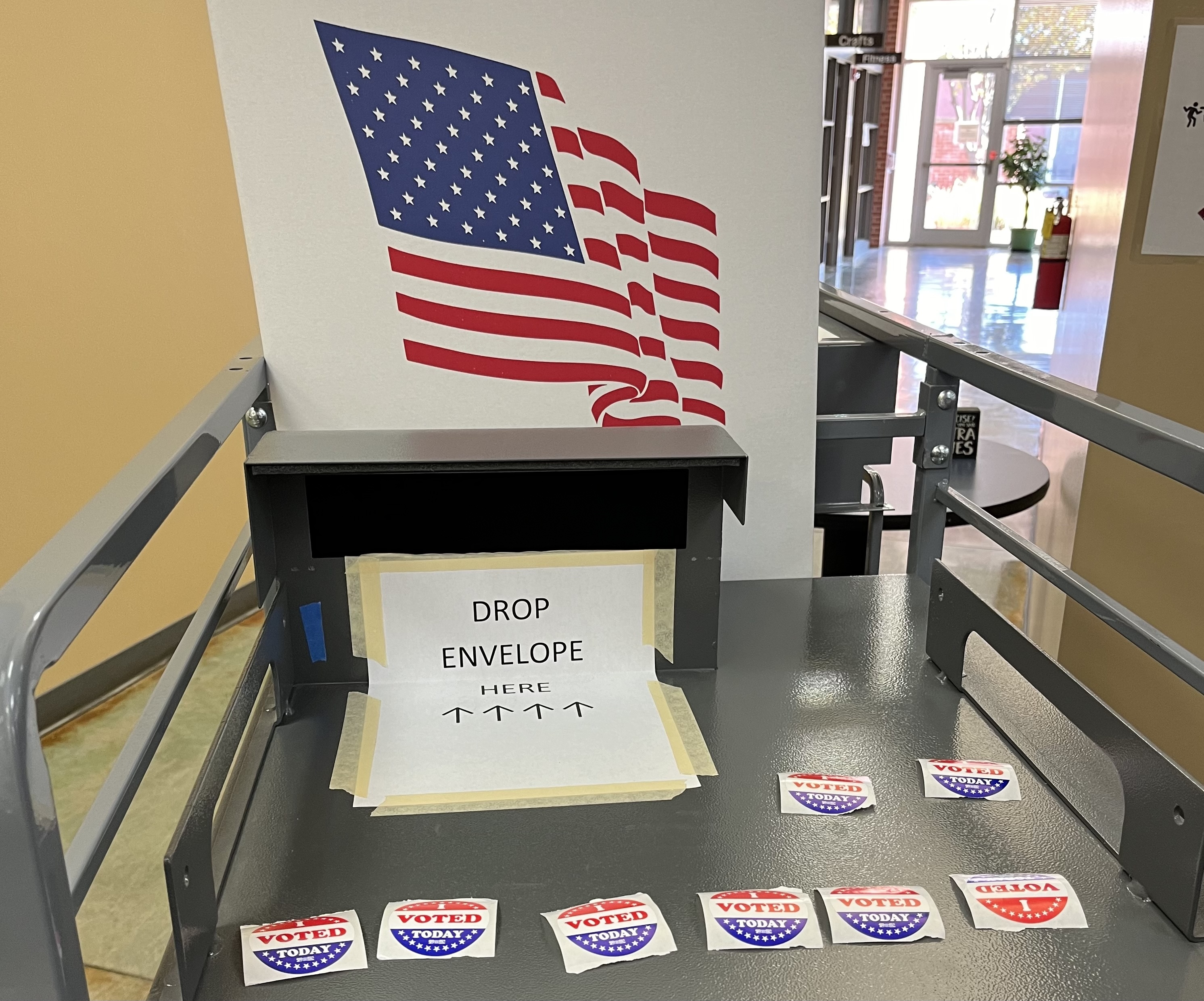
Top image: The box where voters placed completed ballots at the Northwest Community Center in Des Moines in October 2024. Photo by Laura Belin.