
desmoinesdem

Posts 123 Comments 0

Jeff Kaufmann and Cody Hoefert likely to be next Iowa GOP leaders

Former Iowa House Speaker Pro Tem Jeff Kaufmann appears likely to be chosen as the next state chair of the Republican Party of Iowa this weekend. Kaufmann has been rumored to be angling for that position ever since he was elected to the party’s new State Central Committee this spring. He made his plans official in an e-mail sent to fellow State Central Committee members yesterday. Excerpts are after the jump. Kaufmann served four terms in the Iowa House before retiring in 2012. His son, Bobby Kaufmann, currently represents the same district.

Lyon County Republican Chair Cody Hoefert announced yesterday that he is running for state party co-chair. Excerpts from his e-mail are at the end of this post.

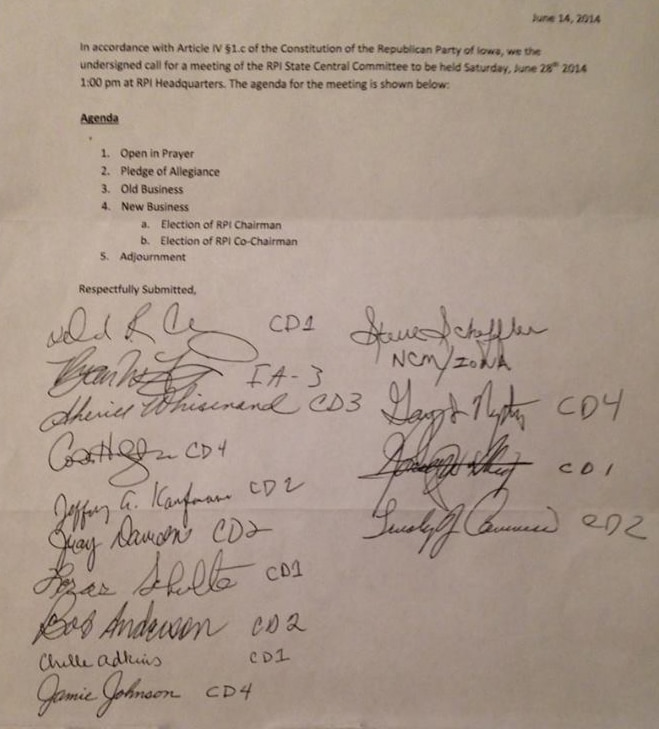
Immediately after their terms began on June 14, the majority of new State Central Committee members signed a letter calling for a meeting on June 28 to elect a new chair and co-chair. Danny Carroll and Gopal Krishna have served in those positions since late March.

Some party activists are upset that the new State Central Committee isn’t giving Carroll a chance to show he can lead. A former state lawmaker and close ally of Bob Vander Plaats, Carroll is popular with social conservatives. At least two GOP county central committees (Jasper and Warren Counties) have passed non-binding votes of no confidence in the State Central Committee’s plan to vote on new leaders. I recommend watching or listening to the video of Republican National Committeeman Steve Scheffler’s remarks to Jasper County Republican Central Committee members, followed by comments from the audience and the no-confidence vote. Scheffler repeatedly brought up the need for the state party to improve its fundraising, and argued that past chair A.J. Spiker created this problem by resigning in March rather than making his resignation effective on June 14, when the new State Central Committee was seated. He also suggested that Carroll should have agreed to resign his position, an assertion that angered some Jasper County activists.

Continue Reading...
No one could have predicted... "Superweed" edition

Sunday’s Des Moines Register carried the latest journalistic exploration of herbicide-resistant “superweeds” on Iowa farmland. The story’s not new: agronomists at Iowa State University anticipated this problem and have been warning farmers for at least 15 years. Various published studies have shown the connection between widespread corn and soybean farming practices and the “rapid selection of 21 species of glyphosate-resistant weeds.”

Industry groups representing conventional growers have repeatedly accused advocates for clean water and sustainable farming of threatening rural Iowans’ way of life. Yet the dominant practices of corn and soybeans growers have accelerated the spread of resistant weeds through natural selection, potentially putting many Iowa farmers out of business in the coming years.

After the jump I’ve posted excerpts from Donelle Eller’s story for the Sunday Register and more background on the herbicide-resistant weed problem. The 2013 Union of Concerned Scientists briefing paper on “The Rise of Superweeds-and What to Do About It” is an excellent starting point.

Continue Reading...

Weekend open thread: Iowa Democratic Party convention edition

What’s on your mind this weekend, Bleeding Heartland readers? The Iowa Democratic Party’s state convention got overshadowed by the circus-like spectacle Republicans put on in Urbandale yesterday. We’re talking about David Young’s surprising nomination in IA-03 here. This is an open thread for all other topics.

After the jump I’ve posted several links about the Democratic convention and the full text (as prepared) of Maryland Governor Martin O’Malley’s speech. He seems to have made a good impression, as he did at the Harkin Steak Fry in 2012. O’Malley won’t challenge Hillary Clinton for the presidential nomination; he was loyal Clinton surrogate during the 2008 primaries, even after Barack Obama crushed her in his state. If Clinton decides against running for president again, O’Malley could have a lot of upside potential in Iowa. He’s much more familiar with this state than your average east-coast governor, having worked as a field organizer for Gary Hart’s 1984 Iowa caucus campaign. John Deeth wrote up O’Malley’s appearance for gubernatorial nominee Jack Hatch and running mate Monica Vernon in Iowa City.

UPDATE: Added below a short version of what would be the progressive case against O’Malley if he competes in the Iowa caucuses.

Continue Reading...

IA-03: David Young is truly a magician (updated)

David Young’s television commercials featured the candidate performing magic tricks, and he certainly pulled a rabbit out of his hat today. Today some 500 delegates selected Young as the Republican nominee in Iowa’s third Congressional district. Not many people saw that coming (aside from Julie Stauch). Young ran a solid and well-funded campaign but finished fifth in a six-man field on June 3.

Kevin Hall live-blogged the special district convention through all five ballots today. Short version: Young won by having less baggage and fewer enemies than the candidate who was eliminated on each ballot. Robert Cramer finished second to last on the second ballot (even though he finished a close second in the June 3 primary) and declined to endorse another contender after dropping out. Matt Schultz was the bottom candidate on the next ballot and endorsed Young afterward. Monte Shaw, widely viewed as the establishment’s favorite and in particular as Governor Terry Branstad’s unofficial favorite, was eliminated after the fourth ballot, leaving just Brad Zaun and Young.

I expected Shaw to win at convention through the same kind of path Young traveled today, benefiting as rivals with more baggage finished last on successive ballots. After his victory this afternoon, Young promised delegates that he would “make [Democratic IA-03 nominee] Staci Appel disappear” in November. Young will have a ton of money at his disposal, thanks to connections built during nearly two decades as a Congressional staffer. From 2006 until last summer, he served as chief of staff to Senator Chuck Grassley.

UPDATE: Radio Iowa has the audio of Young’s victory speech to delegates. After the jump I’ve posted the Appel campaign’s comment on the GOP convention, as well as a comment from Grassley on his protege’s Congressional campaign. Officially, Grassley stayed neutral in the Republican primary, but several of his consultants worked for Young.

SECOND UPDATE: Added more observations below from Craig Robinson, who spent the day at the nominating convention.

Continue Reading...

Ronda Bern will face John Forbes in Iowa House district 40

Republicans held a special convention in Iowa House district 40 yesterday to nominate a candidate against first-term State Representative John Forbes. Remarkably, no Republican filed to run in this district before the March filing deadline. Two candidates attempted to win the nomination through write-in votes on the June 3 primary, but neither reached the required threshold.

Kevin Hall reported for The Iowa Republican that establishment candidate Ronda Bern won the nominating convention by 4.5 to 3.5 over college student Jeremy Freeman. (GOP Polk County Central Committee members from the various precincts in the House district cast weighted votes based on how many Republican votes came from each precinct in the last general election.) I’m surprised Bern didn’t defeat Freeman more decisively. The nominating convention could have gone the other way if Freeman had a few more friends on the central committee.  

Click here for background on Bern. After the jump I’ve posted a map of House district 40 and the latest voter registration numbers. This will likely be a targeted seat in the general election. Republicans currently hold a 53 to 47 Iowa House majority.

Continue Reading...

IA-01, IA-02: NRCC makes Blum, Miller-Meeks "contenders"

The National Republican Congressional Committee has elevated the GOP nominees in Iowa’s first and second Congressional districts to the second level of their “Young Guns” program supporting challengers. Rod Blum will face former Iowa House Speaker Pat Murphy in the open IA-01. Mariannette Miller-Meeks will face four-term Democratic Representative Dave Loebsack for the third time in IA-02. As official NRCC “contenders,” Blum and Miller-Meeks now have a chance to move up to the top level (“young guns”) if they meet certain targets for fundraising and campaign organization.

Only some of the “young guns” will receive major financial assistance from the NRCC. So far, the group has reserved tv time for independent expenditures in seventeen Democratic-held U.S. House districts, none in Iowa. During the last election cycle, the NRCC paid for a small amount of advertising against Loebsack and against Representative Bruce Braley in IA-01 but never made a big commitment to either race.

IA-03: Zaun, Schultz supporters going after Shaw (updated)

More signs suggest that other candidates and their supporters see Monte Shaw as their primary threat at Saturday’s special convention to choose a Republican nominee in IA-03. Craig Robinson wrote about the multi-pronged attacks on Shaw at The Iowa Republican blog. Shaw has served as Iowa Renewable Fuels Association executive director since 2005, and the Liberty Iowa PAC has highlighted donations that trade association’s PAC made to Democratic candidates during the years. The Liberty PAC represents a group of former Ron Paul supporters. They have endorsed State Senator Brad Zaun in the IA-03 primary, although ironically, Zaun backed Michele Bachmann (not Paul) in the 2012 Iowa caucus campaign.

Anonymous e-mails circulated to Republican district convention delegates prompted the Shaw campaign to file a complaint with the Federal Election Commission last week.

I had viewed Shaw and Robert Cramer as the most viable candidates going into convention. Apparently Iowa Secretary of State Matt Schultz and I finally agreed on something. According to Robinson, Schultz’s campaign has sent GOP delegates direct mail “comparing Schultz to Shaw and Cramer on the issues of government spending and taxes.” Meanwhile, an arm of the American Future Fund has been sending out positive mail about Schultz, while the Tea Party Express attacked Shaw for Iowa Renewable Fuels Association PAC contributions to Democrats including “Staci Appel, Chet Culver, Mike Gronstal, Chris Hall, and Pat Murphy.”

I’ll believe an informal survey showing David Young in a strong position when other campaigns start attacking Young. So far, he does not appear to be viewed as a threat. One could argue that’s a great place to be in a contest likely to force multiple ballots, but I still don’t see delegates nominating a career Congressional staffer over rivals who have spent most of their adult lives in Iowa.

UPDATE: Added more details on the convention procedure below and a new argument against Schultz I hadn’t heard before.

Continue Reading...

Steve King still worried about immigration reform

I viewed U.S. House Majority Leader Eric Cantor’s shocking primary loss as a sign that Representative Steve King (IA-04) could stop worrying about comprehensive immigration reform happening during this Congress. I figured, Republican leaders would not dare to move forward with a policy so unpopular with the GOP base. But since when has King ever listened to me? Speaking to Radio Iowa on June 14, he sounded very worried that an immigration reform bill could move “in September or October and then, of course, in a lame duck session it gets to be a very high risk.”

King’s concern is valid, because House Majority Whip Kevin McCarthy quickly consolidated support to replace Cantor as majority leader. McCarthy is on record backing immigration reform principles that King views as “amnesty.” Jeb Hensarling of Texas, an immigration reform opponent like King, took himself out of the running for majority leader quickly. Pete Sessions, also of Texas, abandoned his effort in less than a day.

I still doubt House leaders will bring up the immigration reform bill that passed the U.S. Senate with bipartisan support in the summer of 2013. But if King is right that House Speaker John Boehner plans to give up that job soon, who knows? He may allow immigration reform to reach President Barack Obama’s desk as a a favor to business groups that support the policy and a parting shot to conservative critics. Boehner famously did not appreciate King’s headline-making comments about undocumented immigrants last year. The Senate bill would pass easily with a few dozen House Republicans joining most of the Democratic caucus.

Any relevant comments are welcome in this thread.

IA-Gov: "Stache-less" Jack Hatch and Monica Vernon news roundup

Democratic gubernatorial candidate Jack Hatch announced today that Cedar Rapids City Council member Monica Vernon will be his running mate. In addition to following the Iowa tradition of female lieutenant governors, Vernon balances the ticket geographically and ideologically. An elected official in Iowa’s second-largest city for seven years, she has been campaigning around northeast Iowa since last summer as a Democratic candidate for Congress. She carried Linn County and finished a strong second to Pat Murphy district-wide on June 3.

Some Democrats are grumbling that Vernon is a longtime Republican who joined our party just five years ago. But frankly, Hatch isn’t running in a Democratic primary. He needs to appeal to a statewide electorate including thousands who have become disaffected from the GOP, just like Vernon did. Anyway, she is arguably more progressive than Governor Chet Culver’s running mate, lifelong Democrat Patty Judge. Despite the complaining, there shouldn’t be any major snags when the Iowa Democratic Party’s statewide convention officially nominates Vernon for lieutenant governor this Saturday.

After the jump I’ve posted background on Vernon and other recent news from the Hatch campaign, including his first television commercial for the general election and highlights from his weekend appearance on Iowa Public Television’s “Iowa Press” program.

Continue Reading...

IA-03: David Young gets talking point to take to convention

With only a few days left before special convention delegates choose a Republican nominee in Iowa’s third Congressional district, David Young got a boost from a “poll” by the conservative blog Caffeinated Thoughts. The blog set up a closed, online survey last week and circulated the link to delegates via e-mail.

There’s no way to know whether the 118 people who filled out the survey are representative of some 500 district convention delegates or alternates who will gather in Urbandale on June 21. If they are, it’s good news for Young, who finished fifth in the June 3 voting. Asked which candidate they support, 27 percent of delegates named Young, equal to the percentage backing State Senator Brad Zaun, who won a plurality of votes in the primary. Some 19 percent of delegates who responded named Robert Cramer, 14 percent Monte Shaw (widely seen as Governor Terry Branstad’s favored candidate), and just 8 percent named Iowa Secretary of State Matt Schultz. The results were even better for Young on the “second choice” question: 34 percent of respondents named him, way ahead of 17 percent for Zaun, 14 percent for Schultz and Cramer, and 10 percent for Shaw.

Young’s campaign was quick to spread the news in an e-mail blast I’ve enclosed below.

I had assumed Shaw held the advantage in a convention scenario, as he has longstanding ties with GOP activists, and to my mind, would be seen as a less-offensive alternative to some other candidates in the race. But if this survey is representative, Young has a chance of filling that “least offensive” niche. Maybe conservatives working together to block Shaw are succeeding in creating a bit of a backlash against the leading establishment candidate.

Continue Reading...

Branstad vetoed funds for Iowa civil rights history project

I was so focused on the environmental impacts of Governor Terry Branstad’s recent vetoes, I failed to look closely at other appropriations in a supplemental spending bill he axed. Today I learned from Democratic State Senator Rob Hogg,

Saturday is the 50th anniversary of the start of Freedom Summer and the murder of Schwerner, Goodman and Chaney – it is too bad Governor Branstad vetoed the $300,000 the Legislature appropriated on a bipartisan basis to help the African-American Museum of Iowa collect Iowa’s civil rights history and educate the public about these historic events.

There it is on page 4 of Senate File 2363: $300,000 for “an oral history of civil rights” at the African-American Museum of Iowa in Cedar Rapids.

It’s maddening that Governor Branstad has no problem with tens of millions of dollars in tax giveaways to wealthy corporations, yet he pleads fiscal prudence when vetoing spending like this, which serves the public interest without major impact to the state budget. Many of the 1950s and 1960s civil rights activists have already passed away, and those who haven’t are senior citizens. “Freedom Summer” was a major event in 20th century American history. Some Freedom Summer veterans with connections to Iowa City or the University of Iowa have already told their stories to historians or recorded their memories on paper or film. The Historical Iowa Civil Rights Network are doing their part too, and you can follow their work here. I’m disappointed that the African-American Museum of Iowa won’t have the funding to collect and archive these stories on a larger scale.  

Continue Reading...

Muscatine residents will get day in court against major air polluter

The Iowa Supreme Court ruled unanimously on Friday that a District Court should hear a lawsuit eight Muscatine residents have filed against the Grain Processing Corporation. Muscatine locals have long had to breathe some of Iowa’s dirtiest air, and the Grain Processing Corporation has long been one of the area’s major polluters. Despite being forced to pay a $538,000 civil penalty for air pollution violations eight years ago, the corporation continued to emit excessive amounts, leading to a lawsuit by Iowa Attorney General Tom Miller in 2011. Earlier this year, the company settled that lawsuit, agreeing to pay a $1.5 million civil penalty and to take several steps to reduce toxic emissions from the facility.

But the Grain Processing Corporation stood and fought when local residents filed a class-action lawsuit two years ago, citing health risks as well as damage to personal property related to the air pollution near the plant.

In 2013, a District Court judge granted the defendant’s motion to dismiss the case, prompting plaintiffs to appeal. The Iowa Supreme Court found that the Grain Processing Corporation “was not entitled to summary judgment” and sent the case back to District Court, which will consider the lawsuit on its merits. You can read the full text of Justice Brent Appel’s ruling here (pdf). (It’s more than 60 pages long and gets into some technical legal issues.) All the other Iowa Superme Court justices concurred, except for Justice Edward Mansfield, who recused himself because some of his former law partners were representing the corporation.

After the jump I’ve posted more background on the lawsuit and excerpts from Jason Liegois’ report for the Muscatine Journal on the Iowa Supreme Court ruling. The plaintiffs are not guaranteed to succeed in District Court, but at least they can present their case. In addition to fighting the lawsuit at the lower court level in Iowa, the Grain Processing Corporation could appeal to the U.S. Supreme Court, arguing that the federal Clean Air Act preempts claims like the ones the Muscatine residents are making.

Continue Reading...

Iowa's incarceration rate in a global and national context

The Prison Policy Initiative, a non-partisan non-profit organization created “to document and publicize how mass criminalization undermines our national welfare,” has published a fascinating report on the “global context” of sky-high U.S. incarceration rates. I knew that our country locks up more of its residents per capita than any other country on earth, but I didn’t realize that if you consider the 50 states and Washington, DC individually, three dozen American states have a higher incarceration rate than Cuba, which has the world’s second-highest incarceration rate. Iowa now has 437 people in prison or jail for every 100,000 residents, putting us among the states with the ten lowest incarceration rates. Even so, just three other countries (Cuba, Rwanda, and the Russian Federation) imprison more residents per capita than Iowa. The report notes,

Utah, Nebraska and Iowa all lock up a greater portion of their populations than El Salvador, a country with a recent civil war and one of the highest homicide rates in the world. Five of the U.S. states with the lowest incarceration rates – Minnesota, Massachusetts, North Dakota, New Hampshire, and Rhode Island – have higher incarceration rates than countries that have experienced major 20th century social traumas, including several former Soviet republics and South Africa.

States in New England tend to have the lowest incarceration rates, followed by the Midwest. Most states with the highest incarceration rates are in the South.  

The Prison Policy Initiative recently published a detailed comparison of state prison systems. The Iowa profile shows the growth in the incarceration rate as well as the massive racial disparities other researchers have found in our state. I’ve posted a few graphs after the jump. (Note that one graph shows an incarceration rate a little below 300 per 100,000 residents, rather than 437. That’s because the graph below includes only people serving a prison term longer than one year.) Click here for links to all state incarceration rates by race and ethnicity and here for a report “tracking state prison growth in all 50 states.” Data on that last page show how “state-level policy choices have been the largest driver of our unprecedented national experiment with mass incarceration.”

Continue Reading...

Sam Clovis will run for Iowa state treasurer

Sam Clovis, who finished a distant second in the Republican primary for U.S. Senate, will likely be nominated for state treasurer at the Iowa GOP’s statewide convention on June 14, The Iowa Republican blog reported last night. No Republicans stepped up to run for the office long held by Democrat Mike Fitzgerald in time for the March filing deadline. John Thompson, a native of Jefferson and army veteran, recently declared his candidacy for state treasurer and was hoping to be nominated at the state convention. Earlier this week, Iowa Republican blogger Craig Robinson published a hit piece backgrounder on Thompson that read like a desperate plea for some other candidate to seek the treasurer’s office.

Today’s exclusive report by Kevin Hall says “Clovis has received a lot of encouragement to run over the past couple of days,” including a “Thursday evening phone call” from Governor Terry Branstad and Lieutenant Governor Kim Reynolds. They offered to help Clovis raise money for a statewide campaign, and he would need their help, as fundraising was his weakest area by far as a Senate candidate. Apparently the governor does not want to run on a ticket with Thompson, given the “interesting background” Robinson highlighted.

Fitzgerald is the longest-serving state treasurer in the country, having been first elected in 1982, the same year Branstad was elected governor for the first time. He has been re-elected seven times, twice amid huge Republican landslides (1994 and 2010). He defeated Dave Jamison by more than 60,000 votes in 2010.

One of Branstad’s staffers, Adam Gregg, will be nominated for attorney general at tomorrow’s GOP convention. That’s the only other statewide office for which no Republican filed in time to appear on primary ballots.

Final Iowa trivia note: Fitzgerald’s 2002 opponent was Matt Whitaker, the fourth-place candidate in this year’s GOP Senate primary.

Gaming commission grants casino license to Greene County (updated)

The Iowa Racing and Gaming Commission voted 3-2 today to grant a casino license for a $40 million project near Jefferson (Greene County) in western Iowa, between Boone and Carroll counties. Residents had overwhelmingly approved a gambling referendum last year, but the outcome was in doubt because the commission recently voted down a casino proposal for Cedar Rapids. According to Dar Danielson’s report for Radio Iowa, the commissioners who opposed the license cited evidence a new casino would largely take business from existing Iowa casinos, and that the Greene County community didn’t need a gambling facility as much as other amenities. The commissioners who favored the license cited the potential economic impact for a rural area.

The Prairie Meadows Racetrack and Casino in Polk County had lobbied the commission to reject Greene County’s application, citing potential impact on its business. Jefferson is a little more than an hour’s drive northwest of the Des Moines metro area. But in casting the decisive yes vote, Racing and Gaming Commission Chair Jeff Lamberti noted,

We have lots of advantages in Polk County and I think we have lots of advantages that are going to come in the future,” Lamberti explained. “We’ve got significant population growth amongst all of our suburbs. We’ve got some good things that are in the work that are pretty historic by Iowa standards. And quite frankly, we have advantages that a lot of other parts of the state don’t have, and quite frankly I think we are going to be just fine.”

Cedar Rapids Mayor Ron Corbett, who has vowed to keep working toward a casino for his city, sounds furious about today’s decision. I’ve posted some of his comments below.  

Continue Reading...

Des Moines ranked 4th most LGBT-friendly metro area in U.S.

Hardly a month goes by without news about Des Moines scoring a top-ten national ranking on some economic or livability metric. Here’s something I didn’t expect, though: the new “Vocativ Queer Index” rates the Des Moines metro fourth among the top 35 queer-friendly cities in the U.S.

Vocativ examined the 100 largest metro areas on sixteen factors related to the quality of life for the LGBT community. Click through to read the full list and how Des Moines scored in each category. In particular, the website hailed the Iowa capital’s “inclusive attitude toward adoption and marriage equality, not to mention its high-profile out politicians” like State Senator Matt McCoy and State Representative Daniel Lundby (whom they mistook for a member of Congress).  

Happy Pride Month to everyone in the Bleeding Heartland community. After the jump I’ve posted recent news about how Iowa Safe Schools, a Des Moines-based advocacy group, is working to improve the environment for LGBTQ students in public schools all around the state.

Continue Reading...

Iowa wildflower Wednesday: Beardtongue (Penstemon)

This week’s featured wildflower can be grown in gardens without too much trouble and is popular with many species of bees. According to Wildflowers of Iowa Woodlands by Sylvan Runkel and Alvin Bull, Penstemon species are commonly called beardtongue because “One of the five stamens is sterile and does not produce pollen. It is often modified into a hairy or bearded tongue and probably attracts insects.” The blue or purple lines sometimes seen inside the tubular flowers are also believed to “function as nectar guides to visiting insects.”

After the jump I’ve enclosed several pictures of beardtongue in bloom, not far from Gray’s Lake in Des Moines. The last two photos show this wildflower near other plants I haven’t identified. If you know what they are, please post a comment in this thread or send me an e-mail: desmoinesdem AT yahoo.com.

This post is also a mid-week open thread: all topics welcome.

Continue Reading...

Coalition forming against Monte Shaw before IA-03 nominating convention?

Roughly 500 Republican delegates from the third Congressional district will meet at Des Moines Christian School in Urbandale on June 21 to select a nominee against Staci Appel. I consider Monte Shaw the best-placed candidate going into the convention, despite his fourth-place finish in the June 3 voting. Several signs point to the other campaigns developing a strategy to stop Shaw at the convention. Executing that strategy won’t be easy.

Continue Reading...

Bisignano wins Iowa Senate district 17 as Blake opts against recount

Tony Bisignano will be the Democratic nominee in Iowa Senate district 17, as second-place finisher Nathan Blake declined to request a recount. From a Facebook status update Blake posted yesterday:

According to the official canvass from the Polk County Auditor’s Office, I ended up 18 votes behind in the Democratic primary election for Iowa State Senate District 17. I congratulate Tony Bisignano on a hard-fought victory. Thank you to my supporters, volunteers, and all who voted. Thanks especially to my wife and partner, Andrea, and our two kids for their patience, support, and sacrifices over the last year. I am proud of the campaign we ran. We won over 60% of the Election Day vote, even if we came up a few votes short.

As for the future, I am committed to to electing Democrats up and down the ballot in Iowa this November. I will continue my work in public service, fighting for consumers as an Assistant Iowa Attorney General. I promise to stay involved in progressive politics and will seek future opportunities to serve in elective office. The issues we care about are too important to sit on the sidelines.

A recount wouldn’t have changed the result, so I think Blake did the right thing not to go through the motions. He did manage a very strong election-day turnout, which is promising for any future candidacies.

Senate district 17 was the best chance for Democrats to elect Iowa’s first Latino state legislator, but two other opportunities remain this year in House district 60 and Senate district 47.

UPDATE: In a Facebook post, Bisignano said of Blake, “I can’t say enough about his poise and character. He has a very bright future in public service and I’m looking forward to helping him. His positive and respectful campaign shows what people want and expect from their public officals.”

Continue Reading...

Steve King can stop worrying about immigration reform (updated)

Representative Steve King (R, IA-04) has long been one of the leading voices in Congress against any immigration reform that includes a path to citizenship for undocumented immigrants. He even lost out on a subcommittee chairmanship because of his perceived hostility to immigrants, especially those who came to this country illegally. In early 2013, many pundits predicted King and his allies would not be able to stop a bill like the one that passed the U.S. Senate with bipartisan support, because of the Republican Party’s urgent need to improve its standing with Latino voters. But the anti-reform Republicans won promises from House leaders not to bring the Senate bill up for a vote on the House floor. (It would surely have passed with a few dozen Republicans joining most of the Democratic caucus.)

Every few months, pro-reform forces mount a new push to pass comprehensive immigration reform, and King mobilizes opposition. I think he can rest easy now that House Majority Leader Eric Cantor just lost his Republican primary to a little-known tea party challenger in Virginia’s seventh Congressional district. While immigration wasn’t the only issue brought up during the campaign, it was a salient issue in the primary.

[Challenger David] Brat ran hard against immigration reform, and the issue dominated conservative talk radio in recent days as the Obama administration’s request of funds to cope with an influx of recently detained young illegal immigrants from Central America.

Cantor sought to neutralize the issue, running hard negative television attacking Brat as a “liberal professor” and sending direct mail pieces saying he fought President Obama on “amnesty.”

Regardless of what Cantor said in campaign mailers, beltway insiders considered him a pro-immigration reform Republican.

Any relevant comments are welcome in this thread.

P.S. – During my childhood, there were several Jewish Republicans in Congress. Cantor was the last remaining after Senator Arlen Specter switched parties in 2009. Don’t hold your breath waiting for another one to be elected.

UPDATE: King commented on Twitter, “Earthshaking primary results in Virginia tonight. Resounding rejection of #Amnesty and support for Rule of Law. Personal regrets to Eric.”

SECOND UPDATE: King posted on June 11, “Wanted: Applicants for Majority Leader in US House who have a record opposing amnesty. Come see me.”

THIRD UPDATE: Senator Tom Harkin believes Cantor was defeated because he “lost touch with his district.” He pointed out that Senator Lindsay Graham of South Carolina survived his GOP primary this week, despite openly supporting immigration reform. But Graham had six opponents splintering the protest votes, not one challenger making a coherent case against him.

Continue Reading...

Prospects for increasing diversity in the Iowa legislature

Forty men and ten women currently serve in the Iowa Senate. No senators are African-American, Latino, or Asian-American.

Seventy-five men and 25 women currently serve in the Iowa House. Five state representatives are African-American and none are Latino or Asian-American.

Time for a look at how those numbers might change after the November election, now that primaries have determined the major-party nominees in all state legislative districts. Click here for the June 3 unofficial election results and here for the full list of candidates who filed to run in the primaries.

Continue Reading...

What caused the big drop in Iowa Republican primary turnout?

Earlier this year, I would have predicted high Republican turnout for Iowa’s June 3 primary elections. The five-way race for the U.S. Senate nomination was highly competitive, as was the six-way contest in the open third Congressional district. Multiple candidates contested GOP primaries in the first and second Congressional districts too. The 2012 Iowa Republican caucuses, which involved going out for an hour or more on a cold night in January, attracted a record turnout of roughly 122,000 people.

Yet according to unofficial results, just 158,031 Iowans cast ballots in the GOP primary for U.S. Senate, and 156,275 cast ballots in the governor’s race, where Terry Branstad had a token challenger.

The 2010 midterm election saw much higher Republican turnout, with some 227,404 people voting for one of the three GOP gubernatorial candidates. There weren’t any high-profile statewide Republican primary contests in 2006, but in the 2002 midterm year, 199,234 Iowans cast ballots in the three-way GOP primary for governor, and 197,096 Iowans cast ballots in the two-way GOP primary for U.S. Senate.

In IA-03, five of the six Republican candidates raised enough money to run district-wide campaigns before this year’s primary. Yet only 42,948 Iowans voted in a Congressional district with 160,660 active Republican voters as of June 2014. The seven-way 2010 GOP primary in IA-03 attracted more than 46,000 votes in a district that included only one-fifth of the state’s population at the time and 118,850 active Republican voters. (Iowa lost one of its Congressional districts after the 2010 census).

A similar story took shape in IA-02, where about 30,500 people cast ballots in this year’s GOP primary, compared to nearly 40,000 who voted in the 2010 primary, at a time when the district covered one-fifth of the state’s population rather than one-fourth.

In this thread, please share your thoughts on why Republicans didn’t show up to vote in larger numbers this year. Julie Stauch, a veteran of many Democratic campaigns, speculated that the low turnout “is the cumulative result of every extreme and outrageous statement over the last four years. The current Republicans in Iowa are only talking to those who agree with them 100 percent, which creates a rapidly shrinking base as every outrageous statement drives away a few more people. We can see the effect of this from the loss of 40 percent of the 2010 participants. That’s a serious decline over any range of time, but very bad over four years.”

Iowa Supreme Court allows lawsuit to proceed against Branstad and key officials (updated)

In a 5-2 split decision, the Iowa Supreme Court ruled on Friday that a District Court judge should determine whether Iowa Workers’ Compensation Commissioner Chris Godfrey can sue Governor Terry Branstad and five other administration officials individually for defamation, extortion and other claims. Follow me after the jump for background, links and details about the opinion.  

Continue Reading...

Weekend open thread: Jack Hatch running mate edition

What’s on your mind this weekend, Bleeding Heartland readers? This is an open thread.

Gubernatorial candidate Jack Hatch will announce his choice for lieutenant governor sometime before the Iowa Democratic Party’s statewide convention on June 21. He has been vetting and interviewing possible choices for several weeks. According to Hatch,

“I want to choose a running mate that can become governor on Day One, at any time, and that really supplements and adds to my experience as an elected official and a business person,” he said.

He added he would not be “restricted” by demographic concerns such as a candidate’s gender or geographic location – suggesting he would not consider women exclusively.

I think we can all agree that it would be a huge mistake for Hatch to choose a man, when Iowa Democrats are nominating only one woman for statewide office (Sherrie Taha for secretary of agriculture) and only one woman for federal office (Staci Appel in the third Congressional district).

The last five Iowa lieutenant governors have been women: Jo Ann Zimmerman (independently elected), Joy Corning (Terry Branstad’s running mate), Sally Pederson (who served under Tom Vilsack), Patty Judge (Chet Culver’s running mate), and current Lieutenant Governor Kim Reynolds.

The logical choice for Hatch would be a woman from eastern Iowa, where two-thirds of the state’s voters live. A few days ago, Iowa Senate President Pam Jochum of Dubuque told Erin Murphy that she won’t be the lieutenant governor candidate and “declined to comment on whether Hatch had asked her to run with him.” State Senator Liz Mathis, from the Cedar Rapids metro area, told James Q. Lynch, “I have been approached and encouraged, (but) it is not the right time for me to do that.”

Lynch mentioned two of the unsuccessful candidates in Iowa’s first Congressional district: Cedar Rapids City Council member Monica Vernon, who finished second to Pat Murphy, and State Representative Anesa Kajtazovic of Waterloo, who finished fourth. Vernon would be a better fit for the ticket, according to the criteria Hatch laid out for Lynch: a person “who could actually become governor, someone who does not need to be trained, who has had accomplishments in public life and or business, and who brings a level of depth to a campaign that we would want.” Also, since Vernon was a Republican until about five years ago, she has a potentially compelling message for moderates and swing voters.    

Continue Reading...

IA-01, IA-04: DCCC put Murphy and Mowrer in "Red to Blue" program

The Democratic Congressional Campaign Committee included Pat Murphy (IA-01) and Jim Mowrer (IA-04) in the latest group of candidates promoted to the highest level of the “Red to Blue” program. (Staci Appel, the Democratic nominee in the open IA-03, was already promoted in the Red to Blue program earlier this year.) Mowrer is running in a tough district for any Democrat but raised more money than incumbent Steve King for the last three quarters. The DCCC had previously named IA-04 as an “emerging race.”

Murphy just won a five-way primary in the Democratic-leaning first district. His opponent will be Rod Blum. Technically, IA-01 isn’t a “Red to Blue” district because it’s not Republican-held now; it’s the open seat Bruce Braley is vacating in order to run for U.S. Senate.  

Red to Blue candidates are eligible for the highest level of support from the DCCC, although the committee won’t necessarily spend much money in every named district. Last week the DCCC reserved television air time in IA-03 and IA-04, though ad buys are subject to change. Details are after the jump.

To my knowledge, the DCCC hasn’t reserved any air time in IA-01 media markets. I doubt Murphy will need major independent expenditures to beat Blum. By the way, Murphy’s four rivals in the Democratic primary endorsed him in statements released by the Iowa Democratic Party today. I’ve enclosed that press release below as well.

Continue Reading...

Republicans likely to nominate Ronda Bern in Iowa House district 40

Last week Bleeding Heartland mentioned that two Republicans were actively seeking write-in votes in Iowa House district 40, the Iowa GOP’s most spectacular recruiting failure in a statehouse district this year. Normally, major parties rectify such problems by nominating a candidate during the summer at a special district convention. However, little-known conservative activist Jeremy Freeman started aggressively door-knocking last month to obtain write-in votes (at first using a cowboy card that misspelled Governor Terry Branstad’s name). Due to a little-known feature of Iowa election law and low turnout in Urbandale during the 2012 Republican primary, a write-in candidate could have taken the House district 40 nomination outright with 149 or more votes on June 3.

Local establishment Republicans swung into action behind Ronda Bern. An alert Bleeding Heartland reader shared with me a copy of her direct mail piece, which reached voters shortly before the primary. I got a kick out the fib on the front side: “In order to have a candidate on the ballot in November in HD 40, you must follow the write-in instructions on the back of this card.” Not true, as we’re going to find out during the next couple of months. I’ve posted the mailer after the jump, along with an excerpt from the May 23 press release announcing Bern’s candidacy.

On election night, I saw on the Polk County Auditor’s website that 254 write-in votes were recorded in House district 40, and thought perhaps Bern or Freeman made it over the line. But Bern received just 110 write-in votes, Freeman 103. The rest of the write-ins were for people who received either one or two votes apiece, according to the Polk County elections office. Since no one won the nomination through write-ins, Republicans can schedule a district convention anytime to nominate their candidate. All signs point to Bern. I couldn’t find any record of her donating to Iowa House or Senate candidates in the past, but she and her husband maxed out to Matt Whitaker’s unsuccessful U.S. Senate campaign. In 2010, she gave $2,000 to Jim Gibbons’ campaign in Iowa’s third Congressional district.

House district 40 is likely to be a battleground race this fall. It’s among a handful of Democratic-held Iowa House districts that Mitt Romney carried in the last presidential election. The latest figures from the Secretary of State’s Office indicate that the district contains 6,385 active registered Democrats, 7,405 Republicans, and 6,037 no-party voters. Both parties ran television commercials here during the open-seat race in 2012, which Forbes won by 1,069 votes. Many local Republicans supported the Democrat, a local pharmacist, business owner, and longtime Urbandale City Council member. The latest financial reports show that in mid-May, Forbes’ campaign had a little more than $19,000 cash on hand.

Continue Reading...

Tony Bisignano's lead will hold up in Iowa Senate district 17

Tony Bisignano will be the next state senator representing Iowa Senate district 17, barring some extraordinary turn of events. The final election-night vote count showed him leading with 1,438 votes, to 1,425 for Nathan Blake and 1,001 for Ned Chiodo. Yesterday, officials counted six additional ballots, which all had been hand-delivered to the Polk County Auditor’s office on June 3, primary election day. Bisignano gained five votes and Chiodo one. So the final unofficial result shows Bisignano leading Blake by 1,443 to 1,425.

According to the Polk County Auditor’s elections office, three ballots from Senate district 17 arrived in the mail on June 4, but none will be counted, because they were postmarked June 3. In order to be counted, a late-arriving absentee ballot must be postmarked the day before the election at the latest.

On election night, Blake wrote on Facebook that his “campaign is reviewing all options to ensure that every vote is counted and accurately recorded.” I haven’t seen any statement since on whether he will request a recount. (There are no automatic recounts for Iowa primary elections.) I can’t imagine that a recount would change an eighteen-vote margin. In recent years, recounts of various Iowa House and Senate races have typically only changed the totals by a handful of votes, at most.

No Republican has filed to run in Senate district 17, an overwhelmingly Democratic seat in terms of voter registration. I was hoping for a different outcome in this primary, but I wish Bisignano well in his Iowa Senate work and offer condolences on the loss of his mother. I’ve posted below his statement on his mother’s passing and the primary election results. Bisignano won this race on early GOTV, building up a 102-vote margin on Chiodo and a 649-vote margin on Blake through absentee ballots. Blake had strong election-day turnout, especially considering that there were no competitive Democratic primaries for governor, U.S. Senate, or the third Congressional district, but it wasn’t quite enough. No doubt he’ll have other opportunities to run for office.

Final note for Iowa election trivia buffs: Patrick Rynard set a record this year that will likely never be broken. He has now managed two campaigns that spawned cases eventually reaching the Iowa Supreme Court. Rick Mullin’s Iowa Senate race in Sioux City in 2010 led to the recent court ruling about negative political advertising. Bisignano’s candidacy (or more accurately Chiodo’s determination to drive his rival off the ballot) prompted a high court ruling that may lead to thousands of Iowans getting their voting rights back.

Continue Reading...

IA-Gov: Republican Governors Association hits Hatch as Branstad launches positive ad

The Republican Governors Association jumped out the day after the primary election with a television commercial attacking State Senator Jack Hatch, the Democratic nominee against Governor Terry Branstad. I’ve posted the video and transcript after the jump, along with the Branstad campaign’s opening tv ad, touting Iowa’s “comeback” under his leadership.

It’s standard procedure for incumbents generally, and Branstad in particular, to try to define challengers before they’ve had a chance to introduce themselves to most voters. That said, this spot is also a sign that the RGA may be more concerned about Iowa than they’re letting on. I wonder whether their internal polling is showing a shrinking lead for Branstad over Hatch, as we’ve seen in several polls released in the last two months. Hatch plans to start running a biographical television commercial later this month, but he can’t match Branstad and Republican-aligned forces in money spent on advertising.

Continue Reading...

Iowa wildflower Wednesday: Golden Corydalis

To match this exciting week in Iowa politics, it’s only fitting to share an exciting wildfower. Eileen Miller contributed the spectacular photographs of Golden Corydalis (Corydalis aurea), as well as the commentary. Although this plant is native to Iowa and much of North America, I’ve never seen it in real life–only in wildflower guides.

This post is also an open thread: all topics welcome.

Continue Reading...

IA-03 district convention speculation thread (updated)

For the first time since 2002, a special district convention will select an Iowa Congressional nominee. (Steve King snagged the nomination in IA-05 that year after none of the four Republican candidates reached the 35 percent threshold.) After the jump I’ve posted the unofficial results from yesterday’s six-way primary in IA-03 and my thoughts on who takes the strongest case to convention delegates who will meet on June 21 at Creston High School. UPDATE: Creston will not be the location after all; Iowa GOP leaders are scrambling to find a new location and date. More details below.

Spin your own IA-03 scenarios in this thread. I’m curious to see how Democratic candidate Staci Appel responds to this unusual situation. Will she start building a narrative against one or more of the contenders, or hold her fire until after June 21?

Continue Reading...

Iowa primary election results thread

Polls close at 9 pm, and I’ll be updating this post regularly with primary election results. Rumor has it that turnout was relatively low, even on the Republican side where there are hard-fought primaries for U.S. Senate and the third Congressional district. According to the Polk County Auditor’s office, as of this afternoon only 1,506 absentee ballots had been requested and 1,350 absentee ballots received for today’s GOP primary. Keep in mind that roughly half of all Republican voters in IA-03 live in Polk County, and six campaigns were competing for their votes. Not to mention that five U.S. Senate candidates should have been locking in early votes in Iowa’s largest county.

By comparison, 2,883 Democratic primary absentee ballots were requested in Polk County, and 2,296 of those returned by today. The lion’s share were from Iowa Senate district 17 in Des Moines, where three candidates are seeking to replace Jack Hatch (2,475 absentee ballots requested and 1,950 returned). Democratic campaigns have long pushed early voting more than Republicans, but still–that’s a shocking failure to GOTV by the various Republican campaigns.

Share any comments about any Iowa campaigns in this thread, as well as any interesting anecdotes from voting today.

UPDATE: Polls are now closed and updates will continue after the jump.

Continue Reading...

IA-03: Robert Cramer closes out campaign on faith and family

From his first campaign press release to his official bio and opening television commercial, Robert Cramer emphasized his business background, fiscal and economic issues in his bid to represent Iowa’s third Congressional district. Remarkably, the former board president of the FAMiLY Leader organization led by Bob Vander Plaats even said he had no plans to introduce bills on social issues if elected to Congress.

But over the past six weeks, and especially during the final days of the GOP primary race, the Cramer campaign has emphasized faith and family more in its messaging. From where I’m sitting, that’s not a bad strategy in a six-man field where everyone wants to cut spending, reduce government regulations and repeal Obamacare. Bleeding Heartland covered Cramer’s first tv ad here. More commercials and family values talk from this “Christian businessman” are after the jump.  

Continue Reading...

Branstad staffer Adam Gregg will run for Iowa attorney general

No Republican stepped up to run against Iowa Attorney General Tom Miller in time to appear on the primary election ballot, but yesterday Adam Gregg announced that he will seek the GOP nomination for attorney general at the state party convention later this month. Gregg worked in private practice for the Des Moines-based Brown Winick law firm before joining Governor Terry Branstad’s staff as a legislative liaison in 2012. (He’s quitting that job to run for office.) His press release touted his work to help pass “the largest tax cut in Iowa’s history, historic education reform, and a state based, Iowa alternative to Obamacare.” The tax cut refers to the property tax reform approved during the 2013 legislative session. The Iowa Health and Wellness Plan is more accurately described as an alternative to Medicaid expansion rather than an alternative to “Obamacare.” Iowa is still implementing the 2010 Affordable Care Act.

Gregg promised “to fight everyday for Iowa families, Iowa farmers, and our constitutional freedoms,” to “be an advocate for open government,” and to “hold Washington, DC accountable when the federal government oversteps its bounds.” Around the country, many Republican state attorneys general have used the job to grandstand against federal policies they don’t like for ideological reasons. Sounds like Gregg will be emulating that model.

I don’t give him much chance of beating Tom Miller. Four years ago, Brenna Findley got in the race early and ran a strong and well-financed campaign, only to come up well short amid a huge Republican landslide. Running a statewide campaign will raise Gregg’s profile, though, and possibly open doors to future political jobs. The Des Moines rumor mill expects Miller to retire rather than seek another term in 2018. In that case, Gregg could join Findley as prominent candidates in a much more winnable race.

Three ways the EPA carbon emissions plan will benefit Iowa, plus Iowa political reaction

Yesterday the U.S. Environmental Protection Agency rolled out a proposed rule to reduce carbon emissions from power plants. The full text of the rule and several short fact sheets are available on the EPA’s website. Click here to read EPA Administrator Gina McCarthy’s speech about the new policy. This fact sheet makes the short and sweet case for targeting power plants, “the largest source of carbon pollution in the U.S.” The new policy goal is to “cut carbon pollution from the power sector by 30 percent from 2005 levels” by the year 2030. Other associated benefits: cutting levels of soot and smog in the air by over 25 percent in 2030, and saving money and lives through reducing air pollution. In fact, the EPA estimates $7 in health benefits for every dollar spent to implement the new policy.

While some in the environmental community were hoping for more aggressive carbon reduction targets, the new rule would be a big step in the right direction. For too long, elected officials in Iowa and nationally have ignored evidence that we need to address climate change. Furthermore, coal’s “assault on human health” is immense and under-appreciated.

Iowa political reaction to yesterday’s news was mostly disappointing but not surprising. I’ve enclosed noteworthy comments at the end of this post. But first, let’s examine three reasons Iowans should embrace the EPA’s new rule.  

Continue Reading...

IA-03: Monte Shaw's strengths and weaknesses as a candidate

State Senator Brad Zaun won a crowded primary in Iowa’s third Congressional district in 2010, and he has led the only public polls in IA-03 this spring, but my best guess is that Iowa Renewable Fuels Association Executive Director Monte Shaw will end up becoming Staci Appel’s competition in the general election campaign. I assume no candidate will win 35 percent of the vote in tomorrow’s primary, forcing a special district convention to select the nominee. From where I’m sitting, Shaw’s strengths as a candidate outweigh his potential weaknesses with Republican voters and delegates.

Continue Reading...

Branstad slashes conservation and clean water funding

It’s one of the oldest tricks in any governor’s playbook: schedule media events for bill signing ceremonies you want the public to hear about, while burying bad news late on a Friday, after reporters have filed their stories. I was worried Governor Terry Branstad would make big cuts to environmental funding just before Memorial Day weekend, as he had cut food bank money two years ago.

Instead, Branstad’s office released the news about this year’s spending vetoes after dinnertime on Friday, May 30. Hours earlier, the governor had welcomed reporters, lawmakers, and members of the public to watch him sign a bill legalizing the possession of cannabis oil to treat seizure disorders, as well as a bill altering Iowa’s HIV transmission law.

Follow me after the jump for the gory details. I no longer consider 2014 a good year for Iowa environmental funding.

Continue Reading...

Weekend open thread: Pre-primary edition

Technical issues prevented me from posting the weekend thread earlier today. What’s on your mind, Bleeding Heartland readers?

Candidates and their staff are crossing the last to-do items off checklists, and if possible, enlisting volunteers to phone bank and chase absentee ballots. The Des Moines Register’s latest Iowa poll by Selzer & Co showed Joni Ernst running away with the U.S. Senate primary. She had 36 percent support among respondents, Mark Jacobs 18 percent, undecided 16 percent, Matt Whitaker 13 percent, Sam Clovis 11 percent, and Scott Schaben 2 percent.

I don’t know how important newspaper endorsements are anymore, but today the Cedar Rapids Gazette endorsed Jacobs. Previously the Des Moines Register and Sioux City Journal had endorsed Ernst.

The biggest non-election-related political story of the week was Eric Shinseki’s resignation as Secretary of Veterans Affairs. The growing scandal over care provided at VA hospitals may not be his fault, but someone needed to be held accountable. Talking to veterans I know, I’ve heard mixed things about the level of care at Iowa’s VA hospitals. I agree with a letter to the editor published in the Register today, which argued that bigger investments should have been made in the VA at least a decade ago to handle the serious physical and mental health problems of thousands of Iraq and Afghanistan veterans. I’ve posted that letter after the jump.

Maya Angelou passed away this week at the age of 86. I’m not much of a poetry reader, so I am unfamiliar with most of her poems. I Know Why the Caged Bird Sings must be one of the most important memoirs written during the 20th century, though. How many books in that genre become instant classics like hers did? It made a huge impression on me, and it’s not a book I would likely have picked up if it had not been assigned in a high school English class.  

Continue Reading...

Enter Bleeding Heartland's 2014 Iowa primary election prediction contest

I forgot to put up this year’s primary election prediction contest earlier this week, but better late than never. To enter, post your answers to the twelve questions after the jump as a comment in this thread sometime before 7 am central time on Tuesday, June 3. It’s fine to change your mind about some or all of your answers, as long as you post a comment with your new predictions before the deadline.  

Only comments posted in this thread will be valid contest entries. Predictions submitted by e-mail or twitter will not be considered. Please try to answer every question, even if it’s just a wild guess. We’re all guessing anyway, since few polls have been published about these races.

The winner receives no cash or other prizes–just bragging rights in the Bleeding Heartland community. Can someone stop ModerateIADem from “three-peating”? He won both the 2010 and the 2012 primary election prediction contests.  

Continue Reading...

IA-03: Will Brad Zaun's stealth campaign pay off?

During the 2010 Republican race to represent Iowa’s third district, State Senator Brad Zaun was running radio and television commercials nearly a month before primary day. At that time, he faced six rivals, but only one, Jim Gibbons, had superior fundraising, more television advertising, and substantial support from the Republican establishment. Zaun won the primary easily, despite getting out-spent by Gibbons, thanks to a crushing performance in Polk County.

Zaun is now one of six Republicans seeking the IA-03 nomination. Four of his rivals have been running tv ads for weeks. To my knowledge, Zaun has not run any paid advertising this year, and the primary is only a few days away. CORRECTION: In the comments, Bleeding Heartland user rockm saw a Zaun ad on tv. I haven’t seen it, nor have I seen it announced on Zaun’s Twitter feed or Facebook page, but I will add to this post when I have the video.

I see the IA-03 nomination being decided at a district convention, but some locals think Zaun has a realistic chance to win the primary outright with at least 35 percent of the vote. Craig Robinson even calls Zaun the “heavy favorite” in the GOP primary. I examine that argument after the jump.  

Continue Reading...

IA-Sen: A little outside help for Sam Clovis

Sam Clovis has been campaigning hard around the state since last summer, but contrary to what he’d hoped and planned for, he appears not to be able to run any of his own radio or television commercials before next Tuesday’s primary for U.S. Senate. Clovis’ total fundraising through the end of March was less than $300,000, and a strong statewide paid media campaign would cost at least that much. The Citizens United Political Victory Fund, which previously endorsed Clovis and gave his campaign $5,000, is stepping in with a small television buy on his behalf. $53,000 won’t buy many points, but it’s better than nothing. The commercial features 2012 Iowa Republican caucuses winner Rick Santorum. He endorsed Clovis earlier this month. As a talk radio host in northwest Iowa, Clovis among Santorum’s more influential supporters before the caucuses. After the jump I’ve posted the video and transcript of the Citizens United ad.

I’ve also enclosed below the video of Clovis’ recent meeting with the Des Moines Register editorial board. Listening to him speak on a wide range of topics, I so wished he’d be able to raise the funds to get his name and views out there. He should have been a phenomenally appealing candidate to the Republican base. He speaks with more authority than the others in the Senate field. I think Bob Vander Plaats hurt Clovis badly by spending so long dropping hints about his own possible Senate candidacy. If he’d ruled out running last summer, rather than stretching out his decision to promote a book project, Clovis would have had a better shot.

Maybe Clovis will do surprisingly well on a shoestring budget, as Ed Fallon did in the 2006 Democratic primary for governor. But I doubt Clovis will manage to keep State Senator Joni Ernst below the 35 percent threshold for winning the nomination outright on June 3. I have been wondering whether he might get some fringe benefit from Mitt Romney’s Iowa visit on behalf of Ernst, though. That will generate a lot of media coverage, and Romney isn’t popular in some conservative Republican circles.

Continue Reading...

Iowa wildflower Wednesday: Golden Alexanders

Today’s featured wildflower comes courtesy of Leland Searles, a photographer, birder, naturalist, Iowa Master Conservationist, Master River Steward, and owner of the ecological consulting firm Leeward Ecology. He contributed the photographs and commentary below about Golden Alexanders, a brilliant yellow spring wildflower. You can view more of his photography here. Lee also put together the Raccoon River Watershed Phenology calendar, which is a must-have for Iowans who love native plants and any wildlife (mammals, birds, reptiles, insects).

This post is also a mid-week open thread: all topics welcome.

Continue Reading...

Single-issue voting is only dumb when other people do it

John Deeth is fed up with “narrow-focus ‘progressives’ [who] apply tests of absolute purity on their pet issues,” and in so doing “lost touch with bigger picture values.” The hard-fought Democratic primary for Johnson County supervisor was Deeth’s trigger. Some locals are trying to oust Supervisor Janelle Rettig over a 2013 zoning vote. Deeth thinks it’s unfair to toss out a longtime progressive leader over one issue.

I haven’t closely followed the Johnson County campaign. I think highly of Rettig and Mike Carberry, one of the other Democratic candidates, but know too little about the other candidates to form an opinion. I think it’s reasonable and even admirable for people to be concerned about land use, and specifically the rampant suburban sprawl that is swallowing farmland in growing metro areas like Iowa City. We’ve got too much retail space per capita already, as well as vacant lots in many cities, but it seems like every time you turn around there’s another strip mall or subdivision going in on prime farmground. That’s not a narrow-focus issue from my perspective, even if some of the Johnson County activists are motivated by a Not In My Backyard syndrome.

Deeth’s diatribe against narrow-focus progressives caught my attention because he has been known to support city council candidates over single issues such as the 21-only bar rule or the importance of having student representation in Iowa City’s local government. CORRECTION: Deeth says he’s never cast a single-issue vote against an incumbent because of the local ordinance keeping people under age 21 out of bars.

Single-issue voters often look ridiculous when you don’t share their passion. I remember talking with a frustrated political volunteer who was spending a general election season in Iowa. He was sick of nurses who line up with Democrats on almost all the issues (health care, safety net spending, education, etc.) but planned to keep voting Republican because they were anti-choice. I couldn’t disagree with them more on the choice issue, but who am I to say their priorities are wrong? They are adults and have the right to decide what’s most important in a candidate.

I’m rarely in a position to consider becoming a single-issue voter, because most of the time one candidate clearly aligns more with me on a wide range of policies. I’d never vote out an incumbent for the sole reason that s/he didn’t support letting 19-year-olds hang out with their friends in college bars. On the other hand, I have voted for or against Windsor Heights City Council candidates based solely on whether they favor new sidewalks. I don’t care if you’re a wonderful person and good Democrat and dedicated volunteer anymore–you’re not getting my vote in Windsor Heights unless you recognize that putting sidewalks on some key streets would improve safety, public health, and the quality of life. There’s no way to move forward besides replacing one or more city council members. If that’s unfair to some otherwise good public servants, so be it.

What do you think, Bleeding Heartland readers? Are you or have you ever been a single-issue voter? Would any one mistake inspire you to vote out an otherwise solid incumbent?

IA-03: David Young's coherent campaign message

From the earliest days of David Young’s campaign for U.S. Senate to the earliest weeks of his bid to represent Iowa’s third district in the U.S. House, I’ve been skeptical that many rank and file Republicans would vote for a career Congressional staffer in a competitive primary. I still view Young as an underdog going into next Tuesday’s vote. However, he has been working hard in the IA-03 counties and has put together a stronger campaign than most first-time candidates could manage.

Follow me after the jump for an overview of Young’s campaign themes, including videos and transcripts of the two television commercials he has run so far.  

Continue Reading...

At least two Republicans now seeking nomination in Iowa House district 40

Up to now, the lack of a Republican candidate in Iowa House district 40 has represented one of the most spectacular recruiting failures in Iowa politics this year. Democratic State Representative John Forbes is a first-term incumbent in a wealthy suburban district where registered Republicans outnumber Democrats, and Mitt Romney outpolled Barack Obama in 2012. I’ve posted a map of House district 40 after the jump. The latest figures from the Iowa Secretary of State’s office indicate that the district contains 6,405 active registered Democrats, 7,385 Republicans, and 6,060 no-party voters. On paper, it’s the most promising GOP pickup among the House seats where no Republican filed candidacy papers in time to be on the primary ballot.

I had assumed that Republicans would convene a special district convention this summer to nominate a challenger against Forbes. But I forgot about an obscure provision of Iowa law, which holds that

if there is no candidate on the official primary ballot of a political party for nomination to a particular office, a write-in candidate may obtain the party’s nomination to that office in the primary if the candidate receives a number of votes equal to at least thirty-five percent of the total vote cast for all of that party’s candidates for that office in the last preceding primary election for which the party had candidates on the ballot for that office.

Just 423 votes were cast in the 2012 Republican primary in Iowa House district 40, which means that a write-in candidate might need just 149 write-in votes on June 3 to receive the GOP nomination. Although few write-in candidates receive that many votes in Iowa legislative races, that is not an insurmountable hurdle. A well-organized write-in candidate for Windsor Heights City Council received more than 200 votes one year. Lots of Urbandale Republicans are presumably planning to vote on June 3, given the five-way primary for U.S. Senate and the six-way primary for the third Congressional district.

Late last week, a young guy named Jeremy Freeman announced his candidacy for the GOP nomination. I hear he has been knocking on doors in Urbandale, but I don’t know much about him. His Facebook page contains little information, other than saying he is a “Bold New Conservative Leader.” It appears that the Republican establishment quickly found an alternative write-in candidate, Ronda Bern. Her press release mentions that as well as being a homemaker and co-owner of Vannguard Utility Partners, “a multi-state underground locating business,” Bern volunteers at the Lutheran Church of Hope. That’s one of the largest congregations in the Des Moines metro area; hundreds of its members probably live in House district 40.

UPDATE: In response to Bleeding Heartland user rockm’s question below, I confirmed with the Polk County Auditor’s Office that if both Freeman and Bern receive more than 149 write-in votes, the GOP nomination will go to the person who received the larger number of votes.

Continue Reading...

Still time to help preserve Iowa topsoil, reduce flooding

Comments to the Iowa Department of Natural Resources are still needed in support of a 2012 rule that requires developers and home builders to leave four inches of topsoil on the ground after construction. Bleeding Heartland discussed this issue last week, and Todd Dorman wrote a more detailed background piece for the Cedar Rapids Gazette earlier this month. I’ve posted excerpts from that article below.

Iowa has lost too much of its world-class topsoil already. Not only does this non-renewable resource help plants grow, it reduces stormwater runoff that can cause flooding and water pollution. As Dorman points out, homeowners would also benefit from having more topsoil on their lots, so they could grow grass or other plants without having to inundate hard clay subsoil with chemicals. Representatives of business groups that oppose the DNR rule have estimated its cost at between $1,200 per residential to $2,500 or even $5,000. I haven’t seen any estimate of the hidden costs of more flooding and excess nutrients in waterways. Although farms contribute more to Iowa topsoil runoff than new residential construction does, we all have to do our part.

A public hearing on the soil conservation rule is happening this Thursday, May 29, in Des Moines; click through for details on how to participate in person or by phone. Public comments can be sent via e-mail to Adam.Schnieders AT dnr.iowa.gov, ideally before Thursday’s meeting.  

Continue Reading...

Memorial Day open thread

What’s on your mind this Memorial Day, Bleeding Heartland readers? This is an open thread.

I’ve posted Memorial Day-related links in past years at this site, but I learned only last year that Memorial Day became an official federal holiday only recently, in 1971. That’s surprising, given that the tradition of remembering American war dead on a special day in May goes back to the 1860s. The Iowa National Guard’s website includes brief histories of Iowa soldiers’ involvement in U.S. wars since the mid-19th century and a stunning photo of thousands of men standing in the shape of the Statue of Liberty.

The horrendous shooting rampage in Santa Barbara on Friday night has prompted a wave of new commentaries about mental health, violence against women, and gun violence generally. It’s so upsetting to know that the authorities couldn’t do a thing to disarm the perpetrator, even though his family had been trying to get him help and warned police weeks ago that he was posting YouTube videos about his murderous and misogynistic fantasies.

For many people, Memorial Day marks the unofficial beginning of summer, so I’m re-posting a link to a piece that’s worth re-reading every year: Drowning Doesn’t Look Like Drowning.  

Branstad will sign cannabis oil, e-cigarette bills; undecided on dog racing

Governor Terry Branstad plans to sign a bill that would allow possession of cannabis oil for the treatment of some seizure disorders, he announced while taping Iowa Public Television‘s “Iowa Press” program today. He noted the bill will help some children with epilepsy, and he’s satisfied its “limited” scope will not increase abuse of marijuana in smokeable form.  

The governor also said he will sign a bill banning the sale of e-cigarettes to children, adding that his wife is a “militant” anti-smoker. Trouble is, that bill was backed by tobacco industry lobbyists. Many public health groups lobbied against the bill.

Branstad has not decided whether to sign the dog racing bill, which would end greyhound racing at one casino in Council Bluffs and get a non-profit casino in Dubuque off the hook for subsidizing the races. His concern isn’t the massive giveaway to dog breeders and kennel owners, which makes no sense to me. Rather, he is worried that lobbyists for horse racing interests didn’t get their cut from the bailout. O.Kay Henderson reports for Radio Iowa,

“I understand the benefits that the people in Council Bluffs and Dubuque see from this, and the greyhound industry,” Branstad says. “My concern is the horse industry was left out of this.” […]

However, the governor’s concern is over provisions in the bill that would give the greyhound industry authority to strike deals to simulcast dog and horse races at any of the state’s casinos and get all of the profit from it. Today simulcasting deals are only allowed at the casinos in Altoona, Council Bluffs and Dubuque and Iowa’s horse industry gets the financial take.

“There is some concern that I’m hearing from my friends in the horse industry. I’ve always been close with them,” Branstad says. “We have a very big and significant horse industry in the state of Iowa.”

Branstad has ’til June 2 to decide whether to sign or veto the bill.

“I’m trying to weigh all those things,” Branstad says. “I want to do something that’s fair to all the communities involved and fair to all the parties and the one group that seems to be, because of the simulcasting provisions of that bill, having some concerns is the horse industry and so I’m carefully reviewing that,” Branstad says. “I have not made a final decision.”

Environmental activists in Iowa are nervously awaiting the governor’s decision on a bill to expand solar tax credits and several spending bills that include record-high funding for the Resource Enhancement and Protection (REAP) conservation program. The governor recently said he is concerned about various parts of a supplemental spending bill that contained $5 million of the REAP funding. In 2012, Branstad line-item vetoed half a million dollars for Iowa food banks on the Friday before Memorial Day.

Continue Reading...

More Iowa women are breastfeeding their newborns

More than three-quarters of Iowa mothers are breastfeeding their newborns at the time of discharge from the hospital, according to the latest figures released by the Iowa Department of Public Health. A chart near the bottom of this page shows data compiled through the Iowa Newborn Metabolic Screening Profile Feeding Report since 2000. Statewide, about 63 percent of newborns were receiving some breast milk in the year 2000, but by 2013 the rate had risen to 77.7 percent. This chart shows the breastfeeding incidence for about two-thirds of Iowa counties between 2006 and 2013. (Counties with fewer than 20 recorded births per year were not included in the analysis.) Almost every county saw the breastfeeding rate increase during that period, but there was wide variation among counties. Howard County in northern Iowa started out above the statewide average in 2006 and had the highest breastfeeding rate in 2013 at 95.2 percent. Nearby Chickasaw County had the lowest rate at 54.5 percent and is one of the few Iowa counties where the newborn breastfeeding rate has declined in recent years.

Small changes in hospital policies can make a big difference in breastfeeding rates. This slide show created by Dr. Nils Bergman discusses how skin to skin contact in the first hours after birth promotes more breastfeeding. Toward the middle of the presentation, he discusses a study at one California hospital, where an hour of skin to skin time for babies in the first three hours of life dramatically increased the percentage of mothers who were breastfeeding at the time of hospital discharge.

The new Iowa statistics only reflect the percentage of babies receiving some breast milk in the hospital. For many women, the most difficult period for breastfeeding is the week or two after bringing baby home. (That was my experience.) In-person help from certified lactation consultants or accredited volunteer breastfeeding educators can be crucial. Sometimes a small change in how a woman holds her baby or her breast can make a huge difference in baby’s ability to transfer milk. Free breastfeeding support is available through Iowa chapters of La Leche League and Breastfeeding USA. After the jump I’ve posted information about other free breastfeeding resources for Iowa mothers.

Knowing what to expect during the early weeks of breastfeeding is critical. It’s typical for newborns to nurse every hour or two around the clock, or to go through a period of “cluster feeding” for a few hours each day. In our culture, many women wrongly interpret those and other normal behaviors as a sign that they are not making enough milk. Again, seeking advice in person or over the phone can be helpful. Good online sources for breastfeeding information, including trouble-shooting, include Kellymom, La Leche League, and Breastfeeding, Inc. Among the many good books that have been published about breastfeeding, the best short read in my opinion is Breastfeeding Made Simple by Nancy Mohrbacher and Kathleen Kendall-Tackett. The best book for trouble-shooting is The Ultimate Breastfeeding Book of Answers by Dr. Jack Newman and Teresa Pitman. The best overview of typical breastfeeding behavior is The Womanly Art of Breastfeeding, published by La Leche League International.  

Continue Reading...

New polls show Pat Murphy, Rod Blum favored to win IA-01 nominations

Loras College has released its latest polls of the Democratic and Republican primaries in the first Congressional district. On the Democratic side, not much has changed the first Loras poll in April: State Representative Pat Murphy has a big lead and is close to the 35 percent he would need to win the primary outright on June 3. The latest poll memo is here, and full results are here (pdf). Among 300 likely Democratic primary voters surveyed on May 14 and 15, 34.7 percent plan to support Murphy, with 28.7 percent undecided. The next three candidates are still bunched close together: Cedar Rapids City Council member Monica Vernon and former State Senator Swati Dandekar both have 11.3 percent support, State Representative Anesa Kajtazovic has 9.3 percent, and Cedar Rapids attorney Dave O’Brien has 3.3 percent. Some may argue that Loras doesn’t have a track record of Iowa polling. But it’s notable that first-quarter financial reports indicated that all of the Democratic candidates had paid for survey research, yet only Murphy’s campaign has released partial results from internal polling.

All five Democrats are running paid advertising and direct mail in the final weeks before the primary. Bleeding Heartland will survey the main messages from each candidate in a future post. The other candidates need to hope that no candidate wins 35 percent on primary day, though even in that scenario, I think the nomination would go to Murphy.

The latest Loras Republican poll in IA-01 shows a big shift toward Rod Blum since last month’s survey. Among the 300 Republican respondents surveyed on May 15, 48.7 percent are undecided, but Blum is knocking on the door with 31.4 percent support. Steve Rathje is far back at 15.6 percent, and Gail Boliver barely registers at 2.4 percent. For months, I haven’t doubted Blum’s ability to win the GOP nomination. He is the only candidate in  a position to run a strong district-wide effort, and the National Republican Congressional Committee recognizes that fact.

Any comments about the IA-01 race are welcome in this thread. Most election forecasters, with one exception, see this open seat leaning Democratic. The latest figures from the Secretary of State’s office indicate that the 20 counties in the Congressional district contain 158,580 active registered Democrats, 133,229 Republicans, and 192,921 no-party voters.

If Blum and Murphy win their respective party’s nominations, the Dubuque area would be sending its first resident to Congress since Republican Tom Tauke (coincidentally a Loras College graduate) represented the area from 1979 through 1990.

New poll another sign that convention will choose IA-03 GOP nominee

Dubuque-based Loras College released its second poll of the Republican primary in Iowa’s third Congressional district this week. Full results are here (pdf), toplines here. Half of the 300 likely GOP primary voters surveyed on May 14 are still undecided. State Senator Brad Zaun leads the field with 17.4 percent support, followed by Robert Cramer (8.3 percent), David Young (8.0 percent), Matt Schultz (7.6 percent), Monte Shaw (5.3 percent), and Joe Grandanette (2.0 percent).

The first Loras poll of this race had very similar results. As Bleeding Heartland discussed here, I think it’s a big methodological problem to include only self-identified Republicans in the poll sample. There are sure to be many independents and even some Democrats changing their registration on June 3 to vote in the GOP primary, because that’s where almost all the action is in Iowa this spring. Still, the poll conforms to the rumor around town that many Republicans are still undecided, and no one has broken away from the pack in the six-way IA-03 primary.

To my knowledge, Zaun and Grandanette are the only candidates not running any paid radio or television commercials. From that perspective, Zaun is fortunate that none of his better-funded rivals have overtaken him. On the other hand, being only a little ahead of the others is not a good sign for the 2010 GOP nominee in this Congressional district. I expect the convention delegates who will likely choose the nominee will look to someone else. From where I’m sitting, Shaw has the inside track in a convention scenario, as he has the most longstanding connections with Iowa GOP activists and the least baggage. But to have a shot at the nomination, Shaw probably needs to finish not too far behind the top vote-getters on June 3.

Iowa wildflower Wednesday: Violets

After dandelions, violets may be the native plants most frequently spotted on Iowa homeowners’ lawns. While we usually think of violets as being blue or purple, I’ve also seen many yellow and white violets around the neighborhood and along bike paths. According to Wildflowers of Iowa Woodlands by Sylvan Rukel and Alvin Bull, “Numerous [violet] species found in the state are highly variable and frequently hybridize. Identification is highly technical.” So, I haven’t attempted to figure out which species in the large Viola family are represented in the pictures below. They have one thing in common: heart-shaped leaves with toothed edges. These leaves often remain long after violets have stopped blooming in early to mid-summer.

Violets have frequently been used in traditional medicine and in some modern herbal remedies, but I’ve never tried ingesting any form of this plant.

This is an open thread: all topics welcome.

Continue Reading...

Lazy Beltway journalism: Pat Grassley, Matt Schultz among "40 under 40"

I wouldn’t pretend to know who the rising political stars are in all 50 states, but the Washington Post’s Aaron Blake published a 40 Under 40 feature this week, purporting to identify “people who have made names for themselves in politics outside of Washington, D.C. – state-level politicians, mayors, local officials and operatives – but could soon be known to all of us.”

I strongly disagree with whoever influenced Blake’s Iowa selections (State Representative Pat Grassley and Secretary of State Matt Schultz). After the jump I explain why, as well as which Iowans would make the cut for a more accurate “40 Under 40” list.

Continue Reading...

Labor union endorsements in contested 2014 Iowa Democratic primaries

With less than two weeks remaining before June 3, interest groups with a preference in competitive primaries have presumably made their views known by now. On the Democratic side, labor unions are most likely to get involved in primaries, so I wanted to compile in one place the full list of candidates in competitive Democratic races who have been endorsed by one or more organized labor group. None of the Democrats seeking statewide office in Iowa this year has a primary opponent, and I’ve omitted county-level races. The list below includes candidates running for Congress in the first district and seeking various Iowa House and Senate seats.

I will update this post as needed if I learn of other labor union endorsements. Note that many other Democratic candidates already have or will have organized labor’s official support for the general election campaign. Blog for Iowa posted all of the Iowa Federation of Labor AFL-CIO’s endorsements for 2014 here. A complete list of candidates who will appear on primary ballots is on this page of the Iowa Secretary of State’s website.

Continue Reading...

One easy way to help protect Iowa soil and clean water

In August 2012, Governor Terry Branstad issued an executive order creating a mechanism for “stakeholder groups” to block potentially “burdensome” administrative rules proposed by state agencies. Those groups include representatives of businesses that would be affected by any new regulation. One of those stakeholder groups is meeting next week to discuss the fate of a rule the Iowa Department of Natural Resources has advanced in order to reduce soil runoff and storm water discharge associated with construction activities.

You can view the rule here (pdf). The main point is to require developers and home builders to leave four inches of topsoil on the ground after construction, so that yards will be able to absorb more of the expected rainfall. Some business interests oppose the rule because it will add costs to construction. But they are not considering the hidden costs of runoff (increased water pollution and a loss of irreplaceable topsoil). State government needs to act in the public interest and not only consider the bottom line of a few companies.

An action alert I’ve posted after the jump provides more background and details. Lucy Hershberger, an Iowa City-based landscaper who serves on the stakeholder group, wrote it and gave me permission to publish here. The Iowa DNR is accepting public comments on this issue via e-mail: Adam.Schnieders AT dnr.iowa.gov. It would be better to submit those comments before the public hearing scheduled for May 29. People can also attend that hearing, either in person or by telephone (instructions for calling in are below).  

Continue Reading...

There's never a good time for a speeding ticket

But there may be a worst time: when you’re a candidate for public office, and your campaign has already run a tv ad blasting your opponent for a speeding violation.

As you’ve probably heard by now, State Senator Jack Hatch got ticketed yesterday for driving 65 miles per hour (or maybe 68 mph) on a stretch of I-80 near Altoona, where the speed limit has been lowered to 55 because of road construction. He was lucky his fine wasn’t doubled for a speeding infraction in a work zone, apparently because “road workers were behind concrete barriers all day.” Hatch quickly released a statement praising the work of law enforcement and taking full responsibility for his actions, along with a shot at Governor Terry Branstad: “I will pay this ticket in full when I return to Des Moines Tuesday. Accountability is important. I offer a stark contrast to the current Governor when it comes to dodging responsibility and attempting to hide the truth from Iowans.”

Granted, Branstad tried to evade responsibility when his vehicle was caught going way over the speed limit last summer, and Lieutenant Governor Kim Reynolds made lame excuses at the time. And according to the Des Moines Register, yesterday was only the second time Hatch has been ticketed for speeding, while Branstad received four tickets during his time away from the governor’s office. Still: when you’ve bashed the incumbent for this behavior, you need to be extra careful. Speed limits may be the most commonly-broken laws in the country, judging by how often I get passed on Iowa highways, but that’s no excuse.

Speaking of which, the Sunday Des Moines Register reported that former State Senator Staci Appel, the Democratic candidate in Iowa’s third Congressional district, was ticketed in March for driving her pickup truck 83 mph in a 60 mph zone on a four-lane highway in Warren County.  Her comment to the Register: “In my enthusiasm to talk to voters I regret that I inadvertently made a mistake, and I have paid my ticket.” Unless you’re rushing someone to the hospital, there’s no reason to go that far over the speed limit, ever. Build more time into your campaign schedule or settle for running late. It’s not Appel’s first traffic ticket either.

Any relevant comments are welcome in this thread.

P.S.- Who else is insanely jealous of Todd Dorman’s headline-writing ability?

I reluctantly went with “Hatch Me if You Can,” after considering “Troopers in Hatch Pursuit,” “Speed Trap Delivers Hatch Slap” and “Hatch Trails Branstad by 19 in State Patrol Poll.”

Continue Reading...

2014 chutzpah award-winners: National and Iowa edition

The year’s not even half over, but I doubt any public figure will surpass the brazen chutzpah former Vice President Dick Cheney displayed in television appearances on two consecutive days this week. Cheney asserted that former Secretary of State Hillary Clinton should be “held accountable” for the terror attack in Benghazi, and that President Barack Obama has abused executive power. Look who’s talking! The guy who never faced any consequences for his central role in leading the country into war on false pretenses. The Iraq war killed nearly 4,500 U.S. military personnel in the theater, contributed to hundreds of veteran suicides in the past decade, and left thousands of Americans with life-altering physical injuries or PTSD (not to mention the hundreds of thousands of Iraqi casualties).  I don’t know why anyone would listen to anything Cheney has to say about anything, particularly about being held accountable.

A remarkable example of home-grown chutzpah came from Jerry Rhoads, who recently filed for bankruptcy protection for himself and two Iowa nursing homes he owns. One of the homes is on the federal government’s list of most troubled care facilities, according to Clark Kauffman’s piece in the Sunday Des Moines Register. But to hear Rhoads tell it, he’s an innocent victim of over-zealous inspectors:

“I don’t think I’m the bad guy,” Rhoads said Wednesday [May 14]. “I believe this is criminal, the way we have been treated. They have fined us over $100,000, and we lost another $1 million because of the hold they placed on new Medicaid admissions.” […]

“We’re not bad people, but the state has treated us like criminals.”

No, if the state were treating you like criminals, you’d be facing criminal charges and not just civil fines for substandard care that may have led to several deaths. After the jump I’ve posted some of the shocking details from Kauffman’s article.

Iowa has some outstanding nursing homes and skilled care facilities, but I would still recommend keeping a close eye on any loved ones receiving long-term care, given our state’s weak enforcement of violations and limited capacity for inspections.  

Continue Reading...

Is Iowa State "the best college in America"?

Proud Cyclones have been lighting up social media this week with links to Daniel Luzer’s commentary for the Washington Monthly blog about Iowa State University as a contender for the “best college in America” title. Luzer’s post is three months old, but it flew under my radar (and that of many other Iowans) at that time. To support his point, he cited Rebecca Schuman’s piece for Slate on February 10 of this year. She observed:

Additionally, let me offer a hearty congratulations goes to the proud trend-resisters at Iowa State University, who have increased faculty hiring while others have slashed it, and decreased administration while others have bloated it. […]

After all, it turns out that focusing on academics helps student retention more than climbing walls, anyway. That’s the good news out of Iowa State University, which, according to the report by the Delta Costs Project at the American Institutes for Research, is the only-only-institution of higher learning in the entire country to spend the last eight years hiring full-time faculty and shrinking its administration. ISU President Steven Leath explained to the Des Moines Register that ISU wanted to “run a very lean operation and put as much into direct support of students and faculty” as possible, boosting full-time faculty hiring by an astounding 41 percent. (No riot-inducing tuition hike yet, Rex Ramsier!)

Indeed, Iowa State is being lauded as one of the most efficiently run universities in the nation-and its student retention is up 3 percent since 2005. This might not be a spectacular number, but it’s a better increase than its rival, the University of Iowa, a prestigious flagship Research I institution (that, according to the Delta Costs Project, has added much fewer full-time faculty members and many more staff positions).

Praising Iowa State for its “very real focus on hiring tenure-track faculty and keeping students enrolled from year to year,” Luzer pointed to a 2011 report in Washington Monthly about the trend toward administrative growth at U.S. colleges and universities.

The Bleeding Heartland community includes many Iowa State alumni and more than a few faculty at ISU and other Iowa colleges and universities. I’m interested in hearing your perspective on the points Schuman and Luzer raised.

Continue Reading...

Hard to see Republicans avoiding a convention scenario in IA-03

Without having seen any recent internal polling of the six-way GOP primary in Iowa’s third Congressional district, I nevertheless feel confident in predicting that no candidate will gain the 35 percent of the vote needed to win the primary outright on June 3. All of the campaigns had better be prepared to take their case to a district nominating convention. Here’s why.  

Continue Reading...

IA-Sen: More signs of momentum for Joni Ernst

Good news continues to pile up for State Senator Joni Ernst. After nabbing prized conservative endorsements from the U.S. Chamber of Commerce and the National Rifle Association, Ernst saw a new Loras College poll confirm that she is the front-runner in the five-way GOP primary for U.S. Senate. In mid-April, the inaugural Loras College poll found Ernst and Mark Jacobs essentially tied, but the new poll of 600 registered Republicansshows Ernst with 30.8 percent support to 19.3 percent for Jacobs, 9.5 percent for Sam Clovis, 7.3 percent for Matt Whitaker, and 2.3 percent for Scott Schaben. Even a small portion of the 29 percent undecided voters would push Ernst past the 35 percent threshold needed to win the primary outright. Full poll results are here (pdf); I’ve posted part of the polling memo below. I disagree with the methodological decision to include only registered Republicans in the poll sample, as a sizable number of Iowa no-party voters are likely to participate in the primary. On the other hand, it’s noteworthy that lists from which the poll sample was drawn “included only those who voted in the 2010 Republican primary or 2012 Republican primary.”

Hoping to blunt Ernst’s momentum, the Jacobs campaign rolled out its biggest endorsement yet last week, from Iowa Secretary of Agriculture Bill Northey. (Bleeding Heartland will cover that in more detail in a future post.) Ernst’s team was able to respond quickly with a press release hailing support from two past presidents of the Iowa Farm Bureau. I’ve posted that statement below.

Finally, the Sunday Des Moines Register endorsed Ernst yesterday. Although the Register’s editorial board disagrees with most of the policy stands they mentioned in the endorsement (such as repealing Obamacare, “absolutist position on the Second Amendment”), they appreciated Ernst’s “nuanced grasp of details” on several issues. More important, I suspect, the Register’s editors were motivated to pick the candidate they view as likely to win the primary. The commentary cited her “impressive statewide political campaign,” which has attracted “support from many establishment Republicans.” More excerpts are below.  

Continue Reading...

Weekend open thread: Bernie Sanders in Iowa edition

What’s on your mind this weekend, Bleeding Heartland readers? This is an open thread: all topics welcome.

Did anyone get to the Clinton County Democrats Hall of Fame dinner last night to hear U.S. Senator Bernie Sanders of Vermont? I wasn’t there, but judging from Lynda Waddington’s live tweets, he gave a great keynote speech, touching on economic inequality, climate change, education, and single-payer health care (which drew a standing ovation). Sanders thanked Iowans for sending Tom Harkin to Washington, where he earned his place in history.

Before the speech, Sanders told Waddington that he is considering running for president in 2016. The reception he gets in Iowa will influence his decision. I hope he runs, and not only because I would much rather caucus for him than for Hillary Clinton or “uncommitted.” Ben Jacobs predicts Sanders would “flop” against Clinton in Iowa, but I think he’s viewing the prospect through the wrong lens. People run for president for different reasons. Some are trying to win, while others are trying to drive the debate toward a certain set of issues. Of course Sanders doesn’t have a “path to victory” against Clinton in the Iowa caucuses–no Democrat would be able to beat her here. That’s not why he would be running. He explained his thought process in an interview late last year, which I’ve excerpted below. Sanders has always been elected to Congress as an independent, but I hope he would run for president as a Democrat.

The purpose of a progressive alternative in the race would be to force Hillary to focus more on issues of importance to liberals instead of spending all her time catering to Wall Street executives. On Friday she gave a “populist” policy speech about income inequality (excerpts are after the jump). Maybe she’s only pretending to care, but the more she goes on record promising to do something about these problems, the better. I believe Senator Elizabeth Warren when she says she is not running for president. In her absence, Bernie Sanders would be an outstanding voice for progressive values during the Democratic primaries.

Continue Reading...

Iowa Supreme Court dismisses defamation case based on 2010 political ad

Today the Iowa Supreme Court unanimously dismissed a defamation case filed by Republican State Senator Rick Bertrand over a 2010 negative television ad. You can read the full ruling here (pdf). I’ve posted a few excerpts below.

The Iowa Democratic Party ran the ad on behalf of Democratic candidate Rick Mullin shortly before the 2010 general election. Bertrand immediately filed a defamation lawsuit, in what I assumed was a stunt to change the media narrative. However, he pursued the case after winning the Iowa Senate race. In 2012, a jury decided in favor of Bertrand and awarded him $231,000 in damages. Later, a district court judge reduced the damages to $50,000 but determined that the tv ad constituted “implied libel.” The judge concluded that several statements in the commercial, though technically accurate, created a misleading impression about Bertrand. Both sides appealed to the Iowa Supreme Court. Mullin and the Iowa Democratic Party asked the justices to overturn the original verdict, while Bertrand defended his libel claim and objected to the damages being reduced.

I always expected the verdict to be overturned on appeal, because of extensive case law supporting strong protections for political campaign speech, as well as a high bar for any public figure claiming defamation (libel or slander).

Chief Justice Mark Cady cited many judicial opinions in his ruling, joined by Justices Thomas Waterman, Daryl Hecht, Bruce Zager, and David Wiggins. Justices Edward Mansfield and Brent Appel recused themselves from this case for reasons Bleeding Heartland discussed here. During the oral arguments in January, some observers thought Waterman sounded sympathetic to Bertrand’s attorney–which goes to show comments made during oral arguments don’t necessarily reflect the way a judge will decide a case.

This morning, Bertrand told the Des Moines Register, “The Iowa Supreme Court failed the people of Iowa and they failed the nation today. They did not show the courage to really say no to lies and corruption in politics.” Iowa Senate Majority Leader Mike Gronstal released the following statement: “We are pleased with the decision by the Iowa Supreme Court. The decision affirms our original position: the communication in question was factually accurate and protected free speech.”

Continue Reading...

IA-Sen: Rick Santorum finally endorses Sam Clovis

Sam Clovis is arguably having the best week of his U.S. Senate campaign. Former Senator Rick Santorum, who narrowly won the 2012 Iowa Republican caucuses, finally got behind Clovis on Wednesday. I’ve posted the official announcement after the jump. Earlier this week, Clovis got the public backing of two other popular figures among Iowa social conservatives: talk radio host Steve Deace and former gubernatorial candidate Bob Vander Plaats. All of the above have way more stature among Iowa Republicans than the fringe figures who had previously endorsed Clovis, such as Congressman Louie Gohmert of Texas.

I was surprised Santorum didn’t take this step sooner. As a talk radio host in northwest Iowa, Clovis was a big supporter of Santorum’s last presidential campaign, and he modeled his Senate bid on the same grassroots approach. Last fall, Clovis hired Chuck Laudner, a veteran of the 2012 Santorum effort in Iowa, to manage his Senate campaign.

I have no idea whether Santorum can help turn things around for Clovis, who can’t afford anything like the paid media supporting State Senator Joni Ernst, let alone self-funder Mark Jacobs. But even if Clovis fails to win the GOP primary, backing him may boost Santorum’s reputation in Iowa among Republicans looking for an uncompromising conservative. His previous endorsements in this year’s Congressional races were a bit of a bust. State Representative Walt Rogers didn’t even make it to the starting line as a candidate in IA-01, and Secretary of State Matt Schultz has had to contend with embarrassing news about his management as he fights for the GOP nomination in IA-03.

Two other past GOP presidential candidates have endorsed Republicans running for Iowa’s open U.S Senate seat. Texas Governor Rick Perry is backing Matt Whitaker, while 2012 nominee Mitt Romney is backing Ernst, as is Senator Marco Rubio of Florida, a possible presidential contender in 2016 or 2020.

Continue Reading...

IA-03: New Matt Schultz tv ad focuses on Obamacare

Matt Schultz’s Congressional campaign released its second television commercial yesterday. Unlike the first Schultz ad, which highlighted the candidate’s record as Iowa Secretary of State, the new 30-second spot focuses on repealing Obamacare, a “disaster” for the country. After the jump I’ve posted the video and transcript of “Repeal It.”

Incidentally, the 2010 health care reform law is not “government-run health care.” That would more accurately describe a Canadian-style single-payer system (which would work much better).

Schultz claims in the ad that Obamacare will cost the country “almost 2 trillion dollars,” but the latest estimates from the Congressional Budget Office and the staff of the Joint Committee on Taxation indicate that the Affordable Care Act will cost the federal government less than previously thought. The law’s insurance coverage provisions are now expected to cost about $1.38 trillion over the next ten years. Considering all features of the health care reform law, CBO and JCT expect “that the ACA’s overall effect would be to reduce federal deficits.”

Continue Reading...

Third most-commonly spoken language in Iowa homes is...German

Ben Blatt put together a fascinating set of maps at Slate using data from the U.S. Census Bureau’s American Community Survey. Spanish is the second most-commonly spoken language in Iowa homes, as in most of the U.S. I was surprised to see that once English and Spanish are excluded, German is the most commonly-spoken language in Iowa homes. I assume the Amish population in southeast Iowa accounts for that finding, though Blatt’s map shows German as the third-most spoken language in a lot of states that don’t have a significant Amish community, to my knowledge.

Since Asian-Americans are the fastest-growing demographic group in Iowa, I would have expected some Asian language to rank higher than German on the Census Bureau’s survey. (Vietnamese was the result for Nebraska, while Hmong was the result for Minnesota.) Apparently Iowa doesn’t have a large enough immigrant community from any one Asian country to exceed the number of German-speakers.

Incidentally, Blatt’s other maps indicate that in Iowa, Fox is the most commonly-spoken Native American language, Norwegian is the most commonly-spoken Scandinavian language, Hindi is the most commonly-spoken Indo-Aryan language, and Cushite is the most commonly-spoken African language–though I think “Cushite” refers to a group of east African languages, rather than one distinct language.

Iowa wildflower Wednesday: Swamp buttercup

Warm, dry weather is in the forecast for most of Iowa later this week, so it’s a perfect time to go look for spring wildflowers in parks and along trails. Today’s featured wildflower is a buttercup I spotted along the Bill Riley trail in Des Moines, in between Greenwood Park and Water Works Park. Several photos are after the jump. At the end of this post, I couldn’t resist including one shot of swamp buttercup next to what may be the most despised Iowa wildflower.

Morel mushroom hunters have been finding treasures in Iowa woods this past week, or so I hear. If you come across any garlic mustard while you’re out and about, now’s the time to pull this invasive plant up and throw it away in garbage bags. Recent rains will have loosened the soil, and the garlic mustard roots are not too deep to pull out. Also, while I’ve seen many plants flowering, I haven’t seen any gone to seed so far this year.

This is an open thread: all topics welcome.  

Continue Reading...

Cedar Rapids mayor won't give up casino dream

Talk about opportunity costs: Cedar Rapids Mayor Ron Corbett will not pursue any alternative development plans for a downtown parcel of land where backers hope to build a casino. Rather, he will continue to pursue the casino project despite last month’s 4 to 1 vote by the Iowa Racing and Gaming Commission to reject a gambling license for Cedar Rapids.

Speaking to Rick Smith of the Cedar Rapids Gazette, onetime Iowa House Speaker Corbett said he hopes the Iowa legislature will approve a bill granting a license for a smoke-free casino to Iowa’s second-largest city. Democratic State Senator Wally Horn already tried to add such language to a bill limiting greyhound racing, but his amendment was ruled not germane.

Independent research has repeatedly shown that the hidden economic costs of casinos “far exceed their benefits and that [casinos] are a poor use of precious downtown land.” But even if that were not true, why waste years trying to persuade the Iowa legislature to pass this kind of bill? What are the chances lawmakers will go along with a special deal for Cedar Rapids, when many of them represent districts with casinos that stand to lose market share? Furthermore, current Iowa House Speaker Kraig Paulsen, who represents a suburban Cedar Rapids district, screwed up Iowa’s chance to get passenger rail to Iowa City (and possibly later to Des Moines and Council Bluffs).

Corbett seems to hope Jack Hatch will win the governor’s race; Hatch has expressed support for a Cedar Rapids casino. If elected, he might sign a bill for this purpose, or might appoint like-minded people to the Racing and Gaming Commission. But that process would take years. Why not pursue plan B or plan C for Cedar Rapids? There are many other approaches to economic development that do not hurt other local businesses the way casinos do.

The spin about a smoke-free casino being a “healthy” option for a “Blue Zone” community like Cedar Rapids is a sick joke. Casinos are no benefit to public health. On the contrary, problem gambling increases with accessibility and incurs major hidden health costs.  

Study shows long-term benefits of government welfare

A new working paper for the National Bureau of Economic Research points to significant long-term benefits for children in poverty whose families received cash transfers through the first U.S. government welfare program. Researchers used census, World War II and death records to compare male children of mothers who received help through the federal Mothers’ Pension program between 1911 and 1935 to male children whose mothers applied for help but were rejected from the program. You can read the full research paper here (pdf) or access it here. I’ve posted a few excerpts after the jump.

The main takeaway: “Male children of accepted mothers received one-third more years of schooling, were less likely to be underweight, and had higher income in adulthood than children of rejected mothers.” The study did not include female children of early welfare recipients because name changes through marriage make it much harder to track long-term outcomes for girls.  

Continue Reading...

IA-Sen: Sam Clovis lands Steve Deace, Bob Vander Plaats endorsements

Talk radio host Steve Deace, an Iowa social conservative icon, announced his support for Sam Clovis yesterday in the Republican primary for U.S. Senate. Deace asserted that Clovis is “most prepared to actually govern” and pointed out that he “was the only candidate who publicly did everything he could to assist Iowa’s historic judicial retention election of 2010, which in our opinion is the most important election we’ve ever been a part of.” Furthermore, Deace noted that “those working and volunteering for Sam Clovis’ campaign are some of the most devoted patriots and principled conservatives we know in Iowa politics.”

I’m only surprised it took him so long to make up his mind. Deace considered Clovis, State Senator Joni Ernst, and former U.S. Attorney Matt Whitaker. You can read how each of those candidates responded to the radio host’s questions here, here, and here. Clovis sent the most detailed reply by far. Ernst was the only candidate who did not reply directly, but had her campaign consultant David Polyansky respond on her behalf. In a not very subtle swipe at Ernst, Deace urged conservatives not to let “the media” pick the Republican nominee and praised Clovis for being “willing to have a serious and substantive discussion about the future of the country,” in contrast to those who “just regurgitate talking points or get by on focus grouped catch phrases.”

Meanwhile, three-time Republican gubernatorial candidate Bob Vander Plaats endorsed Clovis this morning. I’ve posted the campaign’s press release after the jump. Vander Plaats told the Des Moines Register’s Jennifer Jacobs that Clovis has the courage of his convictions and is “most prepared to make a difference” in the U.S. Senate. It’s the very least Vander Plaats can do after his long flirtation with a Senate campaign kneecapped Clovis for many months. Who knows how many donors and volunteers stayed on the sidelines while Vander Plaats kept dropping hints that he might run for Senate, in what appears to have been a marketing strategy for his latest book. Clovis worked hard to support the campaign to oust three Iowa Supreme Court justices in 2010, and in return Vander Plaats gave him a gesture that’s likely too little and too late.

A number of right-wing groups have previously endorsed Clovis, including Citizens United, Phyllis Schlafly’s Eagle Forum, Tea Party Patriots, and the Gun Owners of America. But his campaign’s fundraising has been weak, and the latest FEC filing showed only $54,845 cash on hand as of March 31. In three weeks we’ll find out whether conservative activist energy can deliver for Clovis, in the absence of statewide direct mail and paid media.

Continue Reading...

IA-Sen: Ernst feels like front-runner, preparing general election pivot

State Senator Joni Ernst told the Washington Post last week, “I consider myself the front-runner” for the Republican U.S. Senate nomination. I agree, for reasons Bleeding Heartland discussed here–and that was before I knew Ernst had snagged one of the ultimate conservative establishment endorsements: from the U.S. Chamber of Commerce. In what must be a painful blow to Mark Jacobs, who has made business prowess a cornerstone of his Senate campaign, Chamber of Commerce National Political Director Rob Engstrom said in today’s press release,

“Joni understands that big government is an impediment to job creation, and that the best way to turn the economy around and create jobs is through pro-growth economic policies. The U.S Chamber is proud to stand with Joni and highlight her work removing regulatory barriers and encouraging competition in Iowa. In today’s economy, that’s the type of leadership we need in Washington.”

I don’t know what work they’re talking about–as a first-term state senator in the minority caucus, Ernst hasn’t been in a position to remove regulatory barriers or encourage competition. More likely, the Chamber of Commerce settled on Ernst as the most credible alternative to Jacobs.

Over at The Iowa Republican blog, Craig Robinson reviews recent tv ads and campaign spending in the IA-Sen primary. By June 3, Jacobs will have spent more than $1.4 million on broadcast and cable television, plus about $24,000 on radio spots. Based on ad time Ernst has reserved up to now, she will close out the primary race having spent just under $240,000 on broadcast and cable tv. She and her strategists must feel very confident; otherwise they would allocate more campaign funds ($427,201 cash on hand as of March 31) to paid media.

In their Washington Post piece about how Ernst’s debut tv ad “transformed Iowa’s U.S. Senate race,” Philip Rucker and Dan Balz quoted Jacobs supporters Nick Ryan and Doug Gross criticizing Ernst’s ads. Her media consultant Todd Harris shot back, “People should remember that Joni is a mom, a grandmother who has volunteered at a crisis hotline, and that part of her bio will be told.” Thanks for the preview of Ernst’s general election transformation: the pig castrating, Harley-riding, leather-wearing “farm girl” who’s going to “unload” on Obamacare will become a mom and grandmother who volunteered at a crisis hotline. I’m surprised anyone with experience comforting victims would use “Make ‘Em Squeal” as the main slogan on her t-shirts, bumper stickers and campaign bus. Many Americans instantly recognize that phrase from a rape scene in the movie “Deliverance.”

Any comments about the IA-Sen race are welcome in this thread.

P.S. – I think Balz and Rucker should have acknowledged the convenient timing of Ernst’s tiny ad buy for the “Squeal” spot. I find it hard to believe that a campaign endorsed by Mitt Romney didn’t get any advance warning from the Romney-connected outside groups America Rising and Priorities for Iowa, which dropped a bomb on Bruce Braley just as Ernst launched that attention-getting ad.

UPDATE: The National Rifle Association announced its endorsement of Ernst on May 13. The press release is after the jump.

Continue Reading...

IA-03: Matt Schultz still posturing as hero battling "voter fraud"

Iowa Secretary of State Matt Schultz just can’t quit the fantasy that he has saved Iowans from a major “voter fraud” problem. A new report from the Secretary of State’s Office may serve as a welcome distraction from his record of keeping some political appointees on the payroll, but it distorts the reality of election irregularities and ignores more important factors that keep some eligible voters from having their ballots count in Iowa elections.

Continue Reading...

Tom Miller endorses Nathan Blake in Iowa Senate district 17 primary

Iowa Attorney General Tom Miller has endorsed Assistant Attorney General Nathan Blake in the Democratic primary to represent Iowa Senate district 17. State Senator Jack Hatch is running for governor rather than seeking re-election in that heavily Democratic seat. Blake, former State Senator Tony Bisignano, and former State Representative Ned Chiodo are competing in the Democratic primary. No Republican has filed to run for the seat covering much of downtown Des Moines and the south side of the capital city (this post includes a detailed map). Several organized labor groups are backing Bisignano. Chiodo’s supporters include U.S. Senator Tom Harkin.

After the jump I’ve posted Miller’s statement, which the Des Moines Register published as a letter to the editor on May 10. I’ve also enclosed Blake’s biography.

While Miller’s public support for the assistant attorney general covering consumer protection is no surprise, it will likely enrage Chiodo. In a court challenge to Bisignano’s eligibility, Chiodo argued that Miller should have recused himself from the three-member panel that originally cleared Bisignano to run for office despite an aggravated misdemeanor. Chiodo’s court filing asserted that Miller had a conflict of interest, since Blake potentially would benefit from two heavyweights of south-side politics splitting the primary vote.

A Polk County District Court judge rejected that argument, and the Iowa Supreme Court did not rule on whether Miller should have recused himself when five justices determined Bisignano was eligible to run for office.

Any comments about the Senate district 17 race are welcome in this thread. From what I’ve heard, Chiodo was the first to go negative (against Bisignano) in direct mail. I encourage Bleeding Heartland readers who live in the district to save campaign flyers or mail pieces and, if possible, send me scanned copies: desmoinesdem AT yahoo.com . Before the June 3 primary, I plan to post an overview of key arguments for and against each candidate. I am encouraging my friends in the district to vote for Blake. Not only is Blake capable and progressive, I think the Iowa Senate has plenty of long-serving elected Democrats and would benefit from some new blood.

Blake’s official bio also notes that if elected, he “would be the first Latino to serve in Iowa’s legislature.” Two Latina Democrats are running for the statehouse this year as well: Maria Bribriesco against Senator Roby Smith in Senate district 47, and Karyn Finn against Republican incumbent Walt Rogers in House district 60. CORRECTION: Bleeding Heartland user Mitch notes in the comments that I forgot to mention Maria Rundquist, a Latina who is one of two Democrats challenging incumbent Rick Bertrand in Iowa Senate district 7.

Continue Reading...

Weekend open thread: Mother's Day edition

What’s on your mind this weekend, Bleeding Heartland readers? This is an open thread: all topics welcome. I’ve enclosed a few links in honor of Mother’s Day.

The Pew Research Center posted “5 questions (and answers) about American moms today.”

Annie Fox, who has a great website for teens, tweens, and their parents, shared her perspective on “What makes a good mom?”

Mother’s Day can be a difficult holiday for many people, especially women who have experienced the death of a child. State Senator Janet Petersen wrote about her stillbirth and her work since then to educate parents on monitoring their babies’ movements during the third trimester. I’ve posted excerpts after the jump.

Mother’s Day can also be challenging for those whose mothers have died. Hope Edelman, the author of the book Motherless Daughters, shared her experiences and advice on how to spend the day when your mother is gone.

Finally, Mother’s Day can stir up painful feelings for those who never received the emotional support they needed from their mothers. Dr. Laura Markham, who runs my all-time favorite parenting website and writes one of the best parenting blogs, recently re-shared her excellent post on “How to Give Unconditional Love When You Didn’t Get It Yourself.”

Speaking of great advice, Froma Harrop’s latest syndicated column urges college students who are the victims of rape or sexual assault to call 911, rather than reporting to campus authorities. “Rape is a violent crime, and when violent crimes occur, the police should be called.” Parents of college students should pass along these wise words. My only quibble with Harrop is that she assumes all such victims are women. Men can also be assaulted sexually, and if that happens to a male college student, he should call 911 as well.

Continue Reading...

IA-03: A brilliant pander by Brad Zaun

I don’t see State Senator Brad Zaun winning the GOP nomination in Iowa’s third Congressional district. From the numbers I’ve seen, Republican donors and voters are looking elsewhere. But give credit where credit is due: Zaun made the most of his interview with Des Moines Register editors this week. GOP activists will eat up news that Zaun “sometimes carries a 9 mm handgun while working in the Senate chamber” or appearing at public events. Never mind that the rules are clear, and legislators are not exempt from the ban on carrying firearms or other dangerous weapons in the capitol complex. The GOP base will love Zaun’s explanation of why the rules shouldn’t apply to him: “I went through all the lawful procedures that were required of me [to carry a concealed weapon]. I am going to defend myself if someone attacks me, and I have a right to do that.”

Click here for other highlights from Zaun’s sit-down with Register staff. Explaining why he is “smarter and wiser” than during his 2010 Congressional bid, Zaun explained that he now supports government subsidies for the biofuels industry. I took issue with this whining, though:

On another note, Zaun said he doesn’t think it’s fair for news organizations to keep bringing up a 2001 West Des Moines police report that surfaced during the 2010 campaign. The police report detailed his conflict with a former girlfriend at a time when he was divorced. No charges were filed. Zaun has since remarried.

Zaun pointed out that the woman provided a statement to The Des Moines Register just days before the 2010 election in which she said she remained friends with Zaun and she planned to vote for him. “It is something that we have just both moved on from, and I think it is unfortunate that this keeps getting brought up,” he said.

No, what’s unfair is that the mayor of Urbandale was able to keep this incident covered up for so long, including during his first campaign for the Iowa Senate in 2004. When a person’s harassment of someone else becomes intense enough for police to be involved, that’s a red flag voters should know about. I’m glad Zaun and his onetime girlfriend have reconciled, but that “unfortunate” part of his record was newsworthy and should have been public knowledge way before he ran for Congress in 2010.

Continue Reading...

Highlights from this year's Iowa Senate votes on Branstad nominees

During the 2014 legislative session, the Iowa Senate confirmed all but a handful of Governor Terry Branstad’s more than 200 nominees for state boards and commissions. It’s not unusual for senators to vote down one or two appointees, but this year the Senate confirmed everyone who came up for a vote on the floor.

The only close call was former Iowa House Republican Nick Wagner, confirmed to the Iowa Utilities Board last month with just one vote to spare. Branstad originally named Wagner to the three-member utilities board in 2013 but pulled his nomination when it became clear that senators would not confirm him. Branstad named Wagner to that board anyway, right after the Senate adjourned for the year in 2013. By the time his nomination came up for consideration this year, a couple of factors that worked against him were no longer relevant. Former State Senator Swati Dandekar had resigned from the board to run for Congress, so there would no longer be two of three members from Marion (a Cedar Rapids suburb). Furthermore, Branstad named attorney Sheila Tipton to replace Dandekar, so senators could no longer object to the lack of a lawyer on the Iowa Utilities Board.

Still, most of the Democratic caucus opposed Wagner’s nomination. State Senator Rob Hogg cited the nominee’s support for a bad nuclear power bill that the legislature considered a few years back. Meanwhile, State Senator Matt McCoy (who incidentally wanted to pass the nuclear bill) noted that as a key Iowa House Republican on budget matters, Wagner “was not willing to listen” and “took very difficult and very hard-line positions.” After the jump I’ve posted the roll call on the Wagner nomination; 11 Democrats joined all 24 Republicans to confirm him.

As in recent years, the governor withdrew a handful of nominees who were not likely to gain at least 34 votes (a two-thirds majority) in the upper chamber. A few nominees for low-profile boards had to go because of party imbalance issues. Chet Hollingshead, one of seven Branstad appointees to the Mental Health and Disability Services Commission, never came up for a vote, presumably because of a theft incident Bleeding Heartland user Iowa_native described here.

I am not sure why Senate Majority Leader Mike Gronstal informed Branstad that Jason Carlstrom was unlikely to be confirmed as chair of the Iowa Board of Parole. The governor first appointed Carlstrom to that position in the summer of 2012, to fill out the remainder of someone else’s term. The Iowa Senate unanimously confirmed him during the 2013 legislative session. When Branstad reappointed Carlstrom to the parole board this year, I didn’t expect him to run into any trouble. I will update this post if I learn more details.

The highest-profile nominee withdrawn by Branstad was former Iowa House Republican Jamie Van Fossen, whom the governor wanted to chair the Public Employment Relations Board. Cityview’s Civic Skinny described the backstory well; I’ve posted excerpts after the jump. Van Fossen still serves on that board, having been confirmed to a full term in 2012. But the new chair will be Mike Cormack, a Republican who served four terms in the Iowa House and later worked for the State Department of Education. Senators unanimously confirmed Cormack last month. The outgoing Public Employment Relations Board chair, Jim Riordan, has alleged that the board faced political pressure from Branstad staffers to hire an employer-friendly administrative law judge.

Continue Reading...

Iowa wildflower Wednesday: Snow trillium

At this time of year, I love seeing the native plants change almost daily. On the Bill Riley bike trail in Des Moines yesterday, I saw lots of violets, bluebells, spring beauties, toothwort, dogtooth violets, and some buttercups that Bleeding Heartland will cover next Wednesday. In our corner of Windsor Heights we are seeing most of the above, as well as the first Jack-in-the-pulpits, bellwort, sweet William (phlox), and littleleaf buttercups blooming. Buds are developing on May apples, wild geranium, Virginia waterleaf, and even Solomon’s seal. I have trouble identifying birds and insects, but we are seeing a wider variety of both, including a red admiral today. Here’s the latest central Iowa butterfly forecast.

Today, Bleeding Heartland reader Eileen Miller has shared some of her photographs of snow trillium, a beautiful early spring wildflower. I’ve seen these blooming along the Living History Farms woodland trail (between the 1850 farm and the 1900 farm), but I’ve never captured good shots of them. Eileen’s description of this flower is after the jump, along with her pictures.

Continue Reading...

Iowa legislature not serious yet about preserving soil and clean water

The Iowa House and Senate wrapped up the 2014 session during “Soil and Water Conservation Week.” While certain environmental programs did well in the budget for fiscal year 2015, the legislature did not adequately address some of the biggest problems affecting Iowa’s soil and water.

The Iowa Environmental Council blog linked to several recent articles by “top experts on Iowa soil conservation,” who “expressed alarm about the state of our soil” and in particular the rapid rate of erosion. Along with other kinds of agricultural runoff, soil erosion contributes to toxic algae blooms in rivers and lakes, not only in Iowa and neighboring states but also across much of the U.S. Nutrient pollution is a major reason that more than half of the country’s rivers and streams are “in poor condition for aquatic life.”At the end of this post, I’ve enclosed an infographic explaining how toxic algae blooms form and how to prevent them.

Iowa lawmakers continue to throw money at the state’s Nutrient Reduction Strategy, without insisting on numeric criteria for nitrogen and phosphorous levels in water and without the goals, timelines and monitoring needed to assure Iowans that waterways are becoming cleaner. In fact, the fiscal year 2015 appropriation for the Iowa Department of Agriculture and Land Stewardship removed wording requiring that money for watershed projects be used to reduce nutrients. Follow me after the jump for the disturbing details.

Continue Reading...

IA-Sen: One of these forecasts is not like the others

Iowa Republicans are shouting from the social media rooftops about the Washington Post’s new “Election Lab” forecast, which predicts Republicans have a 65 percent chance of winning Iowa’s open U.S. Senate seat. You can read about the Election Lab methodology here; it includes metrics such as U.S. Senate election results from 1980 to 2012 and President Barack Obama’s share of the vote in a given state in 2012. The Election Lab gurus are not factoring opinion polls into their model yet but plan to do so later. Candidate quality does not seem to be reflected in their model, although weak Republican nominees clearly blew several winnable Senate elections in 2010 and 2012. I’m sure the presumptive Democratic Senate nominee Bruce Braley would rather run against some of the Republicans candidates than others.

Over at the New York Times blog The Upshot, Nate Cohn, Josh Katz, and Amanda Cox compared Senate forecasts from six prominent websites or political analysts. Iowa was one of the few states where the Election Lab forecast was markedly different from the rest of the group. For now, the New York Times model gives Democrats an 83 percent chance of holding Iowa’s Senate seat. Nate Silver’s website 538.com has put those odds at 75 percent. The Cook Political Report, Rothenberg Political Report, and Larry Sabato’s website all list IA-Sen as a “lean Democratic” race.

Granted, several of those projections came before Republicans made hay from Braley’s comments about Senator Chuck Grassley, but a couple of public polls since then have suggested the Iowa Senate race will be very tight. I wouldn’t give either party a clear advantage right now, certainly not a 65 percent advantage. (For what it’s worth, Silver hedged his bets on whether Braley’s gaffe will be a “game-changer.”)

Incidentally, the Election Lab’s forecast for Iowa’s U.S. House races was even more strange. The Washington Post’s analysts give Republicans a 60 percent chance of winning the open first district. I will eat my hat if likely nominee Rod Blum pulls that off. The Iowa Democratic Party and Braley’s campaign will be pushing GOTV extremely hard in the key IA-01 counties. I believe any of the five Democrats running for that seat could beat Blum. Election Lab sees Republicans with an 80 percent chance of winning the open third district. To my mind, some of the GOP candidates in IA-03 would be much tougher opponents for Staci Appel than others. Election Lab gives four-term Democratic incumbent Dave Loebsack a 90 percent chance of winning IA-02 and six-term Republican incumbent Steve King a 99.8 percent chance of winning IA-04.

IA-03: Stick a fork in Matt Schultz--he's done

Be careful what you brag about in politics. Iowa Secretary of State Matt Schultz highlighted alleged cost savings to the state in his Congressional campaign’s first television commercial. As journalists looked more closely at staff reorganization in the Secretary of State’s Office, they discovered details that will likely derail Schultz’s aspirations in IA-03.

Ryan Foley of the Associated Press was the first to report that Schultz kept his political appointee Jim Gibbons on the payroll for seven months after deciding to eliminate Gibbons’ position. It’s not clear what work, if any, Gibbons was doing during his final months as a state employee.

Yesterday Foley reported for the Associated Press and Jason Clayworth reported for the Des Moines Register on more political appointees whom Schultz allowed to work from home after requesting their resignations in 2011 and 2012. I’ve posted excerpts from both stories after the jump, but you should click through to read them in full. In a statement to the Des Moines Register, Schultz defended his actions:

“What the liberals in the media are ignoring as they level their attacks against me, is that the Department of Administrative Services, the state’s personnel experts, advised my office that instead of severance an agency could keep an employee on payroll longer than they are required to come to the office, so long as the employee was available for phone calls and questions from home. […] If the media had real integrity they would be thanking me for protecting Iowa’s election integrity and finding ways to save Iowa taxpayers more than $200,000.”

I doubt that excuse will fly in a GOP primary where voters have several other credible candidates to choose from. Schultz has some powerful backers and donors, but so do a few rivals with less baggage. Even if Schultz surprises me by winning the Republican nomination in IA-03, the latest revelations provide plenty of ammunition for Staci Appel in the general election–not that we needed more proof that Schultz has been ineffective in his current position. He pursued the wrong priorities and spent federal funds on his own crusade rather than how they were intended to be used.  

Continue Reading...

2014: A good legislative session for Iowa environmental funding

During the legislative session that just ended, the Iowa House and Senate approved substantial increases in funding for some key environmental programs.

Lawmakers committed to providing $25 million to mark the 25th anniversary of the Department of Natural Resources’ Resource Enhancement and Protection program (REAP) achieved their goal. REAP had only been funded at the $20 million level once before during the past two and a half decades. The REAP money came from three separate bills appropriating funds for the 2015 fiscal year; I’ve posted details after the jump. Many REAP-funded projects have a lasting positive impact on local communities for decades. Click here for more background on the kind of projects REAP has supported around Iowa.

Last month, Linn County Supervisor Brent Oleson posted a guest diary warning about legislative proposals that would indirectly undermine REAP by changing the program’s funding formula. Fortunately, the conference committee agreement negotiated by Iowa House and Senate members did not include that language in the final bill.

Senate File 2349 allocates Rebuild Iowa Infrastructure Fund money, which mostly comes from gambling revenues. That bill included $9.6 million for lake restoration funding during the 2015 fiscal year, a big improvement on the recent past when lawmakers approved just $5.5 million for lake restoration projects. The Rebuild Iowa Infrastructure Fund bill also included $2 million “for the administration of a water trails and lowhead dam public hazard statewide plan.” Just a few years ago, environmental groups including Iowa Rivers Revival were fighting for even $1 million in state funding for rivers. The only downside to the river funding was that the conference committee went with House-approved language allocating the whole $2 million to low-head dam removal and water trails. Iowa Rivers Revival preferred the Senate-passed bill, which contained $1 million for that purpose and $1 million to launch a new Iowa River Restoration Program. You can find the Senate-passed version of Senate File 2349 here and the conference committee report describing agreed changes in detail here (the river funding is discussed on pages 4-5 of the Senate bill).

Governor Terry Branstad hasn’t signed any of these appropriations bills yet, so funding for REAP and Iowa lakes are rivers is not a sure thing. I would be surprised if he item-vetoed any of these appropriations, although in 2011, Branstad vetoed river restoration funds that lawmakers had allocated for fiscal year 2012.

Continue Reading...

IA-Sen: Matt Whitaker catch-up thread, with first tv ad

Former U.S. Attorney Matt Whitaker was the first Republican to jump into the race for Tom Harkin’s Senate seat last year and has been campaigning around the state for nearly a year. However, he launched his campaign’s first television commercial just last week, a little more than a month before the June 3 primary. (I’m not counting a tv ad for Whitaker’s law firm, which ran in heavy rotation during the Winter Olympics, although I suspect that spot was designed to raise Whitaker’s profile.)

After the jump I’ve posted the video and script for Whitaker’s campaign ad, along with highlights from the candidate’s first-quarter financial report and his most prominent endorsement so far, from Texas Governor Rick Perry. A separate Bleeding Heartland post will focus on several recent Senate candidate debates. I’m not sure whether Whitaker’s forceful debating style will strike Republican voters as strong and principled or overly aggressive.

Continue Reading...

Weekend open thread: End of 2014 legislative session edition

What’s on your mind this weekend, Bleeding Heartland readers? This is an open thread: all topics welcome.

The Iowa legislature got out of town on May 2, 110 calendar days after the 2014 session began. That’s ten days after lawmakers’ per diem payments ran out but earlier than in any year since 2010, when Democrats held majorities in both chambers. After the jump I’ve posted closing remarks delivered by the top Iowa Senate Democrats (Majority Leader Mike Gronstal and President Pam Jochum) and the top Iowa House Republicans (Speaker Kraig Paulsen and Majority Leader Linda Upmeyer). A series of posts next week will focus on some of the more significant legislative results from the session, as well as important bills that never did pass.

I’ve also enclosed Gronstal’s prepared remarks on the final Iowa Senate vote of the session: granting subpeona power to the Government Oversight Committee to continue investigating various scandals in Governor Terry Branstad’s administration. Gronstal emphasized that the resolution is “narrowly drafted” and “not a criminal investigation. The goal is not to convict people. The only goal is to find out what went wrong [in state government] and how to fix it.” The resolution passed by voice vote just before the Senate adjourned on Friday morning. Iowa Senate Minority Leader Bill Dix blasted what he called a “dangerous” and “underhanded partisan move.” He claimed the “disruption of separation of powers” will invite “a state constitutional crisis,” and that the Oversight Committee’s investigation is politically motivated.

Finally, in non-legislative news, Patrick Caldwell reported for Mother Jones this week on a remarkably shady deal involving Danny Carroll in 1996. At the time, Carroll was a real estate agent in the Grinnell area and an Iowa House Republican. He currently chairs the Republican Party of Iowa–though probably not for much longer. After reading Caldwell’s piece, I want to know why anyone supposedly committed to Christian values would participate in a scheme to take advantage of an elderly widow with debts.  

Continue Reading...

HIV transmission bill passes in end-of-session surprise

Sometimes bills left for dead rise again in the final hours of the Iowa legislature’s work. So it was for Senate File 2297, an “act relating to the criminal transmission of a contagious or infectious disease.” If signed into law, this bill would replace current Iowa law on HIV transmission, under which a person can be sentenced to 25 years in prison, even if the virus that causes AIDS was not transmitted to anyone. For background on the old law, one of the harshest in the country, click here or here, or listen to this Iowa Public Radio program from March. (Incidentally, the Iowa Supreme Court has heard but not yet ruled on a case related to that law but not challenging its constitutionality.)

Whereas current law takes a “one size fits all” approach to HIV transmission cases, Senate File 2297 outlines more serious penalties for those who intentionally infect a partner (not just with HIV, but with any communicable disease) than for those who either didn’t mean to transmit or did not transmit a disease. In addition,

under the new bill, Iowans would no longer be sentenced as sex offenders and a retroactive clause in the bill would remove anyone sentenced under 709c from the sex offender registry. Prosecutors would also have to prove substantial risk, rather than the current law which simply requires non-disclosure.

Senate File 2297 passed the Iowa Senate unanimously in February. Democratic State Senator Rob Hogg said it would update Iowa law to reflect modern medicine and replace a “badly outdated and draconian” part of the code. Republican State Senator Charles Schneider agreed that current law was “not always proportionate” to the crime committed.

So far, so good. But instead of sailing through the Iowa House, Senate File 2297 stalled. It cleared a House Judiciary Subcommittee but not the full committee in time for the “second funnel” deadline in mid-March. The bill landed on the “unfinished business” calendar, which kept it eligible for debate.

I hadn’t heard anything about this bill for some time, until I saw this morning that it came up for debate in Iowa House a little before 2 am. It passed by 98 votes to 0. After the jump I’ve posted a statement from the LGBT advocacy group One Iowa, which has pushed for similar legislation for years.  

Continue Reading...

Iowa legislature gives final approval to medical cannabis oil

Iowa legislators pulled an all-nighter at the Capitol to close out the 2014 session. The Iowa House adjourned for the year a little before 6 am, while the Senate will return briefly on Friday to authorize further investigation of Branstad administration controversies.

It will take several days for Bleeding Heartland to cover the most important news about the state budget and other bills passed toward the end of the session. I was surprised to see that Iowa House leaders did call up Senate File 2360, the limited medical cannabis bill the Iowa Senate approved last Friday. As of yesterday afternoon, that bill seemed doomed.  I saw some speculation that leaders might not even call it up for debate. A few Republicans had filed more than a dozen amendments, apparently with the goal of killing the bill on the floor. State Representative Chip Baltimore was one sponsor of the poison pill amendments. He told the Des Moines Register that

a bill legalizing marijuana – even in an extremely limited way for an extremely limited purpose – simply couldn’t be introduced, debated and passed in the space of a week.

“We’re being asked to take an extraordinary leap of faith,” Baltimore said, referring to the reassurances [Representative Rob] Taylor and others have given on cannabidiol’s safety and efficacy. “You don’t do that in five days.”

Lawmakers negotiated well pass midnight and agreed to make small changes to the medical cannabis bill. It will still allow only the use of cannabis oil, not marijuana in smokeable form. According to Radio Iowa’s O.Kay Henderson, the new language also “requires patients to get an Iowa neurologist’s recommendation for cannabis oil.” The Iowa House approved the bill by 75 votes to 20 just after 3:30 am. CORRECTION: The final roll call was 77 votes to 20. The Senate approved the House version by 38 votes to 8 about an hour later. The Senate roll call is after the jump. I’ll update this post with the House roll calls once it becomes available on the Iowa legislature’s website.

Governor Terry Branstad indicated a few weeks ago that he is open to a cannabis oil bill, as long as it’s “very limited in focus.” I expect him to sign Senate File 2360.

UPDATE: Added a statement below from State Senator Joe Bolkcom, the legislature’s leading advocate for medical marijuana.

Continue Reading...

Iowa wildflower Wednesday: Hepatica

Naturalist and Iowa outdoor enthusiast Eileen Miller has given Bleeding Heartland permission to publish her gorgeous photographs of an early spring wildflower: Hepatica. (Common variants include Hepatica nobilis and Hepatica americana). This plant can flower anytime between March and June in Iowa woodlands. This year, it started blooming relatively late because of the harsh winter.

After the jump I’ve posted Eileen’s photographs, along with her descriptions of the plant, its stages of growth, and its pollinators. I’ve never managed to get such clear shots of insects on wildflowers.

This is an open thread: all topics welcome.

Continue Reading...

Iowa House Republicans elevate Windschitl, Klein, Hein to leadership

With the 2014 legislative session expected to end any day, Iowa House Republicans voted to elevate two rising stars in their caucus. Four-term State Representative Matt Windschitl moves up from assistant majority leader to Speaker Pro Tem, replacing Representative Steve Olson, who is not seeking re-election. Meanwhile, two-term State Representative Jarad Klein replaces Windschitl as one of four assistant majority leaders. Press releases on the changes are after the jump. All three lawmakers represent districts considered safe for the GOP; Klein and Hein do not have challengers.

So far the best comment on the move came from AFSCME Iowa Council 61 Deputy Political Director Brian Guillaume, who alerted Iowa Senate Minority Leader Bill Dix to the fact that the “House GOP elected a union boss to Speaker Pro Tem.” Windschitl works full-time for the Union Pacific Railroad in addition to working occasionally in his family’s gun store.

The full Iowa House Republican leadership team consists of Speaker Kraig Paulsen, Majority Leader Linda Upmeyer, Majority Whip Chris Hagenow, Speaker Pro Tem Windschitl, and Assistant Majority Leaders Walt Rogers, Joel Fry, Lee Hein, and Jarad Klein. Representative Jeff Smith, who has been an assistant majority leader, is not seeking re-election.

Continue Reading...

More background on Iowa GOP platform dispute on marriage

Republican Party of Iowa State Central Committee member David Chung wrote a must-read post at his Hawkeye GOP blog about Saturday’s dispute over marriage language in the first district Iowa GOP platform. Excerpt:

In the platform committee multiple attempts to add a pro-marriage plank failed. [Liberty faction State Central Committee member] Tony [Krebsbach] only proposed the government-out-of-marriage plank because he did not want the platform to be silent on the issue. In the committee, Tony wanted a pro-marriage plank included. So in the committee (and on the convention floor) he wanted a pro-marriage plank to appear in the platform as it has for several years. As a compromise, he proposed the current plank taking the more libertarian position.

The floor votes happened because somehow the “government-out-of-marriage plank did not make it into the printed version of the proposed platform that was distributed to delegates.” Three times IA-01 delegates rejected amendments that would have restored language opposing same-sex marriage rights. Eventually the wording about keeping the government out of marriage was added to the platform.

Delegates to the statewide GOP convention are not ready for a real debate on marriage equality yet, but it will happen by 2018 or 2020 at the latest. Chung is committed to making sure the statewide party platform includes a “one man, one woman marriage” plank, even though he recognizes that “traditional marriage is probably a losing issue today” and “is one of the biggest issues that keeps young people out of the Republican Party.” At some point a critical mass of party activists will get tired of fighting this battle.

Meanwhile, the governor’s office is trying to straddle the fence.

“The governor and lieutenant governor believe in traditional one-man and one-woman marriage,” spokesman Jimmy Centers told the Register. “(They) do not try to influence or counsel delegates on what planks they should or should not offer and support.”

So they agree with social conservative activists on “traditional marriage,” but they don’t care whether the Republican platform reflects that position? Doesn’t make a lot of sense. But then, they’ve never been coherent on this issue. In 2010, Branstad’s campaign spokesman had to backpedal fast after the candidate indicated he had no problem with gay couples adopting children. Soon after Reynolds joined the ticket, she got in trouble for comments indicating support for civil unions.

UPDATE: Added more Republican reaction below.

Continue Reading...

Two triumphs for Iowa lobbyists: Dog racing and e-cigarettes (updated)

Iowa lawmakers advanced two bills yesterday that illustrate how effective corporate and interest group lobbyists can be. In the Iowa House, a bill allowing greyhound racing to end in Council Bluffs and become less costly for a casino in Dubuque won final passage by 79 votes to 16. I’ve posted the roll call after the jump. As Bleeding Heartland discussed here, Iowa greyhound breeders and trainers, along with their paid representatives, managed to get the state legislature to insist on a massive bailout for their industry–even though public demand for dog racing is near zero these days. According to the Dubuque Telegraph-Herald’s Erin Murphy, Governor Terry Branstad has not committed to signing the bill. But if he does, tens of millions of dollars from the Las Vegas-based Caesar’s corporation will be divided among a relatively small group of greyhound breeders, trainers, kennel owners, and rescue organizations.

Meanwhile, yesterday the Iowa Senate approved “an act relating to vapor products and alternative nicotine products, and providing penalties.” Bleeding Heartland discussed this bill in February, when it passed the Iowa House. On its face, House File 2109 looks like it is designed to protect children’s health by banning e-cigarette sales to minors. But medical and public health groups opposed the bill. Lobbyists who supported it mostly represented tobacco companies or retailers. They liked the bill because it didn’t classify vapor cigarettes as tobacco products and didn’t ban fruit-flavored e-cigarettes. Before final passage, senators rejected an amendment offered by Senator Joe Bolkcom, which would have strengthened the bill. They then approved an amendment offered by Senator Bill Dotzler, making minor changes to the definition of “vapor product.” The lobbyist declarations on the bill still show opposition from the public health community and support from the tobacco industry and retailers. On final passage senators approved the bill by 37 votes to 12. Because of the slight change in wording, this bill goes back to the Iowa House rather than straight to the governor’s desk. I doubt it will run into any trouble there, given how easily it passed in February.

Incidentally, the e-cigarettes bill is a rare example of legislation that passed the Iowa Senate with more votes from the minority party (22 of the 24 Republicans) than from the majority party (15 of the 26 Democrats). Someone please correct me if I’m wrong, but I can’t think of any similar Iowa Senate vote during the last few years. Scroll to the end of this post for the roll call.

UPDATE: On April 29, the Iowa House approved the Senate version of House File 2109, after rejecting along party lines Democratic amendments that would have strengthened the bill. The vote on final passage was 74 to 23, similar to the margin by which House members approved the e-cigarette legislation in February. I’ve posted details on the roll call after the jump.

Continue Reading...

Things we don't need: Constitution lessons from Robert Cramer

As the six Republican candidates in Iowa’s third Congressional district made their pitches to the GOP district convention on Saturday, the central Iowa twitterverse focused on this memorable line from Robert Cramer’s stump speech: “Liberals want to give out condoms; I want to give out Constitutions.” It’s part of Cramer’s larger ambition to make IA-03 “the most constitutionally literate district in the nation.”

Fact is, Cramer is just about the last person I would want giving out constitution tutorials. We’re talking about a guy who gave $30,000 to Bob Vander Plaats’ 2010 gubernatorial bid. Vander Plaats famously opposed the Iowa Supreme Court’s 2009 ruling invalidating part of the state’s Defense of Marriage Act. Over time, the wisdom of that ruling has become increasingly accepted. More and more state courts and federal judges, including a majority on the U.S. Supreme Court, have rejected same-sex marriage bans on equal protection grounds.

But even if you didn’t agree with the Iowa Supreme Court’s ruling, it takes a person truly ignorant about our Constitution to get on board with Vander Plaats’ campaign agenda. He promised that if elected, he would “immediately issue an executive order putting same sex marriages on hold until the Legislature and, ultimately the voters, pass judgment on it.” That’s not how the system works. A governor doesn’t get to nullify an Iowa Supreme Court decision. He doesn’t get to force the state legislature to approve a constitutional amendment of his choice either.

After losing the 2010 gubernatorial primary, Vander Plaats became head of the FAMiLY Leader umbrella organization. Cramer agreed to serve as that group’s board president, while Vander Plaats made it his top priority to oust Iowa Supreme Court justices through the statewide retention elections.

This being a Republican primary, I doubt many GOP voters in IA-03 would be put off by Cramer’s lack of constitutional literacy and support of the anti-retention campaign. The fact that his construction firm took federal stimulus money for road bridge projects will probably be a bigger minus. Not that I think there was anything wrong with bidding on contracts that allowed Cramer’s firm to hire 30 or 40 additional people in 2009 alone.

Iowa House rejects broadband access bill

When bills come to the floor of the Iowa House or Senate, the outcome of the vote is typically a foregone conclusion. Leaders rarely call up bills that don’t have the votes to pass. But in “the most surprising vote of the day, if not this year’s session,” Iowa House members on Friday rejected House File 2472, a bill designed to expand broadband access in small-town and rural Iowa. The initiative was among Governor Terry Branstad’s legislative priorities this year. While the goal is uncontroversial, especially in communities where people are stuck with dialup internet, lawmakers disagreed on how to accomplish the task.

The House Journal for April 25 includes details from the floor debate, including roll calls on two Democratic amendments that failed to pass on party-line votes. One of them was a “strike” amendment replacing the entire content of House File 2472 with stronger incentives favored by House Democrats. After the routine business of rejecting minority party amendments, a vote was called on final passage. But only 42 Republicans voted yes, joined by just two Democrats. I’ve posted a list of yes and no votes after the jump. House Minority Leader Mark Smith said Democrats opposed the bill because it “does not go far enough in expanding broadband access to more homes and small businesses.” The Republicans who voted no may have been put off by the size of the tax breaks or the lack of accountability. State Representative Guy Vander Linden told Radio Iowa, “We don’t say they need to meet any requirements in terms of our capacity, speed – anything. All we say is: ‘If you will put broadband infrastructure in place in any unserved or underserved area…we’ll give you all these benefits.’ That, to me, sounds like a blank check that I’m not willing to sign up to.”

House Majority Leader Linda Upmeyer has already filed a motion to reconsider the vote on this bill, so leaders may believe they can find the votes they need through friendly persuasion or arm-twisting. (She was one of the “no” votes, presumably to preserve her ability to file the bill again after realizing it would not pass.) Two Republicans (Clel Baudler and Ron Jorgensen) were absent from Friday’s vote. Assuming they support the broadband bill and Upmeyer changes her vote, House leaders would need to persuade four more Republicans or Democrats.

Continue Reading...

Weekend open thread: Big Iowa GOP changes

The Republican Party of Iowa and the Iowa Democratic Party held district conventions yesterday. Nothing particularly important happened at the Democratic conventions, but the GOP gatherings continued the march toward overthrowing the “Liberty” faction that gained control soon after the 2012 caucuses. No one from the Ron Paul orbit won a seat on the newly-elected State Central Committee, which will take over after the party’s state convention in June. They are likely to replace Danny Carroll and Gopal Krishna in the party’s top leadership positions.

I’ve listed the new State Central Committee members after the jump. Notable names include Governor Terry Branstad’s legal counsel Brenna Findley and William Gustoff, both elected to represent the third district. Gustoff is a partner in the law firm headed by U.S. Senate candidate Matt Whitaker and State Representative Chris Hagenow. In 2011, Branstad named Gustoff to the State Judicial Nominating Commission, but the Iowa Senate did not confirm him. Findley briefly was an attorney with Whitaker Hagenow after she left Representative Steve King’s staff to run for Iowa attorney general in 2010.

According to Kevin Hall of The Iowa Republican blog, “Liberty” activists handed out flyers at all four district conventions urging delegates not to vote for fourteen State Central Committee candidates. All fourteen of them won seats on the committee anyway.

Another interesting development: the GOP platform committee in the first district removed the plank declaring marriage to be between one man and one woman. Katherine Klingseis reported for The Des Moines Register that the new platform language asserts the government should have no role in marriage. Some delegates tried and failed three times yesterday to restore the traditional marriage plank through amendments. UPDATE: According to conservative blogger Shane Vander Hart, one of the IA-01 convention votes on platform language went 116 to 89 to remove so-called “defense of traditional marriage” from the district GOP platform.

Kathie Obradovich wrote up the six IA-03 candidates’ pitches to Republican convention delegates. For now I consider it more likely than not that the nomination will be decided at a special district convention.

UPDATE: More thoughts on the Iowa GOP State Central Committee changes after the jump.

Continue Reading...

Iowa legislature's quick fix to sexual exploitation statute may need to be fixed

In just two days, both the Iowa House and Senate unanimously approved a bill drafted in response to a recent Iowa Supreme Court ruling. A majority of justices overturned the conviction of an assistant high school basketball coach who had engaged in a consensual sexual relationship with a student, on the grounds that he didn’t meet the definition of a “school employee” under Iowa’s sexual exploitation statute. House File 2474 closes that loophole, but unfortunately, State Representative Mary Wolfe identified a drafting problem that could criminalize behavior many people would not consider sexual exploitation.

Wolfe is a criminal defense attorney by trade and gave me permission to reproduce part of her blog post below. But you should head over to her Iowa House Happenings blog and read the whole thing. Click here to read the full text of the April 11 Iowa Supreme Court ruling and dissent.

Continue Reading...