
Ralph Rosenberg is a retired attorney, state legislator, and non-profit executive. He has followed Iowa environmental, energy, and agricultural policy for decades. He worked in Washington, D.C. for Public Citizen, while opposing the international export of nuclear fuels and materials.
On April 15, the Iowa House handed NextEra Energy a sales tax exemption worth tens of millions of dollars to restart the Duane Arnold Energy Center near Palo. House File 2757 passed by 94 votes to 1, with Democratic State Representative Beth Wessel-Kroeschell the only dissenter.
Supporters are calling the proposal visionary. I’ve heard that word before. In fact, I’ve been reading about its use from the 1950s and heard it directly since the 1970s.
I’ve learned that powerful interests dress up a corporate subsidy in the language of clean energy and national security. Iowans should ask their legislators to take a very pronounced pause on what they’re doing.
As a longtime skeptic about nuclear power’s promises, I can tell this bill is bad policy dressed up in shiny clothes.
“Too cheap to meter” — and too connected to fail
When the nuclear industry was getting started, boosters promised electricity so cheap it wouldn’t even be worth the trouble to monitor usage. That phrase — “too cheap to meter” — became a running joke among critics, because what followed was decades of cost overruns, delays, and publicly socialized risks. Full disclosure: I worked for Public Citizen fighting the U.S. export of nuclear power.
The most telling thing about the nuclear industry’s early days wasn’t the technology. It was the Price-Anderson Nuclear Industries Indemnity Act of 1957 — the same year the U.S. signed its civilian nuclear cooperation agreement with Iran’s Shah under the “Atoms for Peace” program.
Price-Anderson capped the liability of nuclear plant operators in the event of a catastrophic accident. Let that sink in. Congress decided in 1957 that this “safe, clean” technology was so safe that its owners needed special protection from liability that no other American industry enjoys. (Legislators often use caps on liability to insulate liability, which means insulation again harm to individuals and society and passing on those costs onto individuals).
The cap has been revised upward over the years, but the principle remains: if the worst happens, the nuclear industry’s exposure is legally limited, and the public is left holding the rest of the bag. If nuclear energy were truly as safe as its proponents claim, why would any company need that shield?
Safety Review Status: As of mid-April 2026, the Nuclear Regulatory Commission has established a “restart panel,” but the final “licensing bundle” is not expected until January 2028. The legislature needs to pause before safety reviews are complete.
We shared nuclear technology with Iran. How did that work out?
There’s a bitter irony in today’s nuclear enthusiasm that doesn’t get discussed. In 1957, under President Eisenhower’s “Atoms for Peace” program, the United States signed a civilian nuclear cooperation agreement with Iran’s Shah. We provided nuclear materials, technology, training, and eventually a research reactor fueled with highly enriched uranium. Iranian scientists were brought to MIT to study nuclear engineering. The Tehran Nuclear Research Center was established with U.S. help in 1959, and by 1967 we had fueled that reactor with American-supplied enriched uranium.
The stated purpose was peaceful energy development. The long-term result was that we laid the foundation for the Iranian nuclear weapons program. Nuclear infrastructure could also be used to produce plutonium or weapons-grade, highly-enriched uranium, which are the two critical materials you need to make nuclear bombs.” Once released, the atomic genie doesn’t go back in the bottle.
Please note: I’m not suggesting Duane Arnold will fuel a weapons program. I’m saying the nuclear industry’s history of unintended consequences, hidden costs, and over-promised benefits is long, bipartisan, and global. Enthusiasm is not a safety plan.
I believe this is the same 1970s GE Mark I design that failed catastrophically at Fukushima, being restarted under improvised regulations, generating waste that will still be dangerous long after Iowa’s great-great-grandchildren are gone — and the legislature is being asked to subsidize it before any of the safety reviews are even complete.
What would Iowa lose under this bill?
According to the nonpartisan Legislative Services Agency’s fiscal note, House File 2757 would reduce state revenue by nearly $28 million in fiscal year 2027 alone — money pulled from the general fund, from the SAVE fund that supports Iowa schools, and from local option sales taxes that communities depend on for roads, public safety, and services. The broader fiscal estimate for all nuclear-related tax breaks tied to the Duane Arnold restart runs to more than $63 million in reduced state and local revenues between 2027 and 2031.
And who pays sales tax in Iowa? Iowans do — on clothing, on restaurant meals, on over-the-counter medications like aspirin and cold remedies, on soft drinks, on candy, on tobacco, on electronics, on furniture, on appliances. Iowa’s 6 percent state sales tax (plus up to 2 percent in local option taxes) touches purchases people make. Meanwhile, Iowans already squeezed by rising housing costs, escalating health care bills, and unpredictable energy prices will continue paying every dime of their sales taxes — while NextEra Energy gets a multimillion-dollar holiday.
Worth noting: NextEra, to its credit, does pay property taxes and has agreed to a Host Community Agreement with Linn County that includes annual payments once the plant begins selling power. That’s not nothing. But it doesn’t make a blank-check sales tax exemption for a Fortune 200 company good policy. The company reports roughly $11 million in annual Iowa property taxes. The sales tax break is worth many multiples of that during the construction phase.
The promise of 400 permanent jobs is the shiny lure on a very expensive hook. At a cost of over $90 million in tax subsidies over 5 years, Iowa is effectively paying a quarter-million dollars per job—a significant sum when you consider what else that money could buy.
For the same “investment,” we could create far more than 400 jobs by weatherizing thousands of low-income homes, which would lower utility bills for seniors and create immediate work for local contractors in every county. We could fully fund the modernization of dozens of rural health clinics, creating high-value roles for nurses and technicians in towns that are currently medical deserts. Or, we could restore the Leopold Center ten times over, supporting researchers and farm-extension agents whose work helps Iowa farmers lower their overhead.
When the legislature prioritizes a single Florida corporation over these distributed, statewide benefits, they aren’t just creating 400 jobs—they are choosing not to create thousands of others.
A glitzy bill for a Florida corporation
Republican State Representative David Young, who floor managed House File 2757, called the bill a signal that “Iowa is ready to go.” Ready for what, exactly? Ready to offer a $90-million-plus handout to NextEra Energy Resources — a subsidiary of a Florida-based corporation that already has agreed to sell the majority of Duane Arnold’s eventual output not to Iowa farm families or small businesses, but to Google, for its data center operations.
What Iowa could do instead
Here’s what bothers me: the legislature is falling over itself to hand a tax break to a multinational energy corporation, but it can’t seem to find the same urgency for investments that would directly help Iowans.
Restore the Leopold Center. In 2017, the Iowa legislature — with no warning and no public debate — defunded and eliminated the Leopold Center for Sustainable Agriculture at Iowa State University. For thirty years, the center had awarded more than 500 research grants studying conservation buffers, rotational grazing, cover crops, prairie strips, early spring nitrate tests, and local food economies. It investigated precisely the kinds of practices that reduce input costs for Iowa farmers and improve water quality for Iowa communities.
The same legislature that couldn’t find a few million dollars for a center that directly served Iowa farmers is now falling over itself to hand tens of millions to a Fortune 500 company. If you want to reduce the costs of Iowa agriculture, restore the Leopold Center.
Strengthen utility energy efficiency requirements. Iowa law already requires investor-owned utilities to offer energy efficiency programs, and the Iowa Utilities Commission oversees those plans. But there is currently no minimum spending or savings requirement specifically for low-income programs. Utility efficiency programs — insulation, weatherization, efficient appliances, home energy audits — are among the most cost-effective ways to reduce energy bills for the Iowans least able to afford them.
The state could require stronger low-income efficiency standards, expand weatherization assistance, and push utilities harder on conservation before offering nuclear corporations a sales tax holiday.
Give working Iowans a tax break instead. If the legislature genuinely wants to ease the burden on Iowa families, there are obvious places to start. Over-the-counter medications are taxable in Iowa. Clothing is taxable except for one tax-free weekend per year. Housing costs, health care bills, and childcare expenses continue to crush working families. Before we exempt a nuclear energy corporation from sales taxes on construction equipment and digital control systems, maybe we should ask whether we could exempt aspirin, or insulin pump supplies, or diapers beyond the recent narrow exemption, or rent paid by low-income families.
Another problem to be asked and answered before going forward
Duane Arnold was decommissioned in 2020 after sustaining damage from the August derecho. It has sat idle for nearly six years. Restarting a decommissioned nuclear plant is complex — this would be only the third such restart in U.S. history. The Nuclear Regulatory Commission is still reviewing the project. The Iowa Utilities Commission must weigh in.
There is no guarantee the plant will come online by the projected 2029 date, and the bill’s 12.5-year clawback provision — which would require repayment only if the plant isn’t operating within that time frame — is cold comfort if the project drags on for a decade of tax exemptions before anyone admits it won’t work. House File 2757 mandates that if the facility does not resume operations within a set time frame, the taxes must be repaid. This is a retroactive applicability clause (making the exemption valid back to the start of the restart effort).
Democratic State Senator Herman Quirmbach of Ames said it plainly when he declined to sign onto the Senate companion bill: “Duane Arnold isn’t new small scale — it’s old large scale. And as far as I’m concerned, it still has the ongoing issues with safety and disposal of waste.” The question of what to do with nuclear waste remains as unresolved today as it was when the Price-Anderson Act was signed in 1957. We still have no permanent repository. The spent fuel at Duane Arnold, as at every nuclear plant in America, sits in on-site storage because we never solved the back end of the nuclear fuel cycle.
The legislature is voting to subsidize a technology whose waste problem we have not solved in 70 years.
Another question to ask about NextEra’s Iowa tax footprint
One more thing worth examining before the Senate moves this bill forward: NextEra Energy Resources is a subsidiary of NextEra Energy, Inc., one of the largest energy companies in the world. The company reports paying roughly $11 million in annual Iowa property taxes across its wind, solar, and nuclear holdings. It does pay property tax — that was a condition Linn County supervisors insisted upon, and to their credit, they got it in writing. But the sales tax exemption in House File 2757 is on top of all of that, and it covers not just construction materials but digital products, control systems, replacement parts, and services.
The legislature should ask a simple question before passing this bill: Is NextEra Energy paying its full and fair share of Iowa taxes, including state corporate income taxes, and what is that amount? Iowans deserve a complete accounting before their legislature hands a Fortune 500 company a nine-figure tax benefit.
We’ve been told before that nuclear power is safe, clean, and too important to subject to the same economic rules as everyone else. We gave Iran nuclear technology and called it peace. We capped the liability of nuclear operators and called it progress. We defunded the Leopold Center and called it a budget cut. Now we’re handing a Florida energy company tens of millions in sales tax breaks and calling it economic development.
Some of us have been watching this industry make promises for over 50 years. The promises are always glittering. The bill always comes due later — and working Iowans are always the ones who pay it.
Editor’s note from Laura Belin: Senate File 2498, the companion to House File 2757, is eligible for floor debate, having been approved by the Senate Appropriations Committee on April 22.
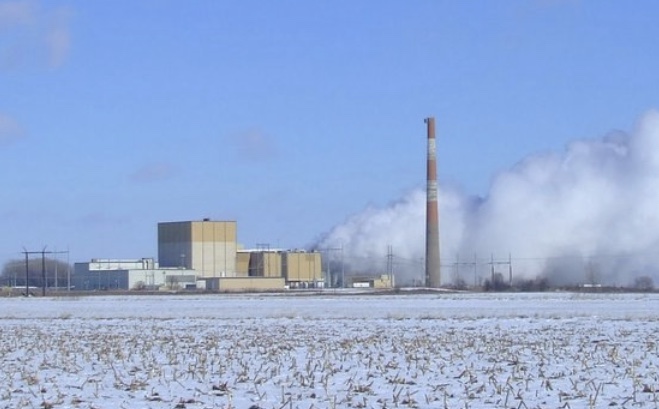
Top photo: Duane Arnold Energy Center in winter, photographed by AsNuke, CC BY-SA 4.0 https://creativecommons.org/licenses/by-sa/4.0, via Wikimedia Commons
2 Comments
Thanks Ralph
I was beginning to think I was the only person in Iowa opposed to the restart of Duane Arnold. Several years ago the nuclear industry was on its way to oblivion. Nuclear plants were closing, and no new plants had been built for years. Renewable energy (nuclear is not renewable. It runs on uranium) was becoming more affordable and it was less polluting. But the nuclear industry found a savior – data centers. And nuclear power has always had its cheerleaders. They have now convinced decisionmakers that we must have nuclear power to provide sufficient power. Even some environmental organizations have jumped on the bandwagon.
I just participated in a hearing before the Iowa Utilities Commission Tuesday on whether a permit should be issued to allow Duane Arnold to restart. The process was also initiated yesterday for the Nuclear Regulatory Commission permitting process. I will be intervening in that proceeding.
So NextEra has a ways to go before Duane Arnold can be restarted. I hope more Iowans heed Ralph’s warning.
Wally Taylor Thu 23 Apr 11:42 AM
The money could also pay to keep Iowa's water monitoring system going...
…though keeping it going would be unpleasant for the legislators who won’t admit they want the system to die so it will stop embarrassing their favorite industry. And since Iowa taxpayers are now on the hook for free farm soil testing, which rewards the many irresponsible farmers and landowners who are not testing their soil already, this money could pay for that too.
PrairieFan Thu 23 Apr 12:37 PM