
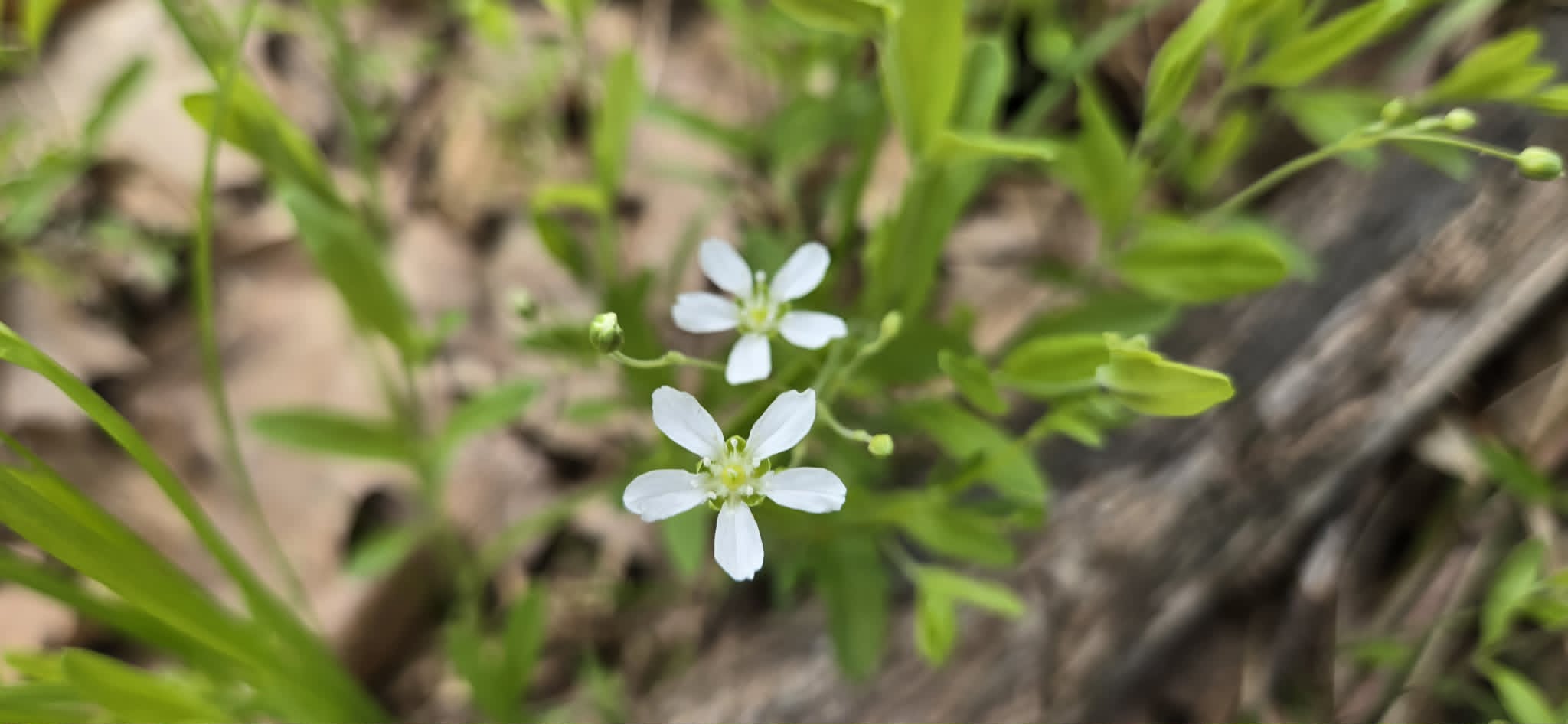
Kenny Slocum, the owner/operator of Light Touch Ecological LLC, features another good wildflower find in northeast Iowa.
I left my job with the Clayton County Conservation Board in March of this year to pursue private land restoration full-time.
It was a leap of faith. I had done some forestry work on the side for several years, and finally felt like I had gotten enough to interest, and enough spousal support, to justify leaving behind the relative comforts of government work and benefits.
Financial concerns aside, I also worried I would come to miss the places I had spent the last decade restoring. I reminded myself often in that work, when I would find a primitive shelter left by behind by boy scouts who haven’t learned leave-no-trace or a bunch of morel stumps indicating someone had found my honey hole, that these lands belonged to everyone and I must abandon feelings of ownership.
I wanted to work more with private lands, in part because my area of northeast Iowa appears to have both the need on the landscape, and the appetite among the landowners for more of the kind of healing work I find valuable.
But on the other side of that coin lies, often, much more degraded landscapes. None but the most dedicated landowners have the practical capacity to engage with the land as often as I could in my prior role, to say nothing of the hands tied by various cost-share programs, for better or worse.

After a few months in, I can safely say I vastly underestimated the amount of fascinating treasures tucked into unexpected places out there.
Take for example, a woodland I worked in this spring. I had 1,200 trees to stick into a tract that had gotten logged five years ago, with some follow-up timber stand improvement last winter to make sure the future stand didn’t have a mess of undesirable trees dropping seed into it.
I crashed through multiflora rose and blackberry so tall it pulled my hat off. I tripped over stacks of timber slash, desperately hoping I’d catch myself before an uncontrolled fall into the unknown hiding beneath the brush.
On one such stumble, a flash caught my eye. This raspberry looked different—wait, is that… Goldenseal?

Goldenseal grows in rich, healthy woodlands, and has become highly valued for its medicinal properties, which in turn becomes its financial properties and thus becomes vulnerable to over-harvest. When I see Goldenseal, I tend to think “intact ground layer.”
And so my eyes started to look a little more carefully. Before too long, I found another curiosity. This one I may have easily mistook for chickweed at a glance.

But something looked different, so I turned to the almighty app. Bluntleaf sandwort (Moehringia lateriflora), also known as grove sandwort.
A new one to me, so I hit pause on the tree planting for a moment to do a little homework. Plants always tell a story, so when I see one I don’t recognize I always try to find the ecological underpinnings so I can hear what it’s trying to say.

A closer look reveals none of the lobed chickweed petals
I could not find much. It appears not altogether uncommon, at least according to BONAP, but I certainly had never seen it nor heard of it.

I texted the picture to a friend who often receives random pictures of neat things I find with no context. He, too, raised an eyebrow—and he’s got a lot of dirt under his own fingernails.
I checked the Coefficient of Conservatism for Iowa, and found a 6, which indicates its not all that delicate, though I still struggle to understand entirely how to interpret that figure. I just know a very high number is considered exciting.

Other than that, I could find only one interesting tidbit from Illinois Wildflowers: like many spring ephemerals (this one was blooming in May), this plant produces elaisomes, the little packets of food that attract ants to aid in seed dispersal. This adaptation occurs in many species, but quite rarely in the Pinks, the family to which bluntleaf sandwort belongs.
This species spreads mostly by rhizomes; seed production is poor.
A few weeks ago I had the pleasure of attending the Iowa Prairie Conference in Dubuque. One of my greatest joys, and possibly greatest annoyances to the people around me, is asking random people if they have seen a random plant. When the internet fails me, a group of Iowa plant lovers never does.
Yet even here, I drew a few curious looks. Some of the more seasoned plant-ganderers squinted briefly, that look one gets when they try to attach a face to a name or vice-versa.
Eventually, one young fellow overheard me and chimed in. He had seen it in an oak grove at the Conard Environmental Research Area. Ironically, I had visited that site on a previous Iowa Prairie Conference. It could not be a more different context, aside from the oak trees.

Conard gets lovingly cared for, by an army of paid staff, unpaid interns, contracted labor, and dedicated volunteers (always). The woods I had found it in had just been logged, again, and had little stewardship applied besides a fairly cavalier approach to herbicide where it got in the way of side-by-side trails.

One other person at the Iowa Prairie Conference had, in discussing the context, wondered if it fit into that niche occupied by many other rare-but-not-rare plants – game trails. I had found other “rare” plants in similar settings, such as oval ladies’ tresses along a popular hiking trail in motor mill.

I found three birds orchid just a few weeks ago in an old pine stand at Yellow River State Forest, again right next to a trail where herbicide helps to keep other vegetation down, albeit much more judiciously.

Many of these plants are not rare, or all that delicate (though they may have some pretty specific habitat requirements)—just cryptic. They hide, playing the long game, waiting for the brief interglacial when the canopy recedes, maybe for just a year or two, giving them the opportunity to bloom, seed, and go back into hiding.
When I see them, it’s a reminder: everywhere has something worth saving. A lot of wild Iowa is still in there somewhere, hiding, waiting for the next opportunity for something to shine a light on it, to recognize it, and to ask it what it has to say about the land to which it’s rooted, the land that I’m only passing through.
3 Comments
Really interesting post, Kenny! Thank you for sharing.
Northeast Iowa landowners are fortunate to have you working there. Best wishes for your new career.
PrairieFan Thu 27 Aug 10:00 PM
Great find!
Great article and a nice find! One small correction: it’s Conard Environmental Research Area (CERA), not Conrad.
Great to see Moehringia lateriflora featured. This summer I found it near my new home at almost 10,000 feet in the Sangre de Cristo Mountains of northern New Mexico. As someone who also once lived at CERA, it’s remarkable to think about the ecological amplitude of this species. Despite being easily overlooked, it occupies habitats separated by substantial differences in elevation, climate, and geography. Just a lovely reminder that some seemingly inconspicuous species can have surprisingly broad ranges and complex biogeographic histories.
Good luck with your new venture after a storied career at CCCB!
pollinator Fri 28 Aug 4:55 PM
No title
Thank you for noting this! Corrected.
Laura Belin Fri 28 Aug 9:41 PM