
Third in a series interpreting the results of Iowa’s 2026 state and federal elections.
For the first time in state history, women will make up more than a third of the 50 Iowa senators in 2027.
The number of women serving in the chamber will rise from fifteen this year to eighteen when lawmakers return to Des Moines in January. A nineteenth woman could be elected to the Senate early next year.
The new record represents rapid change from a decade ago, when only six Iowa state senators were women. It’s consistent with a national trend, as Americans elected more women than ever to state legislatures this month, according to the Center for American Women and Politics at Rutgers University.
However, the number of women serving in the Iowa House will decline from 29 this year to 27 in January. The high point for female representation in that chamber was the 2019 session, when 34 of the 100 state representatives were women.
Open seats lead to big gains in Iowa Senate
Going into the 2026 campaign, fifteen women were serving in the Iowa Senate—tied with the chamber’s previous record in 2023 and 2024.
Six of those women were not up for re-election in 2026: Democrats Sarah Trone Garriott (Senate district 14), Renee Hardman (Senate district 16) and Janet Petersen (Senate district 18), and Republicans Dawn Driscoll (Senate district 46), Amy Sinclair (Senate district 12), and Kara Warme (Senate district 26).
Eight women won another term on November 3: Democrats Liz Bennett (Senate district 39), Molly Donahue (Senate district 37), Catelin Drey (Senate district 1), Janice Weiner (Senate district 45), and Cindy Winckler (Senate district 49), and Republicans Carrie Koelker (Senate district 33), Annette Sweeney (Senate district 27), and Sandy Salmon (Senate district 29).
Republican Senator Cherielynn Westrich didn’t seek re-election in 2026, and a man won the race to succeed her in Senate district 13.
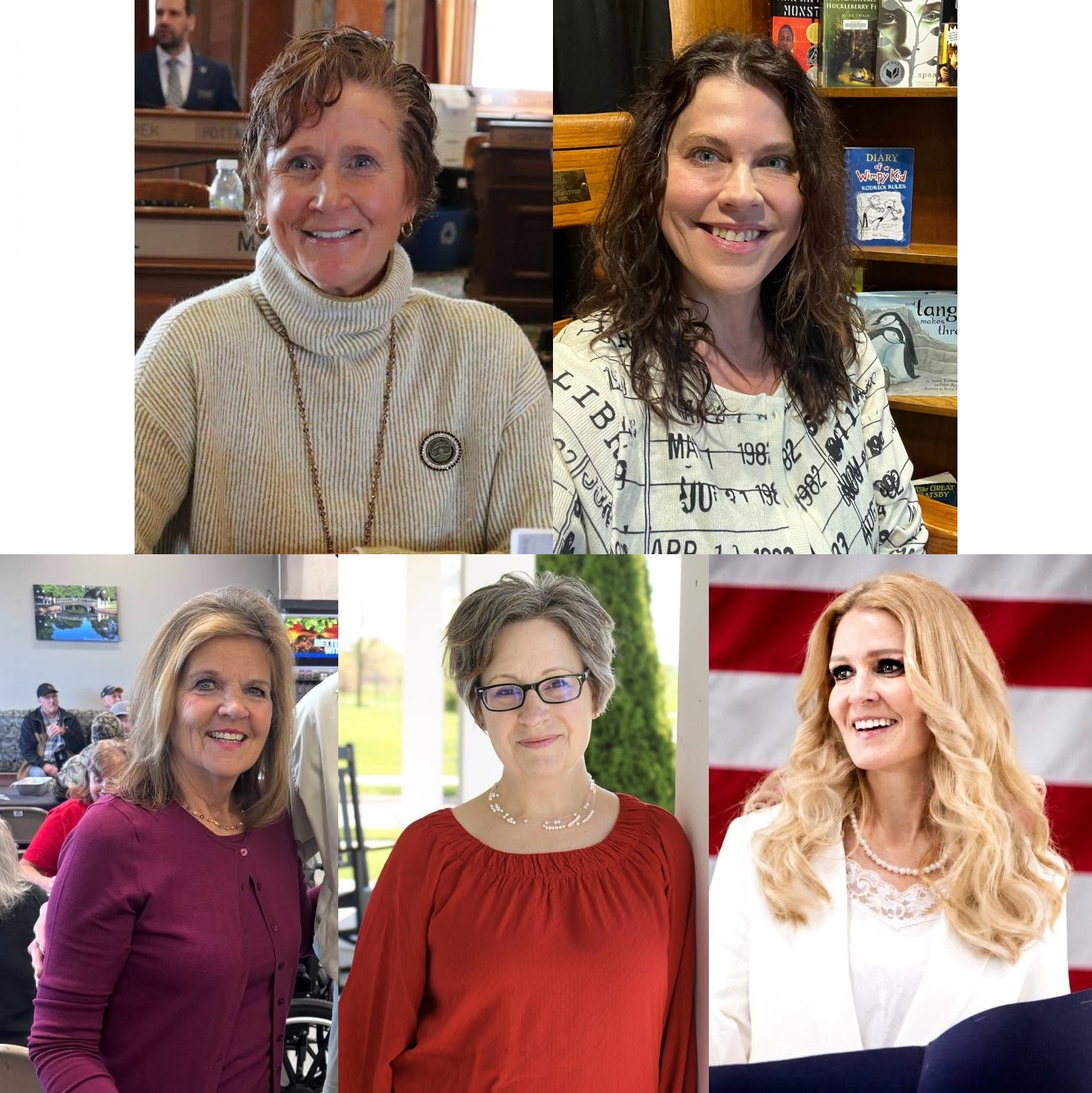
But five women won open Iowa Senate seats previously held by men, named in parentheses:
- Republican Hollie Zajicek won Senate district 11 (Julian Garrett)
- Republican Barb Kniff McCulla won Senate district 19 (Ken Rozenboom)
- Democrat Heather Matson won Senate district 21 (Mike Bousselot)
- Democrat Timi Brown-Powers won Senate district 31 (Bill Dotzler)
- Democrat Meghann Foster won Senate district 43 (Zach Wahls)
That would be nineteen women (eleven Democrats and eight Republicans) on track to serve in the Iowa Senate in 2027. But Trone Garriott will soon resign from the legislature to serve in Congress. We don’t yet know who will run in the special election to replace her; at this writing, Democrat Wendy Marsh and Republican Dave Rosznak are the only declared candidates.
Whether the final number of women senators lands at eighteen or nineteen, that’s unprecedented and triple the number of women who served in the Iowa Senate following the 2016 elections. In addition, women will make up a majority of the Senate Democratic caucus for the first time. (Exactly half of the sixteen Senate Democrats were women in 2023 and 2024.)
A quarter of the 32 Senate Republicans will be women, which is remarkable, considering that Amy Sinclair was the lone woman out of 29 GOP senators in 2017.
“Women bring another set of ideas to the table”
I interviewed three of the incoming senators by telephone on November 14. Foster, a Democrat and the outgoing mayor of Coralville, knew during the campaign that a record-breaking cohort might be elected to the Senate. She recalled being part of a similar trend when she first ran for the Coralville City Council in 2017. The Des Moines Register’s Linh Ta reported in February 2018 on the “wave of women” running for office, which produced several majority-woman city councils in Iowa.
Asked about the significance of growing female representation in the Senate, Foster speculated that women “are probably motivated to run and to lead and to serve because we are often hit the hardest, in a lot of ways, by those kitchen table issues, and the civil rights issues as well.” She said she hoped women would bring their lived experiences into the Senate and turn them into “real action.” It’s not that men don’t care about issues like affordable health care and child care, strong public education, or reproductive rights, she added, but “women experience those policies in a different way.”
Thinking about conservative messaging in recent years, from Project 2025 to “tradwife” social media content aimed at young women and girls, Foster told me, “I feel like there’s been a real shift to push women out of public life and leadership, and I’m glad to see that it’s not working.”
Kniff McCulla, a Republican from Pella who has served in the Iowa House since 2023, was not aware that voters had just elected more women to the Senate than ever. She told me it’s important for people with different life experiences to work together. Based on her experience as a business owner in a male-dominated field (construction) and in the state House, “women bring another set of ideas to the table than what men do,” and men “bring something different to the table” as well. “And I think together it makes a much better Senate,” Kniff McCulla said.
Matson, a Democrat from Ankeny, also hadn’t realized more women would be serving in the Senate. She was part of the record-breaking class of women elected to the Iowa House in 2018. Women made up more than half of the House Democratic caucus in 2019. As an assistant minority leader beginning in 2023, Matson was part of the first all-woman leadership team in the Iowa House.
Before her first (unsuccessful) campaign for the state legislature in 2016, Matson was involved with the nonpartisan organization 50/50 in 2020. Starting in 2009, that group helped train women to run for office in Iowa. (The organization dissolved in 2020.) During our interview, Matson recalled how “impactful” it was to be part of a group “truly focused on elevating women’s voices.”
Given the philosophical differences between the Democratic and Republican parties, women are “not all a monolith, obviously,” Matson told me. But she feels women do have a “unique” ability to work together outside of party.
Based on her research, Matson believes she is the first woman elected to represent Ankeny in the state Senate. (That’s consistent with my review of legislative records.) Voters in that suburb north of Des Moines have elected three women to the state House: Republican Carmine Boal, Matson, and fellow Democrat Molly Buck.
More turnover leads to fewer women in Iowa House
Going into the 2026 campaign, 29 of the 100 Iowa House members were women (fifteen Democrats and fourteen Republicans). Democrats nominated more women for the legislature than Republicans, and picked up eleven Iowa House seats on November 3.
So why will female representation decline next year? It was a little bit of a lot of things.
Republican women drop from 14 to 11
Ten of the fourteen current Republican women state representatives were re-elected: Megan Jones (House district 6), Wendy Larson (House district 7), Ann Meyer (House district 8), Devon Wood (House district 17), Brooke Boden (House district 21), Samantha Fett (House district 22), Shannon Lundgren (House district 65), Cindy Golding (House district 83), Helena Hayes (House district 88), and Heather Hora (House district 92).
Barb Kniff McCulla (House district 37) ran for the state Senate and will be succeeded by a man.
Shannon Latham (House district 55) retired and will be succeeded by a man.
Jennifer Smith (House district 72) lost the general election to a man.
Jane Bloomingdale (House district 60) lost the June primary to a woman (Dani Ollenburg), who went on to win the general election.
That makes eleven women among the 56 Republicans who will serve in the House next year.
Democratic numbers rise from 15 to 16
There was more churn on the Democratic side. Nine of the fifteen female House incumbents sought another term, and all were re-elected: Megan Srinivas (House district 30), Mary Madison (House district 31), Beth Wessel-Kroeschell (House district 49), Elizabeth Wilson (House district 73), Angel Ramirez (House district 78), Tracy Ehlert (House district 79), Aime Wichtendahl (House district 80), Amy Nielsen (House district 85), and Elinor Levin (House district 89).
Two Democrats retired and will be succeeded by men: Jennifer Konfrst (House district 32) and Monica Kurth (House district 98).
Ruth Ann Gaines (House district 33) retired and will be succeeded by a woman (Ivette Muhammad).
Heather Matson (House district 42) ran for the state Senate and will be succeeded by a woman (Amy Tagliareni).
Timi Brown-Powers (House district 61) ran for the state Senate and will be succeeded by a man.
Lindsay James (House district 71) ran for Congress and will be succeeded by a man.
Adding to the ranks of Democratic women:
Jill Alesch picked up an open seat previously held by a man (House district 43).
Four women defeated male incumbents: Heather Sievers (House district 40), Molly Buck (House district 41), Mandy Newton Rosenow (House district 46), and Jennifer Kirkman (House district 99).
So that’s sixteen women among the 44 incoming House Democrats. As a proportion of the caucus, it will be far lower than fifteen out of 33 House Democrats this year or 24 women out of the 46 Democrats in 2019.
Final note
In 2024, Republican lawmakers and Governor Kim Reynolds repealed Iowa’s longstanding requirement for gender parity on most state boards and commissions. In September, I asked Democratic candidate for governor Rob Sand whether he would aspire to have roughly equal numbers of men and women serving on those government bodies, even though that’s no longer required by law. He said he would aspire to do so.
Iowans who would like to serve on any state board or commission can express their interest by visiting this page on the Sand transition website, IowaforAll.com.
Top photos of Timi Brown-Powers, Meghann Foster, Barb Kniff McCulla, Heather Matson, and Hollie Zajicek were first published on the candidates’ Facebook pages.