Katie Byerly of Cerro Gordo County is also known as Iowa Prairie Girl on YouTube. Her video about wild parsnip is at the end of this post.
I don’t use the word hate often. If you asked me if I liked black licorice, I would say “I don’t like black licorice.” I know I wouldn’t say “I hate black licorice.” Hate is a strong word, and I avoid using it. But I’m going to use it here: I hate wild parsnip!

Wild parsnip (Pastinaca sativa) causes phytophotodermatitis.
Imagine enjoying a prairie walk, or you need to “use a corn field” while on a bike ride, and you accidentally brush bare skin against a wild parsnip plant. Add a little sunshine to the combination, and now your misery is about to begin!
The sap destroys your skin’s natural UV protection. The sun burns you. But it is so much more than a sunburn. Oh, so much more!! The Iowa State University Extension and Outreach describe the combination of Wild parsnip sap and sunshine as cellular death!

In a few hours you might begin to notice a little redness on your skin and it might feel a little itchy. But wait, it’s coming! In 36-72 hours you will have a full blown chemical burn that will drive you crazy for the next week, or two, or three. Your skin will blister. The blisters will drain. Your skin is red and inflamed, swollen, tender and itchy. All you want to do is scratch. You try not to, but in private, scratching brings temporary relief. Oh, what wonderful relief.
Soda or oatmeal baths in tepid water, Calamine lotion or Ivy Dry, Hydrocortisone or Benadryl creams, whatever you can find in the back of your bathroom closet, you try. Tylenol PM or Benadryl at bedtime to knock you out. You dream about scratching. It might even require a trip to the physician for some Prednisone, but what you really want is Ativan. This rash is driving you crazy. This is why I hate wild parsnip!
Wild parsnip looking innocent with Prairie Fleabane:

The key to avoiding this horrible chemical reaction is prevention. You can not become complacent with this miserable, monster plant.
Before stepping into a prairie or ditch, it has become second nature for me to scan an area for wild parsnip. But obviously I had to learn this the hard way. Long pants and long sleeves are required if you are going to be around wild parsnip. I’ve become convinced that thin hiking pants don’t offer the necessary protection.
I’ve also become convinced that once exposed, your body will re-react just by being near the plant, but I can’t find scientific proof for this. Gloves are a necessity if you plan on purposely touching this scary weed. And always look around thoroughly before visiting nature’s loo.
Wild parsnip with Field thistle:

If you do come in contact with the sap of Wild parsnip, wash! Wash it off with whatever means you have available. Assuming you are not close to a sink, use your water bottle, a mud puddle, or jump in the river or lake. I’m serious here. When you do get home, wash your clothes and take a shower immediately.

Wild parsnip is a non-native, invasive weed that can be found across the Midwest of the United States. In July, it seems that every unmowed Iowa country road is lined with it. It pops up in prairies and pastures, along walking and biking trails and the edges of rivers and lakes. I forgot to mention to be careful when floating a river—an activity that involves a lot of bare skin and sunshine—a perfect time to get a wild parsnip burn.

I was an outside adventurous child in the 1970s and 80s. I don’t remember ever being warned about wild parsnip. I do remember a few run-ins with poison ivy, though.
Wild parsnip was brought to the United States by our immigrant ancestors as a food source. I find it hard to imagine planning a new start in a new country and feeling the need to bring along a plant that causes such misery. The plant has spread after escaping from vegetable gardens of old.
The Iowa State Extension office explains how and why this invasive weed has spread like wildfire over the past few decades:
Due to limited budgets, most counties and the state only attempt to control roadside weeds that are classified as noxious (wild parsnip is not listed). This contrasts to programs from 40 to 50 years ago where nearly every roadside was mowed or sprayed at least once a year. These programs reduced weed problems, but were very expensive and not very environmentally friendly. Mowing of roadsides is not allowed until July 15 in order to protect nesting bird habitat (there are exemptions). Unfortunately, mowing after mid-July minimizes the effectiveness of this tactic in controlling wild parsnip since viable seed will have already been produced.
Even when the ditches are mowed later in the summer, the plant has already gone to seed. The seeds either get blown around or hitchhike on the mower to the next ditch.
Wild parnsip is in the carrot family. The grooved or ridged stem reminds me of a celery stalk. The plant will grow to be 2-5 feet tall.


The leaves present as leaflets. The lower leaves can get to be as large as 18 inches long and 6 inches wide. These alternate leaves are oval shaped with saw-toothed edges. The leaves towards the base have long stalks. I’m pretty sure that’s to ensure that you can’t walk by without brushing against it.

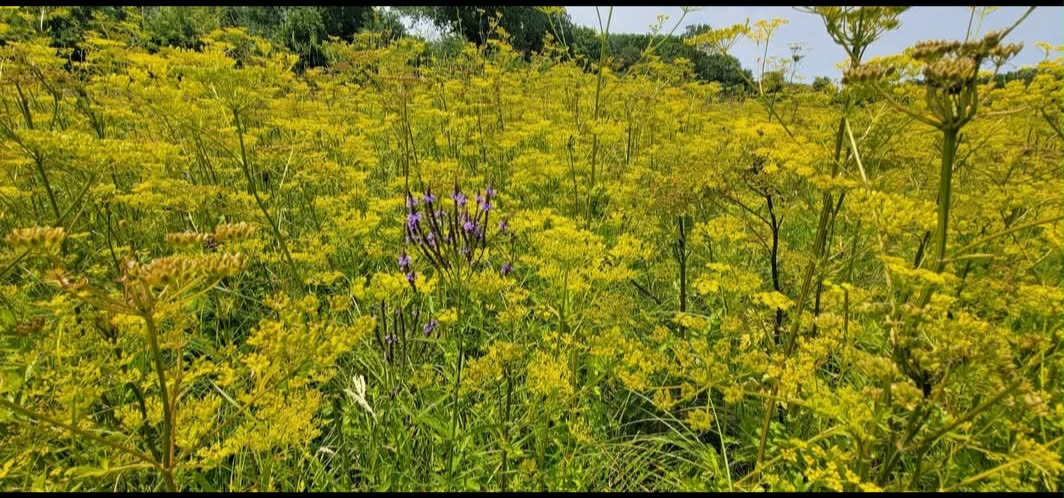
Multiple flat-topped umbels with tiny yellow flowers cover the tops of the plant. (An umbel is an umbrella shaped cluster of flowers.) The plant’s main stalk can branch. These side-spreading side stems also produce umbels. We often write about how tall plants are but rarely mention the width of a plant. Individual wild parsnip plants spread out. Just a few wide plants together can make an area impassable.

A wall of wild parsnip with blue vervain:

Back to the flowers: each umbel divides into 15-25 umbellets (smaller umbrellas) and each embellet produces 12-35 flowers. The tiny yellow flowers have five petals. The little petals initially fold inwards towards each other and then eventually fold outward. The flowers have five yellow stamens.


Each small flower has a greenish-yellow center that acts as a nectar landing pad for insects. Wild parsnip is mostly visited by wasps, flies, beetles and ants. Is it a coincidence that this unpleasant plant is pollinated by insects that many consider unwelcome picnic guests?
Herbivores won’t touch the stuff either. If eaten, it irritates their insides. Yet another reason this menacing plant continues to spread out of control.

The terminal umbel (the one at the top of the plant) can produce around 500 flowers. The secondary or branching umbels on the sides of the plants can grow another 500 flowers. All told, a mature wild parsnip plant could produce over a thousand flowers. The Illinois Wildflowers website writes: “Each flower is replaced by a schizocarp containing a single seed. The seeds are flattened and winged; they are blown about by the wind. This plant spreads by reseeding itself.”

Like other plants in the carrot family, wild parsnip produces schizocarps: A dry fruit that splits apart when mature containing one seed.
Here is an image of dry, open seed capsules. These are from a plant in my windbreak. I can only hope the dropped seeds get eaten by birds or rodents rather than produce more plants.

The plant blooms for 1-2 months in mid-summer (June and July in Iowa). Then the whole plant dries up and eventually disappears. Once it reaches that dried up phase, it is not longer dangerous to touch. But I’d still be careful.

The Minnesota Wildflowers website uses such words as “Noxious weed” and “Invasive – ERADICATE!”
It is a biennnial plant. I have had luck keeping it out of my yard and ditch by either lopping the top of the plant off before it goes to seed or pulling young plants out of the ground. (Be sure not to pull up the lovely, similar looking Golden Alexanders).
I will confess, I have a small prairie that I see parsnip starting to creep into. There just isn’t enough time in the day to keep up with this bothersome weed.

In case you don’t know, invasive plants/weeds create dense growths that beat out our native vegetation. So not only is wild parsnip harmful to humans, but its tall dense canopy takes up all the space that would usually contain beautiful, native, wildflowers.
Other invasive plants in Iowa include Queen Anne’s lace, Purple loosestrife, Garlic mustard and Dame’s rocket. I always feel bad for new wildflower enthusiasts who innocently post Facebook pictures of the above plants, unaware that a wildflower purist is going to unkindly teach them about invasive species. Let’s be kind to each other, my nature loving friends. But on that note, I really do hate wild parsnip.
If you’d like to see me face wild parsnip head on, catch me in my death defying Iowa Prairie Girl YouTube video: DANGEROUS – WILD PARSNIP!!!
2 Comments
I also hate wild parsnip ...
…and have suffered the blisters. Thank you, Katie Byerly, for a valuable post with important information. Three more things:
1) Wild parsnip will often decline if soil disturbance stops and there is robust native-plant competition. I’ve seen parsnip populations mostly disappear from high-quality diverse prairie reconstructions that get good management.
Unfortunately, county road ditches often get eroded soil washed into them from adjacent cornfields, and sometimes from gravel roads. Parsnip loves that.
2) Wild parsnip is a food plant for black swallowtail butterfly caterpillars and is visited by various native pollinators. But that is no reason not to kill it. In Iowa, it’s an ecological menace. Flowers that are native to Iowa support pollinators far better than parsnip.
3) Research indicates that wild parsnip seed is viable in the soil for no longer than five years. If new seed production can be prevented for that long, via mowing, pulling, or root-severing (there is a special tool for that called the Parsnip Predator), wild parsnip can actually sometimes be eliminated.
PrairieFan Fri 4 Sep 12:40 AM
Hater here too!
I got a wild parsnip burn 20 years ago when clearing out the back yard in our then newly purchased home. I can still see the scars on my arm. Nasty stuff.
I’m also susceptible to poison ivy, but this was way worse, and steroids don’t help.
OatFarmer Wed 9 Sep 10:58 AM