
Melissa Wubben lives on a farm in Warren County.
Monarch butterflies have become an iconic species, representing the plight of all of our native pollinators struggling with habitat loss and population decline. They are great ambassadors for conservation because they are so easy to love. From the scientific fascination of their unparalleled migratory journey to the symbolism of their metamorphosis from caterpillar to beautiful butterfly, they have something to offer everyone, and nature enthusiasts have begun planting and nurturing milkweeds to help them recover.
Milkweeds and Monarchs are linked together in people’s minds, and for good reason: milkweeds are the host plants for Monarch caterpillars. They are a necessity for any Monarch to complete its life cycle. Milkweeds do not, however, provide everything that a Monarch needs. While the adult Monarch butterfly will consume the nectar of milkweed flowers, they need additional sources of nectar to sustain them throughout the season, which typically runs from May through early October in Iowa.
In order to create a successful Monarch habitat, it is helpful to consider the whole life cycle of these butterflies.
The Monarchs that arrive in Iowa in the spring have journeyed from the southern United States. It takes a lot of carbohydrate-rich nectar to fuel their flight, and they will be looking for early nectar sources upon arrival. Monarchs enjoy nectaring on plants with clusters of flowers where they have a platform from which to drink from ample flowers at one stop. The flowers on this Nannyberry shrub (Viburnum lentago) are a good example of an early nectar source.

These first generation adult Monarchs live, on average, two to six weeks, with females laying 100-300 eggs throughout that time. Eggs are laid exclusively on milkweed plants, as they are the only food source for the caterpillars that emerge four to five days after an egg is laid. Monarch caterpillars will consume milkweed leaves for nine to thirteen days, as they grow large enough to enter the chrysalis stage.
With two or three non-migratory generations of Monarchs per season, that’s a lot of milkweed and nectar to feed them all!

Monarch egg on the leaf of a Common Milkweed (Asclepias syriaca)

Monarch caterpillars eating Common Milkweed
Once a Monarch caterpillar is ready to enter the chrysalis stage, it will most often leave the milkweed plant, searching for a safe and sturdy location in which to pupate. They might travel 15 to 20 feet to find a suitable location. Despite the protection of the milkweed toxins they’ve ingested, this part of their journey is fraught with danger from various predators.
For this reason, providing appropriate structures for chrysalis formation within a Monarch habitat can be helpful. In a garden setting, this might include a backdrop of trees or shrubs, a garden bench or trellis strategically placed, or some decorative fencing. Chrysalises have even reportedly been found on taller native plants such as New England Asters or Purple Coneflowers (both of which are also excellent nectar sources).

The remains of a chrysalis found on a peach tree located approximately fifteen feet from the nearest patch of milkweed
As fall approaches and milkweeds are eaten down and seeding out, the migratory generation of Monarchs is fueling up for the long journey south. The adults of this generation will live eight to ten months, making the flight to their overwintering grounds in Mexico, before flying back to the southern United States again in the spring.
In order to make this long flight, these butterflies need plenty of late season nectar sources. From Blazing Stars to Goldenrods and Asters, any good habitat will provide essential late blooms.

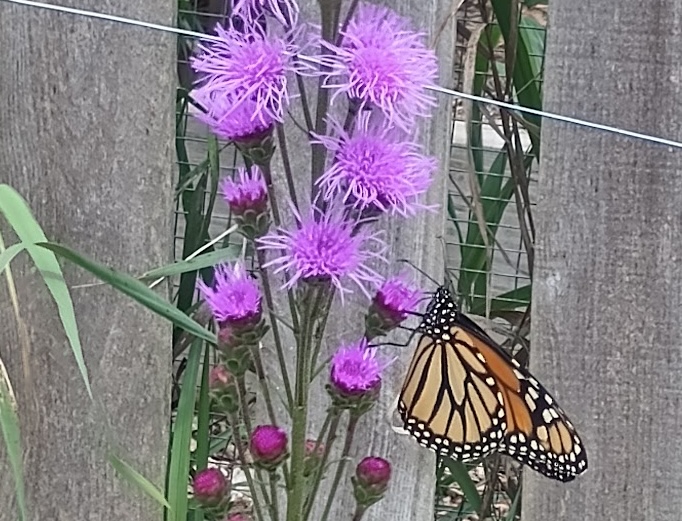
Adult Monarch nectaring on a young Button Blazing Star (Liatris aspera)
It can be overwhelming to think about trying to provide host plants, nectar plants throughout the season, and appropriate shelter for chrysalises in order to create a suitable habitat, especially with limited space, or soil that isn’t ideal for a garden.
The following ideas can serve as a guide for a variety of gardening situations, with plant groupings designed to provide the basic elements of good Monarch habitat. In very limited spaces, including container gardening, simply providing some nectaring plants will help Monarchs and other pollinators that are passing through.

This sunny location offers Butterfly Milkweed as a host plant, Purple Coneflower for mid season nectaring, and a young oak tree for protection. Also present, just outside of the photo, is a Nannyberry shrub for early season nectaring and potential chrysalis site, as well as a retaining wall protecting against prevailing northwest winds. The wall’s stones offer additional chrysalis sites. Not yet blooming, there are Smooth Blue Asters in this site for late season nectar.

A Monarch caterpillar on Butterfly Milkweed (Asclepias tuberosa)
Open/sunny locations provide ideal sites for many native plant options. If tall plants are desired, one potential plant grouping for such a site, based on nectar utilization by Monarchs (per Xerces Society) is Common Milkweed (host and mid season nectar), Prairie Coreopsis (early season nectar), Purple Coneflower (mid season nectar), and Stiff Goldenrod (late season nectar). Two other good options are Wild Bergamot (mid season nectar) and Meadow Blazing Star (late season nectar), depending on gardener’s preference.
For shorter plants in a similar site, consider Butterfly Milkweed (host and mid season nectar), Prairie Coreopsis (early season), Hoary Vervain (mid/long season), and Rough or Button Blazing Star (late season nectar, with by far the most reported Monarch visits of all nectaring plants listed with the Xerces Society). These plants can be paired with fencing, a trellis, or other structure for chrysalis sites.

Monarch nectaring on Purple Coneflower (Echinacea purpurea)
Shady areas can be more challenging, and may be limited to taller species. Poke Milkweed can serve as a host plant in pretty heavy shade. For shade tolerant nectaring plants, consider Nannyberry shrubs (early nectar and chrysalis structure), Sweet Joe-Pye Weed (mid season nectar), and Yellow Giant Hyssop (late season nectar).
For part shade, or where sun dappling is available and shorter plants are desired, consider Whorled Milkweed (host plant and mid to late season nectar), Hairy Beardtongue (early season nectar), and Big leaved Aster (late season nectar).
For dry or sandy sites, either Whorled Milkweed or Butterfly Milkweed can serve well as both host and nectaring plants. To provide nectar throughout the Monarch season in such locations, consider Prairie Coreopsis (early season), Pale Purple Coneflower (early to mid season), Dwarf Blazing Star (mid to late season), and False Boneset (late season). Don’t forget your protective structures for the chrysalises.

Whorled milkweed
Whorled Milkweed (Asclepias verticillata) is small, but mighty. Caterpillars eat the needlelike leaves, and it is an excellent nectar source. According to data from the Xerces Society, this species had the highest reported nectaring visits by Monarchs among the most common Milkweed species in Iowa.
In wet or rain garden locations, Swamp Milkweed makes an excellent host plant and mid season nectar source. Consider adding Buttonbush for a chrysalis structure that can also provide mid season nectar. In addition, Culver’s Root (early to mid season), Prairie Blazing Star (mid to late season), and New England Aster (late season) can provide nectar. Blue Flag Iris is an option for earlier blooms and possible nectar source.

A Monarch Butterfly uses Swamp Milkweed (Asclepias incarnata) as a nectar source. Monarchs are attracted to sites that offer food for themselves as well as their larval offspring.
All native plantings are beneficial to pollinators, so don’t be discouraged if your space is small, or if you don’t see the butterflies visit. Your patch may be exactly what a traveling Monarch needs to complete a longer journey. You might even find that some fireflies or bees enjoy the oasis you’ve created as well.
1 Comment
Great detailed information. Thank you.
One tiny possible clarification. Monarch butterflies used to live and reproduce on Iowa’s vast, almost-treeless tallgrass prairies, and on those prairies, the caterpillars pupated on prairie plants. As described in the post, the caterpillars would crawl away from the milkweed plants on which they had matured, and they would use various sturdy prairie plants as pupation sites, including ironweed, boneset, tall asters, etc. That instinct to crawl away from the “home” milkweed plant and pupate elsewhere prevented predators and parasites from using milkweed plants as monarch-chrysalis snack bars.
In certain prairie situations, such as along creek beds, the caterpillars might use rocks and exposed roots as other pupation options. I occasionally find a monarch chrysalis hanging under a milkweed leaf, indicating that the caterpillar crawled away from its original milkweed plant and came across a new one.
In small habitat areas such as gardens, the crawling caterpillars may find and use a variety of other pupation sites as indicated in the post, including birdbaths, heat pumps, benches, trees, shrubs, porches, etc. What won’t work is lawn. Thank you again, Melissa Wubben.
PrairieFan Thu 30 Jul 9:04 PM