Bleeding Heartland’s Iowa wildflowers series returns for a fifteenth year. Past posts are linked here (alphabetized by the plant’s common name) and here (for posts covering many species).
Leland Searles has had a long interest in birding and wildflowers. He combines that with over fifteen years as a consultant in ecological assessment and restoration, along with graduate studies in environmental and psychological anthropology. His recent writing addresses some facet of ecology, often with awareness of social interests and power that shape our regard for the environment. This essay first appeared on his Substack newsletter, Home on Earth.
In the past two weeks, I have already visited three woodlands to see which early plants have emerged. Over those three visits, the phenology is clearly visible: a few small leaves poking from the chilly but warming soil and no trees in leaf; larger leaves and more species on the surface and swelling buds on trees and bushes; and finally, a few leaf buds bursting into miniature, sometimes crumpled leaves and flowers hovering above or nestled within the growing stems.
Among the emerging plants are: Black Snakeroot (Sanicula, leaves only), Bloodroot (Sanguinea canadensis, flowers topping encircling leaves only on April 5), Dutchman’s Breeches (Dicentra cucullata, at first leaves and now blooms), Elm-Leaved Goldenrod (Solidago ulmifolia, recognizable basal leaves), Fragile Fern (Cystopteris fragilis, from tiny fiddleheads to expanding blades), Heart-Leaved or Woodland Blue Aster (Symphyotrichum cordifolium, basal leaves around last year’s dry stems), Violets (Viola, leaves only), Virginia Bluebells (Mertensia virginiana, from leaves to the first flowers), and Wild Ginger (Asarum canadense, the first fuzzy leaves).

The bursting leaf bud of Ohio Buckeye, Aesculus glabra, is often seen as a seedling, sapling, or understory tree on damp bluffs and stream terraces.
Tender young leaves try out the wavering spring temperatures from Buckbrush or Coralberry (Symphoricarpos orbicularis), Missouri Gooseberry (Ribes missouriense), and Ohio Buckeye (Aesculus glabra), in hopes that this is the real thing, this spring that wobbles between early March cold and the heat of summer. I wish them all well, as a hard freeze is entirely possible, followed by a humid day around November. I hope that they are resilient enough to take these conditions.
Here is a selection of my discoveries.

Mayapple, Podophyllum peltatum, with leaves clasping below the flower bud they eventually overtop. Woodland Hills Preserve, Warren County, April 5.
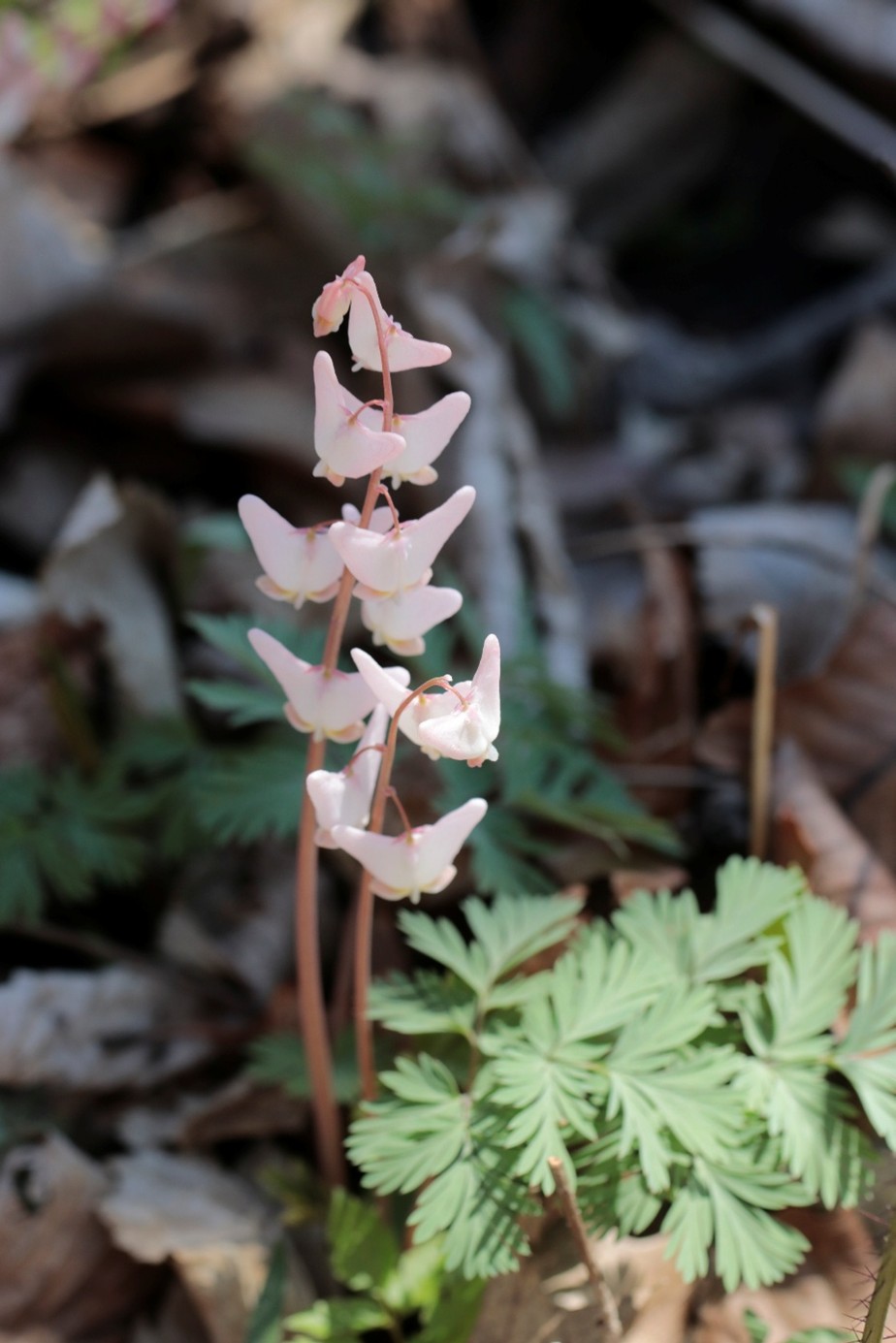
Dutchman’s Breeches, Dicentra cucullata, a close relative of garden Bleeding-Hearts, and usually common in woods with low disturbance from clearcutting, cattle grazing, and other threats.

False Rue Anemone, Enemion biternatum, can be prolific. It closely resembles its relative, Rue Anemone (Thalictrum thalictroides), but the “false” one has deeper “cuts” or notches in its lobed leaves. Enemion biternatum has five (rarely more) petal-like white or pink-tinged sepals that arise from the angle between the main stem and leaf stem or at the top, and it usually grows in small to large clusters or colonies.
On the other hand, Thalictrum thalictroides’ flowers have a variable sepal count of six or more, also shade from white to pink, and arrange themselves in a cluster or umbel at the top of the stem. Its leaves grow at the base of the stem and in a single whorl on the stem, along with leaf-like bracts underneath each flower. It usually occurs as scattered, single plants.

Heart-Leaved or Woodland Blue Aster (Symphyotrichum cordifolium) shows itself early in spring, unlike most other asters, and the cordate or heart-like leaf bases with toothed leaf edges are distinctive. Sometimes the dry remains of last year’s plant retain the branches and seedheads.

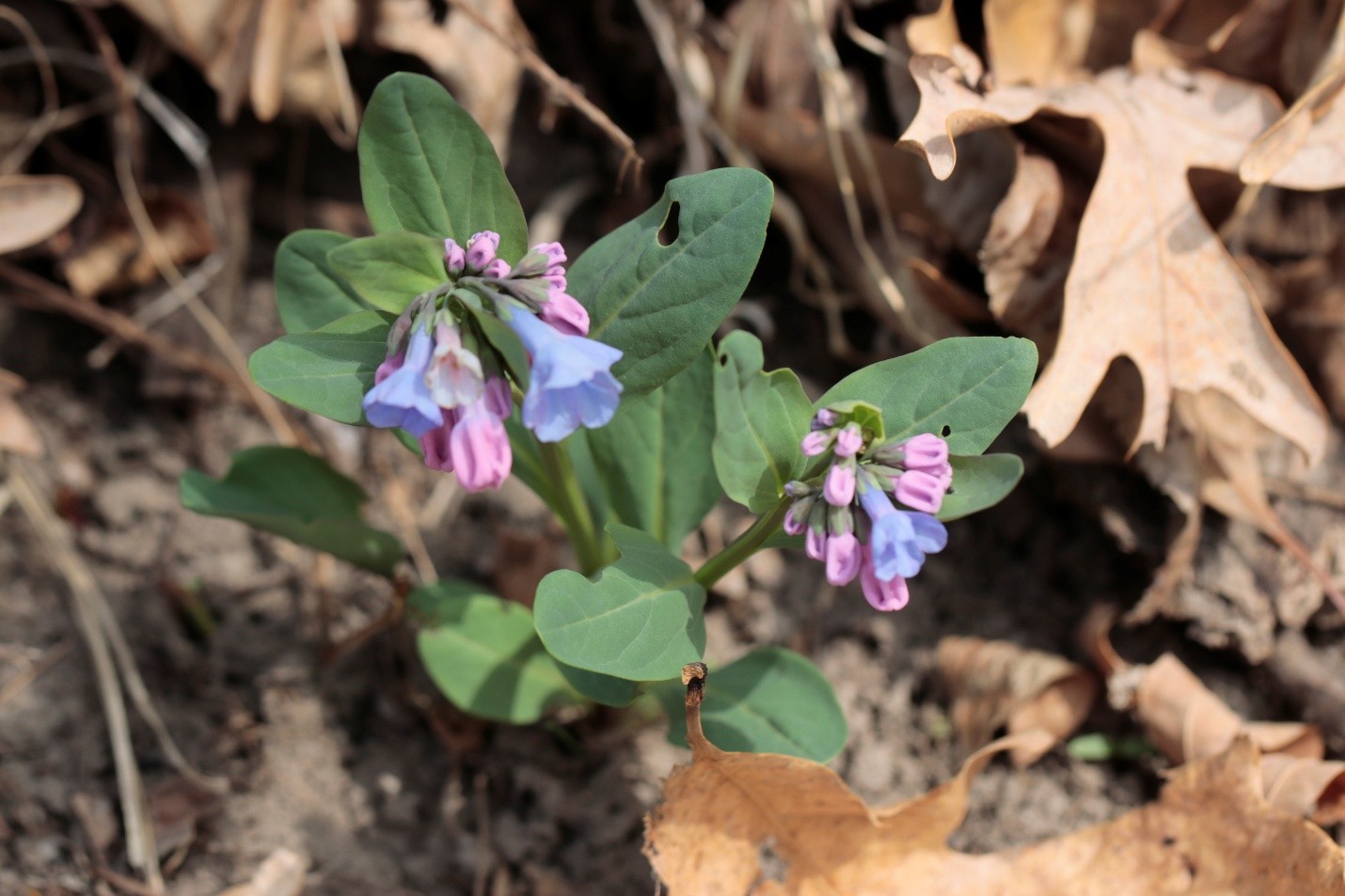
Virginia Bluebells (Mertensia virginiana) can bloom very early, with mature blossoms blue and immature flowers pink. Note the rounded leaf tips and the drooping flowers. Otter Creek Park, Warren County, March 31.

Virginia Waterleaf (Hydrophyllum virginianum) is a common woodland plant that favors damp soils. Early leaves show the pale patches that look like water spots, but the entire leaf may be a brighter green by summer’s end.

Buckbrush or Coralberry (Symphoricarpos orbicularis) has an opposite or paired leaf arrangement like its introduced relatives, the bush honeysuckles. In early spring, the leaves of Buckbrush are oval and fuzzy, and the stems are a red-brown color, unlike the bush honeysuckles. In autumn, its flowers mature into small, red berries.

Woodland Phlox or Wild Sweet William (Phlox divaricata) may be green all winter under snow. It flowers a little later than the flowering plants above and below, but the opposite leaves with each pair at right angles to the pair above and below and the short hairs on leaves and stem make it very recognizable.

In some places, Spring Beauty (Claytonia virginiana) can carpet the woodland floor with a faint pink to white blanket. A single pair of narrow leaves grows before the white to pink-lined to pink petals, and even the pollen is pink, unlike almost all other plant pollen. This and other early spring flowers are pollinated by Mining Bees (genus Andrena), Bumblebee Flies (Bombylius sp.), and a few other bees and flies.
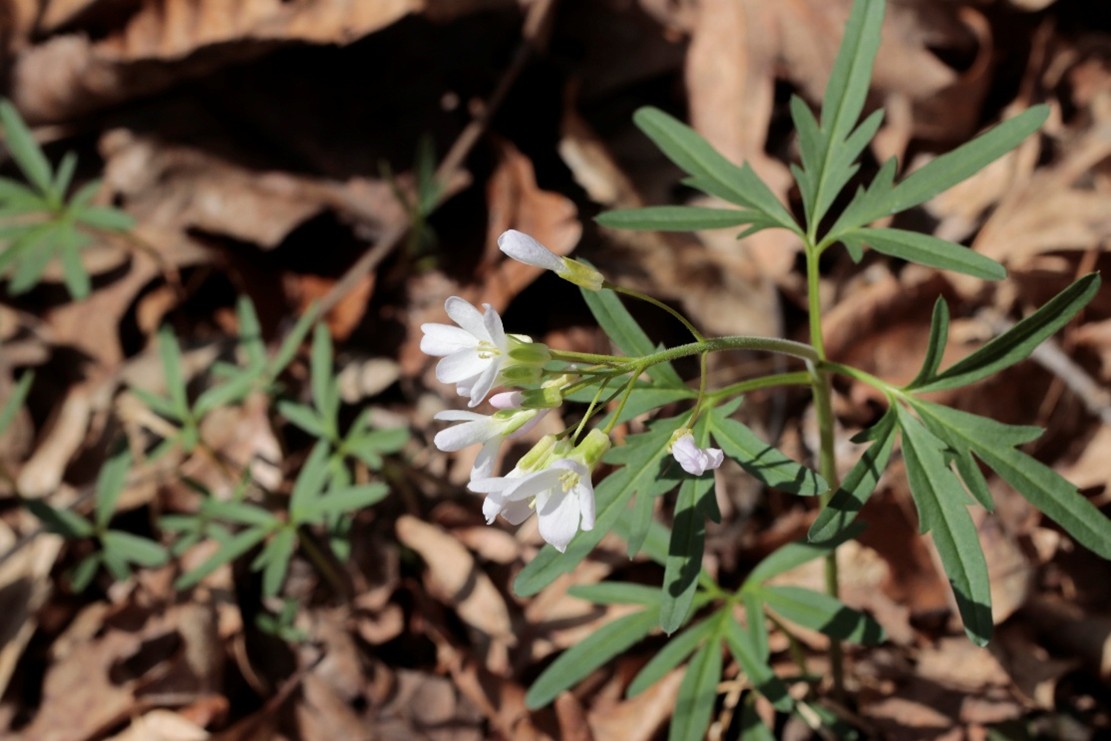
Less common than other flowers like Dutchman’s Breeches and False Rue Anemone, Cut-Leaved Toothwort (Cardamine concatenata) emerges here and there through leaf litter. It is one of a few native plants in the mustard family, which has a plethora of introduced species in North America. The leaves are fan-compound or palmate, and the flowers bear four petals, a common feature of the mustards.

A single compound leaf of Common Agrimony or Tall Hairy Groove-Bur (Agrimonia gryposepala) grows between the leaves of upland White Oak (Quercus alba). A tall, leafless seed stalk appear later with small yellow blossoms, followed by a drum-shaped seed that has grooves around the circumference and a ring of hooked burs that await the fur of mammals to distribute themselves.

A favorite of spring hikers, Bloodroot (Sanguinaria canadensis) seems to appear overnight, often with the flower first or hiding the leaves. At first the leaves encircle the stem, then later expand after the flower has fallen apart.

Pennsylvania Sedge (Carex pensylvanica) is a common sight in woodlands, maintaining some energy production from green leaves even under snow. Its flower heads stand only a few inches tall, and it depends on wind for pollination. It can form large patches under canopy openings, deserving the label “sedge meadow.”
The word “ephemeral” is used in a variety of natural science settings to indicate a short-lived event or the short life of an animal or flowering period of a plant. The Ephemeroptera, the insect order of Mayflies, adults of which often live only a day to reproduce, not even equipped with mouths to eat. The ephemeral flow of a stream that relies only on rainfall or snowmelt to run.
I do not really care for the term, because all natural events and lives are, from some perspective, short in their time, and Homo sapiens should take more time to appreciate the beauty and wonder of it all.
Leland Searles
Milo and Indianola, Iowa, April 2 and 6, 2026