
“We have a big job ahead of us,” Chris McGowan told a Republican crowd in Sioux City on October 22. “They expect Iowa four to do the heavy lifting for the rest of the state. Are we up for the task?”
McGowan is the GOP nominee in Iowa’s fourth Congressional district, an open seat. His remarks underscore why President Donald Trump held that rally in Sioux City, and why Vice President JD Vance headlined an event in Council Bluffs in September.
While Iowans in the first, second, and third Congressional districts could help Democrats win back the U.S. House of Representatives, voters in the fourth district may determine who runs state government.
Republican candidates need big margins in northern and western Iowa in order to win statewide elections. Iowa GOP state chair Jeff Kaufmann screamed at the Sioux City crowd, “It is not an overstatement to say that the fourth district is our secret weapon. We need you again, fourth district! Will you be there for us?”
Signs suggest Republicans may leave votes on the table in the reddest part of Iowa. The two candidates most at risk of underperforming there are U.S. Senate nominee Ashley Hinson and Attorney General Brenna Bird.
“When western Iowa turns out, we win”
The fourth Congressional district covers the blue area on this map. It encompasses the state’s most heavily Republican counties in northwest Iowa, stretching all the way to the Missouri border along the western edge.

The political landscape overwhelmingly favors the GOP. The latest official figures indicate that the fourth district contains 114,271 registered Democrats, 236,520 Republicans, 165,433 no-party voters, and 4,349 voters with some other affiliation (mostly Libertarians). In other words, IA-04 accounts for more than 70 percent of the GOP’s current voter registration advantage statewide (165,863 as of November 1).
Two years ago, Donald Trump received more than 70 percent of the vote in most of the IA-04 counties. Across the district, he outpolled Democratic presidential candidate Kamala Harris by 31 points (64.7 percent to 33.6 percent).
Brenna Bird reminded the friendly crowds in Sioux City and Council Bluffs that she is the first Republican to serve as Iowa’s attorney general since 1979. “And people ask me how we won. Do you know what I tell them? Western Iowa. Because when western Iowa turns out, we win.”
She is correct. Bird defeated long-serving Democratic incumbent Tom Miller in 2022 by just 20,542 votes statewide (50.8 percent to 49.1 percent). It wasn’t an impressive win, given that about 90,000 more Republicans than Democrats cast ballots that year. Bird relied on big margins in the reddest counties.
The fourth district was crucial for Governor Kim Reynolds during her first campaign for a full term in 2018. (District lines were different then, but most of the 36 current IA-04 counties were also part of the district in the last decade.) Reynolds defeated Democratic challenger Fred Hubbell by a little more than 36,000 votes statewide. Hubbell carried Iowa’s other three Congressional districts, but Reynolds’ margin across IA-04 was about 65,000 votes. (You can find district-wide and county totals for the 2018 governor’s race here.)
When the wind is at their back, Iowa Republicans don’t need particularly high turnout in the fourth district. Reynolds won a second full term as governor in 2022 by more than 226,000 votes, and Chuck Grassley won his eighth U.S. Senate race by more than 148,000 votes. But this year—with more competitive statewide races, a difficult national environment for the GOP, and an extensive Democratic field operation—the fourth district could decide it all.
A low-energy Congressional campaign
Candidates and outside groups have cumulatively spent tens of millions of dollars in Iowa’s three competitive U.S. House districts. In contrast, total spending on the IA-04 campaign between McGowan and Democrat Dave Dawson has not even reached the level of a top-tier Iowa legislative race.
A first-time candidate and longtime economic development leader in the Sioux City area, McGowan has raised more than $860,000 this election cycle. His campaign has spent less than half that amount and had more than $440,000 cash on hand in mid-October. (After securing endorsements from President Trump and House Speaker Mike Johnson in early February, McGowan had no competition in the GOP primary.)
McGowan does not appear to be employing any staff or running any advertising. His campaign’s operating expenditures totaled just $55,348.57 from July 1 through September 30, according to Federal Election Commission disclosures. McGowan’s campaign reported less than $60 (that’s sixty dollars) in operating expenditures for the first half of October, while donating a total of $10,000 to seven Republican U.S. House candidates in other states.
To be clear, McGowan can win his race with little effort. The fourth district has more than twice as many registered Republicans as Democrats. Outgoing U.S. Representative Randy Feenstra (a notoriously bad campaigner) won a third term here in 2024 with 67 percent of the vote.
But considering how many times McGowan has told conservative audiences that Republicans need to “maximize turnout in Iowa four” to elect statewide candidates, he hasn’t done much to mobilize the troops. I would guess his name ID is low outside Siouxland.
Meanwhile, his opponent is outspending and outworking him.
An active Democratic candidate and GOTV
Dave Dawson has worked as a prosecutor in Woodbury County for nineteen years and represented part of Sioux City in the Iowa House from 2013 through 2016. Since kicking off his Congressional bid in August 2025, he has campaigned at least four times in each of the district’s 36 counties, attending canvass launches around the district and holding at least four dozen town halls. His two rivals for the Democratic nomination campaigned in many counties before the June primary and likely improved the party’s data on Democratic voters and leaners.
Dawson’s core message is about political reform: term limits, a ban on Congressional stock trading, and overturning the U.S. Supreme Court’s Citizens United ruling. He also wants to end the war in Iran and Trump’s tariffs.
Following the second televised debate between the IA-04 candidates, I asked Dawson how he is appealing to voters, given the overwhelming GOP registration advantage across the district. He said he’s “a small-town kid from Washta” (Cherokee County) who now lives in the small town of Lawton (Woodbury County). He described himself as a “bipartisan problem solver” and said he connects with many people in small towns, where Iowans worry about the education system, roads and bridges in disrepair, the slow disbursement of flood recovery funds, and the rising cost of living.
Dawson has raised around $259,000 this cycle—far less than McGowan. Nevertheless, FEC filings show he has outspent the front-runner since July. His campaign reported about $90,000 in operating expenses during the third quarter and another $41,000 during the first half of October. Major line items include two direct mail pieces (around $38,000 combined) and at least $15,000 for digital advertising.
Dawson is getting a big assist from the largest Democratic “coordinated campaign” seen in Iowa since Barack Obama’s 2012 re-election bid. Democrats have eight field offices in the fourth district: in the three largest cities (Sioux City, Council Bluffs, and Ames) and in the micropolitan centers of Storm Lake, Fort Dodge, Carroll, Boone, and Marshalltown.
I don’t have a full list of GOP field offices, but the Republican “Victory Office” in Sioux City opened on September 19. Democrats had an office up and running there in June and have had volunteers knocking doors in the area every weekend.
None of the above means McGowan is in any real danger of losing IA-04. But it does mean Democrats are poised to squeeze more votes out of these counties than in past cycles, when the party had no western Iowa ground game. To win statewide, Democrats don’t need to carry these counties. They just need to lose them by less. It can’t hurt that Senate candidate Josh Turek is from Council Bluffs and lieutenant governor nominee Dave Muhlbauer is a Crawford County supervisor.
Late rallies with Trump helped Republicans gin up western Iowa turnout for the 2018 and 2022 midterm elections. But that one neat trick may not be as effective this year.
“Trump is just not as beloved as he was back then”
J.D. Scholten knows northwest Iowa well. He campaigned extensively across the fourth district as a two-time Democratic candidate for Congress. Scholten came remarkably close to defeating U.S. Representative Steve King in 2018, losing by about 10,000 votes (50.3 percent to 47.0 percent). He lost his second Congressional race by a 24-point margin to Feenstra, who had defeated King in the 2020 GOP primary. (Feenstra didn’t have King’s baggage and was running in a better environment for Iowa Republicans.)
Scholten has represented part of Sioux City in the Iowa House for the past four years. I interviewed him in September to get his impressions about the atmosphere in northwest Iowa this year compared to his first race while Trump was in office. He said the “big difference” between 2018 and now is that “Trump is just not as beloved as he was back then.”
Both parties had high turnout in 2018, and Scholten connects those numbers to Trump. Eight years ago, “you either loved him or you hated him, and that’s why you were going to the polls. I don’t see that this time. The ‘hate him’ folks are very passionate still, but the ‘love him’ folks are few and far between. And you just, you don’t hear a lot of positive things about what this administration is doing.”
IA-04 is one of the top Congressional districts in the country for agricultural production. Scholten has done a lot of advocacy work related to the rural economy and the harm done by monopolistic practices. So he has a good sense of what’s going on in farm country, he told me. He’s “never seen a backlash” like what happened when the president approved more beef imports in late August. He characterized the reaction as a “complete rejection of Trump” and “the final straw for a lot of folks.” He sees “a lot of opportunity for Democrats right now” in rural Iowa.
Scholten said the rural economy was in better shape during his first campaign. Even though farmers faced challenges in 2018, dealing with five consecutive years of low commodity prices, it’s far worse now with diesel above $6 per gallon. “There’s a sense out there that things aren’t great, they aren’t getting better,” and gas prices aren’t coming down before 2027. Trump’s approval is well underwater, especially on the economy and the war in Iran.
In contrast, he perceived in 2018 that many Republicans were motivated by the idea that “you’ve got to give Trump a chance.”
Scholten hasn’t seen much of a McGowan campaign presence and told me, “I don’t think it’s the kind of campaign that’s really going to add to turnout.”
Reflecting on his narrow loss to King, Scholten told me he’s particularly proud to have carried Woodbury County (the Sioux City area), which King—a member of Congress since 2003—had never lost in any previous election. Scholten was also proud to have reached nearly 25 percent in Sioux County, where Democratic candidates typically receive less than 20 percent of the vote.
“We’ve got to generate quite a lot more energy”
King agreed to a telephone interview about the 2018 campaign and this year’s election. When we spoke in September, he recalled refusing to debate Scholten, thinking the Democrat would get no traction. “Looking back on that, I would have made a different decision.” He was trying to win “without spending any money.”
But King faced a lot of bad press that fall, in part because of news reports about his meeting with far-right politicians in Austria in August 2018. Scholten was raising big money from Democrats repelled by King’s inflammatory comments about DREAMers, diversity, and white people contributing more to civilization than other “sub-groups.” The Republican felt “a whole avalanche was coming down on me” as Scholten “ran a good solid campaign,” with retail politicking and weeks of TV advertising.
Shortly before the 2018 election, the Cook Political Report moved its IA-04 rating from “likely Republican” to “lean Republican.” King went up on TV for the last five days before the midterm. He recalled during our interview that they spent around $139,000 and “warmed over an existing TV commercial” from his 2012 race. There wasn’t time to shoot a new ad.
King had a good relationship with Reynolds at that time; he was a co-chair of her 2018 campaign, and she kept him in that role despite controversy. But as the criticism “kept mounting and mounting,” he told the governor he would avoid joint events with her. He mostly didn’t go where Reynolds was campaigning, aside from a final pre-election rally in Sioux County.
Whatever you think about Steve King’s politics—I wasn’t a fan, to put it mildly—he had passionate supporters. I’ve long suspected that turnout was extremely high in northwest Iowa in 2018 because Republicans realized King might be in trouble. “I think that’s a legitimate evaluation,” he told me. As for Reynolds, he said, “It’s fair to say the fourth district saved her.”
Asked how he expects this year’s turnout to compare to 2018, King didn’t have any specific projection: “What my gut tells me is that we’ve got to generate quite a lot more energy in the state if we’re going to have that kind of turnout.” He saw the governor’s campaign “going along OK” but “not sparkling.” (King endorsed Lahn’s candidacy in April, which was probably a factor in Lahn’s upset win over Feenstra in the primary.)
I asked about my perception that Republican turnout may fall short in the fourth district, given the lack of activity in McGowan’s race. King told me McGowan “is solid, he’s safe, but he’s not making a lot of noise.” His advice would be for him to “crank your name ID up there,” even if you don’t need it, to help the other candidates.
Every Republican running statewide needs big numbers in IA-04, but two are in particular danger, for the same reason: Summit Carbon Solutions’ proposed CO2 pipeline.
Ashley Hinson’s ties to top Summit executive
Private property rights are a hot topic in rural Iowa, where an overwhelming majority oppose the use of eminent domain to seize farmland for a project with no public use. This map shows the initial proposed route for the Summit Carbon pipeline. Note that most of the affected counties are in the fourth Congressional district. Summit has revised its proposal, taking some counties off the route, but eminent domain for CO2 pipelines remains unpopular.

For years, landowners have lobbied state lawmakers to restrict the use of eminent domain. Some have testified at Iowa Utilities Commission hearings or filed lawsuits seeking to derail Summit Carbon’s project. Many Republican politicians are sympathetic to their position; Lahn has ruled out supporting eminent domain to build CO2 pipelines if he becomes governor.
But U.S. Representative Ashley Hinson, the GOP nominee for U.S. Senate, has made no gestures to support affected landowners, even though Summit’s pipeline would run through some counties in the second Congressional district.
Summit Agricultural Group founder Bruce Rastetter is a leading proponent of the Summit Carbon pipeline. He’s also been one of the largest donors to Iowa Republican candidates throughout Hinson’s political career. Federal Election Commission data show that in the 2025/2026 election cycle alone, Rastetter has maxed out to Hinson’s Senate campaign (two $3,500 donations to Ashley for Iowa) and given $12,000 to the Ashley Hinson Victory Committee PAC, $17,000 to the Team Hinson PAC, and $262,000 to the National Republican Senatorial Committee.
Scholten told me in September that he knows people planning to support Lahn for governor and Turek for Senate, “because of Ashley’s connection to Bruce Rastetter.” Let’s assume most conservative property rights advocates are not open to voting for a Democrat, though.
Unfortunately for Hinson, Libertarian Thomas Laehn qualified for the ballot as a U.S. Senate candidate. He has made eminent domain a central theme of his campaign from the beginning and calls the Summit Carbon pipeline “the biggest boondoggle in the history of our state” in every interview.
Laehn hasn’t raised much money to get his message out to voters. However, several brand-new super PACs spent heavily to promote him in the closing weeks of the campaign. FEC records show at least $873,000 in pro-Laehn spending on digital advertising, online videos, and direct mail.
The upshot is that Republicans wary of Hinson have another place to land when they mark their ballot for the Senate race. Polls have shown Laehn drawing between 1 percent and 8 percent, opening a path for Turek to win with less than 50 percent of the vote.
Brenna Bird didn’t lift a finger to help landowners
During Brenna Bird’s first year as attorney general, Republican lawmakers approved and the governor signed a bill giving the attorney general direct control over Iowa’s Office of Consumer Advocate. The office is supposed to represent the interests of ordinary Iowans, including in Iowa Utilities Commission proceedings.
Anna Ryon, an attorney who worked in the Office of Consumer Advocate for nearly nine years, wrote in 2024 that Bird and the person she appointed to lead the office had abandoned their responsibility to represent Iowans. Ryon wrote that Bird’s “failure to discharge the duties required by law has left Iowa landowners subject to unconstitutional eminent domain and their neighbors subject to the dangers of hazardous carbon dioxide pipelines without the legal representation they deserve.”
The CEO of a biofuels company that has partnered with Summit Carbon Solutions gave Bird’s campaign $100,000, making him her largest individual donor. The Iowa Ethics and Campaign Disclosure Board’s database shows Bruce Rastetter donated $26,000 to Bird’s campaign before the 2022 election and $35,000 to her campaign this cycle.
Public polling of the Iowa attorney general race has been sparse. In September, a Republican pollster found Bird and Democratic challenger Nate Willems nearly tied: 40.0 percent for the Democrat and 39.5 percent for Bird. The election forecaster Sabato’s Crystal Ball recently moved Iowa’s attorney general race from “lean Republican” to “toss-up,” a shift “largely driven by the improving prospects for Democrats” in the state.
I’ve seen no sign of enthusiasm for Bird’s campaign. Jared McNett reported for the Sioux City Journal that an August fundraiser for Bird in Sioux City only drew about 40 people (several of whom were GOP candidates). I’ve seen better turnout at fundraisers for state legislative candidates. According to McNett, McGowan and other speakers at Bird’s event emphasized the need to turn out conservative voters. Who will drive the turnout they need?
Steve King knows Bird well; she was his Congressional chief of staff for years before running for attorney general (unsuccessfully) in 2010. He’s also a leader of the Free Soil Foundation, which has been fighting Summit Carbon’s pipeline.
During our September interview, I asked King whether the pipeline would hurt Bird in northwest and north central Iowa. He had seen the poll showing Bird and Willems nearly tied and felt it indicated “dissatisfaction” with Bird.
King agreed that the pipeline issue could hurt her in this campaign. He said Bird had once told a conservative audience the Attorney General’s office wouldn’t need to defend the state in litigation over eminent domain, because the Iowa Utilities Commission has their own attorneys. He characterized that as a “squishy” response and asked rhetorically, “The attorney general doesn’t have a position on what the constitution says about eminent domain?”
Bird warned the crowds at the Trump and Vance rallies about the “radical left” trying to install “socialist candidates.” What did she do to help Iowans fighting efforts to seize their private property?
One advantage for the incumbent: she raised far more money than Willems, largely due to support from the corporate-backed Republican Attorneys General Association. That allowed her to place ads on Sioux City television stations (which reach much of northwest Iowa) since August. But Willems was up on TV in the Sioux City market during the final two weeks of the campaign. His spots depicted Bird as failing to hold corporate polluters accountable.
Fortunately for Bird, there’s no third-party candidate for attorney general. Even so, she cannot afford to have any significant number of Republican voters or GOP-leaning independents leave that line blank or vote for Willems. She will need big numbers in red counties, just like she had in 2022.
After the dust settles, I’ll take a closer look at county-level results for different races to see whether the fourth district delivered as it has for Republicans in the past.
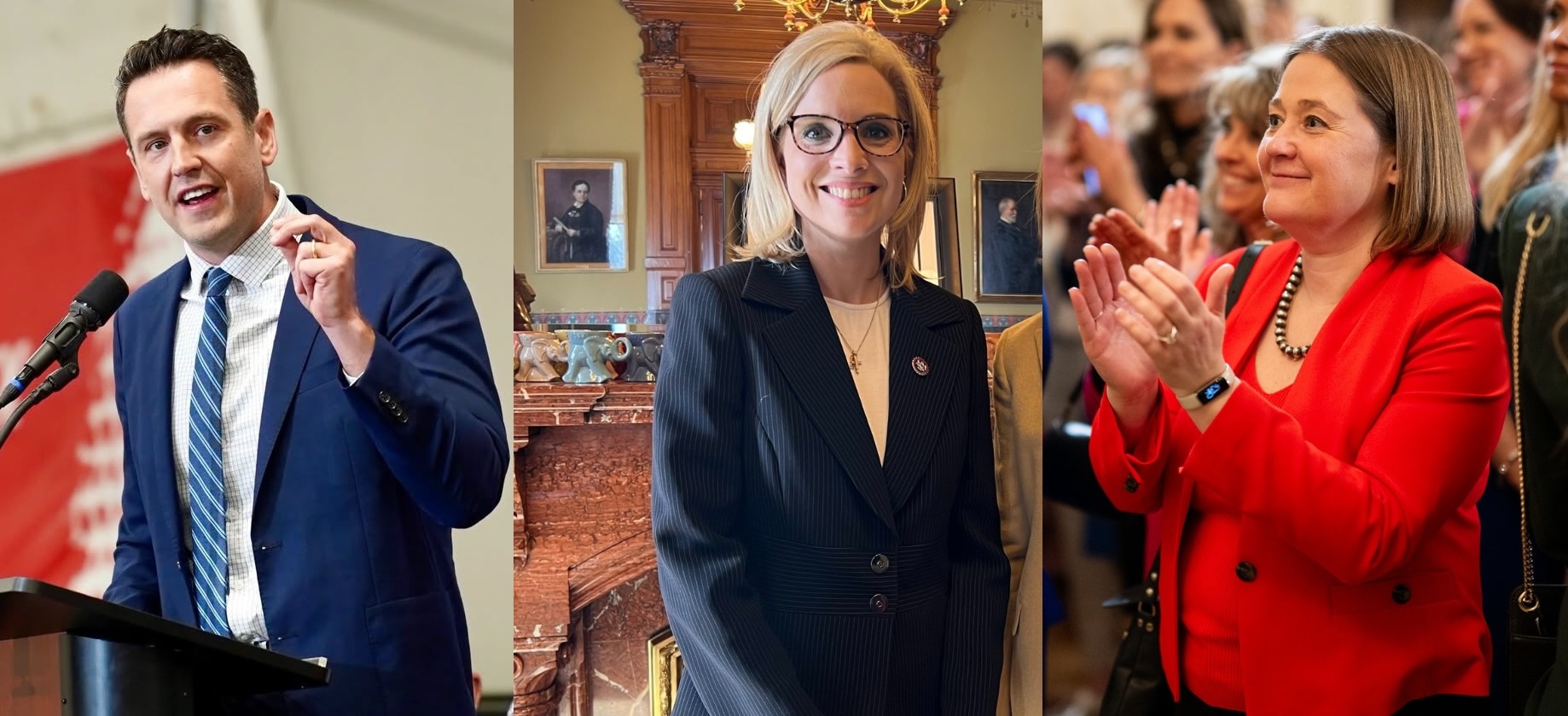
Top images: nominee for governor Zach Lahn speaking at the Iowa GOP’s state convention on June 13, 2026 (cropped from a photo posted on his campaign’s Facebook page); U.S. Representative Ashley Hinson in a photo posted on her official Facebook page on February 18, 2025; Attorney General Brenna Bird at the White House on March 26, 2025 (cropped from an official White House photo).
1 Comment
Whatever You Think . . .
. . . about Steve King, he does seem to call balls and strikes about the 4th District political environment with a level of objectivity.
Bill Bumgarner Tue 3 Nov 7:07 PM