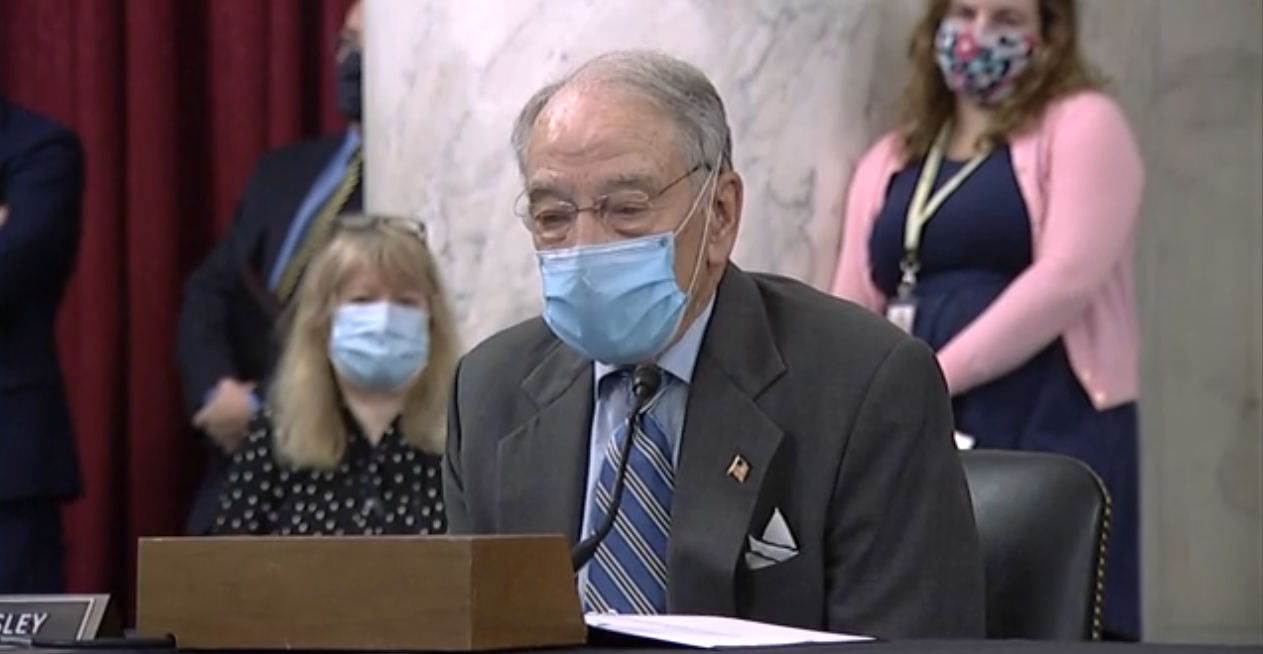
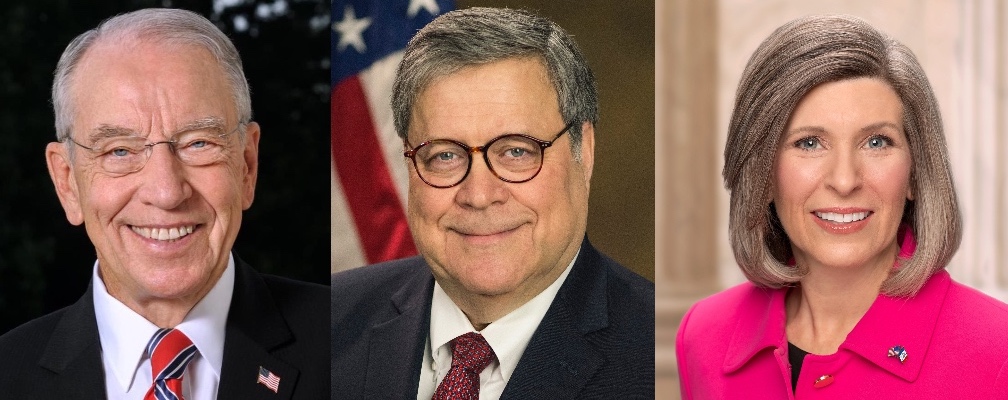
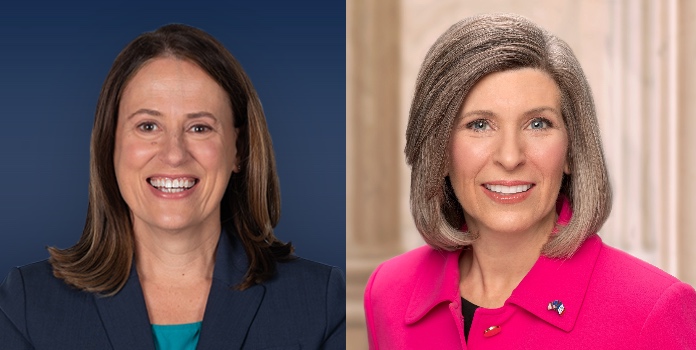
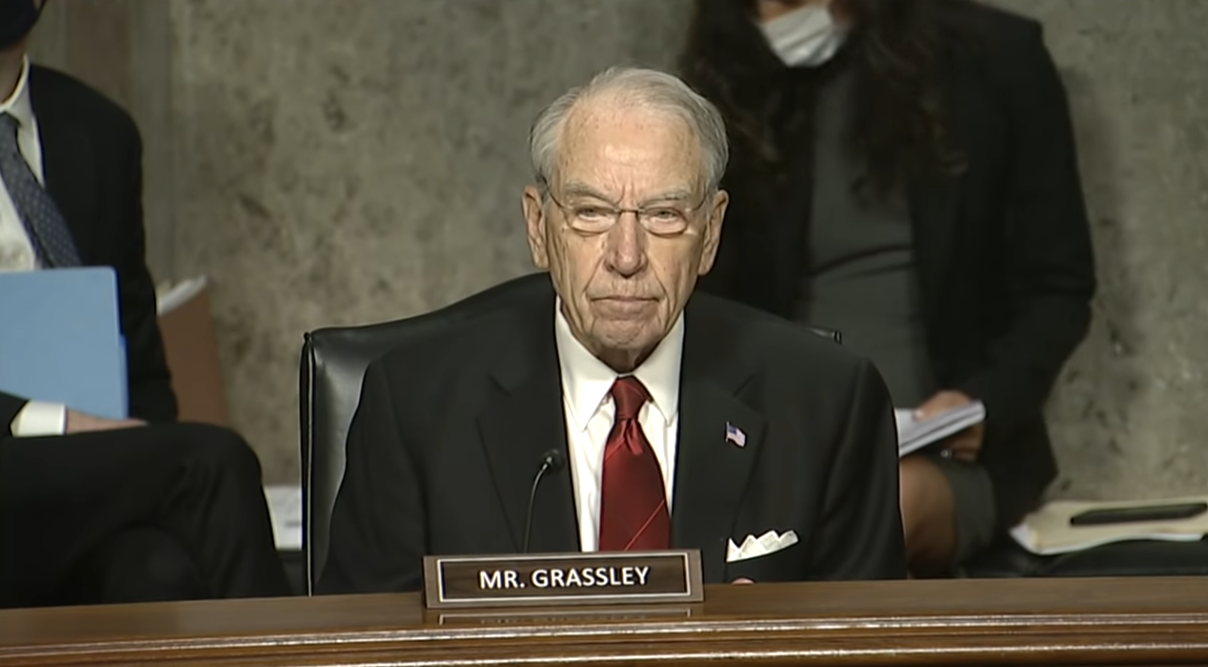
Senator Chuck Grassley has no current plans to get tested for COVID-19, his staff told the Des Moines Register on October 2.
With three Republican senators now confirmed to have active coronavirus infections, Grassley should reconsider.
Senator Chuck Grassley has no current plans to get tested for COVID-19, his staff told the Des Moines Register on October 2.
With three Republican senators now confirmed to have active coronavirus infections, Grassley should reconsider.
President Donald Trump’s unhinged and at times frightening behavior during his first televised debate “worried” and “alarmed” some of his most influential allies. The next day, U.S. Senate Majority Leader Mitch McConnell and other top Washington Republicans criticized the president’s failure to condemn white supremacists. Former Republican National Committee chair Marc Racicot even revealed that he had decided to vote for Democrat Joe Biden, after concluding Trump is “dangerous to the existence of the republic as we know it.”
True to form, Iowa Republicans offered no hint of dissent from the president this week. They either said nothing about Trump’s debate performance or put a positive spin on it.
Dan Guild has “never seen anything like it. The president so dominates the landscape that senators don’t have a distinct political identity.” -promoted by Laura Belin
Selzer & Co. is out with a new Iowa poll for the Des Moines Register and Mediacom. It found President Donald Trump tied with Democratic challenger Joe Biden, each supported by 47 percent of likely voters surveyed.
Iowa is not considered likely to be decisive in the race for the Presidency. But it may be decisive in determining control of the U.S. Senate. Sabato’s Crystal Ball, for example, currently rates only two states as toss-ups: Iowa and North Carolina. Since they predict that the rest of the Senate will split 49-49, the importance of Iowa’s race is clear.
As Brianne Pfannenstiel reported for the Des Moines Register, both sides recognize just how important Iowa is: $155 million has been spent or has been committed to influence the outcome.
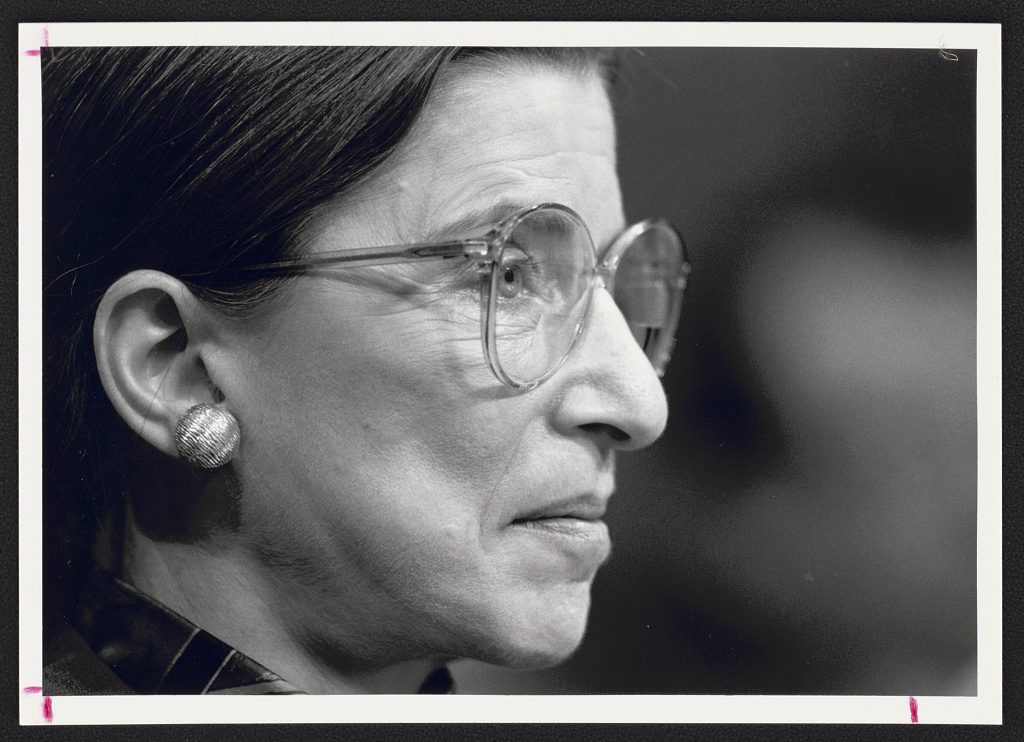
The Jewish new year began in the worst way possible on September 18, with the passing of one of the most influential Jewish Americans. It’s impossible to overstate the importance of Ruth Bader Ginsburg’s work as an attorney and over decades of service as a judge, culminating in 27 years on the U.S. Supreme Court.
U.S. Senators Joni Ernst and Chuck Grassley praised Ginsburg’s legacy in written statements, and Ernst offered prayers and an apology of sorts after her campaign sent out a gross fundraising appeal soon after the justice’s death was announced.
But words in a press release have no lasting value. Iowa’s senators have one chance to honor “the notorious RBG”: by letting the voters decide who should appoint her successor.
Kay Pence is Vice President of the Iowa Alliance for Retired Americans. -promoted by Laura Belin
U.S. Senator Joni Ernst is no longer working for Iowans. She is working at the behest of President Donald Trump, no matter what he says or does. She has become a puppet to Trump no matter how low he sinks, voting with the president more than 91 percent of the time and following his lead to attack our healthcare and defund Social Security.
The Iowa Alliance for Retired Americans recently invited Ernst and her Democratic challenger Theresa Greenfield to virtual forums celebrating the anniversaries of Medicare and Social Security. I was not surprised when Ernst failed to show up for either forum, because she has such a dismal record on both issues.
Herb Strentz reviews recent comments from Senators Chuck Grassley and Joni Ernst and Governor Kim Reynolds. -promoted by Laura Belin
Sea-going metaphors and idioms hardly reflect life in Iowa, but may be useful in considering the double whammy that’s hit us with COVID-19 and Trump.
At least that drives this take on our U.S. senators and governor during past few weeks. As one idiom would have it, they are rearranging the deck chairs aboard Iowa’s political and virus-ridden “Titanic.”
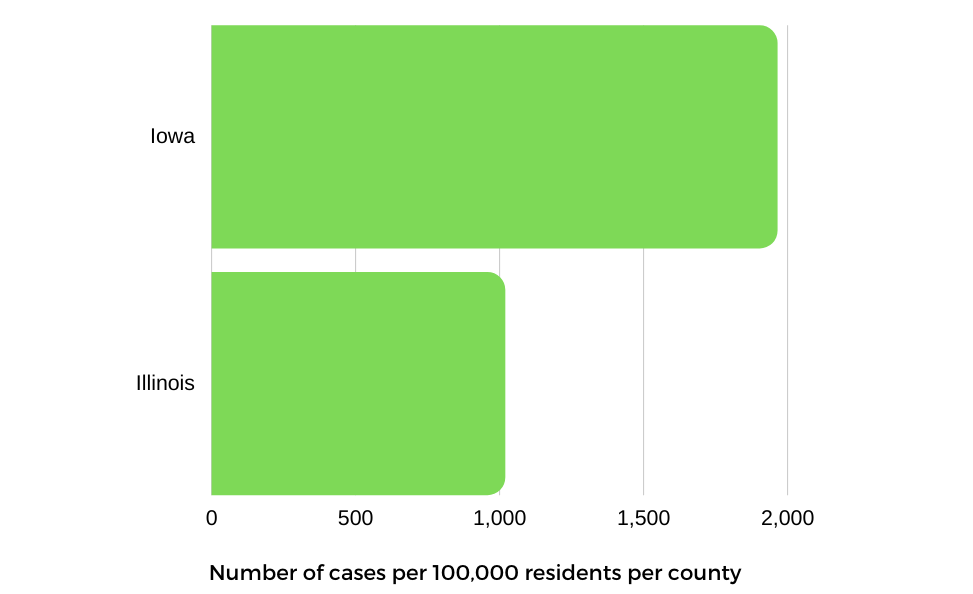
Preethi Reddi found that eight Iowa counties along the Mississippi River continue to have more COVID-19 cases per capita than seven border counties on the Illinois side. -promoted by Laura Belin
In May, Governor Kim Reynolds and the four other Republican governors who elected against stay-at-home orders prematurely published an editorial in the Washington Post titled, “Our states stayed open in the covid-19 pandemic. Here’s why our approach worked.”
Recent data contradict that bold title and point to a need for change in Reynolds’s less aggressive approach to controlling COVID-19 spread.
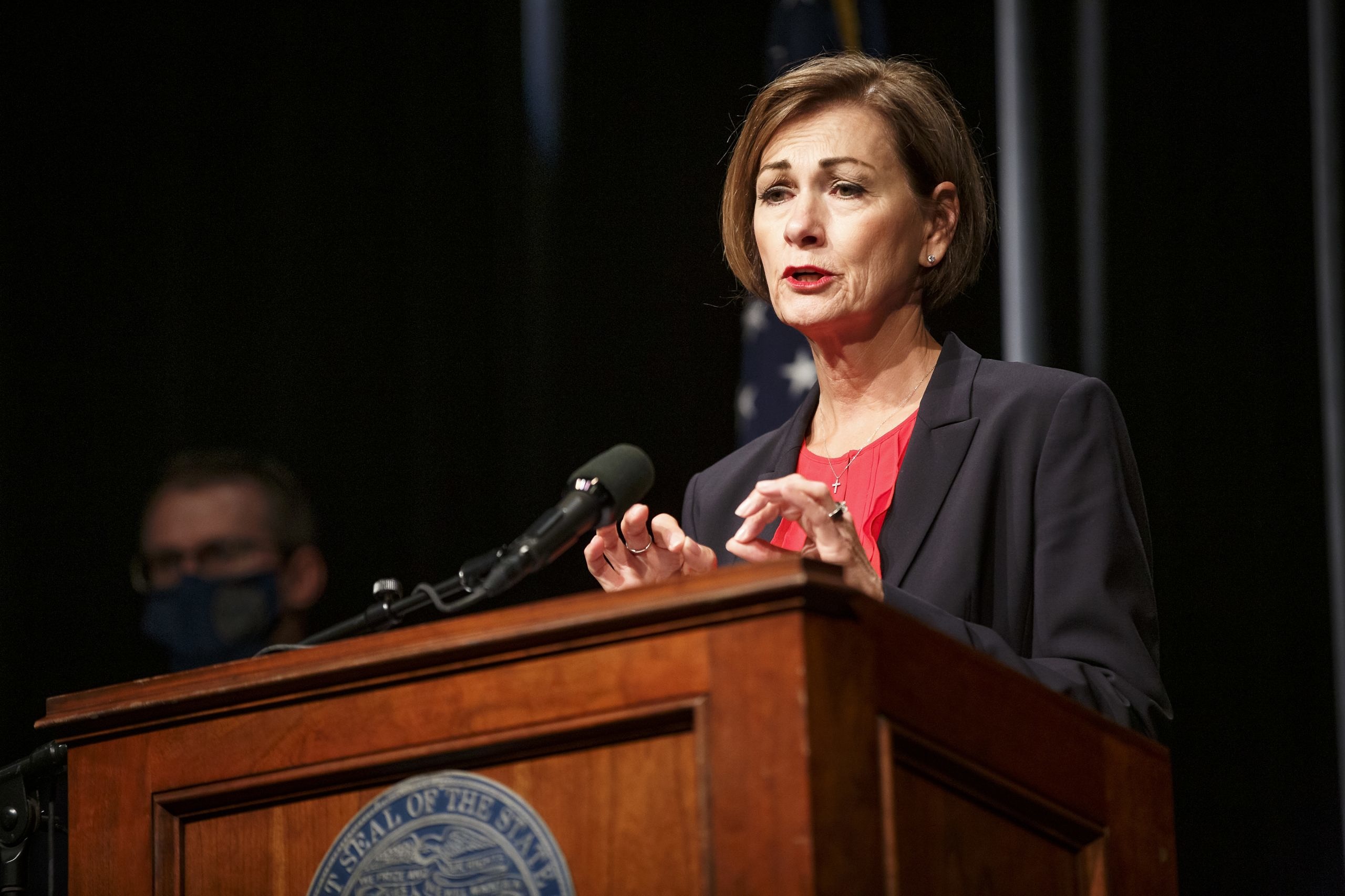
“Much of the spread that we’re seeing in Iowa continues to be tied back to young adults” between the ages of 19 and 24, Governor Kim Reynolds said during an August 27 news conference, where she announced a new proclamation closing bars in Polk, Dallas, Linn, Johnson, Story, and Black Hawk counties.
Reynolds noted that young adults are spreading coronavirus to classmates, co-workers, and others “by socializing in large groups” and “not social distancing.” She added, “While we still know that this population is less likely to be severely impacted by COVID-19, it is increasing the virus activity in the community, and it’s spilling over to other segments of the population.”
The official narrative seems designed to conceal three inconvenient facts. Reynolds didn’t follow expert advice that could have prevented this summer’s explosive growth in cases. For months, she discouraged young, healthy Iowans from worrying about the virus. And despite her “#StepUpMaskUp” public relations campaign, Reynolds has failed to practice what she preaches when attending large gatherings herself.
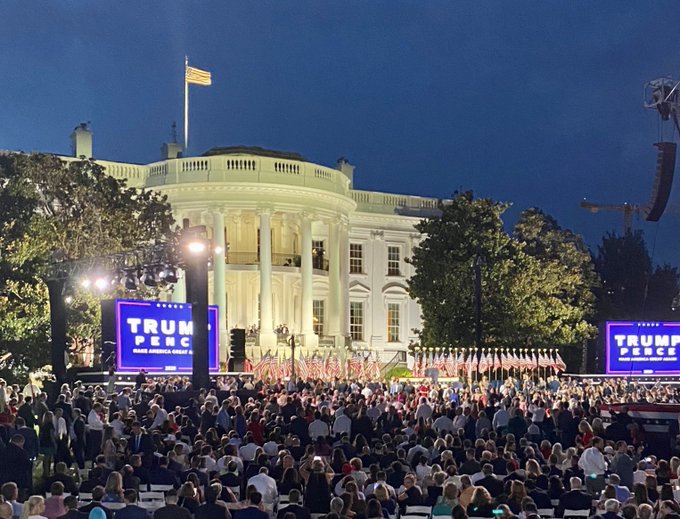
“This abomination may be the most visible misuse of official position for private gain in America’s history,” tweeted Walter Shaub on August 27, as President Donald Trump closed out four days of using the White House grounds and his official duties as props for his re-election campaign.
Not one Iowa Republican elected official or party leader objected.
Shawn Sebastian: To put the pandemic politics of Trump, Reynolds, and Ernst behind us, we must reach out to Iowans and turn pain into action, rooted in justice. -promoted by Laura Belin
This week, my family felt firsthand the complete failure of our political leadership. After nearly a week without power, and without a refrigerator or electric stove, my parents — who both have pre-existing conditions — had to go out every day and risk contracting a deadly disease just to eat a meal.
How did we get here?
Our leaders dragged us down here through denial, lies, incompetence, putting profit over people, and a fundamental lack of vision.
Tyler Granger is a field representative with the National Wildlife Federation in Iowa. -promoted by Laura Belin
U.S. Senator Joni Ernst recently tweeted support for China “increasing their purchases of corn and soybeans from the U.S.” Normally Ernst refers to that country as “Communist China” on her Twitter feed, but when it comes to agriculture, she drops the red scare tactics.
Herb Strentz explores rhetoric from Iowa’s 2014 and 2020 U.S. Senate campaigns and finds parallels between our two Republican senators. -promoted by Laura Belin
Labor Day in even-numbered years usually brings more public interest in politics and the final stage of hopeful campaigns for Congress or the presidency.
This time around, many are driven by dread — dread of elections past, and, oh yeah, fears for the one coming on November 3.
Small wonder, given what “We the people” have inflicted upon ourselves.
Midge Slater, president emeritus of the Iowa Alliance for Retired Americans, authored this post. -promoted by Laura Belin
Senator Joni Ernst wants the people of Iowa to vote for her, but she doesn’t want to say where she stands on Social Security. That is because she won’t admit that she wants to reach into all of our pockets and cut our earned benefits.
More than 1.7 million Iowa workers contribute to Social Security with every paycheck. In exchange, they receive monthly cash benefits if and when wages are lost as the result of old age, disability, or death. Every month, Social Security pays earned benefits to more than 475,000 retired Iowans and to more than 77,500 Iowans with such serious and permanent disabilities that they no longer can work. Social Security pays monthly benefits to 333,275 women and more than 37,370 children in our state. Millions more will receive those benefits in the future — unless Ernst has her way.
Mary Weaver is an active citizen, rural health advocate, farm wife, mom, grandmother, retired nurse, and former administrator at the Iowa Department of Public Health. -promoted by Laura Belin
“We are living in an age when communication has achieved fabulous importance. There is a new decisive force in the human race, more powerful than all the tyrants. It is the force of massed thought–thought which has been provoked by words, strongly spoken.”
–Robert Sherwood, originator of the Voice of America 1939
Lost in the ever-evolving news cycle was President Donald Trump’s recent appointment of Michael Pack as the new administrator of the United States Agency for Global Media. This appointment was quickly followed with the dissolution of the advisory boards of Middle East Broadcasting, Radio Free Asia, Radio Free Europe/Radio Liberty, and the Open Technology Fund.
U.S. Senator Joni Ernst told members of the Iowa Farmers Union in June that she’d prefer for fossil fuel companies not to be eligible for COVID-19 relief funds.
However, months earlier she was among only two farm state senators to sign a letter aimed at ensuring that oil, gas, and coal companies would have access to federal funding from the Coronavirus Aid, Relief, and Economic Security (CARES) Act.
Mike McCarthy is president of the Iowa Alliance for Retired Americans. -promoted by Laura Belin
President Lyndon Johnson signed the Older Americans Act into law on July 14, 1965. It responded to the need for community services, evidence-based health promotion, disease prevention programs, civic engagement, and elder justice for senior citizens. America’s seniors require a similar response to the COVID-19 pandemic.
The Iowa Alliance for Retired Americans believes that seniors must have relevant and accurate information about preventing and treating the coronavirus. Seniors and retirees are becoming more desperate looking for security and a cure. We should be able to trust President Donald Trump’s pronouncements. However, he repeatedly shows us that we cannot believe his statements.
It was painful to watch.
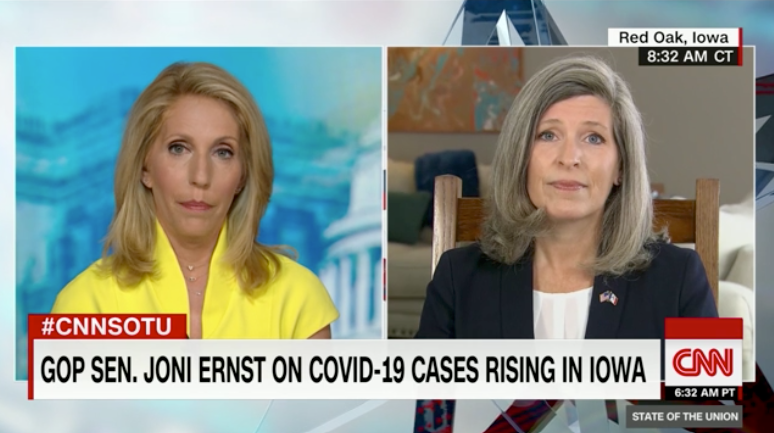
CNN’s Dana Bash had a straightforward question for U.S. Senator Joni Ernst on July 5:
As Donald Trump’s presidency continues to spawn scandals that would seem farfetched as a movie plot, top Iowa Republicans remain silent whenever possible on news that reflects poorly on their party’s standard-bearer.
The latest shameful example: U.S. Senators Joni Ernst and Chuck Grassley have said nothing in public about reports indicating a “Russian military intelligence unit offered and paid bounties to Taliban-linked militants to kill U.S. and coalition troops in Afghanistan.”
Ernst’s silence is particularly striking, since she built her political brand on (and still frequently invokes) her career of service in the Iowa National Guard.
Secretary of State Paul Pate will need approval from the Legislative Council in order to use his emergency powers to alter election procedures, under a bill Governor Kim Reynolds signed on June 25.
While Republicans have a majority on that legislative body, it’s not clear they would use that power to prevent Pate from repeating steps that led to record-breaking turnout for the June 2 primary.
Another Friday night has brought another irregular ouster of a federal official whose work should be insulated from politics.
Four days later, U.S. Senator Chuck Grassley, a self-styled warrior for oversight and accountability in Washington, has said nothing. Neither has Senator Joni Ernst, who like Grassley serves on the committee that oversees the justice system.
“You know, I haven’t heard Theresa Greenfield say one thing that Chuck Schumer hasn’t told her to say,” Senator Joni Ernst declared today on her Twitter feed. “And that’s not what Iowans expect in a leader.”
Several political reporters quickly noted the role reversal in Ernst’s call for six debates with her Democratic opponent. Usually challengers want more debates in order to raise their profiles before the general election. An incumbent making that demand is likely trailing, as the three most recent published polls on Iowa’s Senate race suggest.
Other endangered Republican senators have similarly called for frequent debates this fall, a sign of justified fear that President Donald Trump’s sinking approval will drag them down in November.
Another thing about Ernst’s taunt struck me as more strange, though. If she wants to make the election about who slavishly follows her party’s leader, Iowa’s junior senator is on exceptionally weak ground.
Based on the latest Iowa poll for the Des Moines Register, Dan Guild wonders whether history will repeat itself, with an unpopular president taking down U.S. senators from his party. -promoted by Laura Belin
The presidential election of 1980 was by far the most important election of my lifetime. It gave power to social conservatives who had never tasted power before (Presidents Richard Nixon and Gerald Ford were both pro-choice). It also brought to fore and gave explicit expression to white racial resentment when Ronald Reagan spoke of “welfare queens” driving Cadillacs.
The 1980 election changed not only Republican politics (every GOP nominee since has been pro-life) but also Democratic politics. In the aftermath of the Reagan presidency, Democrats began talking about “ending welfare as we know it.” President Bill Clinton signed a major welfare reform bill 45 days before the 1996 election, in which he had a significant lead.
What is difficult to explain to those who have no memory of 1980 is how shocking the results were. It was not just that Reagan won, but that Republicans took control of the U.S. Senate for the first time in decades. The GOP picked up twelve Senate seats, beating some well-liked Democrats with national reputations.
Iowans haven’t voted a sitting U.S. senator out of office since 1984, but a third poll taken since the June 2 primary shows Senator Joni Ernst slightly trailing Democratic nominee Theresa Greenfield.
One poll might be dismissed as a fluke. Two polls might be explained away by the fact that groups supporting Greenfield commissioned the surveys. But Selzer & Co, which conducts the Iowa Poll for the Des Moines Register and Mediacom, has no dog in this fight.
The 2016 elections were so devastating for Iowa Democrats that I thought Iowa had probably relinquished swing-state status and would not have a targeted U.S. Senate race in 2020.
However, Senator Joni Ernst’s approval numbers have been sliding for some time. The first two polls published following last week’s primary election show Democratic Senate nominee Theresa Greenfield slightly leading Ernst.
The same surveys point to a highly competitive race between President Donald Trump and Joe Biden for Iowa’s six electoral votes.
U.S. Senator Chuck Grassley’s reputation as a defender of whistleblowers and government oversight has taken a hit lately, as President Donald Trump sidelined five inspectors general over a span of two months and rebuffed the senator’s demand for an explanation.
In an escalation of sorts, Grassley announced on June 4 that he would hold up two of Trump’s nominees until the White House complies with federal law requiring that the president explain in writing why he removed inspectors general.
The senator might have some leverage if he were willing to block high-priority nominees for the administration. But the opposite is true. The same day Grassley took a stand on inspectors general, he and Iowa’s Senator Joni Ernst advanced yet another unqualified judicial nominee.
The fields are set for Iowa’s 2020 federal campaigns. The U.S. Senate race and three out of four House races could be highly competitive this November. However, Democratic prospects for picking up the fourth Congressional district took a big hit last night.
Sue Dvorsky is a longtime Democratic activist and former state chair of the Iowa Democratic Party. -promoted by Laura Belin
About a year ago, when Theresa Greenfield announced she was running for U.S. Senate, my husband, retired State Senator Bob Dvorsky and I were proud to be a part of the very first group of nearly 20 Iowa Democratic leaders, elected officials and activists to endorse her. We were drawn to her story. We admired her grace under pressure. We clearly recognized the grit, humor, and work ethic.
U.S. Senate races aren’t like any other election. Statewide. Six years. The state of Iowa and the state of the world has changed so much in the last six years that I can barely recall what 2014 was like. But I do know this: it is imperative for the future of this state, and the future of our country, that we change the leadership and the membership of the United States Senate.
Susan Nelson explains why Admiral Mike Franken is the candidate who can beat U.S. Senator Joni Ernst, and why progressives should be happy about that. -promoted by Laura Belin
Joni Ernst has got to go.
I am usually focused on issues in a primary, but in this race, I just want to pick a winner. A Republican-controlled Senate is an existential threat to preserving health care and doing something about climate change, and conservative Supreme Court nominees will be stopping progressive legislation for decades to come. Ernst is coming for your Social Security benefits, your health care, and so much more. She has glued herself to President Donald Trump. For all those reasons and more, this is a high-stakes election.
David Weaver: To win statewide, candidates must demonstrate service, strong critical thinking skills, and the ability to understand rural Iowa. -promoted by Laura Belin
I have been an Iowan all my life, other than a two-year stint teaching English in Japan. I have lived in small towns like Grinnell, Pella, and Perry. I spent several years living in the city of Davenport, and I have lived in rural towns like Westside and Rippey (my hometown), as well as the farmhouse where my family currently resides. I have been farming since 2006.
I have always paid fairly close attention to politics and government, and ran for the Iowa House in 2018.
Democrats have a (recent?) problem winning statewide elections. Zero for six in the past six races for governor or U.S. Senate. We know Democrats can win, and have won. Barack Obama did it a couple of times, and Rob Sand did it in 2018. Looking at my Iowa House district 47 results from 2018, one thing stood out to me that I believe is important and translates to winning any statewide race in Iowa.
The gaslighting was strong during Governor Kim Reynolds’ White House meeting on May 6 and Vice President Mike Pence’s Iowa visit two days later. Pence described Iowa as a COVID-19 “success story” on Wednesday. He elaborated in West Des Moines on May 8,
“Iowa has been leading the way with Governor Kim Reynolds […] From very early on, the strong steps and mitigation efforts have made a difference here. We grieve the loss of life here in Iowa, but the numbers speak for themselves. The outbreak in Iowa has not been like we’ve seen in other states and other metropolitan areas around the country. It’s a tribute to your early, strong steps.”
Meanwhile, Sioux City still tops a national list of “metro areas with the most recent cases and deaths, relative to their population, in the last two weeks.” Waterloo/Cedar Falls is fourth. Confirmed COVID-19 cases are rising rapidly in several smaller counties where Reynolds lifted restrictions on some business activities last week.
But that’s a topic for another day.
I was struck by Reynolds’ failure this week to follow best practices for slowing the spread of the virus.
A great scoop by Lachlan Markay prompted U.S. Senator Joni Ernst’s campaign to back down on a “subtle accounting maneuver” used to avoid “reporting the names of the campaign staffers on her payroll, how many of those staffers there are, and the extent of payments they’ve received.”
“If China hadn’t covered up #Covid19, the effects of this pandemic could have been lessened,” U.S. Senator Joni Ernst posted on her political Twitter feed and Facebook page on April 25. “We need to hold China accountable.”
Her words were practically a carbon copy of how the National Republican Senatorial Committee has advised endangered GOP incumbents to discuss the novel coronavirus (COVID-19) pandemic.
Herb Strentz: Thanks to lockdowns and self-isolation, we don’t have distractions or escape mechanisms to help us cope with COVID-19 and Trump-45. -promoted by Laura Belin
One of the “curses” or “blessings” of the novel coronavirus pandemic is that we may be reading and thinking more. Either pursuit can be unsettling, nerve-wracking, or even hopeful–but it’s the best we have going for us.
Thanks to lockdowns and self-isolation, we don’t have distractions or escape mechanisms to help us cope with COVID-19 and Trump-45. We have no “bread” — like restaurants to go to, libraries and museums to visit, performances to attend. We have no “circuses” — like televised sports, the I-Cubs at Principal Park, or similar diversions.
Most Christians (aside from those in the Orthodox Church and Jehovah’s Witnesses) are celebrating Easter today, and Jews all over the world are in the middle of the Passover festival. But the novel coronavirus (COVID-19) pandemic has disrupted holiday celebrations along with almost every other aspect of normal life.
Many Iowa houses of worship have adapted by live-streaming services or broadcasting them on radio frequencies congregants can hear from cars parked outside the building.
Dan Piller: Senator Joni Ernst and her Republican handlers don’t need to be told what low corn prices do to incumbents in Iowa in election year. -promoted by Laura Belin
President Donald Trump plans to collude with Russian President Vladimir Putin again this year. We don’t need Robert Mueller or another Steele dossier to tell us–Trump told us so last week. He also is working with OPEC.
It all has to do with oil. At stake: Texas’ 38 electoral votes, Iowa’s ethanol industry, any hope of better corn prices, continued low gasoline prices, and U.S. Senator Joni Ernst’s re-election.
Congress “expanded unemployment insurance by 250 billion dollars” to support laid-off workers, Senator Joni Ernst said during a news conference organized by Governor Kim Reynolds on March 29.
She didn’t mention that she and fellow Republican Senator Chuck Grassley had voted to reduce the amount millions of jobless people will receive over the next four months.
U.S. Senator Joni Ernst told constituents this evening it “would not be prudent” to discourage social distancing by Easter and that Americans should follow the advice of medical professionals.
The U.S. Senate voted on March 18 to approve a second bill responding to the rapidly spreading novel coronavirus (COVID-19), and President Donald Trump signed the legislation later the same day. Senators Joni Ernst and Chuck Grassley were part of the 90 to 8 bipartisan majority that approved final passage of the bill. But first, Iowa’s senators supported a Republican amendment to remove mandatory paid sick leave from the bill the U.S. House approved late last week.
Part of a series catching up on Iowa’s 2020 races for federal offices.
Republicans and GOP-aligned interest groups did not make a serious play for Iowa’s second Congressional district in the 2016 or 2018 elections, but this seat covering 24 counties in southeast Iowa is expected to be much more competitive this year, due to U.S. Representative Dave Loebsack’s retirement.
As the filing period for state and federal candidates approaches, both parties still have two declared candidates in IA-02, but the front-runners–former State Senator Rita Hart for Democrats and State Senator Mariannette Miller-Meeks–have further consolidated their positions.
Now that the presidential candidates have moved on, it’s time to catch up on the state of play in Iowa’s four U.S. House races, all of which should be competitive.
First, a look at the two-woman race shaping up in the first district.