desmoinesdem

Posts 123 Comments 0

University of Iowa reinstates scholarships to undergraduates

The University of Iowa has decided to reinstate scholarships to undergraduates who were informed recently that they would lose promised funding. I enclose below an e-mail many students received this morning from President Bruce Harreld.

Two students had already filed class-action lawsuits over the university’s decision to terminate five scholarships in order to save some $4.3 million. A trial pitting the university against children of alumni would be a public relations nightmare. In addition, Harreld would have had to explain under oath why university officials wrongly claimed last week to have warned current scholarship holders that awards were contingent on state funding levels.

In today’s message to students, Harreld noted,

Over the past few days we heard from many families who were unaware this was a renewable scholarship reliant on state support. While this was not a need-based award, we also heard from families who budgeted for college based on the scholarships and feared financial hardship with the programs’ elimination.

The University of Iowa takes its relationship with students and alumni very seriously and, therefore, will honor the awards previously made to those currently receiving this scholarship. […]

Moving forward we must continue to place a priority on need-based and merit-based awards, which is why the Iowa Heritage Award will no longer be offered to new students who start at the university in 2018.

I also enclose below a statement released by the university.

UPDATE: Added comments from James Larew, the attorney representing plaintiff Jenna Pokorny.

Continue Reading...

Follow-up Iowa licensing bill is dead

A new bill that would have named a task force to study licensing requirements in Iowa will not move forward this legislative session, Republican State Representative Dawn Pettengill told representatives of the National Association of Social Workers Iowa chapter. House Study Bill 174 replaced an earlier proposal from Governor Terry Branstad, which would have eliminated licensing requirements for numerous professions. During the past week, House Study Bill 138 generated as many constituent contacts to Iowa lawmakers as the bill passed earlier this month to destroy collective bargaining rights. Among other things, the governor’s licensing bill would have reduced insurance coverage for mental health care services. On February 27, an Iowa House State Government subcommittee voted not to move that bill forward.

House State Government Committee Chair Ken Rizer introduced the replacement licensing bill on February 28. In addition to changing regulations in several other areas, House Study Bill 174 called for a new task force to review Iowa’s licensing requirements and report back to the legislature by the end of 2017.

Although Rizer’s bill would not have immediately affected marriage and family therapists, mental health counselors, or social workers, the leading association representing Iowa’s social workers expressed concern that “the taskforce as outlined would mostly be selected by the Governor, who has demonstrated that he wants to de-professionalize many different important professions that serve some of our most vulnerable populations.” (You can read the task force membership provisions on on page 37.) The social workers group was seeking an amendment to give licensed professionals greater influence over the task force membership. But last night, Pettengill–one of two Republicans on the subcommittee where the new bill was assigned–said House Study Bill 174 was dead.

Most non-appropriations bills must be approved by at least one Iowa House or Senate committee by March 3 in order to stay alive for this year. Bills need to clear a subcommittee before coming up for a full committee vote.

Whether the licensing task force language led to the new bill’s demise is not clear. The lobbyist declarations on House Study Bill 174 show substantial opposition, presumably related to other provisions on regulating hospitals and electricians.

P.S. Attention-seeking State Representative Bobby Kaufmann could have let the governor’s original licensing bill die quietly by not scheduling a subcommittee hearing, as is normal practice in the Iowa legislature. Instead, the publicity hound wasted a lot of people’s time before drawing cheers as he ripped up the bill’s cover sheet. Alas, television cameras had already left the meeting room before Kaufmann’s dramatic gesture. The young Republican lawmaker was literally not ready for prime time.

Iowa Democratic Party chair defends vote for Tom Perez

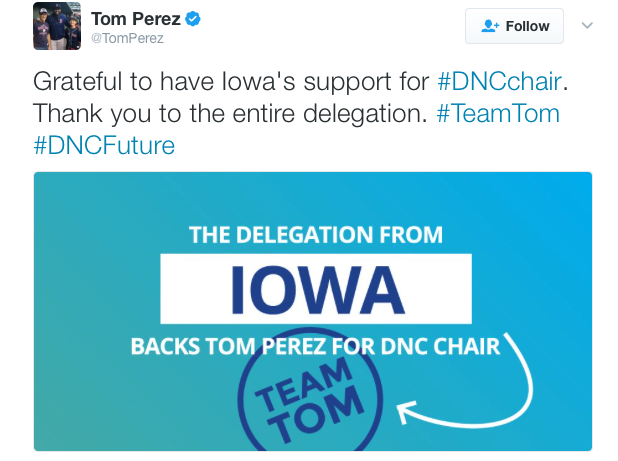
Iowa Democratic Party Chair Derek Eadon wrote to members of the party’s State Central Committee on Monday to explain why he supported Tom Perez to lead the Democratic National Committee. Among the roughly half of SCC members who supported Bernie Sanders for president in 2016, many are unhappy that 1) the Iowa delegation unanimously backed Perez instead of casting some of their votes for Keith Ellison, the preferred candidate of most on the Sanders wing, 2) SCC members were not consulted about the decision, and 3) SCC members received no advance warning before Perez’s campaign tweeted out the news on the day before the DNC election.

Over the weekend, a number of SCC members were among the Iowa activists vehemently expressing their disappointment in public and private forums on Facebook. Several asserted that Eadon and First Vice Chair Andrea Phillips had previously committed to supporting Ellison. Some drafted a joint letter to Iowa’s five voting members of the DNC (Eadon, Phillips, Scott Brennan, Sandy Opstvedt, and Jan Bauer) criticizing the bloc support for Perez and the lack of transparency surrounding the choice.

Multiple sources involved in those discussions told Bleeding Heartland today that SCC members decided to raise those concerns at an upcoming retreat on March 4, rather than sending a joint letter to the DNC delegation in advance. But former Sanders campaign staffer Evan Burger, one of the fourth Congressional district’s representatives on the SCC, did go public with his views. In a commentary for Iowa Informer, Burger argued the “block vote for the establishment candidate was a tone deaf move” symbolizing “a continuation of business as usual” in the Democratic Party.

After the jump I’ve posted the full text of Eadon’s message to the SCC, excerpts from Burger’s post, and part of an e-mail blast by Ed Fallon, an influential voice among Iowa progressives.

UPDATE: Added an excerpt from the speech Phillips gave at the January 21 State Central Committee meeting, where she was elected first vice chair.

Continue Reading...

Read the first lawsuit over revoked University of Iowa scholarships

University of Iowa undergraduate Ben Muller filed a class action lawsuit today in Polk County District Court, charging that the university “revoked its scholarship offers to Plaintiff and the putative class without warning, without due process, and without just compensation.” Muller is among 3,015 undergraduates who learned last week that the University of Iowa was discontinuing five scholarship programs to help cover losses in state funding. Scroll down to read the full seven-page court filing, which alleges multiple violations of the Fifth and Fourteenth Amendments to the U.S. Constitution.

In a news release also enclosed below, attorney Steve Wandro described the university’s action as “not only immoral, but illegal as well.” Jon Muller, the plaintiff’s father, said, “What has occurred here is insane. My son’s decision to attend the University of Iowa was partially based on his being awarded a scholarship.”

Attorneys have scheduled meetings in West Des Moines and Iowa City this Saturday for “students, parents of students, and interested alumni to discuss their concerns and legal options.” The press release includes details on meeting locations and times.

The plaintiff is asking for a jury trial. A Facebook page created to support a class-action filing has nearly 250 likes.

My hunch is that University of Iowa President Bruce Harreld and his advisers will come up with a face-saving way out of this mess before Muller and other members of his class have their day in court. A trial pitting the university against students, most of whom are children of alumni, would generate massive terrible publicity.

After Harreld figures out how to cover the $4,343,699 the university planned to save by canceling the current students’ scholarships, he needs to deal with an extra $1,237,500 reduction in state funding before June 30. The Branstad administration announced additional mid-year cuts to higher education last Friday.

UPDATE: Added below details on a second class-action lawsuit that undergraduate Jenna Pokorny filed in Johnson County District Court on February 27.

Continue Reading...

Iowa House Majority leader commits to preserving non-partisan redistricting

Iowa House Majority Leader Chris Hagenow is committed to preserving Iowa’s “great system” of having a non-partisan commission draw new political maps following each ten-year census, he told Bleeding Heartland on February 25. Iowa’s redistricting process has been a model for the country since the 1970s. I’ve been concerned that during the next few years, Republicans might use their political power to enact a new redistricting law. Following the 2010 census, gerrymandering gave the GOP airtight state legislative majorities in Pennsylvania, Michigan, and Wisconsin, and several other states.

Since the majority leader controls which legislation reaches the Iowa House floor, I asked Hagenow after a February 25 public forum in Clive whether he would ever consider supporting a bill to change Iowa’s redistricting process. “No, we’re not doing that,” he said emphatically. Would he consider such legislation in 2019 and 2020, if Republicans still control both chambers? “No, I don’t want that. We have a great system.”

I noted that everywhere Republicans have had the trifecta during the last decade, they have gerrymandered. Hagenow responded, “We have not had that conversation. I think we’ve got a great system. I think that we should continue with that system.”

Even if Republicans retain the governorship and Iowa House and Senate majorities in 2018? “Yes. We’ve got a great system.”

A few minutes later, I put the same question to Republican Senator Charles Schneider, who serves as Iowa Senate majority whip. “I will never support that,” he said without hesitation. You will never support gerrymandering? “Nope, never.” Even if Republicans control the legislative and executive branches after 2018? “Never. What we have right now is fair.”

I will follow up with House Speaker Linda Upmeyer, Senate Majority Leader Bill Dix, and Lieutenant Governor Kim Reynolds, to see if they also will unequivocally promise to protect non-partisan redistricting in Iowa. The more Republican elected officials we can get on the record now, the better. In November, staff for Governor Terry Branstad did not respond to my e-mails seeking comment on whether the governor would rule out signing a bill that replaced the current system with rules allowing the political party in control of the legislature to draw new legislative and Congressional districts.

Key Iowa Senate Republican: "Loser pays" bill going nowhere

A Republican bill that would have made Iowa courts far less accessible to ordinary people will die in an Iowa Senate subcommittee, GOP State Senator Charles Schneider told Bleeding Heartland on February 25. Bill Brauch, former director of the Consumer Protection Division in the Iowa Attorney General’s Office, explained here how the so-called “loser pays” bill “would in effect kill Iowa’s private consumer fraud law, and just about eliminate any other type of legal action by an individual against a defendant with money.”

Senate Judiciary Committee Chair Brad Zaun introduced Senate Study Bill 1008 during the first week of the legislative session, then assigned it to a subcommittee chaired by Schneider. Following a February 25 public forum in Clive, I asked Schneider about that bill’s status. He replied, “I don’t think it’s going anywhere. I haven’t held a subcommittee meeting for it, and I’m not planning to.”

I mentioned that Senate Majority Leader Bill Dix had named “loser pays” as one of his top four priorities in an interview with Radio Iowa. Schneider responded, “I’m not planning to hold a subcommittee meeting on it. I don’t think any other tort reform bills include a ‘loser pays’ section in them.”

Under Iowa legislative rules, most non-appropriations bills will be dead for the year if they have not cleared at least one Iowa House or Senate committee by the first “funnel,” coming up on Friday, March 3. The leaders of subcommittees and committees have discretion on what bills to bring up for a vote.

I’m pleasantly surprised to learn Senate Study Bill 1008 will go down without a fight. Only a month and a half ago, Dix cited a “measure that ensures losers in those court cases pay for the cost associated with the case” as one of “four bills that I believe define us and give Iowans a clear indication of where we plan to go with policies for our state.” The Iowa Association of Business and Industry, a lobby group with substantial influence among statehouse Republicans, registered in favor of this bill almost immediately. Perhaps Schneider, who practices law as a day job, was able to convince non-attorneys Dix and Zaun that “loser pays” is unnecessary and unfair. Or perhaps Zaun miscalculated by putting Schneider in charge of this subcommittee.

Whatever caused this bill’s demise, any bit of good news from this dreadful legislative session is worth celebrating.

UPDATE: Reader Marian Kuper noticed that Senate Study Bill 1144 contains a “loser pays” clause for nuisance lawsuits against large livestock farms. Senate Agriculture Committee Chair Dan Zumbach proposed that bill, which contains several provisions designed to shield confined animal feeding operations (CAFOs) from lawsuits. It has passed a subcommittee and appears likely to survive the funnel, with support from several Big Ag lobby groups.

Weekend open thread: Is Democratic unity possible?

Former Labor Secretary Tom Perez will be the first Latino to chair the Democratic National Committee, having won Saturday’s election on the second ballot by 235 votes to 200 for Representative Keith Ellison. Perez immediately moved to name Ellison deputy leader of the party, and delegates approved that motion by acclamation. Soon after, Ellison urged those who “came here supporting me”

to give everything you’ve got to support Chairman Perez. You love this country, you love all the people in it, you care about each and every one of them, urban, rural, suburban, all cultures, all faiths, everybody, and they are in need of your help. And if we waste even a moment going at it over who supported who, we are not going to be standing up for those people. We don’t have the luxury, folks, to walk out of this room divided.

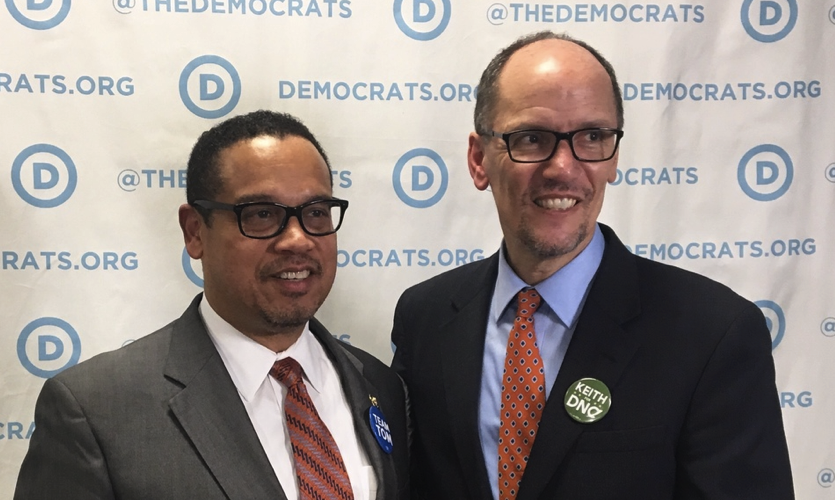
Perez and Ellison then did a joint media appearance, wearing each other’s supporter buttons. Unfortunately, the Facebook comment thread below that video is dominated by angry progressives threatening to leave the party.

I’ve seen similar arguments playing out in several popular Facebook groups for Iowa Democrats, ever since news broke late Friday that Iowa’s voting members of the DNC would support Perez. Many activists who favored Bernie Sanders in the caucuses, including some members of the Iowa Democratic Party’s State Central Committee, are upset by the unified vote for Perez, considering how many Iowa Democrats backed Ellison. Others felt it was poor form that the SCC didn’t get advance warning before Perez announced the Iowa delegation’s support on Twitter. A few claimed that state party chair Derek Eadon and first vice chair Andrea Phillips had led them to believe they would support Ellison for the DNC job.

More broadly, Democrats in Ellison’s camp were upset by what they perceive as party insiders choosing corporate lobbyists over progressives, failing to grasp the need for reform, attaching too much importance to fundraising, or being afraid of a black Muslim representing the party. The comments in this Bleeding Heartland thread reflect views I’ve seen in many other forums. Apparently the rhetoric is even harsher in some of the “secret” Facebook groups frequented by Iowa Democrats on the Sanders wing.

I understand why so many activists preferred Ellison, but I don’t understand the widespread condemnation of Perez, given his record on labor and civil rights issues. People who have followed his work closely think highly of him. After the jump I’ve posted excerpts from Perez’s official bio, along with the statement Sanders released following the DNC vote.

This is an open thread: all topics welcome. Yet again this weekend, legislative forums around the state drew hundreds of attendees. I’m always seeking tips on noteworthy remarks by Iowa House or Senate members at public events. If you have an anecdote to share, or better yet a recording, please post a comment in this thread or contact me privately by e-mail at the address near the lower right of this page.

Continue Reading...

Higher education, human services take biggest hit in final Branstad budget cuts

Governor Terry Branstad’s budget director has finally revealed how $11.5 million in “miscellaneous” spending cuts will be spread around state government before the end of the current fiscal year on June 30. As expected, the ax will fall most heavily on higher education and human services–just like Branstad wanted all along.

Elected officials often bury bad news in a late Friday afternoon dump, but Branstad and Lieutenant Governor Kim Reynolds went one step further to evade accountability: they didn’t even announce the cuts in a press release. Rather, at around 4:00 pm, Department of Management Director David Roederer relayed the news in a letter to the Iowa House chief clerk and the secretary of the Iowa Senate.

Iowa House and Senate Republicans have plausible deniability after calling for $11.5 million in unspecified “Department Operational Reductions” as part of Senate File 130, the “deappropriations” bill GOP lawmakers approved in late January. Let Roederer do the dirty work.

After the jump I’ve posted the document showing how much the latest cuts will affect each department or agency. For comparison, I also enclosed Branstad’s original spending cut proposal, announced January 10, and a document comparing those planned cuts with the deappropriations bill’s provisions.

Continue Reading...

Branstad bill would reduce insurance coverage for mental health care

Governor Terry Branstad has introduced a bill that would make Iowa the only state not to license mental health counselors. House Study Bill 138 would remove licensing requirements for a number of professions and eliminate some state boards, including the Board of Behavioral Sciences and the Board of Social Work. Mental health counselors are expressing alarm about language that would make social workers, marriage or family counselors, and mental health counselors “registered” rather than “licensed.”

The likely consequence would be insurance companies refusing to cover services by unlicensed providers, depriving Iowans of access to therapy unless they are able to pay the full cost of mental health counseling out of pocket.

I enclose below an action alert the Iowa Mental Health Counselors Association posted yesterday, which contains talking points to use when communicating with state lawmakers about House Study Bill 138. The bill has been assigned to a subcommittee of Republican State Representatives Bobby Kaufmann and Dawn Pettengill and Democratic State Representative Mary Mascher.

The lobbyist for the association representing mental health counselors said yesterday, “The bill as drafted will not be having a subcommittee next week and is taking on serious water. The speaker’s office said that [House Speaker Linda Upmeyer’s] members are getting more emails on the licensure provisions of that bill than they did on collective bargaining.” According to one rumor, the bill may be revised and reintroduced next week, so concerned citizens should call the governor’s office (515-281-5211) to share their views with Branstad’s staff.

UPDATE: A Facebook commenter reached Kaufmann, chair of the subcommittee, by phone on February 24: “He said this bill was assigned to him, he thinks it’s a bad bill and he’s going to kill it.”

SECOND UPDATE: On a different Facebook thread, someone reported speaking to House Majority Leader Chris Hagenow about this bill, having run into him while shopping. Hagenow indicated House Study Bill 138 would not advance in its current form.

Multiple sources confirmed on Friday that lawmakers have been bombarded with constituent contacts about this legislation. When the governor’s staff introduce a new and improved version of this proposal, I would guess they will leave licensing of mental health care professionals alone.

According to Claire Celsi, Hagenow announced at a February 25 legislative forum in Clive that the governor is wrong on this bill and that lawmakers do not support it.

Continue Reading...

3,000 University of Iowa students will pay the price for Republican budget policies

See important update below: Jon Muller questions whether the University of Iowa “committed an act of scholarship fraud.”

Three weeks after Governor Terry Branstad signed into law large mid-year budget cuts for Iowa’s state universities, some 3,015 incoming or current students at the University of Iowa learned that they will be picking up part of the tab.

Continue Reading...

If Todd Prichard runs for governor, his stump speech will sound like this

State Representative Todd Prichard spoke to a packed room at last night’s Northwest Des Moines Democrats meeting. Now in his third term representing Floyd and Chickasaw counties in the Iowa House, Prichard is ranking member on the Agriculture Committee and also serves on Natural Resources, Veterans, and Ways and Means, as well as on an Appropriations subcommittee. Pat Rynard recently profiled the army veteran and former prosecutor who may run for governor in 2018.

I’ve transcribed most of Prichard’s remarks from the Des Moines gathering below and uploaded the audio file, for those who want to listen. He speaks directly and fluidly without coming across as rehearsed or too polished, a common problem for politicians.

At one point, Prichard commented that Republicans didn’t spend a million dollars trying to defeat him last year, as the GOP and conservative groups did against several Iowa Senate Democratic incumbents. Republicans tested some negative messages against him with a telephone poll in August, but apparently didn’t sense fertile ground. Prichard’s opponent Stacie Stokes received little help from her party, compared to some other GOP candidates for Iowa House seats, including a challenger in a nearby district.

Based on the speech I heard on Tuesday, I would guess that if Prichard runs for governor, Republicans may regret not spending a million dollars against him in 2016.

One more point before I get to the transcript: Prichard is living proof that retiring lawmakers should not be allowed to hand-pick their own successors. When State Representative Brian Quirk resigned to take another job soon after winning re-election in 2012, he wanted his former high school football coach Tom Sauser to take his place. As a Bleeding Heartland reader who’s active in Floyd County described here, Prichard decided to run for the House seat shortly before the special nominating convention and barely won the nomination.

Prichard had a chance to start his political career because several days elapsed between his learning about Quirk’s preferred successor and the House district 52 nominating convention. Too often, Iowa Democratic legislators announce plans to retire only a day or two before candidates must submit papers to the Secretary of State’s Office. If Quirk had retired right before the March 2012 filing deadline, as three House Democrats did last year, his friend with the inside track would have been the only Democrat able to replace him. Nothing against retired teachers, but Sauser was not a potential future leader of the party, as Prichard is becoming.

Continue Reading...

Iowa attorney general: Outside counsel should defend collective bargaining law

To “avoid any questions about a potential conflict,” Iowa Attorney General Tom Miller will request that outside legal counsel defend the state against a public employee union’s legal challenge to Iowa’s new collective bargaining law. AFSCME, the largest labor union representing state workers, and four of its members filed suit on February 20, charging that House File 291 violates Iowa constitutional provisions on equal protection and non-interference in contracts. In a statement I enclose in full below, Miller said he will ask the Iowa Executive Council to approve other counsel for this case, because “the new collective bargaining law has the potential to existentially threaten the viability of public sector unions,” which have supported him in past campaigns.

The council is likely to approve Miller’s request. Its five members are Governor Terry Branstad, Secretary of State Paul Pate, State Treasurer Mike Fitzgerald, Secretary of Agriculture Bill Northey, and State Auditor Mary Mosiman. Branstad’s spokesperson Ben Hammes told Barbara Rodriguez of the Associated Press, “[Miller] summed it up when he said that AFSCME had supported him in the past and he wants to avoid any questions about a potential conflict.”

The Attorney General’s Office defended the Branstad administration against a lawsuit challenging the closure of the Iowa Juvenile Home, for which AFSCME Iowa Council 61 President Danny Homan was a plaintiff. But outside counsel defended the state when Democratic lawmakers and Homan challenged the governor’s use of line-item vetoes to close Iowa Workforce Development offices.

Miller may need to ask outside counsel to be appointed if other labor unions and public employees file additional lawsuits challenging the collective bargaining law. Aside from the points raised by AFSCME, several other provisions may raise constitutional questions:

• The law bans automatic payroll deductions for labor union dues, while allowing such deductions to continue for professional association memberships or recurring charitable contributions.

• The law may violate free association rights by requiring unions to win a majority of all eligible voters, not just those who cast ballots, in order to stay certified.

• The law eliminates a quid pro quo contained in the first paragraph of Chapter 20, which could be seen as a due process violation.

Continue Reading...

Five Democrats who might run for Congress in IA-01

Despite the huge swing toward Donald Trump and down-ballot Republicans in northeast Iowa last year, Democrats are gearing up for a major challenge to GOP Representative Rod Blum in Iowa’s first Congressional district. Many Iowans considered Blum’s 2014 victory a fluke of a GOP wave year, but he outperformed Trump by about 5 points while winning re-election in 2016.

Now IA-01 is in the top tier of pickup opportunities for the Democratic Congressional Campaign Committee. Former Bernie Sanders campaign staffer Blair Lawton is already on the ground organizing for the Iowa Democratic Party in the district.

A competitive Democratic primary here is a near-certainty. After the jump, I’ve posted background on five possible candidates, in alphabetical order. I’d welcome tips on others who may be considering this race.

The 20 counties in IA-01 contain 164,485 active registered Democrats, 144,687 Republicans, and 189,606 no-party voters, according to the latest figures from the Iowa Secretary of State’s office. The largest-population counties are Linn (the Cedar Rapids metro area), Black Hawk (Waterloo/Cedar Falls metro), and Dubuque, a traditional Democratic stronghold that is also Blum’s home base.

Continue Reading...

Read the first lawsuit challenging Iowa's horrible new collective bargaining law

AFSCME Iowa Council 61 and four of its members filed suit today in Polk County District Court, saying the collective bargaining law Governor Terry Branstad signed on Friday is unconstitutional. I enclose below the petition filed on behalf of Iowa’s largest union representing state employees, as well as the plaintiffs’ request for expedited hearing. The filing repeatedly refers to “the amendments” because House File 291 amended Chapter 20 of the Iowa Code, which has regulated collective bargaining since 1974.

The new law’s disparate treatment of “public safety workers” and other public employees is the central issue raised in AFSCME’s lawsuit. Plaintiffs argue that Article I, section 6 of the Iowa Constitution requires that “all laws of a general nature shall have a uniform operation” and that the legislature “shall not grant to any citizen, or class of citizens, privileges or immunities, which, upon the same terms shall not equally belong to all citizens.” All four individual plaintiffs fail to qualify as “public safety workers,” and therefore have lost almost all meaningful collective bargaining rights, even though some of their occupations are as dangerous or more so, compared to some of the “public safety” jobs. Johnathon Good is a corrections officer, Ryan De Vries is a police officer III, Terra Kinney is a motor vehicle enforcement officer, and Susan Baker is a drafter for the University of Northern Iowa. Excerpt from page 7 of the petition:

The arbitrary definition of “Public Safety Employee,” the arbitrary classification of public employees as “Public Safety Employees” or other public employees and the arbitrary classification of bargaining units into those whose members are at least thirty percent “Public Safety Employees” and those whose members are not which are included in the Amendments deprive Officer Good, Officer De Vries, and Ms. Baker of the constitutional guaranty of equality of all before the law that is set forth in Art. I, § 6 of the Iowa Constitution.

The petition also argues that “transition procedures” altering and terminating bargaining procedures and schedules established in the union contracts violate Article I, section 21 of the Iowa Constitution, which prohibits passing a “law impairing the obligation of contracts.”

Before the text of House File 291 became public, Republican lawmakers were rumored to be at odds over whether to exempt “public safety workers” from most of the new restrictions on collective bargaining. Supposedly Iowa House Republicans opposed that division, while key GOP senators wanted to copy the political strategy used in Wisconsin six years ago. The collective bargaining bill Iowa House Republicans approved in 2011 did not treat law enforcement officers or firefighters differently from other public employees.

Sources in Iowa’s labor community expect other lawsuits challenging the collective bargaining law to be filed later this year. The two main union-busting provisions are seen as particularly ripe for challenge: onerous election requirements for unions to stay certified, and a ban on automatic payroll deductions for union members, even though employees will still be able to automatically deduct membership fees in other professional associations and recurring charitable donations. Neither provision was part of the 2011 Iowa House collective bargaining bill.

Continue Reading...

Four oddities from the audit of ISU president's weapons policy compliance

Iowa State University’s Office of Internal Audit has completed its review of “the storage and transportation of weapons to ensure current practices are in compliance with ISU’s Firearms and Other Weapons policy.”

ISU officials requested the audit after Bleeding Heartland reported in November that President Steven Leath and some companions on his hunting trips neither requested nor received written authorization to transport weapons on university aircraft, as required by ISU policy.

In their brief report on what appears to be an open-and-shut case of the president not following the rules, internal auditors managed to create a lot of wiggle room. ISU staff have not responded to my follow-up questions or provided documents that could address inconsistencies in the new official narrative.

Continue Reading...

IA-Gov: Ron Corbett's think tank running online ad campaign

When Ron Corbett announced in December that he will not seek a third term as Cedar Rapids mayor and will consider running for governor, he promised a “big surprise” at the end of his final “state of the city” address on February 22.

Corbett has long been positioning himself to run for governor. Since creating the conservative think tank Engage Iowa in late 2015, he has given dozens of speeches around the state, most often to Rotary clubs or members of local Iowa Farm Bureau chapters and Chambers of Commerce.

After Governor Terry Branstad confirmed plans to resign in order to become U.S. ambassador to China, many Iowa politics watchers speculated that Corbett would decide against seeking higher office next year. Instead of competing for the GOP nomination in an open primary, he would have to run against a well-funded sitting governor, Kim Reynolds.

To those who don’t share my view that Corbett will take on the challenge of running against a Republican incumbent, I ask: why is Engage Iowa spending money to promote Corbett’s name and catchy conservative slogans online?

Continue Reading...

New Iowa Senate Republican gun bill is unconstitutional as well as unwise

Pro-gun advocates spent a lot of money to help Republicans gain control of the Iowa Senate in last year’s elections. The GOP majority will likely move several of the gun lobby’s legislative priorities soon, including so-called “Stand Your Ground,” an amendment to Iowa’s constitution establishing the right to keep and bear arms, and relaxed rules on concealed carry permits and youth firing of handguns.

If they are smart, Republicans who venerate the Second Amendment will steer clear of State Senator Jake Chapman’s new bill, which would trample on the First Amendment and prevent potentially life-saving conversations.

Continue Reading...

Everything you want to know about Iowa's horrible new collective bargaining law

Republicans in the Iowa House and Senate voted today to dramatically reduce collective bargaining rights for some 180,000 public employees, following approximately 27 hours of debate in the Iowa Senate and fourteen and a half hours of debate in the Iowa House. GOP leaders moved House File 291 and Senate File 213 simultaneously through both chambers in order to speed up the process.

Democrats had offered dozens of amendments to the bills, which were published for the first time on February 7. Instead of allowing full discussion of every amendment, GOP leaders moved to cut off debate at a “time certain” today. That maneuver had never been used in the Iowa Senate and has been invoked only rarely in the Iowa House–including to end debate on the collective bargaining bill Republicans passed in March 2011. Debate ended in the Iowa House at noon, after which the majority quickly voted down all the remaining amendments with no discussion. Six Republicans joined all 41 Democrats to vote against the bill on final passage. Two of them, Tom Moore and Dave Heaton, are former teachers. Clel Baudler is a retired state trooper. Andy McKean and Shannon Lundgren were just elected from eastern Iowa swing districts, where registered Democrats outnumber Republicans. McKean is also very familiar with Chapter 20 as a former county supervisor and longtime state lawmaker. I don’t know why Mary Ann Hanusa opposed the bill. UPDATE: Hanusa did not respond to my request for comment, but I learned from another source that she is also a former teacher who works in education administration.

Senators debated all night long Wednesday into Thursday morning, with Republicans voting down every Democratic amendment. Independent State Senator David Johnson voted with Democrats on all the amendments and joined them in giving several passionate speeches. Few Republicans in either chamber chose to speak in favor of the bills, aside from Senate Labor Committee Chair Jason Schultz, House Labor Committee Chair Dave Deyoe, and State Representative Steven Holt, who floor-managed the bill and distinguished himself as the legislature’s least convincing liar. The Des Moines Register’s William Petroski summarized some of the important Democratic amendments. I didn’t stay up to watch the whole debate, so would welcome examples of some of the most absurd Republican comments, like State Senator Mark Chelgren accusing Democrats of “stalling” while his party had shown an “incredible amount of patience.” Nothing says “patient” like making sweeping changes to a 43-year-old law, affecting 180,000 Iowans, after only nine days in the legislature.

Senate leaders ended debate at 2 pm Thursday, after which Republicans voted down the remaining Democratic amendments, then substituted the text of the House bill for the Senate bill, to get the legislation to Governor Terry Branstad more quickly. Branstad’s chief of staff, Michael Bousselot, spent the final hours of debate in the Senate chamber. House File 291 eventually passed on a 29-21 Senate vote.

Iowa’s largest public-sector union, AFSCME Iowa Council 61, plans to file a lawsuit claiming the new law is unconstitutional, presumably because of the way it grants more bargaining rights to “public safety” workers than to others, many of whom do dangerous jobs. Video from a February 16 press conference by labor leaders is available here.

I enclose below statements about the bill by legislative leaders from both parties, as well as documents prepared by Iowa House Democratic and Republican staff, which discuss in more detail how House File 291 will affect collective bargaining rights for different types of public employees. Regarding substantive impacts, I also recommend the recent guest posts here by state employee Ruth Thompson, University of Northern Iowa Professor Chris Martin, and attorney James Larew, who predicted that today’s action “will be remembered as the most destructive blow to our ability to govern ourselves fairly and efficiently in nearly half a century.”

GOP spin notwithstanding, collective bargaining “reform” in Iowa was designed primarily with political goals in mind, like similar measures in other states. Republicans know that crippling public sector unions will make it harder for Democrats to win elections.

Although Republicans repeatedly claimed during the House and Senate debates that their bill would help local governments, Chapter 20 has worked so well that more than 140 school districts rushed to sign new contracts with the teachers union before the legislature acted. Boards of supervisors in several large counties passed resolutions condemning the proposal. Linn County Supervisor Brent Oleson’s case against the bill is convincing.

Continue Reading...

Iowa House, Senate GOP leaders not co-sponsoring "personhood" bills

While most Iowa politics junkies were absorbed by lengthy collective bargaining debates in the state House and Senate, Republican lawmakers introduced identical “personhood” bills in both chambers on February 14.

Notably, leaders of the House and Senate are not among the co-sponsors of the bills declaring “that life is valued and protected from the moment of conception, and each life, from that moment, is accorded the same rights and protections guaranteed to all persons by the Constitution of the United States, the Constitution of the State of Iowa, and the laws of this state.”

Continue Reading...

Trump least popular new president in history of Des Moines Register's Iowa poll

Less than three months after Donald Trump carried Iowa by a convincing margin (wider than his victory in Texas), only 42 percent of Iowa adults approve of the new president’s job performance. The latest Iowa survey by Selzer & Co for the Des Moines Register and Mediacom found that 49 percent of Iowans disapprove of Trump’s performance. Trump was also underwater among self-identified independents: 39 percent approval and 50 percent disapproval. Jason Noble reported for the Register,

It’s unprecedented in the history of the Iowa Poll to see a president begin his first term with such low approval ratings. Since The Des Moines Register began asking about presidential job approval in February 1964, no president in the early weeks of his first term has ever before seen more Iowans disapproving than approving. […]

Beyond his wide support [82 percent] among Republicans, Trump enjoys strong approval ratings from rural voters (64 percent), evangelical Christians (60 percent), residents of Iowa’s 4th Congressional District (55 percent), Iowans ages 35-54 (51 percent) and men (50 percent).

Vice President Mike Pence, meanwhile, is viewed positively by a plurality of Iowans. Forty-eight percent approve of the job he’s doing compared to 38 percent who disapprove.

This poll’s margin of error is plus or minus 3.5 percent, strongly indicating Trump is below 50 percent approval in Iowa. The survey doesn’t prove the president has lost support among the Iowans who voted for him last fall, because some of the 802 respondents may not be registered, or may not be active voters. Still, Selzer has a solid track record; her firm’s final survey before the November election showed Trump expanding his lead and came closer to predicting the final margin than most other late Iowa polls. Given the many scandals Trump is already facing, due to his security lapses and manifold business conflicts of interests, not to mention keeping his national security adviser on board for weeks after Flynn lied about an inappropriate conversation with the Russian ambassador, I don’t see the president gaining popularity in Iowa anytime soon.

Continue Reading...

The real reason Iowa Republicans want to break public unions

On Tuesday the Iowa House and Senate took up companion bills seeking to destroy every significant aspect of collective bargaining for more than 100,000 public employees. Although police officers and firefighters would be exempt from some provisions of House File 291 and Senate File 213, they too would lose important workplace protections.

As Linn County Supervisor Brent Oleson explained in his written comments to Iowa lawmakers, the collective bargaining system that has been in place since 1974 works well. Local governments don’t need the legislature to be “big brother to us by dictating our collective bargaining rules.” Oleson characterized the Republican bill as a “solution in search of a problem,” driven by “pure and raw partisan politics”: “This bill takes a sledgehammer to the pesky fly that has been labor leaders you dislike. And that’s what this really is…payback! Political payback.”

Here’s what Republicans stand to gain by smashing that fly.

Continue Reading...

Iowans aren't buying the Republican case against Planned Parenthood funding

Iowa Republican lawmakers have been trying to eliminate state funding for Planned Parenthood’s non-abortion services for years. Since they acquired the power to make their vision a reality, the issue has attracted much more public attention and news coverage. At the statehouse and in media availabilities, Republicans have repeated talking points about “access” and not wanting to “subsidize” abortion providers.

The latest Iowa poll by Selzer & Co for the Des Moines Register indicates they aren’t convincing anyone.

Continue Reading...

Iowa House leaders Upmeyer, Hagenow have held no public forums this year

Four weekends in a row, Iowans have turned out in large numbers to challenge Republican lawmakers about cuts to higher education and other state services, a historically small funding increase for K-12 schools, a bill to discontinue funding for Planned Parenthood’s non-abortion services, and most recently, plans to sweep away every meaningful aspect of public employees’ collective bargaining rights.

The two people with the most influence over events in the Iowa House won’t be found in any images of packed legislative forums carried by local news outlets or shared on hundreds of social media feeds.

That’s because House Speaker Linda Upmeyer and House Majority Leader Chris Hagenow haven’t scheduled any meetings open to the public since the 2017 session began.

Continue Reading...

Weekend open thread: Packed Iowa legislative forums

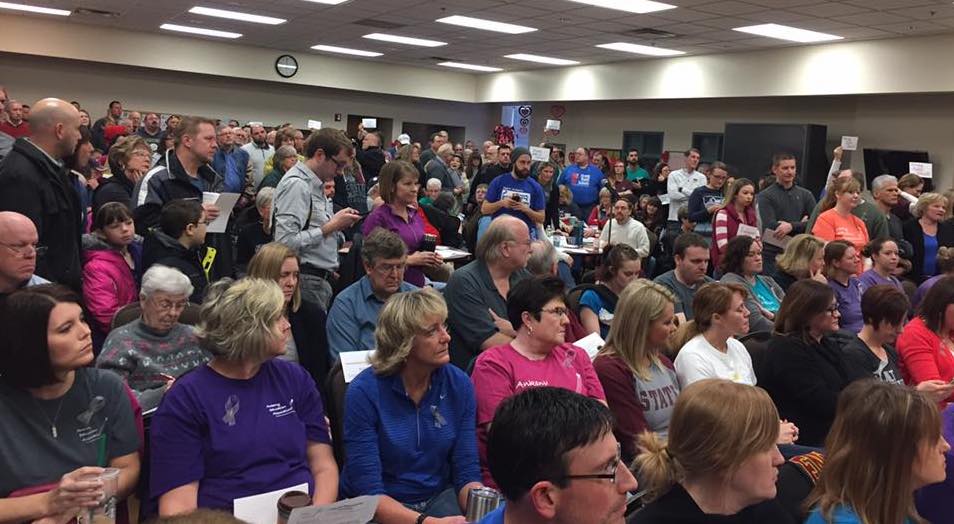
All over Iowa this year, record numbers of citizens have been turning out for legislative forums. Controversies over education spending and Planned Parenthood funding brought out many activists earlier in the legislative session. This weekend, the overwhelming majority of attendees wanted to talk about the Republican bill to eviscerate Chapter 20, Iowa’s law that has governed collective bargaining for public employees since 1974.

Continue Reading...

Dallas County screw-up could scare Iowans away from early voting

When I heard elections officials in Iowa’s fastest-growing county somehow failed to count 5,842 ballots from the 2016 general election, my first thought was that Dallas County Auditor Julia Helm should resign immediately, along with anyone else responsible for the “human error” that disenfranchised almost 13 percent of the county’s residents who cast ballots in the presidential election.

My second thought was that someone on Secretary of State Paul Pate’s staff should have suspected a problem much sooner when Iowa’s fastest-growing county reported only a few hundred more votes in November than in the 2012 general election.

Since Pat Rynard already covered that ground, I will focus on another concern: the Dallas County disaster could discourage Iowans from voting early in the future.

Continue Reading...

IA-Gov: Jon Neiderbach officially launches campaign

This morning Jon Neiderbach announced on Facebook that he will seek the Democratic nomination for governor:

I make two promises: I will not accept donations of over $500 – big money is poisoning our politics – and there is nobody you can vote for in 2018 who will do more to fight a rigged system, shake up Iowa government, and help Iowans achieve the American dream. I will be campaigning essentially full-time: please help me with a small donation to help kick off this campaign.

Neiderbach’s campaign website is under construction, but a preliminary version is online. He’s also on Twitter and Facebook. Click here for more background on the former Des Moines School Board member and 2014 Democratic nominee for state auditor.

Neiderbach, fellow gubernatorial candidate Rich Leopold, and State Representative Todd Prichard, who may seek the nomination too, will all speak at tonight’s Ankeny Area Democrats Annual Winter Fundraising Banquet. The event starts at 6 pm at United Auto Workers of America Local 450, 4589 NW 6th Dr in Des Moines. Featured speakers will also include new Iowa Democratic Party chair Derek Eadon, Senate Minority Leader Rob Hogg, House Minority Leader Mark Smith, and Ankeny City Councilwoman Kerry Walter-Ashby. I won’t be able to attend this dinner but would welcome a guest post if someone wants to share impressions later. Guidelines for Bleeding Heartland authors are here.

Continue Reading...

Republicans deliver worst month ever to Iowa students and educators

For all their talk about helping Iowa provide a “world class” and “globally competitive” education, Iowa Republicans are unwilling to provide the resources public schools need to keep up with rising costs.

And for all their talk about getting “better teachers in the classroom” and giving “hardworking teachers … all the tools necessary to succeed,” Iowa Republicans seem determined to discourage people from pursuing a teaching career in this state.

Continue Reading...

The first eight vice presidents to become president did not appoint new VPs

Reacting to my last post on questions surrounding the future title and authority of Lieutenant Governor Kim Reynolds, Joe Kristan commented that when a similar controversy arose in 1841, Vice President John Tyler set the “Tyler Precedent” by insisting he would be president for the remainder of the term to which William Henry Harrison had been elected.

I responded that the U.S. Constitution was later amended to say clearly that the vice president becomes president in the event of a vacancy–language that Iowa lawmakers chose not to introduce into our state’s constitution when amending passages related to succession on multiple occasions.

Kristan countered that nobody calls Tyler, Millard Fillmore, Andrew Johnson, Chester Arthur, Theodore Roosevelt, Calvin Coolidge, Harry Truman or Lyndon Johnson “acting presidents,” just because the 25th Amendment was subsequently adopted in 1967.

True. But guess what? None of those eight men appointed a new vice president during the term in which they assumed the powers of the presidency.

Continue Reading...

Weekend open thread: Bad signs for education

The next few years won’t be a good time to be a public school student in the U.S. generally or in Iowa specifically. Betsy DeVos is likely to be confirmed as secretary of education, despite bombing in her confirmation hearing, where she dodged some important questions and revealed shocking ignorance about basic education policy matters. Only two GOP senators say they will vote against the billionaire, who has given generously to Republican candidates and causes and worked to undermine public schools for decades.

Iowa’s Senators Chuck Grassley and Joni Ernst have yet not published statements about DeVos, but I enclose below comments confirming they will support her nomination.

Meanwhile, in a party-line vote on February 2, Iowa Senate Republicans approved a bill to increase state funding for K-12 school districts by just 1.11 percent for the year beginning on July 1. Under state law, the Iowa House and Senate should have set school funding for fiscal year 2018 more than a year ago. However, statehouse Republicans have refused to follow that law for the past several years. Last year was no exception: despite action by Iowa Senate Democrats, House Republicans did not vote on fiscal year 2018 “allowable growth” (now officially known as “supplemental state aid”) during the 2016 legislative session.

If Senate File 166 is approved by the Iowa House and signed into law by Governor Terry Branstad, next year’s 1.11 percent growth in K-12 funding would be the third-smallest increase in more than 40 years. I enclose below a chart showing allowable growth levels approved by the state legislature since 1973. Branstad requested 2 percent more funding for K-12 schools in his draft budget. To my knowledge, the governor has not said whether he would sign Senate File 166 in its current form.

Recruiting and retaining educators to work in Iowa may become a lot more difficult after Republicans destroy collective bargaining rights for public employees, including thousands of teachers. House and Senate leaders have indicated that they will make the first significant changes in Iowa Code Chapter 20 since 1974. Details about the plan have been hidden from public view up to now, but a bill on collective bargaining is expected to appear on the state legislature’s website on February 6.

This is an open thread: all topics welcome.

Continue Reading...

Four things I learned about the Iowa Republicans who just voted to defund Planned Parenthood

On Thursday Iowa Senate Republicans approved a bill that would end most state and federal funding for Planned Parenthood’s family planning services. All 29 Republicans and independent Senator David Johnson voted for Senate File 2, while all 20 Democrats voted against the measure. The Senate Judiciary Committee had approved the bill on a party-line vote the previous day.

Passage was a foregone conclusion, since the entire GOP caucus co-sponsored the bill, and statehouse Republicans have been trying to defund Planned Parenthood for years.

Although I already knew Republican lawmakers were willing to force the state to spend ten times more for family planning services, with no reliable funding stream, I still learned some new things watching Senate File 2 move through the upper chamber.

Continue Reading...

Democrats set to target Blum in IA-01; GOP will go after Loebsack in IA-02

Iowa’s non-partisan redistricting system has given our state an unusual number of competitive Congressional districts. Major-party candidates and outside groups spent millions of dollars last year in Iowa’s first district race pitting GOP Representative Rod Blum against Democratic challenger Monica Vernon, as well as in the third district, where Republican Representative David Young faced Democrat Jim Mowrer.

Not only are Democrats determined to go after IA-01 and IA-03 again in 2018, Iowa Republicans have signaled that they will try to defeat six-term Representative Dave Loebsack, who mostly got a pass in the second district during 2016.

Continue Reading...

Senator asks attorney general for opinion on future title, powers of Kim Reynolds

State Senator David Johnson has asked Attorney General Tom Miller to provide an official opinion on whether Lieutenant Governor Kim Reynolds will have the title of governor and the authority to appoint a new lieutenant governor once Governor Terry Branstad resigns, as expected later this year.

Johnson asked Miller to answer nine specific questions regarding language in the Iowa Constitution stating that “the powers and duties of the office” of governor “shall devolve upon the Lieutenant Governor,” and referring to the lieutenant governor “acting as governor” and “performing the duties pertaining to the office of governor.”

Continue Reading...

IA-03: Democrat Anna Ryon is thinking about it

Anna Ryon, an attorney with the Office of Consumer Advocate, may run for Congress in Iowa’s third district next year, she announced on Facebook today. She has launched a possible campaign website and is recruiting volunteers to join her e-mail list for updates and “action alerts” on when to call members of Congress. She is not raising money “until I make a final decision” on a Congressional campaign.

Yesterday Ryon uploaded to YouTube a video of her remarks in May 2015 before the Bishop and Cabinet of the Iowa Conference of the United Methodist Church. Ryon “was invited to be part of that meeting to share my story of being a queer woman in the UMC, and in particular the hurtful response from the church when my ex-wife and I got married.” Instead, she shared the story of her father, a United Methodist minister who was gay and took his own life in 1999.

I enclose below Ryon’s bio from her new website. She is on Twitter @annakryon and on Facebook. Her “deep dive” about Adams County became one of the most popular Bleeding Heartland posts of 2016.

Current U.S. Representative David Young defeated Democratic challenger Jim Mowrer by 53.4 percent to 39.7 percent in 2016. Young performed substantially better than Donald Trump, who carried the third district by 48.5 percent to 45.0 percent over Hillary Clinton. Outside groups spent more than $7.4 million on the Young-Mowrer race. The Democratic Congressional Campaign Committee confirmed this week that IA-03 will be on its target list again in 2018.

One of Mowrer’s 2016 primary opponents, Mike Sherzan, has turned up at a number of local Democratic events lately, including the January 21 State Central Committee meeting of the Iowa Democratic Party, which attracted a large crowd because of the state chair election.

The sixteen counties in IA-03 contain 167,453 active registered Democrats, 177,457 Republicans, and 166,620 no-party voters, according to the latest figures from the Iowa Secretary of State’s office.

Continue Reading...

Monica Kurth wins special election in Iowa House district 89

Democrat Monica Kurth easily won the January 31 special election to represent Iowa House district 89. The seat covering parts of Davenport (map enclosed below) became vacant after Jim Lykam won the recent special election to represent Iowa Senate disrict 45. Kurth defeated Republican Mike Gonzales by 2081 votes to 784 (72.4 percent to 27.3 percent). In effect, she won before polls opened yesterday. Absentee ballots broke 1,092 to 86 in her favor, Ed Tibbetts reported.

Kurth has been a community activist for many years and was a longtime instructor and counselor at Scott Community College. During the campaign, she promised to advocate for higher wages, good education, and retirement security, and to “keep focused on working families, not special interests.”

The total number of ballots cast in House district 89 was close to what special election guru David Beaudoin projected, based on his analysis of the district and Lykam’s results against Gonzales in December. However, Kurth’s winning margin exceeded Beaudoin’s prediction. Republicans put little effort into winning this district, which contains 7,403 active registered Democrats, 4,730 Republicans, and 8,416 no-party voters, according to the latest figures from the Iowa Secretary of State’s office. Gonzales raised less than $3,000, of which about $1,000 came from GOP county committees. He reported no in-kind expenditures by the Iowa GOP.

In contrast, Kurth raised about $24,000 for this race, of which $15,000 came from Democratic or labor organizations. The Iowa Democratic Party also spent nearly $30,000 on direct mail and advertising.

Former (and presumably future) presidential candidate Martin O’Malley came to Davenport last weekend to help Kurth’s campaign. He showed up for Lykam before the December Senate election as well.

Once Kurth has been sworn in, the Iowa House will have 59 Republicans and 41 Democrats. She will bring the number of women in the chamber to 28: nineteen Democrats and nine Republicans.

P.S.- Nine people went to the trouble of casting a ballot in this January election for a write-in candidate. I’m always fascinated by such behavior.

Continue Reading...

Trump delivers stolen Supreme Court seat to Neil Gorsuch

President Donald Trump announced this evening that he is nominating 10th Circuit Appeals Court Judge Neil Gorsuch for the U.S. Supreme Court seat that should have gone to President Barack Obama’s nominee. A few good backgrounders on the man who will benefit from last year’s unprecedented Republican obstruction: Eric Citron for SCOTUS blog, Robert Barnes for the Washington Post, and Adam Liptak for the New York Times. Liptak dug up a 2002 article by Gorsuch, in which he lamented the Senate’s treatment of two appeals court nominees “widely considered to be among the finest lawyers of their generation”: John Roberts (the current Chief Justice) and Merrick Garland (who should have been confirmed to fill this vacancy).

USA Today’s justice reporter Brad Heath observed, “It would be hard for Trump to have picked a federal appellate judge more like Scalia than Gorsuch.” Heath posted excerpts from a number of Gorsuch’s opinions in this thread, noting the judge believes in “applying the Constitution’s ‘original public meaning.’” Some of the rulings are counter-intuitive, such as this case in which Gorsuch found “extortion doesn’t violate the Equal Protection Clause if [the] corrupt official solicited bribes from everyone.”

Senator Chuck Grassley praised Gorsuch for being well qualified and having been confirmed unanimously to the appeals court. Speaking to the Des Moines Register’s Jason Noble, the Judiciary Committee chair said he hoped Democrats would not filibuster Gorsuch, just as Republicans didn’t filibuster Supreme Court nominees during the first terms of Presidents Bill Clinton and Barack Obama. What’s missing from this narrative? Grassley never even gave Garland a hearing.

After the jump I’ve posted prepared statements from Grassley and Senator Joni Ernst welcoming the nomination. I also enclose below the Alliance for Justice fact sheet on Gorsuch, which references many of his legal writings. That non-profit’s president Nan Aron described Gorsuch as a “disastrous choice,” because his “record shows no sign that he would offer an independent check on the dangerous impulses of this administration. What it does show is that he would put the agenda of powerful special interests ahead of the rights of everyday people […].”

Gorsuch is only 49 years old, so he will probably serve on the high court for decades. Several analysts believe picking him was an effort to “reassure” Justice Anthony Kennedy “that it would be safe to retire.” Once Kennedy goes and Trump appoints another justice, we can say goodbye to reproductive rights, voting rights, any kind of environmental and labor regulations, consumer protections, and equal rights for women and LGBTQ people. The Supreme Court will for all practical purposes be unavailable as a check on Republican governance.

While conservatives across the country celebrate tonight, a few locals may be disappointed Trump passed over 8th Circuit Appeals Court Judge Steven Colloton of Iowa. Colloton and Iowa Supreme Court Justice Edward Mansfield were both on the long list of possible Supreme Court nominees Trump released during the campaign. By some recent accounts, Colloton was on the president’s short list after the election too. Maybe next time.

Continue Reading...

Read Iowa Secretary of State Paul Pate's draft voter ID and election reform bills

The Legislative Services Agency has drafted three bills fleshing out Iowa Secretary of State Paul Pate’s proposals on voter ID and other changes to election administration, such as signature verification and wider use of electronic poll books. Bleeding Heartland obtained copies of the documents, which I enclose below.

Important caveats:

These drafts are not the final versions of Pate’s bills.

The voter ID plan is consistent with Pate’s comments at an early January press conference and talking points the Secretary of State’s Office distributed the following week. As far as I can tell, these drafts have not incorporated feedback from the four county auditors who testified at a January 26 Iowa House hearing. Many election administrators have reservations about signature verification requirements as well as voter ID. Legislative staff may rewrite some provisions before the bills are assigned numbers and formally introduced in the Iowa House and Senate.

Republican lawmakers will alter Pate’s bills, if they run them at all.

Departmental bills often die in Iowa legislative committees. State Representative Ken Rizer and State Senator Roby Smith, who lead the State Government Committees in their respective chambers, told Barbara Rodriguez of the Associated Press last week “they’re working together on possible changes” to Pate’s plan. Rizer described the secretary of state’s recommendations as “a starting point for an election reform bill.” I expect Pate will end up playing “good cop,” with the “bad cops” in the House and Senate passing more restrictive ID requirements as well as steps to limit early voting, which Pate has not endorsed.

These bills do not yet come with a price tag.

Eventually, the Legislative Services Agency will produce a fiscal note estimating the cost of enacting each bill. Pate initially suggested his plans would require $1 million, roughly half to make electronic poll books universally available, and half to provide voter ID cards to about 140,000 registered Iowa voters lacking a driver’s license or other valid identification. More recently, he has said only about 85,000 current Iowa voters would need a new ID card to bring to the polls, reducing the cost to the state.

Continue Reading...

IA-Gov: Democrat Jon Neiderbach launching campaign soon

Jon Neiderbach, the 2014 Democratic candidate for state auditor, plans to announce a campaign for governor by the end of the week, he confirmed to Bleeding Heartland. A New York native who has lived in Iowa since attending Grinnell College during the 1970s, Neiderbach has in-depth knowledge of state government, having worked for the Legislative Fiscal Bureau and later in the Iowa Department of Human Services. He also served a term on the Des Moines School Board and has been an attorney in private practice since 2012. He campaigned for a few months in Iowa House district 43 during the last election cycle but withdrew from that race before the filing period.

Last year, Neiderbach was an active supporter of Bernie Sanders for president, and he will need support from that part of the Democratic base in a primary likely to include better-funded candidates. His new Twitter handle is @Neiderbach4Gov, and he’s on Facebook here. A campaign website will launch soon. I enclose below a short bio released during Neiderbach’s 2014 race for state auditor.

The field of Democratic challengers to future Governor Kim Reynolds will expand further. Rich Leopold is already campaigning around the state, and former Iowa Democratic Party chair Andy McGuire is expected to make her candidacy official within a month or two. (However, when I asked McGuire at the recent State Central Committee meeting when she was going to announce, the mother of seven grown children answered with a joke: “Oh, do I look pregnant?”)

The rumor mill sees State Representative Todd Prichard as a likely gubernatorial candidate too.

State Senator Liz Mathis told a Democratic gathering in Des Moines this month that she thought about running for governor in 2018, “but I don’t believe it’s in the cards for me.” I’ve talked to several Democrats who hope she will reconsider, including AFSCME President Danny Homan. (He is not in McGuire’s fan club.) Terry Branstad ruled out running for governor in May 2009 but changed his mind a few months later.

Continue Reading...

Iowa Senate Republicans bury "unfiltered" debate with rule change

As of this week, Iowa state senators are no longer able to give speeches about matters of political or personal importance at a predictable time of day, when the chamber is relatively full.

For many years, members have been allowed to offer “Points of Personal Privilege” shortly after the Senate gavels in at 9:00 a.m.

Republicans ended that tradition on a party-line vote last Thursday. GOP leaders have not explained their reasons for moving the open discussion period to the end of each session day. The rule change is likely designed to reduce the visibility of Democratic remarks highlighting controversial legislation or Branstad administration policies. A former Democratic senator decried the move as “pushing public discourse in the dark.”

Continue Reading...

Weekend open thread: Threats to national security edition

What’s on your mind, Bleeding Heartland readers? This is an open thread: all topics welcome.

Only one week into Donald Trump’s presidency, the outrages are piling up. Philip Rucker and David Filipov report today for the Washington Post that Trump has restructured the National Security Council to give his political strategist Steve Bannon a permanent spot on the “principals committee” of senior officials. Meanwhile, the chairman of the Joint Chiefs of Staff and the director of national intelligence will no longer be regular members of that committee. President George W. Bush never allowed his hatchet man Karl Rove to attend National Security Council meetings.

Trump issued several executive orders this week related to immigration. The most controversial (and probably unconstitutional) one restricts entry from seven countries–but maybe not for Christians from those areas. Despite the trending hashtag #MuslimBan, the order is technically not a ban on Muslims entering the U.S.–though Rudy Giuliani says Trump asked advisers to help him accomplish that goal through legal means. The White House is portraying the order as an anti-terrorism measure, but knowledgeable people know otherwise.

Continue Reading...

IA-01: Democrat Courtney Rowe may challenge Rod Blum

Cedar Rapids-based engineer Courtney Rowe may run for Congress against Representative Rod Blum in Iowa’s first district, she confirmed to Bleeding Heartland today. Rowe has been an active Democrat locally and was a Bernie Sanders delegate to last year’s Linn County, first district, and state conventions, as well as an alternate to the Democratic National Convention. She has volunteered her time on church missions, as a mentor for middle-school students, and as an officer for Parents and Friends of Lesbians and Gays (PFLAG).

Rowe described her background and motivation for considering a Congressional bid in a document I enclose below. She has not yet created an exploratory committee but plans to launch a campaign website sometime next month, both to present some of her policy ideas and to create an interactive format for voters to weigh in on the issues.

The 20 counties in IA-01 contain 166,338 active registered Democrats, 146,164 Republicans, and 191,340 no-party voters, according to the latest figures from the Iowa Secretary of State’s office. The largest-population counties are Linn (the Cedar Rapids metro area), Black Hawk (Waterloo/Cedar Falls metro), and Dubuque, a traditional Democratic stronghold that is also Blum’s home base, where Democrats underperformed badly in 2016.

Blum was considered one of the most vulnerable U.S. House members in the country going into the 2016 election cycle, and many Iowa Democrats believed his narrow victory over Pat Murphy in 2014 had been a fluke. However, the Freedom Caucus member defeated Monica Vernon by a larger margin of 53.7 percent to 46.1 percent. Blum ran about five points ahead of Donald Trump, who carried the IA-01 counties by 48.7 percent to 45.2 percent. That was a massive swing from Barack Obama’s double-digit advantage in this part of Iowa in 2012.

Although I haven’t yet heard of any other Democrats thinking seriously about challenging Blum, I expect a competitive 2018 primary. Any comments about the race are welcome in this thread.

UPDATE: The Democratic Congressional Campaign Committee released its first target list on January 30. IA-01 and IA-03 are among those 33 Republican-held House seats.

Continue Reading...

Will ISU's president ever fully cover the cost of his personal medical travel?

Six weeks after Iowa State University released the Internal Audit report on ISU Flight Service and University Owned Aircraft, I’ve made surprisingly little headway toward filling in the gaps.

Not for lack of trying.

The Iowa Board of Regents and ISU have withheld information that should have been included in a “comprehensive audit” purporting to cover every flight President Steven Leath has taken on a university airplane.

For today, I will focus on one issue: ISU staff’s refusal to tell me whether Leath has reimbursed the ISU Foundation for the full cost of flights to Rochester, Minnesota in July 2015. The matter raises questions about the foundation’s compliance with federal tax code and the accuracy of ISU’s official narrative.

Continue Reading...

How Paul Pate is spinning county auditors on his voter ID plan

Nearly three weeks after Iowa Secretary of State announced plans to push for new voter ID requirements, Pate still hasn’t produced a draft bill that would answer important questions about how his scheme would work. Skeptics including John Deeth, Gavin Aronsen, Pat Rynard, the Des Moines Register editorial board, the Quad-City Times editorial board, and I have posited that the proposal would disenfranchise a significant number of eligible voters, largely from groups that tend to lean Democratic. Pate strenuously objects, claiming that his only concerns are for the “integrity” of Iowa elections and voter confidence in the system.

In addition to arguing his case on social media and in “a public relations tour of Iowa newsrooms,” Pate has sought to enlist support from county auditors, many of whom “aren’t fans of voter ID” requirements.

I enclose below two documents the Secretary of State’s Office distributed to county auditors during the week after his voter ID rollout.

Continue Reading...

Iowa Republicans unprepared for backlash on Planned Parenthood funding

GOP lawmakers have been trying to defund Iowa’s leading provider of reproductive health care for years. Their previous efforts attracted relatively little public attention, since the Democrats in control of the state Senate would not go along.

Democrats no longer hold enough seats in the legislature to stop Republicans from enacting a plan that will require Iowa to spend ten times more, even as family planning services become less accessible.

As expected, an Iowa Senate Judiciary subcommittee advanced Senate File 2 during a January 24 meeting. The outcome was a foregone conclusion, since all 29 Senate Republicans are co-sponsoring the bill that would create a state-run family planning program, excluding Planned Parenthood as a qualified provider.

But the vast majority of Iowans support continued state funding for Planned Parenthood’s non-abortion services. Republicans weren’t prepared for hundreds of them to show up at the Capitol yesterday.

Continue Reading...

Iowa House Republican: I received Planned Parenthood services, we need to preserve access to health care

Republican State Representative Ashley Hinson used Planned Parenthood services when she first moved to the Cedar Rapids area and “couldn’t get in to an OB/GYN for over a year,” she told an audience in Linn County on Saturday. Hinson added that as any legislation defunding Planned Parenthood moves forward in the Iowa House, her “top concern” will be ensuring “we’re not making it harder on anyone to get services” and that “services are available.”

Continue Reading...

Grassley, Ernst not concerned by Trump's nominees or antics

U.S. Senators Chuck Grassley and Joni Ernst have given the White House nothing to worry about as the chamber begins the process of confirming President Donald Trump’s cabinet appointees. Not only have Iowa’s senators voted for the three cabinet members approved so far, they have yet to voice serious concern about any nominee.

Two of the least controversial cabinet appointees gained Senate approval within hours of Trump’s inauguration on January 20: James Mattis for secretary of defense and John Kelly for director of Homeland Security. Only one senator (Democrat Kirsten Gillibrand) voted against confirming Mattis, because she opposes the waiver allowing him to serve in the cabinet less than seven years after leaving the military. Only eleven Democrats voted against confirming Kelly.

Mike Pompeo’s nomination as director of the Central Intelligence Agency drew more opposition when it came to the Senate floor on January 23. Thirty Democrats, Republican Rand Paul, and independent Bernie Sanders voted against Pompeo’s nomination, largely over concerns about his positions on torture and government surveillance.

As dangerous as Pompeo could be to the rule of law as it relates to intelligence gathering and interrogation techniques, Trump’s deceptive, off-topic, self-centered speech on Saturday at CIA headquarters knocked Pompeo down the list of things that terrify me about the coming years. Robin Wright explained for the New Yorker why “Trump’s vainglorious affront to the CIA” horrified intelligence community professionals. According to NPR’s national security correspondent Mary Louise Kelly, former CIA chief of Russia operations Steve Hall has said that agency staff are worried they might not be able to trust Trump enough to reveal the source of unflattering information about Russian President Vladimir Putin.

This thread is for any comments related to Trump’s cabinet or out-of-control narcissistic rages, which require his advisers to serve as glorified babysitters keeping the president from spending too much time watching television. I enclose below official statements from Ernst on the first cabinet confirmations and from Grassley on his meeting with Kelly earlier this month. Both senators have studiously avoided any public comments about Trump’s child-like temperament or sometimes contradictory outbursts on matters of national security.

Continue Reading...

How Kim Reynolds built her $1.1 million war chest

Lieutenant Governor Kim Reynolds will take many advantages into the 2018 gubernatorial campaign, by virtue of being the incumbent after Governor Terry Branstad leaves for China.

Though Cedar Rapids Mayor Ron Corbett is considering a bid for the Republican nomination next year, he may have second thoughts after looking at the Reynolds committee’s latest campaign finance reports. The lieutenant governor ramped up her fundraising during 2016 and has more than $1.1 million in the bank.

Contrary to the picture painted by spin doctors for Reynolds, most of the money came from major donors.

Continue Reading...

44 photos from the Iowa Women's March

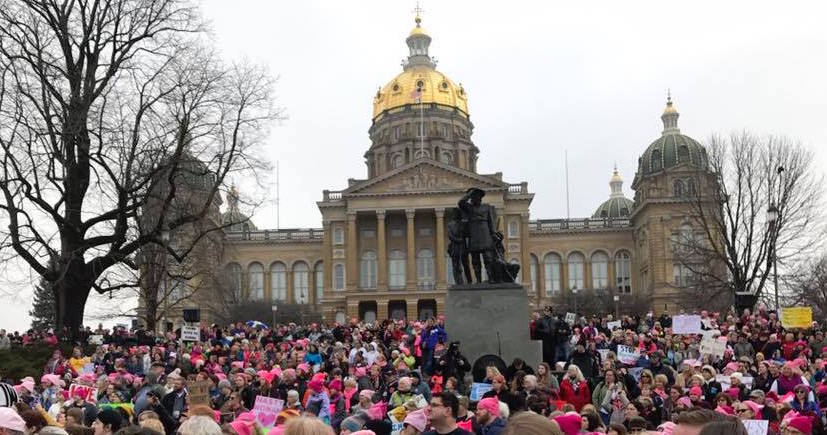
Turnout for the Women’s March in Washington and companion events around the world shattered expectations on Saturday, far exceeding the number of people who showed up to watch Donald Trump be sworn in as president the previous day. Trump and White House press secretary Sean Spicer had a right royal meltdown over media coverage of attendance at the inauguration. The president must have been seething to see yesterday’s news about more than 2.5 million people marching, including at least half a million in Washington and massive numbers in city after city: 750,000 in Los Angeles, 250,000 in Chicago, 100,000 in Denver, and so on.

Before the weekend, I heard predictions that 10,000 people might come to the Iowa Women’s March outside the Capitol in Des Moines. Instead, an estimated 26,000 people were there–impressive turnout for a state with about 3 million residents.

I spent most of Saturday at the Iowa Democratic Party State Central Committee meeting, so I’m grateful to Bleeding Heartland readers who gave me permission to share their Iowa Women’s March photos below (click on any image to enlarge). The only problem was choosing what to post among scores of inspiring images from the rally.

This is an open thread: all topics welcome. The Iowa City Press-Citizen published a photo gallery from the women’s march in the “people’s republic.”

Continue Reading...

Leadership contest may leave Iowa Democrats more divided than before

UPDATE: Derek Eadon was the winner; have added more about the meeting below, along with the audio from his first comments to reporters as state party chair and background on the new vice chairs. Democrats avoided a polarizing result today.

For many years, the Iowa Democratic Party’s State Central Committee “elected” the state chair in name only. In reality, insiders rubber-stamped a decision made by one person (Senator Tom Harkin, Governor Tom Vilsack, or Governor Chet Culver). So I was thrilled to see an open competition among four talented people seeking the top position in 2015. Contrary to some predictions, that race was not a foregone conclusion for the establishment’s favorite candidate; Andy McGuire needed three ballots to win.

The spirited campaign to become state party chair for the next two years is encouraging, considering the huge challenges facing our party after losses in November exceeding most people’s expectations.

I decided early not to endorse any candidate, because everyone in the field brought valuable skills and experience to the table. Reading the pieces posted here by Julie Stauch, Kurt Meyer, Derek Eadon, Sandy Dockendorff, Blair Lawton, and Kim Weaver, along with messages to State Central Committee members from Mike Gronstal and Bob Krause, I felt confident that whoever won would understand the key tasks facing the party and could draw on many good ideas floated during the process.

As today’s election approached, I have become increasingly concerned that the outcome will leave Iowa Democrats more angry and divided–party because the voting procedure won’t allow for consensus-building, and partly because some old hands simply don’t understand the mindset of many activists energized by the Bernie Sanders campaign.

Continue Reading...

These Iowa Democrats will conduct the 2016 election post-mortem

On a dark day for Democrats across the country, the Iowa Democratic Party announced most members of the “Building Blocks” committee that will analyze what went wrong in the 2016 elections. Representative Dave Loebsack spearheaded the initiative and will help raise money to cover the costs of a listening tour and research including a professional focus group. Members named in a January 20 press release:

– Joe O’Hern- Campaign Manager Loebsack for Congress
– Laura Hubka- 1st District SCC Member
– Kate Revaux- 2nd District SCC Member
– Jason Frerichs- 3rd District SCC Member
– Penny Rosfjord- 4th District SCC Member
– Emily Parcell- Wildfire Consulting
– Jessica Vanden Berg- Maverick Consulting and Mail
– Erich Schmidt- Laborers International Union
– Representatives from House Truman Fund
– Representatives from State Senate Majority Fund
– Representatives from the Iowa Democratic Party Staff

Best of luck to this group. I look forward to reading their report sometime this spring. Broadly, we know that white voters without a college degree were the key to Iowa’s massive swing to Trump. But we have a lot to learn about why so many people in counties that had voted for Barack Obama twice either did not vote or voted for Trump. We need to figure out how to reconnect with voters in eastern Iowa communities that were Democratic strongholds for decades. We need to assess the party’s early GOTV strategy, which seems to have inadvertently turned out Trump voters. We also need to understand why some of our hard-working Iowa Senate incumbents and state House candidates performed so poorly in down-ballot races. Why didn’t Governor Terry Branstad’s disastrous Medicaid privatization and under-funding of education and mental health care resonate more with voters in communities of all sizes?

P.S.- I learned after publishing my latest Throwback Thursday post that Jessica Vanden Berg and Scott Ourth (an Iowa House Democrat since 2013) worked on John Judge’s campaign for the January 1999 special election to replace Patty Judge. I hope to hear their stories someday and publish an account of that race from the Democratic perspective.

Iowans shut out of Trump's cabinet, and Chuck Grassley's not happy

The less said about President Donald Trump’s divisive, angry, poorly-delivered inaugural address, the better.

Catching up on transition news of particular importance to Iowa, yesterday Trump’s team finally announced that former Georgia Governor Sonny Perdue will lead the U.S. Department of Agriculture. Perdue had long been considered a front-runner for the last cabinet position to be filled, but Trump delayed the selection for weeks in an apparent scramble to find a Latino. (He is the first president since Jimmy Carter not to appoint any Latinos to a cabinet-level position.)

The only Iowans Trump has tapped for important jobs so far are Sam Clovis, who is heading the transition at USDA, future U.S. Ambassador to China Governor Terry Branstad, and Eric Branstad, in line to become White House liaison to the Commerce Department. (By some accounts, U.S. Appeals Court Judge Steven Colloton is on Trump’s short list for the U.S. Supreme Court.)

Senator Chuck Grassley had expressed concern about the delay in choosing a secretary of agriculture and specifically about rumored efforts to find someone other than a white man for the job. He didn’t sound pleased about the Perdue appointment either.

Continue Reading...

How to keep up with Iowa legislative happenings and take action

As Iowa Republicans prepare to undermine public education, reproductive rights, access to health care, collective bargaining, and much more, it’s easy to feel overwhelmed by the number of battles ahead and the prospects for Democrats to stop the onslaught.

Individuals may feel powerless, but when enough of them contact lawmakers, they can sometimes make a difference. Earlier this month, U.S. House Republicans backpedaled on a proposal to neuter the Office of Congressional Ethics after thousands of constituents jammed phone lines.

Iowa House and Senate Democratic legislators and staff have created a new way for activists to stay informed and get involved in the key battles during this year’s legislative session.

Continue Reading...

Don't panic: Iowa House Education chair doesn't want to abolish tenure

State Senator Brad Zaun’s bill to prohibit “the establishment or continuation of a tenure system” has worried many people who understand how badly that policy would harm Iowa’s state universities. Wisconsin Republican lawmakers spurred an exodus of highly-regarded faculty from that state’s top university, and the Wisconsin law to weaken tenure didn’t go nearly as far as Zaun’s bill would.

Fortunately, the bill seems unlikely to clear the Iowa House Education Committee–if it even gets that far.

Continue Reading...

Loebsack will attend both Trump's inauguration and the Women's March

At least 60 U.S. House Democrats have said they will boycott Donald Trump’s inauguration on January 20. But the lone Democrat in Iowa’s Congressional delegation said today he will attend both Trump’s swearing-in and the massive Women’s March on Washington scheduled for the following day.

Here’s the statement from Representative Dave Loebsack:

There is no question that our nation, and in fact the President-elect himself, would be best served if he started behaving in a manner more reflective of the leader of the free world. The President-elect’s divisive, disturbing and distasteful remarks should have no place in our society. That being said, I have an enormous amount of respect for our nation’s history of peaceful transition of power and will stand with President Obama, President and Secretary Clinton and others who are attending. The next day, I will be attending the Women’s March in Washington with my daughter where I will join folks across the country to stand firm and fight against policies that will harm hard-working Iowans while working to create jobs, grow the economy, help our veterans and strengthen Social Security and Medicare.

Hundreds of Iowans are going to the capital for the Women’s March. I would be happy to publish one or more first-person accounts from the event. Guidelines for Bleeding Heartland guest authors are here.

Continue Reading...

Kent Sorenson will serve time over illegal campaign payments

Former State Senator Kent Sorenson will spend time in prison for taking money in exchange for endorsing Ron Paul shortly before the 2012 Iowa caucuses. Sorenson pled guilty to the federal offenses more than two years ago, but his sentencing was delayed repeatedly as he cooperated with investigators looking into conduct by others. Sorenson’s testimony helped to convict three former senior Paul campaign officials of crimes including conspiracy, causing false campaign expenditure reporting and making false statements.

Prosecutors recommended probation and community service for Sorenson, but U.S. District Court Judge Robert Pratt sentenced him to 15 months in prison today, Grant Rodgers reported for the Des Moines Register. Pratt described Sorenson’s actions as “the definition of political corruption.”

In contrast, prosecutors had sought sentences of two years in prison for Paul’s former campaign chairman Jesse Benton and campaign manager John Tate. But last September, District Court Judge John Jarvey sentenced them to two years probation and $10,000 fines instead. The same judge sentenced former deputy campaign manager Dimitri Kesari to three months in prison for orchestrating the illegal payments scheme.

One thing I’ve never understood: why did federal prosecutors focus only on crimes involving Paul’s operatives, when Sorenson also conspired to accept $7,500 per month from entities linked to Michele Bachmann’s presidential campaign? A special investigator’s report on payments from pro-Bachmann committees prompted Sorenson to resign from the Iowa Senate in 2013.

Sorenson avoided trial on domestic abuse charges last year by pleading guilty to disorderly conduct.

17 Iowa politics predictions for 2017

Two weeks late and humbled by the results from previous efforts to foretell the future, I offer seventeen Iowa politics predictions for the new year.

I struggled to compile this list, in part because it’s harder to come up with things to predict during a non-election year. I didn’t want to stack the deck with obvious statements, such as “the GOP-controlled Iowa House and Senate will shred collective bargaining rights.” The most consequential new laws coming down the pike under unified Republican control of state government are utterly predictable. I needed time to look up some cases pending before the Iowa Supreme Court. Also, I kept changing my mind about whether to go for number 17. (No guts, no glory.)

I want to mention one prediction that isn’t on this list, because I don’t expect it to happen this year or next. I am convinced that if the GOP holds the governor’s office and both chambers of the Iowa legislature in 2018, they will do away with non-partisan redistricting before the 2020 census. I don’t care what anyone says about our system being a model for the country or too well-established for politicians to discard. Everywhere Republicans have had a trifecta during the last decade, they have gerrymandered. Iowa will be no exception. So if Democrats don’t want to be stuck with permanent minority status in the state legislature, we must win the governor’s race next year. You heard it here first.

Continue Reading...

Some of Branstad's extended family will move with him to China

I didn’t believe the early speculation about Governor Terry Branstad becoming ambassador to China, for two reasons. First, the governor shot down the rumor the day after the election. WHO-TV’s Dave Price quoted Branstad as saying on November 9, “I’m not interested in living overseas,” adding that the governor “pointed out he has seven grandchildren now and wants to remain in Iowa.”

Second, I doubted First Lady Chris Branstad would ever agree to move halfway around the world from her grandkids. At a November 21 press conference, the governor said he would consider a job offer from President-elect Donald Trump but added that he wanted to stay in Iowa and that his wife’s views on the matter would carry weight: “We are not doing anything without her blessing, that’s for sure. […] We have been married for 44 years and I want to stay married.”

In what may be his final appearance on Iowa Public Television’s “Iowa Press” program Friday, Branstad explained that some of his grandkids will be moving to China along with him and his wife.

Continue Reading...

Throwback Thursday: When Terry Branstad first tried to elevate Kim Reynolds, 18 years ago

Terry Branstad passed over some better-known and better-connected Republicans when he picked State Senator Kim Reynolds to be his running mate in 2010. During that campaign, Branstad said he was looking for a lieutenant governor who could take his place. He made clear on many subsequent occasions that he was “grooming” Reynolds. The plan will come to fruition after Branstad is confirmed as U.S. ambassador to China.

Few Iowans outside Clarke County had heard of Reynolds in June 2010, but Branstad had taken an interest in her political career long before then. If his original plan had worked out, Reynolds would have been elected to the Iowa Senate for the first time on this day in 1999.

Continue Reading...

Defunding Planned Parenthood will cost much more than Iowa Republicans let on

Governor Terry Branstad and Republican leaders in the Iowa House and Senate are finally poised to eliminate Planned Parenthood’s state funding, a cherished goal Democrats had repeatedly blocked in recent years.

Branstad said during his Condition of the State address on Tuesday that his budget “redirects family planning money to organizations that focus on providing health care for women and eliminates taxpayer funding for organizations that perform abortions.” House and Senate leaders likewise depict their plan as a simple change to reimburse different health care providers, creating “better options for more women.”

What Iowa Republicans don’t broadcast: they are setting the state up to spend ten times more on family planning services, without a reliable funding stream.

Continue Reading...

Branstad's budget puts Kim Reynolds on a collision course with Big Ag

Governor Terry Branstad has rarely found himself at odds with any powerful farm lobby group. In 1995 he signed a law banning agricultural zoning, which fueled explosive growth of confined animal feeding operations across Iowa. Since returning to the governor’s office in 2011, he has named several agribusiness representatives to the the Environmental Protection Commission. He signed the probably unconstitutional “ag gag” bill targeting whistleblowers who might report alleged animal abuse. He moved to protect farmers from state inspections for electrical work. He joined a poorly-conceived and ultimately unsuccessful lawsuit seeking to block a California law on egg production standards. He has consistently rejected calls to regulate farm runoff that contributes to water pollution, instead supporting an all-voluntary nutrient reduction strategy heavily influenced by the Iowa Farm Bureau.

Despite all of the above, the governor’s two-year budget blueprint contains an obscure proposal that will draw intense opposition from Big Ag. By this time next year, the fallout could cause political problems for Branstad’s soon-to-be-successor, Lieutenant Governor Kim Reynolds–especially if Cedar Rapids Mayor Ron Corbett challenges her for the 2018 GOP nomination.

Continue Reading...

Higher education would take a huge hit in Branstad's budget

While delivering his final condition of the state address to Iowa lawmakers on Tuesday, Governor Terry Branstad warned that he was offering “difficult” recommendations to cover a shortfall of more than $100 million in the current-year budget. His speech played up the good news: “My proposal does not include across-the-board cuts, does not reduce funding for K through 12 education, does not reduce property tax credits and does not include furloughs for state employees.”

The bad news was buried deep in a 196-page two-year budget blueprint. Nearly a third of the governor’s proposed spending cuts this year would fall on Iowa’s public universities and community colleges. The underfunding doesn’t stop there.

Continue Reading...

GOP leaders gloss over divisive priorities on Iowa legislature's opening day

The Iowa House and Senate convened for the 2017 legislative session yesterday. If all goes according to schedule under Republican control of both chambers for the first time since 2004, lawmakers will complete their work by late April or early May.

Listening to the platitudes in opening day speeches by GOP leaders, you’d never guess what some of their top priorities are for this year.

Continue Reading...

Who's who in the Iowa Senate for 2017

The Iowa legislature’s 2017 session begins today with minor adjustments to business in the state House but massive changes in the Senate. After ten years of Democratic control, the last six with a one-seat majority, the upper chamber now contains 29 Republicans, 20 Democrats, and one independent (former Republican David Johnson).

I enclose below details on the Iowa Senate majority and minority leadership teams, along with all chairs, vice chairs, and members of standing Senate committees. Click here to find the same information from the 2016 legislative session.

Just six senators are women (five Democrats and a Republican), down from ten women serving in the chamber in 2013 and 2014 and seven during the past two years. All current senators are white. To my knowledge, the only African-American ever to serve in the Iowa Senate was Tom Mann, elected to two terms during the 1980s. No Latino has ever served in the Iowa legislature; in 2014, Nathan Blake fell 18 votes short of becoming the first to join the Senate. No Asian-American has served in the state Senate since Swati Dandekar resigned in 2011.

As a group, the members of the new majority caucus have much less legislative experience than do their Democratic counterparts. As detailed below, only three of the 29 Senate Republicans have served ten or more years in the Iowa legislature, compared to thirteen of the 20 Democrats.

Some non-political trivia: the 50 Iowa senators include two with the surname Johnson, four Marks, three Bills, and two men each named Richard (Rich and Rick), Robert (a Rob and a Bob), Dan, Tim, Tom, Jeff, and Charles (one goes by Chaz).

Continue Reading...

Who's who in the Iowa House for 2017

The Iowa House opens its 2017 session today with 59 Republicans, 40 Democrats, and one vacancy, since Jim Lykam resigned after winning the recent special election in Iowa Senate district 45. The 99 state representatives include 27 women (18 Democrats and nine Republicans) and 72 men. Five African-Americans (all Democrats) serve in the legislature’s lower chamber; the other 95 lawmakers are white. No Latino has ever been elected to the Iowa House, and there has not been an Asian-American member since Swati Dandekar moved up to the Iowa Senate following the 2008 election.

After the jump I’ve posted details on the Iowa House majority and minority leadership teams, along with all chairs, vice chairs, and members of standing House committees. Where relevant, I’ve noted changes since last year.

Under the Ethics Committee subheading, you’ll see a remarkable example of Republican hypocrisy.

Some non-political trivia: the Iowa House includes two Taylors (one from each party) and two Smiths (both Democrats). As for first names, there are six Davids (four go by Dave), four Roberts (two Robs, one Bob, and a Bobby), four Marys (one goes by Mary Ann), and three men each named Gary, John, and Charles (two Chucks and a Charlie). There are also two Elizabeths (a Beth and a Liz) and two men each named Brian, Bruce, Chris, Greg, Michael, and Todd.

Continue Reading...

Weekend open thread: Terrible predictions edition

What’s on your mind this weekend, Bleeding Heartland readers? This is an open thread: all topics welcome.

In the real world as well as on social media, many Iowa Democratic activists have been talking about Rich Leopold this week. Since announcing his candidacy for governor on Wednesday, Leopold has reached out to county chairs and other local leaders in a bunch of towns. I hope his early, aggressive campaign will drive other Democrats thinking about this race to start pounding the pavement sooner rather than later. I’m all for a spirited, competitive 2018 primary.

Longtime Johnson County elections office worker John Deeth wrote a must-read “deep dig” about the real-world implications of “the proposed voter ID legislation, with the Orwellian name ‘Voter Integrity,’ launched by Secretary of State Paul Pate on Thursday.” Key point: county auditors of both parties are not fans of voter ID, “because they’ve been on the front lines of dealing with the public and they know that it doesn’t solve anything and that it will make it harder for the public.” Bleeding Heartland’s take on Pate’s solution in search of a problem is here.

Des Moines Register statehouse reporter Brianne Pfannenstiel published a heartbreaking account of her mother’s terminal illness during the presidential campaign, a “sudden and devastating” ordeal that still “hurts like hell every day.”

Along with most Iowa politics watchers, I’m gearing up for the 2017 Iowa legislative session, which begins on Monday. First, let’s take care of some unfinished business from 2016. Like many political writers and a fair number of Bleeding Heartland readers, I had a horrendous year for predictions.

Continue Reading...

Steve King's unconstitutional Obamacare bill getting national ridicule

For a self-style “constitutional conservative,” Representative Steve King has a lot of trouble with the separation of powers concept. In the past, King has tried to block federal courts from hearing cases related to marriage rights and encouraged state governments to disregard the U.S. Supreme Court’s 2015 marriage equality ruling.

King went one step further this week by introducing a bill to prohibit the Supreme Court from citing its previous cases involving the 2010 Affordable Care Act.

Legal experts agree King’s proposal is itself unconstitutional.

Continue Reading...

Shorter Paul Pate: Iowa elections clean, but let's make it harder for people to vote

Following the standard Republican playbook, Iowa Secretary of State Paul Pate announced a series of steps today that would make it harder for thousands of Iowans to exercise their right to vote. He produced no evidence of any fraud problems his proposals would solve, which isn’t surprising, because Iowa is already one of the most highly-rated states for electoral integrity.

Continue Reading...

Steve King defends scrapping Ethics Office; Blum and Young say they oppose

The main order of business in the U.S. House on January 3 was electing the speaker on the first day of the new session. House members returned Paul Ryan to that position with only one dissenting vote from the GOP caucus, in contrast to January 2015, when Representatives Rod Blum (IA-01) and Steve King (IA-04) were among 25 Republicans not supporting Speaker John Boehner’s re-election.

The big news on Tuesday, however, was House Republicans backpedaling on their vote the previous night to gut the powers of the Office of Congressional Ethics.

While staff for dozens of House members hid behind “we don’t know” or “we’ll get back to you” in response to constituent calls, King became one of the few “loud and proud” supporters of the amendment. In fact, he will seek to abolish the office rather than merely neutering it.

Continue Reading...

Rich Leopold becomes first Iowa Democratic candidate for governor

Vowing to be an outsider who can bring a “different kind of government” to Iowa, Rich Leopold just announced in a Facebook live appearance that he will run for governor as a Democrat in 2018. I enclose below his news release and a statement of “four cornerstones” that will guide his candidacy, along with a transcript of his comments on video. Leopold’s campaign website is here and his Facebook page is here.

A first-time candidate for office, Leopold stands apart from the “lobbyists, special interests, and the insider’s club that for far too long has run our government” and “is free from the generations of deal-making and permanent campaigning that has poisoned the capitol,” his “cornerstones” document declares.

Leopold has government experience at the local, state, and federal level. He served as Iowa Department of Natural Resources director during Chet Culver’s administration from 2007 to 2010, when he took a job with the Midwest Region of the U.S. Fish and Wildlife Service. He later worked for the Dickinson County Conservation Board and since 2013 has been with the Polk County Conservation Board, where he is now director. (Disclosure: I joined the board of directors of the Iowa Environmental Council when Leopold was that non-profit’s executive director, shortly before he left to lead the DNR.)

Leopold also chairs the new Grow Iowa PAC, which raised about $10,000 last year and donated to eighteen Democratic candidates or committees.

No other Democrats have confirmed plans to run for governor, but outgoing Iowa Democratic Party chair Andy McGuire is widely expected to announce her candidacy early this year. If either wins the June 2018 primary, Leopold or McGuire would be the first Iowa nominee for governor since Roxanne Conlin in 1982 not to have held elected office.

Many politics-watchers expect at least one member of the Iowa House or Senate to seek the nomination as well, perhaps State Senator Liz Mathis or State Representative Todd Prichard.

UPDATE: State Senator Chaz Allen is also rumored to be considering the gubernatorial race. He or Prichard would have to give up their seats in the legislature in order to run for governor. Mathis was just re-elected to a four-year term, so could run for governor without leaving the Iowa Senate.

Continue Reading...

A year's worth of guest posts, plus tips for guest authors

One of my blogging new year’s resolutions for 2016 was to publish more work by other authors, and I’m grateful to the many talented writers who helped me meet that goal. After the jump I’ve linked to all 140 guest posts published here last year.

I encourage readers to consider writing for this site in 2017. Guest authors can write about any political issue of local, state, or national importance. As you can see from the stories enclosed below, a wide range of topics and perspectives are welcome here.

Pieces can be short or long, funny or sad. You can write in a detached voice or let your emotions show.

Posts can analyze what happened or advocate for what should happen, either in terms of public policy or a political strategy for Democrats. Authors can share first-person accounts of campaign events or more personal reflections about public figures.

Guest authors do not need to e-mail a draft to me or ask permission to pursue a story idea. Just register for an account (using the “sign up” link near the upper right), log in, write a post, edit as needed, and hit “submit for review” when you are ready to publish. The piece will be “pending” until I approve it for publication, to prevent spammers from using the site to sell their wares. You can write under your own name or choose any pseudonym not already claimed by another Bleeding Heartland user. I do not reveal authors’ identity without their permission.

I also want to thank everyone who comments on posts here. If you’ve never participated that way, feel free to register for a user account and share your views. If you used to comment occasionally but have not done so lately, you may need to reset your password. Let me know if you have any problems registering for an account, logging in, or changing a password. My address is near the lower right-hand corner of this page.

Continue Reading...

Senate should demand full disclosure of Branstad donors before his confirmation

The Branstad-Reynolds Scholarship Fund, which collected money to pay for Governor Terry Branstad’s 2011 and 2015 inaugural celebrations, has not disclosed the names of donors who contributed $1.1 million in 2015, Ryan Foley reported today for the Associated Press. That information should have been included on the non-profit’s 2015 tax return. However, the return filed on November 15, 2016 named only one donor: Principal Financial Group, which gave $25,000.

Before considering Branstad’s nomination to be U.S. ambassador to China, the Senate Foreign Relations Committee should insist that the governor bring his non-profit into compliance with federal law. Senators should also scrutinize all donations to the group, to see whether Branstad did any political favors for individuals or businesses that bankrolled his inaugural.

Continue Reading...

Iowa Senate Democrats give David Johnson seat on Natural Resources

Former Republican State Senator David Johnson will remain an independent during the Iowa legislature’s 2017 session, but he will not be entirely shut out of committee work. William Petroski reported for the Des Moines Register this weekend that Democrats offered Johnson one of their positions on the Natural Resources Committee, recognizing his work on issues in that committee’s jurisdiction. In recent years, Johnson has been the leading Republican advocate for increasing conservation spending in the state budget as well as for raising the sales tax to fill the Natural Resources and Outdoor Recreation Trust Fund.

Johnson quit the Republican Party in June to protest the nomination of Donald Trump for president. He had occasionally found himself at odds with this GOP colleagues before then. For instance, he supported the unsuccessful Democratic effort to stop Medicaid privatization and later voted for a Democratic bill on stronger Medicaid oversight.

First elected to the Iowa House in 1998 and to the Senate in 2002, Johnson told Petroski he hasn’t decided whether to run for re-election in Senate district 1 next year. Zach Whiting, a staffer for U.S. Representative Steve King, announced in August that he will run in Johnson’s district, which is the GOP’s second-safest seat in the state. The latest figures from the Secretary of State’s office show Senate district 1 contains just 7,900 active registered Democrats, 21,374 Republicans, and 13,574 no-party voters. The five counties in the district voted for Trump by wide margins in November. The GOP nominee received 81.4 percent in Lyon, 78.8 percent in Osceola, 68.2 percent in Clay, 65.5 percent in Palo Alto, and 65.2 percent in Dickinson.

Despite having only one committee assignment for the coming legislative session, Johnson sounds content with his new independent status:

“I have made some votes in the past that I wasn’t comfortable with, and I don’t believe really represented the district that I am honored to represent,” Johnson told The Des Moines Register. “I am free now to really follow my conscience and my constituents. We always talk about how you should put your district first. Well, I can now because I represent everybody. I don’t represent Republicans here. That has created quite a furor among some Republican leaders, and that’s fine.”

According to legislative records cited by Petroski, an independent hasn’t served in the Iowa Senate since 1925 or in the Iowa House since 1972.

Continue Reading...

The 16 Bleeding Heartland posts that were most fun to write in 2016

Freedom to chase any story that captures my attention is the best part of running this website. A strong sense of purpose carries me through the most time-consuming projects. But not all work that seems worthwhile is fun. Classic example: I didn’t enjoy communicating with the white nationalist leader who bankrolled racist robocalls to promote Donald Trump shortly before the Iowa caucuses.

Continuing a tradition I started last year, here are the Bleeding Heartland posts from 2016 that have a special place in my heart. Not all of them addressed important Iowa political news, but all were a joy to write.

Continue Reading...

The 16 Bleeding Heartland posts I worked hardest on in 2016

For the first time last year, I put some thought into what posts had consumed the greatest amount of my energy. I realized that some of those deep dives were among my most satisfying writing projects. That new awareness informed my editorial choices in good and bad ways. Unfortunately, some election-related stories I would have covered in previous cycles didn’t get written in 2016, because I was immersed in other topics. On the plus side, those rabbit holes led to work I’m proud to have published.

Assembling this post was more challenging than last year’s version. Several pieces that would have been among my most labor-intensive in another year didn’t make the cut. A couple of posts that might have made the top ten were not ready to go before the holidays. Maybe they will end up in a future collection of seventeen posts I worked hardest on in 2017.

Continue Reading...

The 16 highest-traffic Bleeding Heartland posts in 2016

Traffic can be a touchy subject for bloggers. Most writers know the pain of pouring a lot of effort into a project that gets little traction. On the flip side, although clicks are always welcome, seeing a post take off is not as satisfying when you are less invested in the piece. The most-viewed post in nearly 10 years of Bleeding Heartland’s existence was nothing special, just another opinion poll write-up. FYI: A good way to get the Drudge Report to link to your site is to type up a long list of negative statements about Hillary Clinton.

I’ve never compiled a year-end list like this before, but since people occasionally ask what material is most popular at the blog, I figured, why not start a new tradition? Ulterior motive: I hope more readers will be inspired to write for Bleeding Heartland in 2017 after learning that guest authors wrote some of this year’s most-viewed posts, including the one at the very top.

Follow me after the jump for the sixteen posts that generated the most traffic in 2016. Some of the results surprised me.

Continue Reading...

Index of all Iowa wildflower Wednesdays

Bleeding Heartland’s weekly wildflower series has grown far beyond what I envisioned when I published the first Iowa wildflower Wednesday in March 2012. The search for material has taken me to many parks and nature preserves I’d never explored and connected me to some incredible photographers and naturalists, including Eileen Miller, Leland Searles, and Marla Mertz.

Many readers have told me the wildflower posts are among their favorites at the site. For a long time I’ve been meaning to collect all of the links in one place.

After the jump you’ll find the common and scientific names of nearly 150 species featured here so far. The date next to each plant’s name links to a post with multiple photographs. I would not have been able to identify most of these plants five years ago. Before my son’s interest in Jack-in-the-pulpits inspired me to start learning more about native plants in 2009, I could not have identified even a dozen of them.

I will continue to update this index once Iowa wildflower Wednesday returns during the spring of 2017. UPDATE: As of the summer of 2019, this series has featured more than 200 plant species.

Continue Reading...

Iowa Senate district 45 special election: Jim Lykam vs. Mike Gonzales

Voters in some Davenport precincts will choose a new state senator today in a special election that Governor Terry Branstad set at the worst possible time.

Democratic State Representative Jim Lykam appears to be on track to succeed the late Senator Joe Seng, despite the governor’s efforts to engineer even lower turnout than for a typical election to fill an Iowa legislative vacancy.

Continue Reading...

Weekend open thread: Christmas and Chanukah edition

Merry Christmas and Happy Chanukah to Bleeding Heartland readers who are celebrating today, and Happy Kwanzaa to those who will be celebrating tomorrow.

Did you know that Christmas “was not among the earliest festivals of the Church”? If you enjoy reading about historical origins of religious traditions, I recommend this post on the New Advent website, along with “How December 25 Became Christmas” by Andrew McGowan, dean and president of the Berkeley Divinity School at Yale University. Contrary to popular belief that Christians chose a birthday for Jesus in order to appropriate pagan celebrations around the winter solstice, McGown argues that “the key to dating Jesus’ birth may lie in the dating of Jesus’ death at Passover.”

I also enjoyed Kenneth Bailey’s analysis of the manger and the inn. More Christmas-related links are here.

The eight-day festival of Chanukah began last night, unusually late because an extra month was added to the lunar calendar during this Jewish version of a leap year. For those celebrating Chanukah with children, my best advice is to buy extra boxes of candles. Kids love to help load the menorahs, and they will break some candles.

I recommend Rabbi Brant Rosen’s reflections on a “tragic irony”: “the festival of Hanukkah, a Jewish holiday that commemorates an ancient uprising against an oppressive Assyrian ruler, is being observed as we hear the unbearably tragic reports coming from an uprising in modern-day Syria.” Follow Rosen’s links if you are interested in the ongoing debate among modern Jews about the Maccabees. Were the heroes of the Chanukah story religious fanatics who acted like the Taliban have done in Afghanistan during our lifetimes, carrying out a “civil war” against fellow Jews? Or were the Maccabees the freedom fighters celebrated by early Zionists? David Frum makes the case that the “miracle of the oil” lasting for eight days “is not the reason for the holiday. It’s a revision compiled six centuries after the fact, at a time when the true reasons for the holiday had become too embarrassing to remember.”

Rabbi Robin Podolsky is for celebrating the miracle and not viewing the Maccabees as the modern-day Taliban. But even she acknowledges,

Sadly but not shockingly, the Hasmonean dynasty launched by the Maccabees turned out to be as corrupt and decadent as everything it sought to replace. They even turned aggressively on their neighbors, seeking to convert others to Judaism by force, much as the Seleucids had attempted to convert the Jews. Contemporary Zionists who paint the Maccabees as entirely positive role models might want to remember this, especially in the context of current events. How is the “stubbornness” of Palestinians who insist on a sovereign state so different from that of our ancestors? How to make sure we don’t switch roles in the drama?

This is an open thread: all topics welcome.

Continue Reading...

Bleeding Heartland 2016 general election prediction contest results

My father taught me never to begin any presentation with an apology, but I do regret being so late to publish results from this year’s general election prediction contest. I intended to write this post soon after the last U.S. Senate and House elections were completed in Louisiana on December 10. However, I spent most of the following week buried in the Iowa Board of Regents internal audit of Iowa State University’s Flight Service. After I finished that piece, the election contest slipped my mind.

Without further delay, follow me after the jump to see who seized the mantle from JoshHughesIA, winner of our primary election prediction contest. You can view everyone’s guesses in this comment thread.

Be warned: as a group, Bleeding Heartland readers did much more poorly this year than we did predicting the 2012 or 2008 election outcomes.

Continue Reading...

Politically motivated Iowa fraud case points to Polk County prosecutor's failure

A former administrative law judge who testified about political interference at Iowa Workforce Development is facing a felony fraud charge after staff in the Polk County Attorney’s office failed to do their homework.

Ryan Foley reported Thursday for the Associated Press that former Administrative Law Judge Susan Ackerman is charged with making fraudulent submissions, having “falsely certified that her married daughter was single so that she could receive state health insurance in 2013 and 2014.” When the Iowa Supreme Court Attorney Disciplinary Board reviewed an Iowa Workforce Development complaint citing the same conduct a year and a half ago, the board determined “that Ackerman didn’t commit an ethical violation and declined to take action against her law license,” Foley noted.

So why is she facing criminal prosecution now? Because no one in the Polk County Attorney’s office researched this case before filing charges.

Continue Reading...

Grassley still determined to hold short, early Sessions confirmation hearings

U.S. Senator Chuck Grassley announced on December 21 that he will continue to chair the Senate Judiciary Committee in the new Congress. In doing that job, his priorities will be “the hearings and confirmation process on executive branch nominations to the Department of Justice, starting with United States Attorney General nominee Jeff Sessions. The committee will also receive and process the nomination of a new Supreme Court justice. Grassley plans to focus on reforming the federal criminal justice system, conducting rigorous oversight of the FBI and Justice Department, ensuring the immigration laws are enforced, working to keep competition in the prescription drug market, reining in excessive government regulations, and protecting whistleblowers and the tools used to root out fraud against the federal government.”

Sessions can expect a less than “rigorous” vetting when Grassley’s committee takes up his nomination next month.

Continue Reading...

Bruce Rastetter still in the running to be Trump's agriculture secretary

Bruce Rastetter visited Trump Tower in New York today, as seen in this photo Craig Robinson posted on Twitter. Since making a fortune in the agriculture sector (large hog lots and ethanol), Rastetter has been among the largest Iowa donors to Republican candidates. He gave the maximum allowable contribution of $2,700 to Trump’s campaign in August, shortly before joining the GOP nominee’s informal agricultural advisory committee, aptly described by Brian Barth as a “who’s who of industrial agriculture advocates.” Rastetter had supported New Jersey Governor Chris Christie before the Iowa caucuses and maxed out to several Republican U.S. senators as well as to Christie’s presidential campaign.

Trump said little about food or agricultural policy during his campaign and has kept people guessing about his favored candidates to run the U.S. Department of Agriculture. Rastetter’s name didn’t appear on short lists for the job published in the New York Times or Modern Farmer, but he was mentioned in similar stories by Politico and Successful Farming. Such articles aren’t necessarily accurate; Idaho Governor Butch Otter has confirmed that he is being vetted for secretary of agriculture, and his name wasn’t on any short list that I’ve seen.

I assumed Rastetter was no longer a serious contender for Trump’s cabinet in part because of his connection to Christie, who appeared to have fallen out of favor soon after November 8. Vice President-elect Mike Pence took charge of the transition effort and specifically “assumed oversight of the transition at USDA,” according to Daniel Looker’s November 21 report for Successful Farming.

On the other hand, Rastetter is a frequent and influential adviser to Governor Terry Branstad, whom Trump selected to be U.S. ambassador to China this month. He was backstage during Trump’s December 8 “thank you” rally in Des Moines. Though he doesn’t obsessively brag about his wealth like the president-elect does, Rastetter has a large enough bank balance to fit into a cabinet packed with billionaires and multimillionaires.

Picking Rastetter to run the USDA would reassure biofuels supporters who are deeply concerned that Trump chose opponents of the Renewable Fuel Standard to run the U.S. Department of Energy (former Texas Governor Rick Perry) and the Environmental Protection Agency (Oklahoma attorney general Scott Pruitt). For what it’s worth, Branstad has claimed “Trump personally reassured him that Pruitt ‘is going to be for ethanol.’” If Trump keeps his promises on immigration policy, the agriculture sector may be facing a different set of problems. Barth observed in this Modern Farmer story that deporting millions of undocumented immigrants “would undermine the agricultural workforce and ripple out in the food economy in unforeseen, but likely negative, ways.”

Rastetter is currently president of the Iowa Board of Regents, the governing body for Iowa’s state universities. His six-year term on that body expires in April 2017, and Democrats have enough Iowa Senate seats to block his confirmation, should Branstad appoint him to another term.

UPDATE: Ryan Foley of the Associated Press predicted that Rastetter’s attempt to use Iowa State University to promote a major land acquisition in Tanzania “will be thoroughly re-examined” if Trump names Rastetter to his cabinet. Foley reported in 2012 that Rastetter “blurred the line between his role as investor in AgriSol Energy […] and his position on the Board of Regents” when working with ISU on his company’s “plan to develop 800,000 acres of Tanzanian farmland for crop production.” Bleeding Heartland posted many more links here on Rastetter’s attempted “land grab” in Africa.

Tom Philpott reviewed the top prospects for the USDA job in a December 20 piece for Mother Jones. Rastetter’s not on his list. Philpott considers him a “truly heinous” option for various reasons.

SECOND UPDATE: Speaking to the Des Moines Register’s Jason Noble on December 21, Trump spokesperson Jason Miller said, “I do not know if Mr. Rastetter is being considered for a particular post. Obviously he’s someone who comes with a wealth of knowledge and is very well-known in Iowa politics. But [I] don’t have any particular updates on his meeting with transition officials.” (Trump is spending this week at his Florida resort.)

JANUARY UPDATE: After a late push to find a Latino for the USDA position, Trump was supposedly leaning toward former Georgia Governor Sonny Perdue, according to Politico’s morning “Playbook” on January 2. Marvin G. Perez and Jennifer Jacobs reported for Bloomberg later the same day,

Perdue appears to be emerging from a broad pack of candidates. Trump and his aides have interviewed several others, including former Texas A&M University President Elsa Murano, former Texas U.S. Representative Henry Bonilla, Texas Agriculture Commissioner Sid Miller, former Texas Agriculture Commissioner Susan Combs, former California Lieutenant Governor Abel Maldonado, Idaho Governor Butch Otter, and North Dakota U.S. Senator Heidi Heitkamp, a Democrat

Continue Reading...

IA-Gov: Ron Corbett may challenge Kim Reynolds for the GOP nomination

Despite early efforts to consolidate the Republican establishment around Governor Terry Branstad’s successor, Ron Corbett announced this morning on Simon Conway’s AM 600 Radio show that he will not run for re-election as Cedar Rapids mayor in 2017 and will consider running for governor in 2018. By that time, Lieutenant Governor Kim Reynolds will be the incumbent, assuming the U.S. Senate confirms Branstad as ambassador to China, as expected.

Corbett has been laying the groundwork for a gubernatorial bid for some time. Since creating a new conservative think tank late last year, he’s been rolling out policy proposals and speaking at numerous Rotary clubs and other groups around the state.

The Republican Party of Iowa will back Reynolds against any GOP primary challenger in 2018, state party chair Jeff Kaufmann has warned. (CORRECTION: See update below.) But Corbett has presumably found enough support among potential major donors to proceed with considering a gubernatorial bid. I look forward to covering that primary and will update this post following a press conference Corbett has planned for this morning. Corbett would need to raise millions to run an effective statewide campaign, especially since the Republican Governors Association might get involved to protect Reynolds.

Related side note: There’s no love lost between Corbett and Branstad, dating from the time during the 1990s when Corbett served as Iowa House speaker. As soon as Branstad was back in the governor’s office in 2011, he issued an executive order on project labor agreements that caused problems for a big Cedar Rapids project. Branstad didn’t accommodate Corbett’s efforts to negotiate, and Corbett and Cedar Rapids leaders eventually backed down to avoid costly litigation.

UPDATE: Adding to this post after the jump.

Continue Reading...

Weekend open thread: Iowa Democratic Party rebuilding edition

Having spent most of this week buried in the Iowa Board of Regents internal audit of Iowa State University’s Flight Service during President Steven Leath’s tenure, I’m catching up on the campaign to become the next Iowa Democratic Party state chair. We should all be thankful eight good people are interested in the job after this year’s horrendous outcome, especially in what used to be Iowa’s “blue” eastern half. Barack Obama carried 53 Iowa counties in 2008 and 38 counties in 2012, but Hillary Clinton won a plurality in just six counties this year. The coming midterm election will pose additional challenges for Iowa Democrats.

The brave souls hoping to lead the party forward, in the order that they announced their candidacies, are Kim Weaver, Sandy Dockendorff, Kurt Meyer, Julie Stauch, Blair Lawton, Derek Eadon, Mike Gronstal, and Bob Krause. I posted background on the first six candidates here. All of them decided to stay in the race after longtime Iowa Senate Majority Leader Gronstal declared he would seek the position. Krause was the final candidate to join the race. UPDATE/CLARIFICATION: A reader thought I was implying that other candidates should have bowed out for Gronstal. I did not mean to suggest that anyone should have stepped aside and do not plan to endorse a state party chair candidate. I welcome a robust competition to lead the party. For too many election cycles, the State Central Committee rubber-stamped one political heavyweight’s opinion.

Seven of the eight candidates spoke at a forum in Des Moines on December 16 and presented to State Central Committee members the following morning. Pat Rynard shot a video of the forum and wrote up some highlights at Iowa Starting Line. Rynard and Radio Iowa’s O.Kay Henderson both tweeted highlights from the SCC meeting. Recurring themes included the need to improve messaging and outreach to rural areas. UPDATE: Videos of each candidate’s presentation to the SCC meeting are available on the Iowa Democratic Women’s Caucus Facebook page. Henderson posted an article at Radio Iowa.

Gronstal was absent because of a trip planned long before he decided to run for state party chair. Ingrid Olson, a Council Bluffs resident who was a Bernie Sanders delegate to the Democratic National Convention, spoke to SCC members on Gronstal’s behalf. She emphasized Gronstal’s long work in the trenches, fighting for many causes. One of the plaintiffs in the Varnum v Brien case that led to the Iowa Supreme Court’s marriage ruling, Olson praised Gronstal for being willing to “put a target on his back” in order to defend marriage equality. To his credit, Gronstal immediately welcomed the Supreme Court’s decision. He forcefully and repeatedly rejected Republican calls for a vote on a constitutional amendment to overturn it.

Olson’s support for Gronstal is understandable, given her strong personal investment in a cause he championed. On the other hand, after reading her harsh post-election assessment, I didn’t expect her to back one of the longest-serving Iowa Democratic politicians, who also happened to be a DNC superdelegate for Clinton, for state party chair. In that commentary, Olson slammed the insiders who (in her view) “anointed” Clinton “because all the ‘good old boys’ in the Dem elite knew it was ‘her turn’.” Speaking to the SCC yesterday, Olson acknowledged Gronstal “has been around a long time, but it’s because he’s weathered more storms than I can even imagine.”

Representative Dave Loebsack, the only Iowa Democrat left in Congress, announced near the end of the State Central Committee meeting that a committee will “systematically” review what went wrong for the party here in 2016. Outgoing state party chair Andy McGuire indicated that the effort will be more in-depth than a “typical analysis.” The committee members will include “Loebsack as the honorary chair, his campaign manager, four SCC members, three campaign professionals, a member from the Iowa House and Senate and members of the IDP staff.” Members will “conduct a listening tour of activists, volunteers and party stakeholders” and “hold a professional focus group” before submitting their report in April.

Among many angles that need to be investigated, I hope to learn more about what happened with the early vote program. We need to understand why Clinton didn’t carry absentee voters by a larger margin. Whether because of poor targeting or inadequate persuasion, Democratic field organizers and volunteers appear to have mobilized a lot of early voters who ended up not marking the ballot for Democratic candidates.

Bleeding Heartland has posted guest commentaries by Stauch, Meyer, Eadon, Dockendorff, and Lawton. I’ll publish Weaver’s contribution soon. UPDATE: It’s online here. You can read Gronstal’s announcement message to SCC members here and Krause’s case for his candidacy here.

No one has a monopoly on understanding what went wrong and how to fix it. I welcome viewpoints from any Iowa Democratic activist. So far Pete McRoberts, Sue Dvorsky, Tim Nelson, Ben Nesselhuf, Claire Celsi, Tracy Leone, John McCormally, Paul Deaton, Bill Brauch, Laura Hubka, and Jeff Cox have shared their insights here. It’s easy to create a Bleeding Heartland account; the link to register is near the upper right corner of the front page.

This post is an open thread: all topics welcome.

Twelve holes in the internal ISU Flight Service audit

The Iowa Board of Regents gave Iowa State University President Steven Leath a well-choreographed vote of confidence on Monday. First, Chief Audit Executive Todd Stewart took the board through highlights from his team’s review of ISU’s Flight Service, noting the “full cooperation” provided by ISU staff. Then a contrite yet defensive Leath took the floor. Still insisting he did not violate any policies or laws, the president admitted he could have shown “better judgment” and said he is “very sorry” about “things I should have done differently.” In particular, he “used the university planes more frequently than was absolutely necessary, and should have been more transparent about some of the use.” He promised to be “more thoughtful” and learn from this experience. The 12-page auditor’s report and full statement from Leath are enclosed at the end of this post.
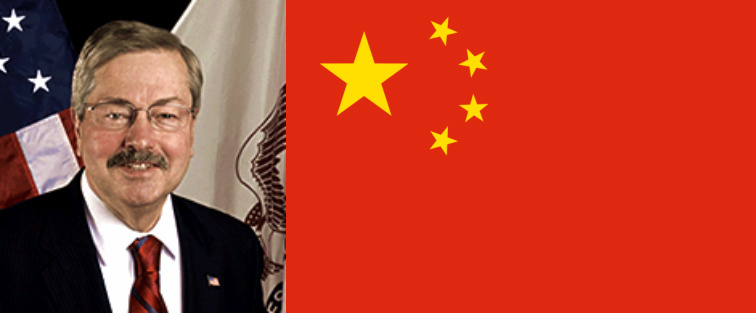
Regent Larry McKibben was up next to thank Leath for his leadership and contribution to positive trends at ISU, adding that he hopes for more “great things” during the next five years. The chair of the Regents’ audit committee has never viewed what he called a “ding on an airplane wing” as grounds to change his opinion of Leath. His remarks before the regents went into closed session signaled that the overseers would neither fire nor severely sanction the ISU president.

After board members evaluated Leath’s performance, Board President Bruce Rastetter asserted that Leath had “eliminate[d] any questions about the personal benefit that he may have received by using the university aircraft,” having reimbursed the ISU Foundation for costs associated with some flights. He went on to say,

“Clearly, President Leath’s acknowledgment that he takes full responsibility for the issues identified in the audit and that he should have been more transparent about the use of the planes reassures this board, and I hope all Iowans, that the president deserves our continued trust and support,” Rastetter said. “Furthermore, the board believes the audit has put to rest any concerns about President Leath’s use of the aircraft.”

This Iowan is not reassured. The audit has big holes and failed to fully account for costs of Leath’s airplane habit.

Continue Reading...

Will Kim Reynolds become Iowa governor, or merely "acting governor"?

Lieutenant Governor Kim Reynolds told Iowa reporters this morning that she expects to become governor after Terry Branstad steps down and will appoint someone else as lieutenant governor. At the same press conference, Branstad said the Iowa Constitution and state law are “pretty clear” that the lieutenant governor becomes the governor after the governor resigns.

However, a close reading of Iowa Constitution Article IV, Section 17 leaves doubt about whether Reynolds will become governor. The text states that the “powers and duties” of the governor’s office “shall devolve upon the Lieutenant Governor” in the event of a vacancy. That language differs from the U.S. Constitution’s directive that “the Vice President shall become President” in the event of a vacancy and “shall nominate a Vice President” subsequently.

The four previous times Iowa governors left before the end of their terms, their successors were called governor but did not appoint new lieutenant governors. Reynolds will certainly exercise the powers of the governor, but under the state constitution, she may do so from her current position and remain unable to name a likely 2018 running mate as lieutenant governor.

Continue Reading...

Weekend open thread: Alarming ties between Trump and Russia edition

President-elect Donald Trump continues to assemble a cabinet full of people “who have key philosophical differences with the missions of the agencies they have been tapped to run.”

But arguably, the scariest news of the week was the political reaction to the Central Intelligence Agency assessment that it is “quite clear” Russia intervened in the U.S. elections with the goal of electing Trump.

Despite what one retired CIA officer described as a “blazing 10-alarm fire,” only four Republican senators have taken up the call for a bipartisan investigation of Russian interference in U.S. elections. For his part, Trump dismissed the CIA’s findings as “ridiculous,” while members of his transition team discredited the agency and leaked news that Trump will appoint a close ally of Russian President Vladimir Putin as secretary of state.

Continue Reading...

Bob Krause makes eight candidates for Iowa Democratic Party chair

Saying he is the “compromise candidate” best positioned to unify the Iowa Democratic Party and bring back blue-collar workers who swung to Donald Trump, Bob Krause e-mailed Iowa Democratic Party State Central Committee members late Friday night to announce his candidacy for state party chair.

Krause served in the Iowa House during the 1970s and in recent years has been an outspoken advocate for veterans as president of the Des Moines-based Veterans National Recovery Center. He sought the Democratic nomination for U.S. Senate in 2010 and 2016, finishing a distant second in the 2010 primary and fourth in 2016. Krause also explored a candidacy for governor in 2014 before leaving that race to endorse Jack Hatch.

I enclose below Krause’s message to Iowa Democratic leaders, who will hear from contenders on December 17 and vote for a new chair in January. Krause’s comments about the shortcomings of the Vote Builder database echo frustrations I’ve heard from quite a few down-ballot candidates and activists.

The others seeking to lead the state party, in order of their official announcements, are Kim Weaver, Sandy Dockendorff, Blair Lawton, Derek Eadon, Kurt Meyer, Julie Stauch, and Mike Gronstal. Click here for background on each. Bleeding Heartland has published commentaries by Stauch, Meyer, and Eadon, and I hope to run guest posts by the other candidates soon.

UPDATE: Krause also posted an announcement video on Facebook late on December 9.

Continue Reading...

ISU stonewalls, Leath plays the victim ahead of airplane use audit

Any day now, the internal auditor for the Iowa Board of Regents may complete his review of all plane trips on Iowa State University’s Flight Service since President Steven Leath came to ISU nearly five years ago.

Although Leath has promised to be “as open and transparent as possible” regarding his airplane use, ISU officials have steadfastly refused to clarify certain details about specific flights or university practices. Reporters probing facts not found on the “frequently asked questions” page keep getting the same runaround: ISU cannot comment, so as not to “jeopardize the integrity of the audit.”

ISU has also slow-walked some information requests related to the airplane controversy. Ten days since the university’s Public Records Office received my payment for one set of records, I’m still waiting for documents that were supposed to take only 3.5 hours to compile. The delay will prevent me from reporting on a potentially newsworthy angle before Todd Stewart sends his findings to the Board of Regents. Depending on when the material arrives, how long it takes to review it, and whether ISU answers follow-up questions promptly, I may not be able to publish before board members convene a special meeting to discuss the internal audit.

Leath complained last week about supposedly “vicious personal attacks” in media coverage of the airplane controversy. It’s not the first time he has claimed to endure “unfair” treatment by writers supposedly engaged in “distortions” and asking “inappropriate” questions.

In reality, “planegate” reporting has addressed Leath’s conduct and use of university resources, not his personal qualities.

Continue Reading...

Branstad going to China: Let the IA-Gov speculation commence

Jennifer Jacobs reported for Bloomberg last night that Governor Terry Branstad has accepted President-elect Donald Trump’s offer to become the next U.S. ambassador to China. Jacobs cited three unnamed sources, and an unnamed member of Trump’s transition team confirmed the news to the Washington Post this morning. I expect Trump to make the official announcement during his Thursday “thank you” rally in downtown Des Moines. (By the way, many central Iowa Democrats as well as Republicans received a robocall invitation to that rally, featuring Donald Trump, Jr.)

I wish Branstad well in his new adventure. He’ll have a lot to contend with: the president-elect’s recent overture to Taiwan was destabilizing; Trump’s threats to punish China for supposedly unfair trade and currency practices could spark a trade war; and horrific air pollution has made Beijing “almost uninhabitable.”

Kim Reynolds is the fifth woman to hold the office of Iowa lieutenant governor and will soon become the first woman governor in our state’s history. Branstad has been saying for years he wanted her to succeed him, and many Democrats expected him to step down before the end of his sixth term, to give her the advantages of incumbency going into the 2018 campaign. The domain KimReynoldsforgovernor.com has been registered since 2012, Mark Langgin pointed out today.

Reynolds will select the next lieutenant governor, and she may use that power to neutralize a potential rival, such as Iowa Secretary of Agriculture Bill Northey. (Why Northey would agree to that arrangement is a mystery to me.) I don’t expect Reynolds to clear the field for the 2018 Republican primary, but as governor, she will be able to raise more money and possibly deter some ambitious people. Cedar Rapids Mayor Ron Corbett has been laying the groundwork for a gubernatorial campaign for years. I don’t know how many major donors would back him now that Reynolds will be the incumbent, though. Running a credible campaign against her would require millions of dollars.

Many Democrats were delighted to read this morning that Representative Steve King told The Hill’s Scott Wong he is thinking about running for governor himself. I suspect this will play out like the early months of 2013, when King attracted a lot of attention by saying he might run for U.S. Senate. I never believed then and don’t believe now that King will run for higher office. However, two recent developments may have changed the equation for him.

First, Iowa’s sharp turn to the right this November may have convinced King he has a chance to win a statewide election, which didn’t appear to be the case a few years ago. Second, he and Branstad are not on good terms. King was a leading surrogate for presidential candidate Ted Cruz, whom Branstad attacked shortly before the Iowa caucuses. Reynolds and many other prominent Iowa Republicans endorsed King before this year’s GOP primary in the fourth Congressional district, but Branstad didn’t join them. Adding to the insult, soon after King defeated State Senator Rick Bertrand in that primary, the governor’s son Eric Branstad hired some of Bertrand’s former staffer to work on Trump’s campaign.

Any thoughts about Branstad’s prospects in China or the 2018 campaign are welcome in this thread.

UPDATE: The Des Moines rumor mill sees State Representative Peter Cownie as a likely lieutenant governor choice for Reynolds. Further updates are after the jump.

Continue Reading...

Energy centers got their money from the Iowa Utilities Board this year

During the first week of December 2015, an unexpected political scandal went out with a whimper as the Iowa Energy Center and the Center for Global and Regional Environmental Research finally received the remittances the Iowa Utilities Board had collected on their behalf from gas and electric utility companies. For many years, the board had transferred those funds without incident, as stipulated by state law. But in her first year as Iowa Utilities Board chair, Geri Huser took the “unusual, perhaps illegal, step of withholding funding […].”

Huser’s power play was aimed at the Iowa Energy Center affiliated with Iowa State University. (Its leaders denied her unsupported claim that they had refused to provide sufficient financial information to the board.) Because funds for both centers are calculated and released at the same time, the unprecedented board action also delayed resources for the Center for Global and Regional Environmental Research at the University of Iowa. Huser backed down a week after Ryan Foley of the Associated Press exposed the controversy to a wider audience.

Having heard nothing about the energy centers’ funding lately, I reached out this week to Iowa Utilities Board communications director Don Tormey. He sent documents showing that in accordance with the usual formula for splitting the remittances, the board disbursed $4,123,150.49 to the Iowa Energy Center and $727,614.79 to the Center for Global and Regional Environmental Research. The board sent warrants (paper checks) using regular mail, as had happened in 2015 for reasons I still don’t understand. Before last year, the board typically transmitted those funds via wire transfer.

Communications staff at the state universities confirmed that the energy centers received checks in the mail last month for $4,123,150.49 and $727,614.79, respectively. Those totals comprise the remittances from utility companies but not the interest accrued on those funds. John McCarroll of Iowa State University noted, “In the letter with the check, IUB said they will be forward[ing] the interest payment in June 2017 as they close out the fiscal year. This is how they handled the interest in 2016.”

The board has faced criticism on other fronts this year after approving the Dakota Access (Bakken) pipeline and allowing its construction to commence this summer, when Dakota Access did not have all applicable federal permits. Pending lawsuits are challenging the board’s authority to use eminent domain for the pipeline, saying a 2006 Iowa law does not allow a company that isn’t a utility to condemn farmland. It would have been foolish for Huser to stir up more trouble by flexing her muscles at the energy centers’ expense again. Also possibly relevant: former Iowa Energy Center executive director Mark Petri, with whom Huser had tangled, left Ames this summer to take a new job as director of the Critical Infrastructure Resilience Institute at the University of Illinois at Urbana-Champaign.

Iowa results certified: Clinton carried early vote, Trump crushed election day

The scale of Iowa’s unexpectedly large swing toward Donald Trump has been clear for nearly a month. But until today, we didn’t know how much early and election-day voters contributed to transforming Iowa from a bellwether state to one that voted much more Republican than the rest of the country, from a state the Democratic presidential nominee carried by nearly 6 points in 2012 to a state the Republican nominee won by more than 9 points four years later.

According to numbers released following the official state canvass, Hillary Clinton went into election day with a cushion less than half as large as Barack Obama’s early vote lead in 2012. Meanwhile, Trump’s advantage among election-day voters was more than four times as large as Mitt Romney’s.

Continue Reading...

Mike Gronstal makes seven candidates for Iowa Democratic Party chair

At least seven people hope to lead the Iowa Democratic Party forward after two brutal election cycles. Outgoing Iowa Senate Majority Leader Mike Gronstal has made no public statement but e-mailed State Central Committee members on December 1, William Petroski reported first for the Des Moines Register. Gronstal lost his bid for a ninth term last month after leading his caucus in the chamber for two decades.

Gronstal instantly becomes the front-runner, but he doesn’t have a lock on the job yet.

Continue Reading...

Chuck Grassley's ready to run interference for Jeff Sessions

After meeting with his longtime colleague Jeff Sessions on November 29, Senator Chuck Grassley signaled that he will not only support President-elect Donald Trump’s choice for attorney general, but also limit Democrats’ ability to expose the nominee’s record during confirmation hearings.

In a statement enclosed in full below, the Judiciary Committee chair warned he will not allow a repeat of the 2001 debate over President George W. Bush’s nominee for the same job, John Ashcroft. In Grassley’s view, those hearings “turned into a reckless campaign that snowballed into an avalanche of innuendo, rumor and spin.”

Citing Senate consideration of the last four attorneys general as precedent, Grassley promised a “fair and thorough vetting process” for Sessions: hearings lasting one to two days, without a large number of outside witnesses. He expressed the hope that Democrats “will resist what some liberal interest groups are clearly hoping for – an attack on [Sessions’s] character.”

Grassley “intends to hold the hearing before the President-elect is sworn in.” His statement explained, “it is customary to hold a hearing for the Attorney General prior to the Inauguration as was the case with both Attorney General Eric Holder and Attorney General John Ashcroft.”

In other words, after presiding over a committee that slow-walked numerous federal judicial nominees, after obstructing a Supreme Court nominee for an unprecedented length of time, Grassley is in a hurry to get Sessions confirmed. He doesn’t want to get bogged down examining the nominee’s extreme views on immigration policy or criticism of the Americans with Disabilities Act or the racially motivated conduct that kept Sessions out of a federal judgeship in the 1980s.

Still no word from Grassley on any of Trump’s abnormal behavior or disregard for the Constitution. Some watchdog.

Continue Reading...