desmoinesdem

Posts 123 Comments 0

Weekend open thread: Iowans remember Don Avenson

A an Iowa political legend passed away suddenly this week. Former House Speaker Don Avenson had a heart attack on May 19 while on the way home from vacation. He told Iowa Public Television in 1984, “A speaker of the House, if he wants to, can change the course of the state, can change the face of a great deal of legislation, a great deal of law.” As speaker from 1983 through 1990, “nearly twice as long as any other Speaker in Iowa history,” Avenson helped craft many laws that still affect state government and education. He left the House to run for governor in 1990, winning the Democratic nomination but losing to Terry Branstad. For more than 25 years, he remained an influential force at the statehouse, representing many clients through the Avenson, Oakley & Cope lobbying firm.

Dozens of people who have been involved in Iowa legislative politics reflected on Avenson’s legacy as news spread of his death. I compiled some of those recollections after the jump.

The Vilsack family suffered a devastating loss this week as Ella Vilsack, daughter of Jess and Kate Vilsack and granddaughter of Tom and Christie Vilsack, died at the age of six of complications related to influenza. Condolences to all who are bereaved. This kind of tragedy is every parent’s worst nightmare.

Speaking of untimely passings, Nina Martin of ProPublica and Renee Montagne of NPR published a terrifying article this month about maternal mortality, which “is rising in the U.S. as it declines elsewhere” in the developed world. Because “the American medical system has focused more on fetal and infant safety and survival than on the mother’s health and well-being,” new mothers are rarely monitored closely in hospitals, and doctors and nurses often miss symptoms of potentially life-threatening complications. The central figure in this article is Lauren Bloomstein, a neonatal intensive care nurse who died of preeclampsia the day after giving birth. It’s important to be aware of the signs; I know healthy women who had close calls with this condition during pregnancy or shortly after delivery.

The scenarios Martin and Montagne describe are among the reasons peer-reviewed research has shown the “risk of death associated with childbirth is approximately 14 times higher than that with abortion.” But in their infinite wisdom, Branstad and Iowa’s Republican lawmakers enacted new requirements this year for doctors to warn women seeking to terminate pregnancies about “possible detrimental physical and psychological effects of abortion.” Naturally, the state does not require obstetricians to give patients information about the risks of continuing a pregnancy.

This is an open thread: all topics welcome.

Continue Reading...

Now we can see which Iowans will suffer most from Planned Parenthood and victims assistance cuts

It’s not abstract anymore.

We knew eliminating state funding for Planned Parenthood’s family planning services would cause thousands to lose access to basic health care.

We knew deep cuts to state funding for victims assistance would affect thousands of sexual assault and domestic abuse survivors.

Now we are starting to see which Iowans will be the first to suffer from Republican choices on how to spend the public’s money.

Continue Reading...

Czech newspaper: Steve King's name submitted for U.S. ambassador UPDATED: Different Steve King

UPDATE: Jennifer Jacobs of Bloomberg reported that the person recommended for the ambassadorship is a “Different Steve King, Trump aides tell me.” A source told Radio Iowa’s O.Kay Henderson that the story may be about a Wisconsin Republican National Committeeman named Steve King. Iowa’s representative in Congress told Sahil Kapur of Bloomberg he’s not up for a State Department position.

SECOND UPDATE: My husband contacted one of the Hospodarske Noviny reporters to let him know their story was about the wrong Steve King. The journalist e-mailed back to say that they had their doubts, but their sources spoke of a Congressman Steve King. King’s office did not respond to their request for comment.

THIRD UPDATE: Hospodarsky Noviny has posted a corrected story.

Original post follows after the jump:

Continue Reading...

Iowa Democrats face incredibly difficult path back to legislative majorities (part 1)

Many Iowa Democrats expect to have the wind at their backs for the 2018 elections, due to surging progressive activism, an unpopular Republican president, and backlash against GOP lawmakers who used their power this year to take rights away from hundreds of thousands of workers, lower wages for tens of thousands more, and undermine protections for those who suffer workplace injuries.

It’s too early to predict the political climate next fall, but Democrats need to hope for favorable external conditions as well as strong recruits and well-run campaigns. New calculations of last year’s presidential election results by state legislative district point to a very steep climb back to 51 seats in the Iowa House and 26 seats in the Senate. This post will survey the terrain in the upper chamber.

Continue Reading...

Michael Kiernan running for open Des Moines city council seat

Former Des Moines City Council member Michael Kiernan announced yesterday that he will run for the open seat in Ward 3 this year, focusing on an “agenda of improving public safety, fixing potholes and continuing progress.” He held the at-large city council seat from 2004 to 2010 and served as Iowa Democratic Party state chair from January 2009 to June 2010. You can find his campaign on Facebook and on Twitter @mjkiernan.

Josh Mandelbaum has been campaigning in Ward 3 for the last two months. His strong challenge drove 24-year incumbent Christine Hensley to retire rather than seek re-election. Now that the odds of a Democrat winning this seat have increased, Kiernan has decided to give it a shot. In a thinly-veiled swipe at Mandelbaum, Kiernan posted on Facebook yesterday, “I’ve been hearing a lot about crime in our city lately. I keep expecting to hear people who say they want to serve our community talk about this issue. Instead, all I’m hearing about is political endorsements and campaign war chests.” He echoed the talking point in his news release and on Twitter: “Lot of talk about politics, political endorsements and political cash…no talk of public safety. That’s why I am running.”

If Kiernan had attended Mandelbaum’s first event as a candidate, he would have heard his opponent talk about many substantive issues including “the importance of public health and public safety” and “providing resources to our first responders, police and fire.” Granted, Mandelbaum’s campaign did announce last month that he had raised more than $110,000 in three weeks, “recruited over 150 volunteers to help door-knock and hold house parties, and will soon have an elected official and labor leader endorsement list.” Taking on an entrenched incumbent requires a lot of groundwork, including early fundraising and lining up prominent supporters. But contrary to the impression Kiernan is trying to create, endorsements and cash have not been the focus of Mandelbaum’s message to Des Moines residents. You can read or listen to his first speech as a candidate here.

I enclose below a map of the ward, covering west-side and south-side neighborhoods, as well as Kiernan’s news release, more background on his life and career, and the list of elected officials backing Mandelbaum. (His campaign hasn’t rolled out the labor endorsements yet.)

Mandelbaum has not publicly commented on Kiernan entering the race. I anticipate his case to Democratic voters will be similar to a statement his campaign released after Hensley disclosed her retirement plans: “When this race looked impossible to win, Josh stepped up to run because the values we share as a community were being threatened everyday.” I’ve closely followed Mandelbaum’s work over the years and will encourage voters in the ward to support him, because of his skills and commitment to progressive policies.

Local elections are non-partisan, but I expect some Republican backed by corporate interests to join the field in Ward 3 before long. I welcome tips on other possible candidates.

UPDATE: Added below new comments from Kiernan, who answered some questions by phone on May 18.

Continue Reading...

Iowa wildflower Wednesday: Wild chervil

This week’s featured plant is so easily overlooked that I failed to notice its flowers in my own yard for more than ten years. But once I learned to recognize wild chervil (Chaerophyllum procumbens), it seemed to pop up everywhere.

This “somewhat weedy” member of the carrot or parsley family is native to much of North America. Wild chervil is not spectacular like its relative Golden Alexanders, or even as eye-catching as Sweet Cicely, both of which bloom around the same time in the spring.

I took all of the enclosed pictures in Windsor Heights within the past few weeks.

Continue Reading...

Special election coming on June 27 in Iowa House district 22

Voters in Iowa House district 22 will choose a successor to the late State Representative Greg Forristall on Tuesday, June 27, in accordance with a proclamation Governor Terry Branstad issued today. The district covers a small portion of Council Bluffs and most of Pottawattamie County outside that city (see map above).

Special district conventions, tentatively scheduled for May 30, will determine the Democratic and Republican candidates for House district 22. Forristall’s widow and longtime clerk, Carol Forristall, will seek the GOP nomination, but others are expected to compete at the Republican district convention as well. (The late State Senator Pat Ward’s widower did not win the 2012 nominating convention in Senate district 2012.) The conservative blog Iowa Statesman reported that some locals recruited Naomi Corrie to run for the seat. Corrie was heavily involved as a volunteer for former Iowa Secretary of State Matt Schultz and new State Senator Dan Dawson, and has “been a Council Bluffs organizer for Senator [Joni] Ernst and Lt. Gov [Kim] Reynolds.” However, Corrie ruled herself out of this race today.

The GOP will be heavily favored to hold House district 22, where more than twice as many voters are registered Republicans as Democrats. However, an activist reported on Facebook this evening that as many as a dozen people have already contacted Pottawattamie County Democratic Chair Linda Nelson to express interest in the race. Anything can happen in a low-turnout special election.

Forristall had a Democratic opponent for his first election in 2006 but did not face a Democratic challenger in his 2008, 2010, 2012, 2014, or 2016 re-election bids.

Grassley's excuse-making for Trump is beyond embarrassing

Yesterday’s revelation that President Donald Trump disclosed “highly classified information” to senior Russian officials in the Oval Office last week, jeopardizing “a critical source of intelligence on the Islamic State,” sent the White House into crisis mode. Reporters “could hear yelling emanating from the presidential residence” as senior officials tried to contain the fallout. Amy Zegart estimated the possible damage to U.S. intelligence-gathering at “about a billion” on a scale of 1 to 10.

After sending his national security adviser out yesterday to make a “non-denial denial,” Trump asserted this morning he had “the absolute right” to share pertinent information in an “openly scheduled” meeting with Russia, claiming he did so for “Humanitarian reasons, plus I want Russia to greatly step up their fight against ISIS & terrorism.” By the way, that meeting was closed to American journalists, as Trump gave exclusive access to a photographer for the Russian state-run news agency ITAR-TASS.

All of the above would be disturbing, even if Trump hadn’t just fired FBI Director James Comey and improperly asked Comey whether he was under investigation.

The reaction from self-styled watchdog Senator Chuck Grassley was a classic example of normalizing some of the most abnormal behavior we’ve seen yet from Trump–which is saying something.

Continue Reading...

Interest in running for office surging among Iowa women

Iowa has historically not been a friendly environment for female candidates. The number of women in our state legislature is stagnant and below the national average. But Iowa is no exception to a trend observed across the country: since Donald Trump was elected president, record numbers of women are considering running for office and signing up for candidate training programs.

Participants in the latest set of Ready to Run® workshops at the the Carrie Chapman Catt Center for Women and Politics at Iowa State University more than doubled the previous record in the program’s ten-year history.

Bleeding Heartland will soon begin publishing an occasional series of commentaries by Iowa women who recently decided to run for state or local offices, or who have become more deeply involved in political or issue advocacy campaigns. I reached out to Dr. Dianne Bystrom, director of the Carrie Chapman Catt Center, for more details on this year’s Ready to Run® workshops and participants.

Continue Reading...

Where things stand with Iowa's new anti-abortion law

Ten days after Governor Terry Branstad signed sweeping limits on access to abortions, part of the new law is still on hold while courts consider a challenge filed by Planned Parenthood of the Heartland. Planned Parenthood maintains that a 72-hour waiting period for abortions at any stage of pregnancy would violate women’s due process and equal protection guarantees. In addition to creating an “undue burden” for women with “onerous and medically unnecessary restrictions that the Iowa Legislature does not impose upon any other medical procedure for which people may consent,” the law imposes new requirements for physicians, which Planned Parenthood is challenging as a violation of the doctors’ due process rights.

That aspect of the lawsuit informed the Iowa Supreme Court’s May 9 order continuing a temporary injunction. The high court found, “The State has failed to rebut the assertion by the petitioners that the materials that serve as the foundation information required to be provided to women seeking an abortion have not yet been developed by the Department of Public Health pursuant to the law.” The order remanded the case back to Polk County District Court, where within 30 days, Judge Jeffrey Farrell will hold a final hearing on Planned Parenthood’s request for an injunction on the new law. Farrell had denied the first request for a temporary injunction, saying plaintiffs had not shown new burdens on women seeking abortions in Iowa would constitute an “undue burden.”

For those who want a preview of the legal points Farrell will consider when he decides whether to block enforcement of Iowa’s law, I enclose below four documents:

Continue Reading...

24 things that won't happen under Iowa's new medical cannabis law

In one of his final official acts before he departs for China, Governor Terry Branstad signed into law the last bill approved during the 2017 legislative session.

House File 524 has been portrayed as a major expansion of medical cannabis in Iowa. Whereas the 2014 law permitted the use of only one cannabis derivative (CBD oil) to treat certain seizure disorders, the new law allows the same product (cannabidiol with no more than 3 percent THC) to be used for nine medical conditions: cancer, multiple sclerosis, epilepsy, AIDS or HIV, Crohn’s disease, amyotrophic lateral sclerosis (Lou Gehrig’s disease), Parkinson’s disease, untreatable pain, or “any terminal illness with a life expectancy under one year associated with severe or chronic pain, nausea or severe vomiting, cachexia or severe wasting.” Threase Harms, who lobbied for the bill, described it as a “great next step in the process of making medical cannabis available for many folks here in Iowa who need access to it as a medical treatment.”

A more comprehensive bill, which had gained broad bipartisan support in the Iowa Senate, had the potential to improve the quality of life for thousands.

I see little evidence anything “great” will come out of legislation finalized during an all-nighter by House Republican lawmakers who refused to take up that Senate bill.

As Iowa implements the new law, the following outcomes are predictable.

Continue Reading...

Bill Northey, Sam Clovis lined up for senior USDA posts

Two weeks after Iowa Secretary of Agriculture Bill Northey publicly expressed interest in a job with the U.S. Department of Agriculture, he appears to have an offer on the table. Farm Journal Radio reported on May 12 that Northey will become undersecretary for farm production and conservation, a position that “includes overseeing the Farm Service Agency, Risk Management Agency and the Natural Resources Conservation Service.” The source was Jim Wiesemeyer, senior vice president of policy and trade issues for Informa Economics Inc. WHO-TV’s Dave Price said his sources confirm Northey is the pick for that job. UPDATE: Agri-Pulse was first to report this news Friday morning.

Depending on when Northey resigns, either Governor Terry Branstad or soon-to-be-Governor Kim Reynolds will appoint someone to serve as secretary of agriculture until after the 2018 election. State Representative Pat Grassley has long been rumored to be interested in Northey’s job. That statewide position would be a nice stepping stone to a campaign for his grandfather Chuck Grassley’s U.S. Senate seat in 2022.

Continue Reading...

Branstad "saved" ISU's Leopold Center for Sustainable Agriculture in name only

Governor Terry Branstad used his item veto power today to “preserve the existence” of Iowa State University’s Leopold Center for Sustainable Agriculture, but he allowed provisions redirecting almost all of its funding to take effect. In his veto message on Senate File 510, the agriculture and natural resources budget, Branstad wrote,

I am unable to approve the items designated as Section 34, and Subsection 2 of Section 35, in their entirety. The veto of these particularly specified items will preserve the existence of the Leopold Center for Sustainable Agriculture while also maintaining the sections transferring funding to Iowa State University’s College of Agriculture and Life Sciences to continue valuable research into environmental and water quality issues.

Those sections of the bill repeal language establishing the Leopold Center from Iowa Code.

Under Section 30, which Branstad didn’t veto, the center will lose almost its entire operating budget, since revenue from a fertilizer tax (about $1.5 million annually) will be redirected to ISU’s Nutrient Research Center. The Leopold Center’s work was more broadly focused than that of the Nutrient Research Center, and less influenced by agribusiness groups. The separate Republican education budget zeroed out what had been a $400,000 appropriation to the Leopold Center from the Board of Regents.

Although the Leopold Center receives some income from an endowment managed by the ISU Foundation, Director Mark Rasmussen has said those funds are “wholly inadequate to keep the center functioning at any level of reasonableness.” Branstad told reporters last week he was concerned bequests to the Leopold Center “could be put in jeopardy if it were eliminated.”

The donors Branstad had in mind might as well revise their wills now. There’s no point leaving money to an entity that will be unable to support sustainable agricultural research in the future.

It’s a disappointing choice by the man who helped create the Leopold Center when he signed the landmark Groundwater Protection Act in 1986. Just as Republican lawmakers ignored the many Iowans who attested to the value of the center’s work at a public hearing or through written comments, Branstad was unmoved by the many calls and messages his office received in support of keeping the center running.

I am seeking comment from the governor and will update this post as needed.

UPDATE: Added below absurd spin from ISU.

Continue Reading...

Throwback Thursday: When Greg Forristall fought against putting commerce ahead of education

Republican State Representative Greg Forristall passed away yesterday at the age of 67. First elected to the Iowa House in 2006, he was most recently vice chair of the Education Committee and also served on the Human Resources, Labor, and Ways and Means committees. He had been battling cancer for some time and was too ill to participate in the last few weeks of this year’s legislative session.

In a written statement, Republican Party of Iowa chair Jeff Kaufmann described Forristall as a “friend to conservatives across our state” and a “happy warrior” in the Ronald Reagan tradition. House Speaker Linda Upmeyer said Forristall “was a dedicated public servant to the people he represented and an advocate for the arts and education, two issues that he was incredibly passionate for.”

I never met Forristall, but one episode stands out for me as I think about his legislative career. The first two years after Republicans regained their Iowa House majority, Forristall chaired the Education Committee. House leaders reassigned him to lead the Labor Committee in 2013, a position he retained through the 2016 legislative session.

Why did then House Speaker Kraig Paulsen and Majority Leader Upmeyer take the Education Committee away from Forristall, knowing how much he cared about that issue? I never saw any public confirmation, but the Iowa political rumor mill pointed to Forristall’s stance on one controversial bill.

Continue Reading...

IA-Gov: Ron Corbett to decide soon, previews case on taxes and education

Outgoing Cedar Rapids Mayor Ron Corbett will decide “in the next 45 days or so” whether to seek the Republican nomination for governor, he told WHO-TV’s Dave Price on May 8. After months of laying the groundwork for a possible gubernatorial campaign, Corbett launched a tour this week promoting his new political memoir, Beyond Promises. He will use those speaking engagements to see “if people can feel a connection to Ron Corbett.”

Asked how he could compete financially against Kim Reynolds, who will be the incumbent governor, Corbett responded,

Yeah, people have asked me that, “You know, you’re going to have a big uphill battle ahead of you, a big challenge ahead of you.” But you know, what in life isn’t, you know, sometimes a big climb? And I’ve taken on big challenges. Again, when–and I talk about this in the book, when I take on an incumbent speaker of the House or an incumbent state representative, I don’t do it because I want to take on that particular person. I just have ideas that I want to talk about and get implemented.

Assuming Corbett does run for governor, tax and education policy will be central to his message, so let’s take a closer look at his ideas.

Continue Reading...

Iowa wildflower Wednesday: Ohio buckeye

I’ve rarely featured flowering trees for this series. I’m making an exception today for Ohio buckeye (Aesculus glabra), which is native to most of North America east of the Rocky Mountains. The tree is sometimes known as horse chestnut, buckeye, American buckeye, or stinking buckeye because its leaves give off “a strong fetid odor when crushed.”

The blossoms of Ohio buckeye are distinctive, and once you learn to recognize them, you’ll know where to come back in the fall to collect the round, smooth seeds.

Elizabeth Garst once told me that during one of her grandfather Roswell Garst‘s visits to the Soviet Union, his Russian host gave him a buckeye for good luck. He was surprised to learn some Americans follow the same tradition. According to the Lady Bird Johnson Wildflower Center’s website, “Pioneers carried a buckeye seed in their pockets to ward off rheumatism.” Wood from the tree was often used to carve children’s cradles or artificial limbs, “because it is light, easily worked, and resists splitting.”

I enclose below some pictures of buckeye trees now flowering in Clive and Windsor Heights.

Early spring wildflowers are mostly gone now, but if you venture into wooded areas during the coming week, you may find lots of Jack-in-the-pulpits, sweet William, sweet Cicely or aniseroot, false rue anemone, wild geranium, Missouri gooseberry, and Virginia waterleaf blooming. Buds are open on many May apples/umbrella plants and wild ginger too, but you have to bend down and look under the leaves to see them. Unfortunately, the invasive garlic mustard is also flowering and developing seed pods. If you see it when you are out and about, try to pull it up by the roots and throw it away in a garbage bag. (If you leave garlic mustard on the ground, the plants can take root start growing again.)

Continue Reading...

Grassley facing one of the most important decisions of his career

When President Donald Trump fired James Comey yesterday, not even halfway through the FBI director’s ten-year term, the Nixonian parallels were immediately obvious to almost everyone, except for Iowa’s senior Senator Chuck Grassley.

While others saw the White House citing “pretexts” in a “blatant effort to derail” the FBI’s investigation of the Trump campaign’s connections with Russia, Grassley issued a statement accepting every lame excuse from the administration.

“Over the course of the last several months, Director Comey’s decisions on controversial matters have prompted concern from across the political spectrum and from career law enforcement experts.

“The handling of the Clinton email investigation is a clear example of how Comey’s decisions have called into question the trust and political independence of the FBI. In my efforts to get answers, the FBI, under Comey’s leadership, has been slow or failed to provide information that Comey himself pledged to provide.

“The effectiveness of the FBI depends upon the public trust and confidence. Unfortunately, this has clearly been lost.

“The FBI Director serves at the pleasure of the president. Under these circumstances, President Trump accepted the recommendation of the Justice Department that the Director lacked the confidence needed to carry out his important duties.”

Within hours of Comey’s dismissal, multiple journalists confirmed that the president “had talked about the firing for over a week.” Attorney General Jeff Sessions and Deputy Attorney General Rod Rosenstein wrote up their recommendations “to give him rationale.” Sessions formally recused himself from the Russian investigation after failing to disclose his contacts with that country’s ambassador last year.

Grassley is among very few people to take Trump’s goodbye letter to Comey at face value, rather than as a smokescreen for a president who just “decisively crippled the F.B.I.’s ability to carry out an investigation of him and his associates.” CNN reported last night, “Federal prosecutors have issued grand jury subpoenas to associates of former National Security Advisor Michael Flynn seeking business records […].” This morning, the New York Times revealed that last week Comey “asked the Justice Department for a significant increase in money and personnel for the bureau’s investigation into Russia’s interference in the presidential election.”

Some other Republicans were not so gullible. More than 100 members of Congress, joined by some conservative commentators, are now calling for an independent commission on Russia. Senate Majority Leader Mitch McConnell wants no part of that, telling reporters this morning that a new investigation would “impede” current work on Russia’s involvement.

Grassley is uniquely positioned to demand an independent inquiry. As Senate Judiciary Committee chair, he controls the process for confirming Comey’s successor. He could use that power to delay any confirmation hearings on a new FBI director until a special prosecutor has been named to investigate ties between Trumpworld and Russia, just as he exercised his prerogative to deny President Barack Obama’s Supreme Court nominee any consideration during 2016.

Regrettably, Iowa’s longest-serving senator has signaled he will run interference for the White House. Asked this morning what he would say to those who have called the president’s action “Nixonian,” Grassley told the hosts of “Fox and Friends,” “My message is suck it up and move on.”

Grassley’s instinct to protect the president from came through during a May 8 Senate Judiciary subcommittee hearing as well. While questioning former Acting Attorney General Sally Yates and former Director of National Intelligence James R. Clapper Jr., he revealed remarkably little interest in the bombshell revelation that Trump kept Flynn on his staff for eighteen days after Yates warned White House officials the president’s national security advisor had been compromised by Russia. Instead, the self-styled champion of whistle-blowers pushed Yates and Clapper hard about government leaks and “unmasking” of Trump administration officials. (The Washington Post published a full transcript of that hearing). Longtime GOP strategist Rick Wilson commented, “Grassley is running the WH talking points. It’s painful to see him so diminished.”

Historians will record who stood up for the rule of law, and who gave cover to a president’s cover-up. It’s not too late for Grassley to do the right thing.

P.S.- At this writing, Iowa’s junior Senator Joni Ernst has released no statement on the biggest political news of the last 24 hours. Her Twitter and Facebook feeds are full of photos and mundane comments about her visits to businesses yesterday and this morning. Three months ago, Ernst made a big show of urging Trump to “pursue a principled and tough-minded Russia policy.”

UPDATE: The Des Moines Register’s Jason Noble received this statement from Ernst’s office by e-mail: “We didn’t send out a release. However, Senator Ernst has said the Director of the FBI serves at the pleasure of the President; therefore, this decision was up to President Trump to make.”

SECOND UPDATE: Grassley expressed concerns this morning about Andy McCabe serving as acting FBI director, given his wife’s connections to Democrats.

THIRD UPDATE: Added below Grassley’s stated reasons for opposing a special prosecutor on Russia’s attempts to influence our elections and connections to Trump associates.

Continue Reading...

One last chance to save the Leopold Center for Sustainable Agriculture

Republicans in the Iowa House and Senate approved the death warrant for the Leopold Center for Sustainable Agriculture at Iowa State University only a week after news of the planned ambush became public. Three weeks later, Governor Terry Branstad still has not signed the agriculture budget bill, which eliminates both major funding sources for the world-renowned center.

Under Iowa law, the governor can item-veto provisions in appropriations bills. Branstad told reporters on May 5, “We have heard from a lot of people that are concerned about the Leopold Center […] And that is one of the items that we’ll be giving close scrutiny to.”

Those who want to save the center can send a message through the governor’s website or call Branstad’s office at (515) 281-5211–the sooner the better. After the jump I’ve posted a few talking points that may be helpful.

Continue Reading...

Early clues about the Kim Reynolds leadership style are not encouraging

Lieutenant Governor Kim Reynolds will likely begin performing the duties of our state’s highest office very soon, following Governor Terry Branstad’s expected confirmation as U.S. ambassador to China. Speaking to journalists, some Republicans who have worked with Reynolds have enthused about her willingness to study the issues and be engaged in policy-making as part of her long preparation for the job.

Unfortunately, the way Reynolds has handled the controversy surrounding her authority to appoint a new lieutenant governor has revealed a willful disdain for research and opposing views.

Now, she admits she may have trouble working with Attorney General Tom Miller, whom she views as “my legal counsel” interfering with “my plan.”

If recent events reflect how Reynolds will approach other complicated and contentious issues, Iowans have reason to worry.

Continue Reading...

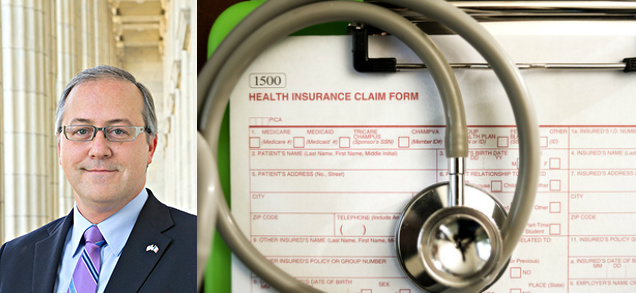
His biggest lie yet? David Young says GOP bill "strengthens" Medicaid

Representative David Young (IA-03) is denying that the American Health Care Act “will kick millions of people off of Medicaid,” telling constituents the bill “Modernizes and strengthens Medicaid so the state can better serve our Iowa neighbors and patients who are most in need.”

Of all the misleading things Young has said to justify his late decision to support an atrocious bill, this one may be the most blatant lie.

Continue Reading...

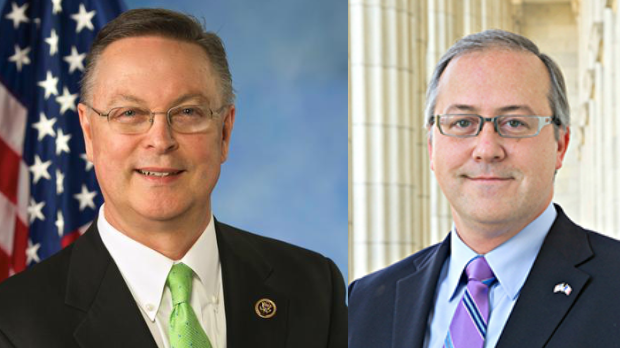
Rod Blum, David Young lie to cover for reversal on health care bill

All three Iowa Republicans helped the American Health Care Act clear the U.S. House on May 4 with only one vote to spare. Representative Steve King (IA-04) has long called for repealing the 2010 health care reform law “root and branch” and came around to supporting the GOP replacement proposal in March. So nothing about his vote was surprising, aside from his awkward description of how former Representative Michele Bachmann’s “finger joined mine today to push my vote button to dismantle” Obamacare.

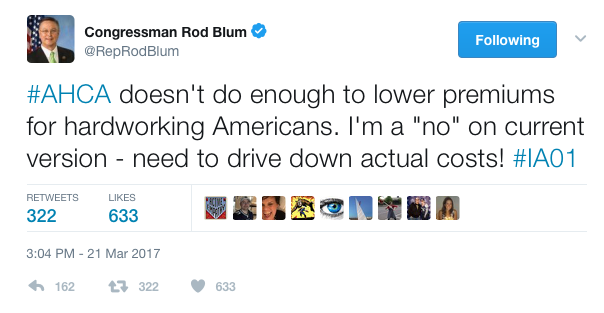
Unlike King, Representatives Rod Blum (IA-01) and David Young (IA-03) made a big show of opposing the AHCA in March. Blum pledged to insist on lower costs for consumers and helping “people who need the help.” Young repeatedly promised to protect people with pre-existing conditions while making sure the bill wouldn’t bring back caps on health benefits.

Feigning concern about the legislative process, Blum said in March, “I believe Congress should slow down and discuss in an open and transparent manner” how to address the “unsustainably high cost of healthcare in America.” Similarly, Young warned, “The ACA [Affordable Care Act] was rushed through Congress and to President Obama’s desk which resulted in a failed law that does not work for everyone [….] It is a fundamental principle that repeal, reforms and fixes to healthcare are done in the right way, for the right reasons, and in the right amount of time it takes to ensure we avoid the mistakes of the past. We need to be thoughtful and deliberate and get this right […].”

Over the past week, Blum studiously avoided comment as GOP leaders sought ways to give members cover for caving. Young’s staff told hundreds of callers he was still against the bill, even as late as Wednesday morning. The same day, he signed on as co-sponsor of an amendment that “comes nowhere close to meeting Republican commitments to people with pre-existing conditions.”

Self-styled deficit hawk Blum and “affordable for every patient” Young proceeded to vote for the bill without waiting for a Congressional Budget Office score to tell them “how many people it covers or how much it would cost.” It wasn’t the first time Young reversed his position on a matter of principle to please his party leaders.

In their comments on the House vote, Young and Blum tried to take credit for imaginary improvements in the AHCA. Their claims can’t withstand scrutiny.

Continue Reading...

Read Planned Parenthood's lawsuit against Iowa's new anti-abortion law

Iowa’s proposed 72-hour waiting period for all abortions represents an “unwarranted intrusion into women’s personal privacy and autonomy” that “will threaten women’s health” and create “an undue burden” with “an improper purpose,” according to a lawsuit Planned Parenthood of the Heartland filed yesterday in Polk County.

Governor Terry Branstad plans to sign Senate File 471, which would be one of the country’s most restrictive anti-abortion laws, first thing in the morning May 5. Originally conceived as a ban on most abortions after 20 weeks of pregnancy, the bill became much broader when Iowa House Republicans added the no-exceptions 72-hour waiting period, new ultrasound rules and a requirement that doctors inform women about other options and “indicators, contra-indicators, and risk factors including any physical, psychological, or situational factors related to the abortion.”

Continue Reading...

Iowa wildflower Wednesday: Littleleaf buttercup (Kidney-leaf buttercup)

Longtime followers of this series know I have a soft spot for wildflowers that might not be particularly “showy” but are tough as nails, thriving in some inhospitable habitats.

Littleleaf buttercup (Ranunculus abortivus) falls into that category. Native to almost all of the U.S. and Canada, this “somewhat weedy” plant can grow in “open woodlands, woodland borders, areas along woodland paths, degraded meadows, banks of rivers and ditches, pastures and abandoned fields, edges of yards, vacant lots, grassy areas along railroads and roads, and waste areas.”

Also known as littleleaf crowfoot, small-flowered buttercup, or kidney-leaf buttercup, these plants are easily overlooked among more striking spring bloomers. The flowers are small, and the foliage often blends in with surrounding plants.

Except where otherwise noted, I took all of the enclosed pictures near our home in Windsor Heights.

Continue Reading...

Young and Loebsack yes, Blum and King no on keeping the government running

A federal government shutdown before October appears unlikely now that the U.S. House has approved a $1.1 trillion deal to fund the government through the current fiscal year. The roll call for the May 3 vote shows that Iowa’s Representatives David Young (IA-03) and Dave Loebsack (IA-02) were among the 131 Republicans and 178 Democrats to support the funding measure. Representatives Rod Blum (IA-01) and Steve King (IA-04) voted against it. Cristina Marcos reported for The Hill,

Democrats claimed victory over what the spending bill lacked: funding for the U.S.-Mexico border wall promised by President Trump, restrictions on federal grants for so-called “sanctuary cities” that shield immigrants from deportation and steep cuts to domestic programs proposed by the White House. […]

The legislation also includes an extension of health benefits for retired coal miners and $1.1 billion in disaster assistance. Funding for Planned Parenthood remains untouched.

Republicans, unable to otherwise advance many conservative policy priorities in the bill, touted the $15 billion increase for defense spending. That’s approximately half of the $30 billion in supplemental military spending requested by the Trump administration earlier this year.

It’s still a break from the Obama era, when Democrats insisted that any hike in defense spending had to be matched by an increase in non-defense programs.

Assuming the U.S. Senate passes the spending bill tomorrow, President Donald Trump can sign it before current funding expires on May 5. Trump seems to be itching for a government shutdown, but not just yet.

The other big news from the House is that Republican leaders now believe they have the votes to pass a health care reform bill on May 4. Young is among the high-profile flip-floppers on the American Health Care Act. In March, he opposed the bill, saying health care fixes must be “done in the right way, for the right reasons, and in the right amount of time it takes to ensure we avoid the mistakes of the past. We need to be thoughtful and deliberate and get this right to achieve accessible, affordable quality healthcare.” Over the past week, his staff have told hundreds of constituent callers (some as recently as today) that he opposed the bill.

But this afternoon, Young agreed to co-sponsor an amendment providing a pitiful extra $8 billion over five years–spread across an unknown number of states–to cover people with pre-existing conditions. Get this: the $8 billion would go to states that “apply for waivers allowing insurers to charge higher rates based on a person’s ‘health status’”–that is, states that let insurance companies gouge people with pre-existing conditions. Young has previously stated, “no one should be denied access to affordable healthcare because of a pre-existing condition.” He repeated that commitment in a recent meeting with Indivisible activists.

Aviva Aron-Dine of the Center on Budget and Policy Priorities explained that “the $8 billion would restore less than 1 percent of the nearly $1 trillion the House bill cuts from programs that help people afford coverage.” Furthermore, “the House bill creates major problems for people with pre-existing conditions that the new funding doesn’t even purport to solve.”

Bleeding Heartland will have more to say on health care reform in a forthcoming post. For now, read Sarah Kliff on the absurdity of House Republicans voting for a bill that will affect millions of people and a huge portion of the U.S. economy, “without knowing how many people it covers or how much it would cost.” Nothing supports Young’s press release asserting that the new GOP proposal “will help make healthcare coverage less expensive than under current law […] and accessible for patients who need it most.”

Blum has not commented publicly on his plans, but Congress-watchers expect him to follow Young’s path, voting for a bill he claimed to oppose on principle six weeks ago.

Continue Reading...

Hear more from Abby Finkenauer, who's running for Congress in IA-01

Declaring that “Iowans need a fighter who is on their side” who “isn’t afraid to take on out-of-state corporate interests,” State Representative Abby Finkenauer of Dubuque made it official this morning: she will run for Congress next year, rather than seek a third term in the Iowa House. Her campaign is online here, and she’s on Twitter and Instagram @abby4Iowa and on Facebook at Abby4Iowa.

I enclose below Finkenauer’s campaign announcement as well as parts of a passionate speech she delivered on the Iowa House floor last month. I also included excerpts from the transcript of last weekend’s Iowa Public Television program featuring Finkenauer and State Senator Nate Boulton. Some of her remarks echoed themes she raised before a group of Democratic activists in Des Moines in late March. Bleeding Heartland published the full text and audio of that speech here.

Finkenauer joins Cedar Rapids-based engineer Courtney Rowe, the first Democrat to launch a campaign in IA-01. Former State Senator Steve Sodders recently ruled out running for Congress. Earlier this year, State Senator Jeff Danielson of Waterloo and Linn County Supervisor Brent Oleson said they are considering this race, but to my knowledge neither has taken concrete steps toward a campaign yet.

Two-term Republican Representative Rod Blum is a top 2018 target for Iowa and U.S. House Democrats. The 20 counties in IA-01 contain 161,355 active registered Democrats, 143,269 Republicans, and 187,099 no-party voters, according to the latest figures from the Iowa Secretary of State’s office. The largest-population counties are Linn (the Cedar Rapids metro area), Black Hawk (Waterloo/Cedar Falls metro), and Dubuque, which is Blum’s home base.

UPDATE: Added below Finkenauer’s statement after Blum voted for the American Health Care Act on May 4.

Continue Reading...

IA-Gov: Andy McGuire has her work cut out for her

I’ve never seen a bigger disconnect between Iowa Democratic Party donors and activists than in their attitude toward Dr. Andy McGuire as a candidate for governor.

I’ve never seen a bigger disconnect between Iowa pundits and activists than in their assessment of McGuire’s chances to become the Democratic nominee.

Since McGuire rolled out her campaign three weeks ago, I’ve been thinking about how she might persuade enough rank-and-file Democrats to support her in a crowded gubernatorial field. I’m stumped.

Continue Reading...

Iowa attorney general: Kim Reynolds can't appoint new lieutenant governor

Iowa Attorney General Tom Miller announced today that he believes Lieutenant Governor Kim Reynolds will become the governor, and not merely “acting governor,” once Governor Terry Branstad resigns to become U.S. ambassador to China. However, in the same 23-page opinion (enclosed in full below), Miller determined that under Iowa’s constitution, Reynolds will not have the authority to appoint a new lieutenant governor once she is sworn in.

Reynolds has been vetting candidates to take her place for months, as staff in the governor’s office insisted she will have the right to appoint a new lieutenant governor. Miller’s office had indicated in December that the attorney general agreed with the Branstad administration’s view on the coming transfer of power, despite language in the Iowa Constitution stating that the governor’s powers “shall devolve upon the Lieutenant Governor” in the event of a vacancy, and calling for the Iowa Senate president to be next in line if the lieutenant governor proves incapable of “performing the duties pertaining to the office of governor.” At the time, Miller provided no legal analysis, but his office released a 1923 Iowa attorney general’s opinion, which you can read here.

Three months ago, independent State Senator David Johnson exercised his right to request a formal opinion from Miller on nine questions about the succession. He asked Miller to produce the opinion “on an expedited basis” and specifically asked him not to “simply rely on the precedent of a predecessor’s 1923 opinion.”

Staff in the Attorney General’s office, led by Solicitor General Jeffrey Thompson, conducted “extensive legal and historical research” before reaching the conclusions Miller characterized as a “split decision” during today’s press conference.

Miller noted the precedent for using the title of “governor” when previous Iowa lieutenant governors exercised the governor’s powers following a vacancy. He also noted that when vice presidents have assumed the presidency, we have called those men “president” rather than “acting president.”

Miller said five factors pointed toward the conclusion that Reynolds does not have the authority to appoint a new lieutenant governor. An important one for him was language in Article IV, Section 19 of the Iowa Constitution, which spells out the succession of power from the governor to the lieutenant governor to the president of the Senate. (I’ve enclosed that passage below.) A state constitutional amendment in 1988, which provided for the lieutenant governor to be elected on a ticket with the governor, did not change the wording about the line of succession. Furthermore, Miller found, the historical record shows “The framers [of Iowa’s constitution] intended that those in the gubernatorial line of succession be elected.”

Miller also pointed to historical practice when the U.S. Constitution’s succession language mirrored the current wording of Iowa’s constitution (saying the president’s powers “shall devolve on the Vice President”). Before the 25th Amendment to the U.S. Constitution was adopted in 1967, none of the eight vice presidents who became the head of state following the death of a sitting president attempted to appoint a new vice president for the remainder of the term.

Speaking to reporters today, Miller said that as a matter of policy, he supports the idea of the new governor having the power to appoint a new lieutenant governor. But he maintained the Iowa Constitution would have to be amended to provide for that process.

Asked what would happen if the governor’s office disagrees with his legal analysis, Miller said he expects them to follow his opinion and repeatedly expressed hope that they will do so. If Reynolds proceeds with appointing a new lieutenant governor, her action “may or may not be challenged” in court. Responding to a follow-up question, Miller clarified that the Attorney General’s Office would not file that lawsuit, repeating that he hopes Reynolds will not take that course.

I am seeking feedback from attorneys on whether an ordinary Iowa voter would have standing to go to court if Reynolds disregards Miller’s conclusions about what the constitution allows. Iowa Senate President Jack Whitver would clearly have standing, since a new lieutenant governor would take his place in the line of succession. But the loyal Republican Whitver certainly would not object.

Front-runners for the lieutenant governor spot in the Reynolds administration are rumored to include State Representative Zach Nunn and State Public Defender Adam Gregg.

UPDATE: Added early reaction from the governor’s office and other political figures below. Reynolds sounds intent on ignoring Miller’s opinion.

Continue Reading...

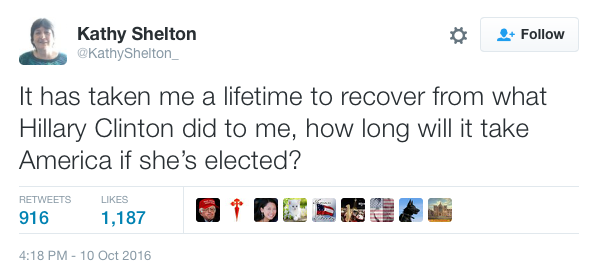
Kathy Shelton's voice needs to be heard

Sexual Assault Awareness Month ended today with no sign our political leaders are committed to addressing a problem affecting millions of Americans.

Republicans in the Iowa legislature just approved a 25 percent cut to victims assistance grants that support a wide range of programs, from crisis counseling and court advocates for assault survivors to sexual violence prevention education. The federal government may also reduce funding for victim services during the next fiscal year.

The long-term effects of rape and sexual assault are well-documented but mostly invisible.

Six months ago, Kathy Shelton offered a rare window onto the severe trauma many victims still experience years or decades after an attack. Her cries of pain and anger should be a call to action for everyone.

Continue Reading...

Iowa Supreme Court suspends Ted Sporer's law license for six months

A once-prominent voice for central Iowa Republicans will be unable to practice law for six months under an Iowa Supreme Court ruling announced yesterday. In a unanimous decision enclosed in full below, the justices found that Ted Sporer made “false statements to a tribunal” and engaged in “misrepresentation or deceit,” as well as conduct “prejudicial to the administration of justice.” For Sporer’s side of the story, watch his presentation during last month’s oral arguments before the high court (video also enclosed below).

The disciplinary action stemmed from a 2013 case, in which Polk County District Court Judge Douglas Staskal determined “beyond a reasonable doubt” that Sporer “fabricated evidence” and “lied under oath” to help a client who was violating the terms of a divorce decree. Bleeding Heartland posted relevant excerpts from that ruling here.

The Supreme Court’s Grievance Commission had recommended the six-month suspension, citing “significant aggravating circumstances”: Sporer’s long experience as an attorney, violations of multiple ethics rules, and prior disciplinary history including a public reprimand. Scroll to the end of this post to read a 2011 letter to Sporer from the Iowa Supreme Court Attorney Disciplinary Board, citing misrepresentations to a client he had failed to represent “with reasonable diligence and promptness.”

Sporer chaired the Polk County Republican Party from 2001 to 2009 and served on the Republican Party of Iowa’s State Central Committee from 2002 to 2008, during which time he spent five years as the GOP’s State Organization Chairman. He was also an active voice in Iowa’s conservative blogosphere during the last decade. However, he has not updated The Real Sporer blog since 2012.

The last time Sporer was in the news, he was representing then State Senator Kent Sorenson in a lawsuit over allegedly stolen e-mails (which was later settled out of court) and during a criminal investigation of Sorenson’s actions before and after the 2012 Iowa caucuses. Sporer repeatedly denied his client had received any “direct or indirect payment from the Ron Paul campaign.” Even as revelations about payments from Michele Bachmann’s presidential campaign forced Sorenson to resign from the Iowa Senate, Sporer continued to insist his client had not lied. Sorenson later pled guilty to the hidden payment scheme and was eventually sentenced to 15 months in prison after cooperating with the federal investigation into former Paul campaign operatives.

Continue Reading...

IA-Gov: John Norris calls on Democrats to limit campaign donations, spending

Iowa is one of only twelve states with no limits on individual contributions to state-level races. John Norris is challenging Democrats who run for governor in 2018 to “lead by example,” adopting federal campaign contribution limits (capped at $2,700 per person) for the primary election.

Speaking to Democratic activists in Panora (Guthrie County) on April 27, Norris also urged gubernatorial candidates to agree to keep their primary election spending below $1.5 million, saying, “We should campaign on the power of our ideas and spend our time talking to Iowans and not chasing money from wealthy special interests.” I enclose below a longer excerpt from his speech.

Norris will decide soon whether to run for governor. Democrats Rich Leopold, Jon Neiderbach, and Dr. Andy McGuire are already running, likely to be joined by State Representative Todd Prichard, State Senator Nate Boulton, Fred Hubbell, Mike Matson, and/or Mike Carberry (though many Democrats expect Carberry to seek re-election as Johnson County supervisor instead).

Among those candidates, McGuire, Boulton, and Hubbell are the only ones well-positioned to collect many campaign donations larger than $2,700. McGuire recently completed a two-year stint as Iowa Democratic Party chair, during which she solicited many four-figure and five-figure gifts. Roxanne Conlin is among McGuire’s most prominent endorsers. Boulton raised a considerable amount for his first campaign in 2016 and is expected to have strong support from labor unions and attorneys if he joins the field. Hubbell is independently wealthy, having donated $30,000 to the state party during the 2016 cycle, as well as four-figure sums to some other Democratic campaigns. He is rumored to have the support of other central Iowa major donors including Bill Knapp, who gave the Iowa Democratic Party more than $60,000 during the last two years alone. (You can search any individual’s Iowa political donation history here.)

Neiderbach has made campaign finance reform a major theme of his early stump speeches and has promised not to accept any contribution exceeding $500. Leopold speaks often of the need to break the grip “expensive consultants, corporate lobbyists and powerful special interests” have on Iowa’s “insider elite political class.” Bleeding Heartland will soon publish an in-depth interview with Leopold that touches on similar themes.

UPDATE/CLARIFICATION: Former Iowa Democratic Party executive director Norm Sterzenbach, who has been advising Prichard in recent months, noted in response to this post that both Norris and Prichard have networks outside traditional Iowa donors. Point taken, and I did not mean to imply that other gubernatorial candidates would be unable to raise contributions larger than $2,700. Prichard’s leadership team includes some political heavyweights. Norris has years of experience fundraising for Iowa Democrats and connections to many potential out-of-state donors, due to his past work in President Barack Obama’s administration and with nationally-known Democratic operatives like David Plouffe.

Reacting to this post on Facebook, Neiderbach commented, “Do we want a Governor beholden to the voters – especially those who have historically been marginalized or ignored – or beholden to the rich, to big business, and to other special interests? Couldn’t the money spent on endless TV ads and campaign consultants better be spent donated to food banks and homeless shelters and our underfunded schools? Spending $1.5 million on a primary is obscene. Voters are tired of it. I urge all candidates to follow my lead and limit all donors to $500, telling those who would donate more to feed the hungry, house the homeless, and educate our students.”

Continue Reading...

Young a no, Blum nowhere as House leaders shelve new health care vote

U.S. House Republican leaders called off plans to vote today on a new proposal to replace the 2010 health care reform law. Representative David Young (IA-03) was among at least 21 Republicans who had indicated they don’t support the MacArthur amendment to the American Health Care Act.

At this writing, Young has not released a statement, and his communications staff have not responded to my inquiries. His social media feeds are full of the usual photos of constituents or groups who stopped by his Washington office this week. But on Thursday, other staffers told various constituent callers (including me) that Young’s “position has not changed” since he came out against the Republican alternative to the Affordable Care Act in March. The Hill included him on their “whip count” of no votes, based on Young’s comments to Independent Journal Review reporter Haley Byrd: “Moderate GOP member David Young says he’s still a no on AHCA and tells me he *somehow* hasn’t read the MacArthur amendment yet. (Hmm. Okay.)”

Representative Rod Blum (IA-01) hasn’t commented publicly on the latest proposal, which was drafted to appease members of the House Freedom Caucus to which he belongs. I haven’t heard back from his communications staff, and numerous constituents who called his offices were told he has no position, either because nothing is on the House floor yet or because the bill is only in “draft” form. Notably, Blum didn’t wait for a floor vote to announce his opposition to the American Health Care Act last month. At that time, he said any health care reform bill needs “to drive down actual costs” and “help people who need the help.”

Groups including the AARP, the March of Dimes, American Hospital Association, and American Medical Association oppose the MacArthur amendment, under which states could decide not to force insurers to cover “essential health benefits.” The policy would also lead to much higher insurance premiums for older people and those with pre-existing conditions. The new Republican proposal envisions a return to state-based high-risk pools, which “failed consumers in the past.” Iowa was among 35 states that established high-risk pools before Congress passed the Affordable Care Act. Karen Pollitz of the Kaiser Foundation explained the shortcomings well here.

I will update this post as needed if Blum or Young comment further on GOP health care reform alternatives. The third Iowa Republican in the U.S. House, Representative Steve King (IA-04), came around to supporting the American Health Care Act in March.

UPDATE: Iowans living in the first district continue to report being told that Blum’s staff told them he doesn’t have a position on the bill. Blum has taken a stand on countless other policies that never came up for a vote on the House floor. Just this week, he expressed support for President Trump’s “tax plan,” which is nothing like fleshed-out legislation.

I’ve added below a news release from State Representative Abby Finkenauer, who is likely to make her campaign against Blum official soon.

Continue Reading...

IA-Gov: Ron Corbett continues to lay groundwork for 2018 campaign

Outgoing Cedar Rapids Mayor Ron Corbett continues to signal that he is serious about seeking the Republican nomination for governor in 2018. Speaking as “president and founder” of the Engage Iowa think tank, Corbett will deliver a major speech on education policy at the Downtown Cedar Rapids Rotary this Monday, May 1.

In a press release enclosed in full below, Corbett said, “This event kick-offs my second round of visits to Iowa rotaries. Last time I was talking about the need for tax modernization and improving Iowa’s water quality – two topics that were at the forefront of discussion this past legislative session and continue to be hot topics. I look forward to re-imagining education and rallying education champions as we work to make improvements to our state’s educational system.” Since late 2015, Corbett has spoken to scores of local business-oriented groups (Rotary Clubs, Chambers of Commerce, or Farm Bureau chapters) in 55 counties as of last December.

The landing page of Engage Iowa’s website now advertises a livestream of Corbett’s forthcoming speech. He will promote a new “research-based teacher compensation plan” and discuss “opportunities that the state needs to address” in light of the new collective bargaining law, which could profoundly affect public schools and teachers. The full plan will go up on the think tank’s website after the May 1 Rotary event.

Corbett also has a new book coming out, which sounds like a case to Iowa voters, judging by the blurb on the Barnes and Noble website (emphasis added):

“Beyond Promises” is a memoir of sorts by Ron Corbett, who became the youngest speaker of the Iowa House of Representatives and who now is finishing up his eighth year as mayor of Iowa’s second largest city, Cedar Rapids. In the late 1990s, Corbett was considered a possible Republican candidate for Congress or governor. Then he surprised many and resigned from the Legislature so he wouldn’t have to spend so much time away from home and his growing family. He headed the local Chamber of Commerce for six years, a period in which he led a community campaign to rebuild schools, another to redevelop the Cedar Rapids riverfront and a third that brought professional management to Cedar Rapids city government. Corbett’s tenure as Cedar Rapids mayor coincided with the city’s recovery from a devastating flood in 2008, the costliest natural disaster in Iowa history. Can someone who was a leading Republican voice in much of Iowa reclaim statewide prominence and be elected governor? In 2017, that’s the elephant in the room-the unstated question lingering in the backdrop of “Beyond Promises.” This book is Corbett’s first-person account of where he came from and what shaped him, as well as a chronicle of doing, not simply promising.

Lieutenant Governor Kim Reynolds has a big head start on fundraising and will have more establishment support in next year’s Republican primary, as the sitting governor–or acting governor, to be more precise. But Corbett sounds ready to take on this challenge, and the book title Beyond Promises hints at a possible line of attack. The Branstad/Reynolds administration hasn’t accomplished any of the four key goals promised during the 2010 gubernatorial campaign: creating 200,000 new jobs, reducing the cost of government by 15 percent, increasing family incomes by 25 percent, and having the “best schools in the nation.”

This year’s severe budget shortfall could also create an opening for Corbett to argue that Branstad and Reynolds mismanaged the state’s finances, compared to the period when he was Iowa House speaker. If revenues fall well below projections again during the coming fiscal year, as former Iowa revenue estimator Jon Muller considers likely, Reynolds may be forced to enact large, disruptive spending cuts in early 2018, as happened this year.

Continue Reading...

Pat Grassley could be biggest winner if Bill Northey moves to USDA

A potential federal job for Iowa Secretary of Agriculture Bill Northey may provide a stepping stone for State Representative Pat Grassley.

Northey discussed ethanol policy at the White House on Tuesday during a round-table meeting with President Donald Trump and newly-confirmed U.S. Secretary of Agriculture Sonny Perdue. Reports of the event fueled speculation that Northey may soon move to a position in the U.S. Department of Agriculture. Speaking to Iowa reporters yesterday, Northey emphasized that no job offer is on the table but said of Perdue, “I certainly look forward to working with him. I don’t know what role that might be. […] I certainly would love to work with him as Iowa Secretary of Ag. If there’s another job offered, I’d be very willing to consider that as well.”

Trump put Iowa’s own Sam Clovis in charge of handling USDA appointments in January, after Clovis had served as his surrogate in some agricultural policy discussions during the campaign.

Northey has not clarified whether he plans to seek a fourth term as secretary of agriculture in 2018. He had been widely expected to run for governor next year but ruled that out immediately after Governor Terry Branstad agreed to serve as U.S. ambassador to China.

If Northey resigns before the end of his term, Iowa law calls for the governor to appoint a replacement to serve until the next election. The last time that process came into play, Branstad named Mary Mosiman as state auditor in 2013. She was unchallenged for the GOP nomination for that office the following year.

I would expect Grassley to lobby Branstad–or Kim Reynolds, if she is acting as governor by that time–for the secretary of agriculture position. The job would be a good way to increase his statewide profile with a view to running for his grandfather’s U.S. Senate seat in 2022. The elder Grassley wasn’t subtle about lobbying for Northey to get the top USDA job, presumably to clear a path for his grandson.

First elected to the Iowa House in 2006, the younger Grassley just completed his second year leading the House Appropriations Committee. He had previously chaired the House Agriculture Committee for three years and the Economic Growth/Rebuild Iowa Committee for two years before that.

I enclose below the official bios for Northey and Pat Grassley. Radio Iowa’s O.Kay Henderson posted the audio of Northey’s comments about a possible USDA position.

Continue Reading...

Iowa wildflower Wednesday: Dogtooth violet (White trout lily)

Today’s featured plants are among the few wildflowers I could identify before I embarked on the journey that led to the Iowa wildflower Wednesday series. I grew up calling them dogtooth violets. More often, I hear others use the common name white trout lily. Alternative names include thousand leaf or white fawnlily.

Erythronium albidum is native to most of North America east of the Rocky Mountains. According to Wildflowers of Iowa Woodlands by Sylvan Runkel and Alvin Bull, dogtooth violets are “found throughout the state in rich moist woodlands, especially in bottomlands with open woods.” The Illinois Wildflowers site notes,

An abundance of this plant indicates that a woodlands has never been subjected to the plow or bulldozed over. White Trout Lily is one of the spring wildflowers that is threatened by the spread of Alliaria petiolata (Garlic Mustard) in wooded areas.

Picking these flowers kills the plant, so leave them alone. Runkel and Bull write that the bulbs underground used to be a common food source for American Indian tribes. I’ve never tried to dig them up.

Dogtooth violets are “one of the first woodland flowers to bloom in the spring,” but they don’t last as long as some other early bloomers. In my corner of Windsor Heights, the dogtooth violet flowers have come and gone, whereas I still see lots of violets, rue anemone, and spring beauty. I took all of the enclosed pictures in mid-April.

Continue Reading...

Pete D'Alessandro, Theresa Greenfield a step closer to running in IA-03

Pete D’Alessandro confirmed yesterday that he has created an exploratory committee for a possible campaign Iowa’s third Congressional district. In a statement first provided to The Guardian and enclosed in full below, D’Alessandro said progressives throughout the district have encouraged him to run. “The many offers of support have been humbling. It is clear that a great many people believe it is not possible to change the clutter in Washington DC if we choose our candidates from the same failed pool that we have in the recent past.” He will spend the next few months “traveling to all 16 counties in our district listening to everyday people, talking with activists, and engaging with community leaders to gather their views on the condition and the direction of the district and our country.”

A veteran of many Iowa Democratic campaigns and a consultant for candidates elsewhere, D’Alessandro most recently worked here as political director for Bernie Sanders before the 2016 caucuses. Sanders energized a large number of activists to get involved in Democratic Party politics for the first time, and if that small army becomes engaged in the IA-03 primary, they could be an important volunteer and donor base for D’Alessandro.

In recent weeks, many Des Moines area activists have been talking about Theresa Greenfield as a possible challenger to two-term Representative David Young. Greenfield is president of the family-owned real estate development company Colby Interests in Windsor Heights. She confirmed today,

I am exploring a run for Congress in Iowa’s 3rd Congressional District and am having fun doing it! For now, my focus is to introduce myself to community leaders, visit all 16 counties, and invite folks to share what their priorities are and what our communities need. I am exploring a run for Congress because people like us — need people like us to lead, not life long politicians. It’s the only way we’re going to bring about real change.

State Senator Matt McCoy told me last month he was considering running for Congress and will make a final decision this fall. Since McCoy is up for re-election next year in Senate district 21, covering parts of Des Moines and West Des Moines, he would have to abandon his seat in the legislature in order to seek the Democratic nomination in IA-03.

Anna Ryon has been the only declared Democratic candidate in IA-03 since Mike Sherzan recently withdrew from this race. Ryon is an attorney with the Office of Consumer Advocate; her campaign is online here.

The sixteen counties in IA-03 contain 167,092 active registered Democrats, 177,376 Republicans, and 167,828 no-party voters, according to the latest figures from the Iowa Secretary of State’s office. Young won re-election in 2016 by 53.4 percent to 39.7 percent, outperforming the top of the GOP ticket by about five points. Although Donald Trump carried IA-03 by 48.5 percent to 45.0 percent, the swing to the Republican presidential nominee here was significantly smaller than in Iowa’s first and second Congressional districts.

IA-03 is on the Democratic Congressional Campaign Committee’s long list of 2018 targets but not among the 20 top-priority Republican-held districts.

UPDATE: D’Alessandro has launched a website for his exploratory committee.

The Republican Party of Iowa’s first hit on D’Alessandro came in a bizarre press release on April 27, which I’ve added below.

Continue Reading...

John Norris: Why he may run for governor and what he would bring to the table

With the exhausting battles of the 2017 legislative session behind us, Iowa Democrats can turn their attention to the most pressing task ahead. Next year’s gubernatorial election will likely determine whether Republicans retain unchecked power to impose their will on Iowans, or whether some balance returns to the statehouse.

A record number of Democrats may run for governor in 2018. Today Bleeding Heartland begins a series of in-depth looks at the possible contenders.

John Norris moved back to Iowa with his wife Jackie Norris and their three sons last year, after nearly six years in Washington and two in Rome, Italy. He has been touching base with potential supporters for several weeks and expects to decide sometime in May whether to become a candidate for governor. His “concern about the direction the state’s going” is not in question. Rather, Norris is gauging the response he gets from activists and community leaders he has known for many years, and whether he can raise the resources “to make this a go.”

In a lengthy interview earlier this month, Norris discussed the changes he sees in Iowa, the issues he’s most passionate about, and why he has “something significantly different to offer” from others in the field, who largely agree on public policy. The native of Red Oak in Montgomery County (which happens to be Senator Joni Ernst’s home town too) also shared his perspective on why Democrats have lost ground among Iowa’s rural and small-town voters, and what they can do to reverse that trend.

Continue Reading...

A shameful end to the most destructive Iowa legislative session of my lifetime

The Iowa House and Senate adjourned for the year around 7:15 am on Saturday, after staying up all night while Republican leaders tried to hammer out last-minute deals on medical cannabis and water quality funding.

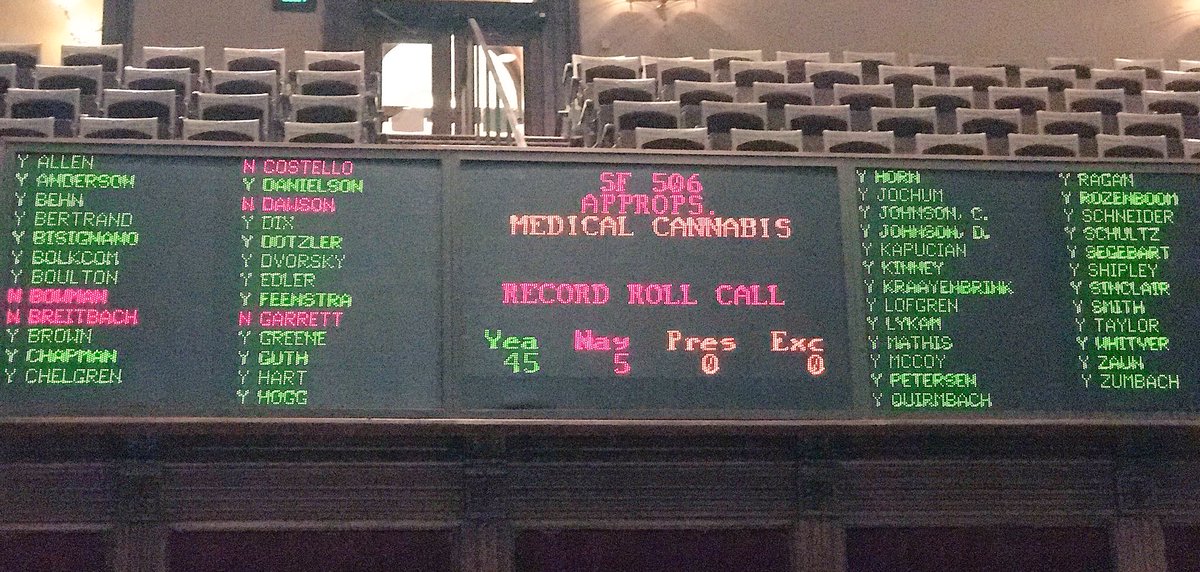
The medical cannabis compromise passed with bipartisan majorities in both chambers, but I’m not convinced the revised House File 524 will be an improvement on letting the current extremely limited law expire on July 1. The bill senators approved last Monday by 45 votes to five would have provided some relief to thousands of Iowans suffering from nearly 20 medical conditions. House Republican leaders refused to take it up for reasons Speaker Linda Upmeyer and House Majority Leader Chris Hagenow never articulated.

The new bill thrown together during the all-nighter theoretically covers nine conditions, but as Senator Joe Bolkcom explained in a video I’ve enclosed below, the only form of cannabis allowed (cannabidiol) will not be effective to treat eight of those. Although few if any Iowans will be helped, Republicans can now claim to have done something on the issue and will consequently face less pressure to pass a meaningful medical cannabis bill during the 2018 legislative session.

Republicans shut down the 30-year-old Leopold Center for Sustainable Agriculture, which supported research on farming practices that could preserve our soil and water resources. But on Friday night, they gave up on doing anything serious to clean up our waterways, 750 of which are impaired, according to the latest data released by the Department of Natural Resources. CORRECTION: More recent DNR data indicate Iowa “contains 608 waterbodies with a total of 818 impairments.” (Some waterways have more than one impaired segment.) On the opening day of this year’s session, Hagenow promised “significant new resources to water quality efforts.” Why not come back next week and keep working until they find some way forward?

I’ll tell you why: lawmakers’ per diems ran out on April 18. Heaven forbid Republicans should work a few more days with no pay to address our state’s most serious pollution problem. Incidentally, this crowd just passed an education budget that will force thousands of students to go deeper in debt. They voted earlier this year to cut wages for tens of thousands of Iowans living paycheck to paycheck in counties that had raised the minimum wage. These “public servants” also handed more than 150,000 public workers an effective pay cut by taking away their ability to collectively bargain over benefits packages. As if that weren’t enough, they made sure many Iowans who get hurt on the job will be denied access to the workers’ compensation system or will get a small fraction of the benefits they would previously have received for debilitating shoulder injuries.

Lives will be ruined by some of the laws Republicans are touting as historic accomplishments.

Even worse, lives will likely end prematurely because of cuts in the health and human services budget to a wide range of programs, from elder abuse to chronic conditions to smoking cessation to Department of Human Services field operations. I enclose below a Democratic staff analysis of its provisions. During House and Senate floor debates, Republican floor managers offered lame excuses about the tight budget, which doesn’t allow us to allocate as much money as we’d like to this or that line item. Naturally, they found an extra $3 million for a new family planning program that will exclude Planned Parenthood as a provider.

Different Republican lawmakers used the same excuses to justify big cuts to victims assistance grants in the justice systems budget. That choice will leave thousands of Iowans–mostly women–without support next year after going through horrific assaults or ongoing abuse.

Despite some big talk from House Appropriations Committee Chair Pat Grassley, Republicans didn’t even try to rein in business tax credits, which have been the state’s fastest-growing expenses in recent years. The budget crunch is real and may get worse. But no one forced Republicans to inflict 100 percent of the belt-tightening on those who rely on public services.

More analysis of the 2017 legislative session is coming to Bleeding Heartland in the near future. All posts about this year’s work in the Iowa House and Senate are archived here. The Des Moines Register’s William Petroski and Brianne Pfannenstiel summarized some of the important bills that passed this year.

After the jump you’ll find Bolkcom’s commentary on the medical cannabis bill that offers “false hope” to Iowans “who have begged us to help,” along with closing remarks on the session from House Minority Leader Mark Smith and Senate Minority Leader Rob Hogg.

Continue Reading...

KWWL won't correct error-filled story on Stand Your Ground

Generally accepted journalism guidelines call for acknowledging mistakes in news reports, setting the record straight quickly, and doing so “in a way that encourages people who consumed the faulty information to know the truth.” The Online News Association’s “Build Your Own Ethics Code” project lists “promptly correct errors” among a short list of “fundamentals” that “should apply to all journalists.” The Radio Television Digital News Association’s code of ethics states, “Ethical journalism requires owning errors, correcting them promptly and giving corrections as much prominence as the error itself had.”

KWWL, the NBC affiliate in Waterloo, doesn’t hold its reporters to that standard.

Continue Reading...

Branstad nominees held accountable for violating women's constitutional rights

Iowa Senate Democrats held two members of the Iowa Board of Medicine accountable yesterday for hasty action in 2013 to approve an anti-abortion rule that had no scientific basis and was later found unconstitutional by a unanimous Iowa Supreme Court.

Iowa Board of Medicine Chair Diane Clark and fellow board member Dr. Hamed Tewfik became the first (and probably the only) nominees for state boards or commissions to be rejected by the Iowa Senate this year. Republicans are predictably denouncing the vote as “petty partisan politics.” But senators have confirmed without dissent the overwhelming majority of more than 200 people Governor Terry Branstad selected.

Clark and Tewfik have only themselves to blame for losing their prestigious positions.

Continue Reading...

Iowa wildflower Wednesday returns: Downy yellow violet

Iowa didn’t experience much severe winter weather this year, but the political climate was harsher than at any other time in living memory. After writing up too much bad news these past few months, I’m glad to revive Bleeding Heartland’s weekly wildflower series. Click here for the full archive of posts featuring more than 140 native plants and a few plants of European origin that are now widespread here.

Downy yellow violet (Viola pubescens) is native to all of North America east of the Rocky Mountains. In Iowa, you may see it near homes as well as in wooded areas. Except where noted below, I took most of the enclosed pictures not far from our house in Windsor Heights. However, most violets I see in people’s yards are purple or the white color variation of that flower, the common blue violet. Less often, you may find striped white violet, a separate species.

According to John Pearson of the Iowa Department of Natural Resources, Viola pubescens are the only yellow violets native to our state. The Minnesota Wildflowers site has botanically accurate descriptions of the foliage, flowers, and seeds. Common yellow violet or smooth yellow violet are alternate names for this plant.

Continue Reading...

With Hensley out, who will business interests run against Josh Mandelbaum?

Christine Hensley will not seek re-election to the Des Moines City Council this year, she announced today in an interview with the Business Record. The 24-year incumbent told Perry Beeman, “I’ve got a tremendous amount done, and it’s time for me to look at the next chapter and figure out what I’m going to do.” Hensley discussed spending “a little more time with family” and didn’t mention her challenger Josh Mandelbaum, though his capacity to run an effective campaign likely factored into her retirement plans.

The race for Des Moines City Council Ward 3 was shaping up to be a focal point for central Iowa progressives. Mandelbaum has raised more $110,000 in less than a month as a candidate, his campaign told Iowa Starting Line today. More than 150 people have volunteered to help spread the word.

While winning an open seat is usually easier than beating an entrenched incumbent, no one should celebrate victory too soon. Republicans and business groups will surely recruit and heavily promote someone to run in Hensley’s place. Proxies of the Iowa Farm Bureau have spent hundreds of thousands of dollars on television and radio advertising bashing the Des Moines Water Works during the last two years, so I anticipate a well-funded smear campaign against Mandelbaum. Countering that message will require a strong grassroots effort. City council races are usually low-turnout affairs, so a few thousand people will decide the outcome. You can sign up to volunteer here.

Democrats outnumber Republicans in the west-side and south-side neighborhoods that are part of ward 3 (a map is at the end of this post). That reality, along with Mandelbaum’s early start and big fundraising, may deter other potential candidates. But some ambitious person with business connections will step up. Any speculation about who might enter the Des Moines City Council race is welcome in this thread.

UPDATE: Mandelbaum released the following statement on today’s news.

I want to thank Councilwoman Hensley for serving her community for 24 years. While Councilwoman Hensley and I have our disagreements, we should all honor and respect the work that all of our civil servants do every day to make our community stronger.This race was and still is about representing the interests, values, and concerns of the residents of Des Moines. I will continue to champion clean water, strong neighborhoods with strong public schools, and investing in people through policies that support decent wages. I also want to thank my supporters. The outpouring of support throughout the community in the month since we have announced has made it clear that Des Moines is ready for a progressive voice on the City Council. With your continued support, we will be prepared to fight outside special interests that have been attacking champions of clean water like what the so-called Partnership for Clean Water has done to Bill Stowe and the Des Moines Water Works. This election will still be a fight to be won even if it’s not the original one we anticipated when we announced one month ago. This campaign has just begun and I look forward to continued conversations with residents throughout the third ward as I keep running vigorously all the way through Nov. 7th, 2017. Thank you again-

According to Jason Frerichs of the Progressive Voices of Iowa blog, he has interviewed another Democrat planning to run for city council in this ward. Will update once that person’s identity is known.

P.S.- Hensley’s decision to stand with the Farm Bureau against her local water utility was a political mistake as well as a betrayal of her constituents. And it was all for nothing, because despite lobbying by groups including the city of Des Moines, the plan to dismantle the Water Works stalled in the Iowa House and won’t be attached to an appropriations bill this year. Since the Water Works lawsuit against three northwest Iowa counties will not move forward, state lawmakers will have little reason to pursue this goal during the 2018 legislative session either.

P.P.S.- If outgoing Cedar Rapids Mayor Ron Corbett seeks the Republican nomination for governor in 2018, as I expect him to do, Hensley will be a leading contender for the lieutenant governor spot on his ticket.

APRIL 24 UPDATE: Multiple central Iowa sources have relayed a rumor that Hensley is being considered for the lieutenant governor position under Kim Reynolds after Governor Terry Branstad leaves for China. Offering Hensley that job could be a way for Reynolds (who has a big head start on fundraising for the 2018 governor’s race) to hurt Corbett’s ability to tap major Republican donors in the Des Moines area. If Hensley joined the Reynolds administration, it would be a slap in the face to Corbett, with whom she has worked closely as an original board member of the Partnership for Clean Water.

Continue Reading...

Yes, Kim Weaver's undisclosed work as a psychic is newsworthy

An “anonymous package mailed with a Sheldon, IA, postmark” led to an exclusive report by the Des Moines Register’s Jason Noble on Monday: Kim Weaver, a Democratic challenger to Representative Steve King in Iowa’s fourth Congressional district, “operated an array of psychic services websites” and “charged customers as much as $3.99 per minute for readings online and over the phone.”

In an interview, Weaver, 52, did not deny dabbling in psychic services, but described her activities as “life coaching” and said they never amounted to more than a “hobby.”

“I didn’t really actually do anything,” Weaver said. “It was all for entertainment purposes. Did I make a living from it? No, definitely not.”

On many social media threads yesterday, I saw Iowa Democrats complain about the Register hyping a “hit piece” planted by Republicans.

But even clickbait hit pieces have news value sometimes.

Continue Reading...

Near-total support for medical cannabis bill in Iowa Senate

What a difference two years makes: the Iowa Senate approved a comprehensive medical cannabis bill today by 45 votes to five. Almost two years ago to the day, a similar bill covering fewer medical conditions barely passed the Senate with just one Republican (Brad Zaun) joining 25 of the 26 Democrats. State Senator Tod Bowman was the lone Democrat not to support the 2015 cannabis legislation, and he was the only Democrat to vote against Senate File 506 today, joined by Republicans Mike Breitbach, Dan Dawson, Julian Garrett, and Mark Costello. (Garrett had voted for the bill in the Senate Appropriations Committee last week.)

Bleeding Heartland covered the important provisions of Senate File 506 here. Whereas the current law allows the use of cannabis oil to treat a few seizure conditions but doesn’t provide for in-state production, the new bill would cover thousands more Iowans, permit licensed users to obtain cannabis in more forms (but not smokeable marijuana), and create conditions for manufacturing and selling medical cannabis in Iowa.

Before final passage, senators adopted two amendments by voice vote. Language introduced by Republican Tom Greene added polyarteritis nodosa to the list of covered conditions and reduced the maximum number of licensed medical cannabis manufacturers in Iowa from twelve to four. Republican Mark Chelgren’s amendment removed a passage that would have allowed patients to register for a nonresident card in Minnesota and obtain medical cannabis from a manufacturer in that state.

Iowa House Republican leaders may not allow a vote on this bill without amendments to limit its scope. However, they will face pressure to do something before adjournment, because the current law expires on July 1. During today’s floor debate, several senators urged colleagues in the lower chamber to send the legislation to Governor Terry Branstad, Steffi Lee reported for CBS-2 in Cedar Rapids.

Advocacy groups representing Iowans affected by various diseases or medical conditions are lobbying in favor of Senate File 506, while some organizations representing law enforcement or medical professionals are registered against it, including the Iowa Pharmacy Association. Ironically, the only two pharmacists serving in the legislature are strong supporters of the bill. Greene floor-managed Senate File 506, and Democratic State Representative John Forbes has been one of the lower chamber’s leading advocates for medical cannabis reform for years.

Continue Reading...

Steve Sodders rules out running for Congress in IA-01

Former State Senator Steve Sodders will not run for Congress in Iowa’s first district next year, he told Bleeding Heartland this morning.

I’m taking my hat out of the congressional race, after long consideration and discussions with family and friends, it would be very difficult for me to run for higher office at this time due to my work schedule at the Marshall County Sheriff office. I do plan on staying in politics and will likely run for another office in the future. I can retire in January of 2019 from law enforcement after 29 years.

Sodders, a longtime deputy sheriff, represented Marshall and Tama counties in the Iowa Senate for two terms before losing his re-election bid to Jeff Edler last year. Republicans spent heavily in that race, as did some conservative interest groups. Many Democrats would support Sodders in a 2020 rematch with Edler. Another possibility would be a campaign for Marshall County supervisor. Two of the three current supervisors (Bill Patten and Dave Thompson) are up for re-election in 2018.

To my knowledge, Courtney Rowe is the only declared Democratic challenger to two-term Representative Rod Blum in IA-01. Bleeding Heartland posted more information about the Cedar Rapids-based engineer here. Her campaign has a Facebook page.

State Representative Abby Finkenauer of Dubuque is likely to join the Congressional field soon, having filed paperwork with the Federal Election Commission and spoken recently at several Democratic events around the district. Click here for background on Finkenauer and to hear what her stump speech might sound like if she runs against Blum. Her campaign website is here.

State Senator Jeff Danielson of Waterloo and Linn County Supervisor Brent Oleson have previously said they are thinking about running for Congress next year.

Blum is a top 2018 target for Iowa and U.S. House Democrats. The 20 counties in IA-01 contain 164,113 active registered Democrats, 144,584 Republicans, and 190,664 no-party voters, according to the latest figures from the Iowa Secretary of State’s office. The largest-population counties are Linn (the Cedar Rapids metro area), Black Hawk (Waterloo/Cedar Falls metro), and Dubuque, which is Blum’s home base.

Continue Reading...

Read highlights from Art Cullen's Pulitzer Prize-winning editorials

The best news out of Iowa last week was Storm Lake Times editor Art Cullen winning the 2017 Pulitzer Prize for “editorials fueled by tenacious reporting, impressive expertise and engaging writing that successfully challenged powerful corporate agricultural interests in Iowa.” Our state’s journalism community has long recognized the quality of Cullen’s work. The same series of columns earned him one of the Iowa Freedom of Information Council’s Skip Weber Friend of the First Amendment awards last year.

Cullen will donate most of his prize money to non-profits, including charities assisting refugees and the Iowa Freedom of Information Council, whose executive director Randy Evans helped Cullen press his case with Buena Vista County leaders who were withholding public records. Speaking to James Warren of Poynter and Jared Strong of the Carroll Daily Times Herald, Cullen went out of his way to credit his son, Tom Cullen, who “did most of the heavy lifting” while digging into who was paying for the legal defense of three counties sued by the Des Moines Water Works.

The Storm Lake Times posted all of the winning editorials on this page. Links to the individual columns are on the Pulitzer Prize website. I enclose below excerpts from those columns, from Storm Lake Times publisher John Cullen’s tribute to his brother, and from Art Cullen’s “thank you” column. I hope this post will inspire Bleeding Heartland readers not only to click through and read last year’s award-winning work, but also to bookmark the Storm Lake Times website and check its opinion page regularly.

Continue Reading...

Courts will have the final say over Iowa's voter ID law

New restrictions on voting in Iowa are headed to Governor Terry Branstad after one last party-line vote in the state Senate on Thursday. The final version of House File 516 contains voter ID and signature verification requirements that will surely prevent some eligible voters from having their ballots counted. For more on those barriers, read Johnson County Auditor Travis Weipert’s statement enclosed below, testimony from the public hearing in the Iowa House last month, Bleeding Heartland guest posts by representatives of One Iowa and the American Civil Liberties Union, John Deeth’s “deep dig,” and the position paper from Iowa’s Commission on Asian and Pacific Islander Affairs. That commission took its first-ever stand on pending legislation out of concern House File 516 will “impede access to the voting booth.”

Continue Reading...

Iowa Republicans slash funds for sexual violence and domestic abuse survivors

Times won’t be equally tough all over when Republican cuts take effect in the justice systems budget.

The Attorney General’s Office receives only about 3 percent of state funding in this area (totaling some $559 million for the next fiscal year) but will absorb about 84 percent of the $2.9 million in cuts Republican lawmakers agreed on behind closed doors. The Department of Corrections, which consumes about three-quarters of justice systems spending, will face a net reduction only $1.6 million, and the Department of Public Safety, which costs six times more to run than the Attorney General’s Office, will see a small increase despite the bleak revenue forecast for the state as a whole.

Justice Systems Appropriations Subcommittee Chairman Gary Worthan commented on April 12, “We would have liked to have done better with a lot of areas, but we’re forced to work with the realities of the budget.”

Fiscal constraints didn’t force anyone to inflict the deepest cuts on Iowans who have already experienced some of this world’s harshest realities. Republicans who put together this bill chose to spend 25 percent less next year on grants supporting survivors of sexual violence and domestic abuse.

Continue Reading...

IA-03: Mike Sherzan is out, Pete D'Alessandro to decide soon

Mike Sherzan will withdraw his candidacy in Iowa’s third Congressional district. In a written statement enclosed in full below, the runner-up in the 2016 Democratic primary to represent IA-03 said today,

I am exiting this race because I have recently come to the conclusion that conducting the type of campaign I am comfortable with would require substantial financial self-funding, and that’s not how this process should work. The campaign finance system we currently have is wrong and must be changed. For this and other personal reasons I have decided to withdraw from the campaign. Going forward I will support the progressive causes I campaigned on and have great passion for. These causes include campaign finance reform, public education and student debt reduction, and funding Planned Parenthood. I will also continue to support candidates who value the policies and positions of the Democratic Party. It was a true honor to run for this office and I will always be grateful for all of my amazing supporters.”

“I’ve spoken with all kinds of Iowans about what’s happening in our country and there’s a real desire for change from what is happening under David Young and Donald Trump. The energy among Democrats is as high as I’ve ever seen, and I’m confident a strong candidate is going to defeat Young next November. I look forward to hearing from those who step forward and working to help them win.

Sherzan’s departure leaves Anna Ryon as Young’s only declared challenger. You can read more about her here or on her campaign website.

Longtime Democratic consultant Pete D’Alessandro, who was political director for Bernie Sanders in Iowa, is also considering this race. I reached out to ask how Sherzan’s decision might affect his plans. D’Alessandro commented by phone this afternoon, “Mike’s statement was pretty solid and showed a guy with a lot of character, with how he described what his thought process was, and also about how he viewed where we need to move.” Sherzan wasn’t “throwing any negative stuff at anybody else.” Rather,

I thought that he showed that he grasped progressive values and just didn’t think he was the right vehicle at this time. I really thought it was very well thought out […] You really grasp from that statement that he is a person that understands that what we’re going through is bigger than any one person, and that he sees the fact that we have to move in a certain direction as much more important than any particular campaign, including his own. So I think he deserves a lot of credit for that.

And the fact that he wants to stay involved–anyone with that kind of view of what we need to do is going to be able to stay involved.

As for his own plans, D’Alessandro said he won’t make any announcement until after Easter weekend, but expects to have something “concrete” to say about the race “sooner rather than later,” probably sometime next week.

UPDATE: I asked John Norris, who may run for governor, whether he might consider becoming a candidate for Congress instead. He is very familiar with both offices, having served as chief of staff for Representative Leonard Boswell after the 1996 election before doing the same job for Governor Tom Vilsack. Norris responded by e-mail today, “My focus is on Iowa and helping turn this state around. I believe I can have the most impact here, especially as the Trump Administration shifts so much of the responsibility to the states.”

SECOND UPDATE: Added below Ryon’s statement on Sherzan leaving the race.

Continue Reading...

Journalists, stop validating Republican spin on voter ID

Later today, Iowa Senate Republicans will give final approval to a bill that could prevent thousands of eligible voters from casting ballots. A broad coalition of groups oppose House File 516, because common sense and research on similar laws in other states overwhelmingly point to one conclusion: voter ID and signature verification requirements will create barriers to the exercise of a fundamental constitutional right, disproportionately affecting students, the poor, the elderly, and people of color.

Republicans don’t acknowledge any of the expert testimony. They pay no attention to the conservative judge who regrets his ruling on Indiana’s voter ID law, having concluded that such laws are “a means of voter suppression.” They keep insisting their so-called “election integrity” bill won’t block a single citizen from voting.

They offer up false equivalencies, saying in their newsletters and on the Senate floor that Iowa Democrats also passed a voter ID law when they controlled both legislative chambers.

These tactics can be effective because most news reports on contentious issues give equal weight to both sides, even if one side is not credible. The “he said/she said” frame with no effort to evaluate competing claims is one of my major journalism pet peeves.

But I realized last Friday that when a politician stretches the truth, a reporter’s incompetent fact-check is worse than no fact-checking at all.

Continue Reading...

Resolution of lawsuit removes political case for Des Moines Water Works bill

Opponents of the legislative effort to disband the Des Moines Water Works got a boost yesterday when the water utility’s Board of Trustees voted not to appeal last month’s federal court ruling dismissing their lawsuit against three northwest Iowa counties. The Iowa Farm Bureau’s wrath over that case inspired a bill that would transfer authority over the Des Moines Water Works to three area city councils.

Agriculture committees in the Iowa House and Senate advanced versions of the Water Works bill, but neither chamber voted on the measure before a “funnel” deadline in late March. Several House and Senate Republicans representing districts with independently-managed water utilities spoke privately about opposing the bill.

Among Iowans who have been fighting this legislative overreach, one big fear has been that powerful Republicans would slip Water Works language into an appropriations bill during the final days of the session. Senate Appropriations Committee Chair Charles Schneider has pledged not to do so, but his House counterpart Pat Grassley has made no such promise. The deadline for appealing the federal court ruling was coming up on April 17, and some Water Works supporters worried that pursuing the case might strengthen the Farm Bureau’s allies at the Capitol, who are still trying to get this language to Governor Terry Branstad.

Instead, the Water Works will waive its right to appeal in exchange for the defendants agreeing not to pursue legal fees. According to Laura Sarcone, communications specialist for the water utility, the next step will be defense counsel getting the boards of supervisors of Sac, Buena Vista, and Calhoun counties to sign off on the agreement. The U.S. Department of Justice would also have to approve the resolution.

I would guess that the county supervisors will happily agree not to pursue legal fees in exchange for finalizing an end to the lawsuit. After all, the cost of defending the case didn’t come out of their budgets. As Art Cullen discussed in a Pulitzer Prize-winning series of editorials for the Storm Lake Times, secret donors, supposedly unknown even to the county supervisors themselves, paid for the first $1 million or so of the defendants’ legal expenses. The Iowa Farm Bureau and Iowa Corn Growers Association stepped in to cover the rest.

I enclose below a Water Works news release and the ruling from U.S. District Court Chief Judge Leonard Strand. In dismissing the case, he found that the Water Works “may well have suffered an injury” from pollutants entering waterways in the named counties, but the northwest Iowa drainage districts “lack the ability to redress that injury.” Almost certainly, the Water Works would not have prevailed on appeal to the Eighth Circuit. The lawsuit accomplished only one thing: making Iowa’s dirty water a more salient political issue. Even so, bills that would address the major source of the problem–agricultural runoff–have no more traction now than they ever did.

APRIL 19 UPDATE: No Water Works provisions are in the standings bill Schneider introduced this week.

Continue Reading...

Republicans seeking to eliminate Leopold Center for Sustainable Agriculture

Republican lawmakers are seeking to eliminate the two main sources of funding for the Leopold Center for Sustainable Agriculture at Iowa State University. The Iowa legislature created the center 30 years ago as part of the Groundwater Protection Act, one of the landmark environmental laws in this state’s history. Its threefold mission:

(1) identify the negative environmental and socioeconomic impacts of existing agricultural practices, (2) research and assist the development of alternative, more sustainable agricultural practices, and (3) inform the agricultural community and general public of the Center’s findings.

The center’s director, Dr. Mark Rasmussen, told Bleeding Heartland today that roughly $1.5 million of the Leopold Center’s approximately $2 million annual budget comes from receiving 35 percent of revenues from a fee on nitrogen fertilizer sales and pesticide registrations. The modest fee of 75 cents per ton of anhydrous ammonia (now selling for approximately $550 per ton) hasn’t changed since the Groundwater Protection Act set up this funding stream in 1987. Citing legislative sources, Rasmussen said Republicans are apparently planning to redirect nitrogen tax revenues. To my knowledge, no bill spelling out the new recipients has been published yet. UPDATE: I have seen the draft appropriations bill for agriculture and natural resources and can confirm it redirects these revenues to a new “Iowa Nutrient Research Fund.” (The Leopold Center’s research addresses a broader range of farming practices.) That appropriations bill calls for the ISU College of Agriculture and Life Sciences to take over any incomplete work by the Leopold Center after July 1, 2017.

The second-largest source of funding for the center is a line item in the Iowa Board of Regents budget, which used to be about $425,000 per year. Actual state funding during the current fiscal year totaled $397,417, and Governor Terry Branstad proposed keeping the center’s funding at that level for fiscal year 2018. But the Republican plan negotiated behind closed doors and revealed this afternoon at an Education Appropriations Subcommittee hearing zeroes out the Leopold Center line item.

The center also receives a “small amount of foundation earnings” from donations to an endowment managed by the ISU Foundation, Rasmussen said, but those funds are “wholly inadequate to keep the center functioning at any level of reasonableness.”

I enclose below an e-mail Rasmussen sent to Leopold Center Advisory Board members today. He noted that the center has been involved with than 600 projects “on topics spanning water quality, manure management, livestock grazing, cover crops, alternative conservation practices, biomass production, soil health and local food systems development in Iowa.” The center’s grants have facilitated “thriving local foods networks,” and research supported by the center informed practices that are now part of Iowa’s Nutrient Reduction Strategy for addressing the state’s major water pollution problems.

It’s not hard to guess why statehouse Republicans want to ax one of the country’s leading institutions in the sustainable agriculture field. Corporate interests associated with conventional farming practices have long been hostile to research supported by the center, such as efforts to reduce nitrogen and phosphorus runoff that causes the Gulf of Mexico “Dead Zone.” Pressure from Big Ag was believed to have influenced Wendy Wintersteen, endowed dean of the ISU College of Agriculture and Life Sciences, when she chose not to offer the job of Leopold Center director to the search committee’s top choice in 2009. (Rasmussen was hired in 2012.)

The GOP education budget would also eliminate state funding for the Iowa Flood Center at the University of Iowa. Advocates for solid research on sustainable agriculture and flood patterns need to contact Republican members of the Education Appropriations Subcommittee: State Senators Tim Kraayenbrink (chair), Craig Johnson (vice chair), and Jason Schultz, and State Representatives Cecil Dolecheck (chair), Tom Moore (vice chair), Dean Fisher, Gary Mohr, and Walt Rogers.

UPDATE: Dolecheck told reporters on April 11 that there was no need for further work by the Leopold Center: ““Most people would tell you that farmers have been educated to that point, the research has been put in place whether it’s cover crops, waterways, those type of things.”

I’ve added below two messages ISU sent to supporters on April 12, seeking to generate constituent contacts to state lawmakers. At Iowa Informer, Gavin Aronsen posted a “set of talking points prepared yesterday for President Steven Leath’s office,” which covers similar ground.

SECOND UPDATE: Democrats requested a public hearing on the state budget, which will take place Monday, April 17, from 10 am to noon. Iowans can sign up here to speak or leave a comment. Although time constraints won’t allow everyone to speak, it’s worth making your voice heard. In addition to eliminating the Leopold Center’s main funding sources, the Republican education and natural resources budgets repeal language establishing the center from the Iowa Code.

Continue Reading...

Republican budget would eliminate Iowa Flood Center

UPDATE: The House Appropriations Committee restored about $1.2 million of this funding on April 12. Added more details below.

The Republican education budget proposal would eliminate $1.5 million in state funding for the Iowa Flood Center at the University of Iowa. According to an e-mail from Professors Witold Krajewski and Larry J. Weber, enclosed in full below, the cut “will have a devastating impact on the Flood Center’s ability to continue to provide flood prevention and real-time flood support to communities, businesses, emergency managers, public works professionals and citizens.”

In addition to ending the Iowa Flood Information System, zeroing out the flood center’s budget would “jeopardize Iowa’s $96 million dollar federal Iowa Watershed Approach HUD [Housing and Urban Development] grant and the Center’s ability to continue to implement projects in nine Iowa watersheds.”

Republican lawmakers have been negotiating behind closed doors on appropriations bills that will likely be approved in quick succession during the next two weeks.

Although the education appropriations bill has not been published, to my knowledge, the Education Appropriations Subcommittee is scheduled to meet today at 2:00 pm to discuss (and probably approve) the GOP-agreed budget numbers. Iowans should urgently contact Republicans who serve on that subcommittee: State Senators Tim Kraayenbrink (chair), Craig Johnson (vice chair), and Jason Schultz, and State Representatives Cecil Dolecheck (chair), Tom Moore (vice chair), Dean Fisher, Gary Mohr, and Walt Rogers. UPDATE: Barbara Rodriguez of the Associated Press published photos of the proposed education budget: page 1, page 2, and page 3.

Iowa lawmakers created the country’s “first academic center devoted to the study of floods” in 2009, following the previous year’s devastating natural disaster.

The IFC is now actively engaged in flood projects in several Iowa communities and employs several graduate and undergraduate students participating in flood-related research. IFC researchers have designed a cost-efficient sensor network to better monitor stream flow in the state; have developed a library of flood-inundation maps for several Iowa communities; and are working on a large project to develop new floodplain map for 85 of Iowa’s 99 counties.

UPDATE: A number of readers have speculated that Republicans may want to shut down the flood center to disrupt a major watersheds project, which might influence public discourse on land-use policies or climate-change impacts in Iowa.

Also, I learned this morning that Democratic State Senator Joe Bolkcom is the outreach and community education director for the flood center, as well as doing the same work for the University of Iowa’s Center for Global & Regional Environmental Research. Bolkcom is the ranking member on the Senate Appropriations Committee and has been a relentless critic of GOP budget policies this year.

SECOND UPDATE: GOP State Representative David Maxwell copied me on his e-mail to Professor Larry Weber, saying, “Not all of us are in favor of defunding the Iowa Flood Center. I will not have the final say, but I will make my thoughts known to someone who will have an effect on the bill.” Keep contacting House and Senate Republicans. A reader told me that bringing up the threat to Iowa’s $96 million dollar federal HUD grant may be a particularly effective talking point.

THIRD UPDATE: O.Kay Henderson reported for Radio Iowa,

During an interview with reporters on Tuesday, Dolecheck said if the University of Iowa wants to keep the Iowa Flood Center open, administrators can shift funds from elsewhere in the university’s operating budget.

Larry Weber of the Iowa Flood Center said the center provided invaluable projections for Iowans who were bracing for flooding last year. “We shut down a Google Map server because the traffic to the Iowa Flood Center was so intense during the run-up of the crest of the flood coming to Cedar Rapids,” he said, “so many people using that data wanting to see what the extent of the inundated would be, what the water depth on their property would be.”

FOURTH UPDATE: Brianne Pfannenstiel reported for the Des Moines Register, “The House Appropriations Committee adopted an amendment Wednesday that would restore $1.2 million for the program by transferring $250,000 away from a National Guard educational assistance program and transferring another $950,000 out of general aid to the University of Iowa. […] Dolecheck, who is co-chair of the subcommittee that oversees the education budget proposal, said the Senate already is on board with the amendment and plans to adopt it.”

Continue Reading...

Only four senators voted to hold Geri Huser accountable

Disappointing but not surprising: the Iowa Senate on April 10 confirmed Geri Huser as chair of the Iowa Utilities Board by 44 votes to four. Senators delayed consideration of Huser’s nomination in late March, after Ryan Foley reported for the Associated Press that she “has maintained a busy and profitable private legal practice” during her first two years as board chair.

Iowa Code 474.8 stipulates that each utilities board member “shall devote the member’s whole time to the duties of the office.” For decades, every other attorney appointed to that board halted his or her legal practice during the term of service. For some reason, Huser decided those standards need not apply to her. She has also given out conflicting information about her work for the Skinner Law Office. Although she has claimed not to receive any income from that firm, she appears to work out of their office, as Bleeding Heartland discussed near the end of this post.

Only four senators–Democrats Tony Bisignano, Kevin Kinney, Bob Dvorsky, and Herman Quirmbach–found Huser’s outside legal work concerning enough to oppose giving her two more years of greater administrative responsibility and higher pay as the board chair. Most Iowa Senate confirmations are unanimous, so four votes against Huser indicates unusually strong discomfort with her conduct.

On the other hand, the 44 senators who supported Huser on Monday sent a clear message to Iowans. If state law on devoting one’s “full time” to public service gets in the way of a earning a side income, sometimes during regular business hours, powerful and well-connected officials don’t need to follow that rule.

Huser’s ongoing legal practice isn’t her only unprecedented behavior as Iowa Utilities Board chair. Less than six months into her term, she withheld funding for energy centers affiliated with state universities. That inappropriate exercise of her authority was disruptive to the centers and possibly illegal. At the time, a former lawmaker who helped create the energy centers described Huser’s interference as “way out of line.”

Democratic State Senator Joe Bolkcom works at the Center for Global and Regional Environmental Research at the University of Iowa, which got caught up in Huser’s power play, even though the Iowa Energy Center at Iowa State University was her primary target. I am seeking comment from Bolkcom on his vote to confirm Huser and will update this post as needed.

Defunding Planned Parenthood will deal another blow to human services budget

The multimillion-dollar cost of excluding Planned Parenthood as a provider in Iowa’s new family planning program will come directly out of the health and human services budget, Iowa Senate Appropriations Committee Chair Charles Schneider has confirmed to Bleeding Heartland. Republican lawmakers and Governor Terry Branstad have committed to creating a fully state-run program because federal rules do not allow states to disqualify Planned Parenthood from the Medicaid Family Planning Waiver. Under that waiver, federal funds have covered 90 percent of the Iowa Family Planning Network’s costs for many years.

In contrast, the state will be on the hook for every dollar spent on the new family planning services program. According to a fiscal note prepared by non-partisan legislative staff, that program is estimated to “increase General Fund expenditures by $2.1 million in FY 2018 and $3.1 million when implemented for a full year in FY 2019.”

The governor proposed using part of Iowa’s federal Social Services Block Grant funding to cover that cost, which is consistent with spending bills House Republicans approved during the 2015 and 2016 legislative sessions.

Instead, “a general fund appropriation in the health and human services budget” will pay for the new family planning program, Schneider said during an interview following the April 8 legislative forum in Waukee. After reviewing the proposal from the governor’s office, he explained, he chose to file “our own [bill] that didn’t take the money from the Social Services Block Grant.”

It’s understandable that Republican appropriators rejected Branstad’s idea. As Bleeding Heartland discussed here, the Social Services Block Grant is not a reliable funding stream. The U.S. House Ways and Means Committee leader has called for eliminating the grant, and House Republicans voted to do so last year.

But Republican plans to give up millions of federal family planning dollars look even more foolish now than they did a few months ago, when one considers Iowa’s worsening state revenue picture and the huge spending cuts already inflicted on human services.

Continue Reading...

Top Iowa Senate appropriator: No Water Works language in my spending bills

Iowa Senate Appropriations Committee Chair Charles Schneider has pledged not to include language dismantling the Des Moines Water Works in any spending bill this year.

Legislative action to transfer authority over the Des Moines Water Works from an independent board of trustees to area city councils was once seen as nearly a sure thing, thanks to strong support from the Iowa Farm Bureau. But Republican leaders never brought House File 484 up for debate before a legislative deadline in late March. The bill now sits on the “unfinished business” calendar, fueling speculation that it may rise from near-death before lawmakers adjourn for the year.

Governor Terry Branstad has been an outspoken critic of Des Moines Water Works leaders since the utility sued three northwest Iowa counties in 2015, demanding better enforcement of the Clean Water Act to reduce agricultural runoff. At the Waukee legislative forum on April 8, I asked Schneider about a rumor that Branstad has told House and Senate leaders to get the Water Works bill on his desk, and that such language may be attached to the “standings” bill in order to accomplish that end. The standings bill is typically among the last pieces of legislation considered each year and can become a grab bag of provisions power-brokers demand. Would Schneider commit not to add Water Works language to the standings bill or any other appropriations bill coming out of his committee?

Schneider: That’s the first I’ve heard of the standings rumor. It’s not going to go in my standings bill, and I’m not going to support a Water Works bill unless the Des Moines Water Works, West Des Moines Water Works, and Urbandale Water Works themselves–the utilities, not the cities, the utilities–tell me they would like to see some language in there to give them the ability to regionalize on their own.

Bleeding Heartland: So, you won’t put that in any appropriations bill.

Schneider: I’m not putting it in my standings bill.

Republican State Representative Rob Taylor responded to my question as well:

And I also sit on Appropriations on the House side now. I’m not the chair, but I wouldn’t support putting it in that standings bill either. I think that a bill with that kind of substance–although I will say, that the original bill, and the House version with the amendments from Representative [Jarad] Klein have changed substantially from the original bill–I think that’s a, that’s a critical enough bill for or against that it needs to stand on its own. And putting it on an appropriation is not appropriate, and I would fight tooth and nail to prevent it.

I enclose below the official video from yesterday’s Waukee forum. The relevant response from Schneider begins at 1:20:00.

Here’s hoping Schneider has the clout to keep Water Works language out of any final spending bills. He also serves as majority whip, the third-ranking Senate GOP leadership position. The three independent utilities Schneider mentioned oppose the Water Works bill. The city of Des Moines is still registered in favor of House File 484, but the city of West Des Moines changed its stance last month from “for” to “undecided.”

To my knowledge, most of the Republicans on the House Appropriations Committee have taken no public position on this legislation. I’m wary because Appropriations Chair Pat Grassley formerly chaired the Agriculture Committee, where the Water Works bill originated. Assisting the Farm Bureau’s revenge mission could bring political benefits to Grassley, who is widely expected to run for Iowa secretary of agriculture if Bill Northey does not seek re-election in 2018. A front group for the Farm Bureau called the Iowa Partnership for Clean Water ran radio ads supporting the Water Works legislation.

UPDATE: On Iowa Public Television’s “Iowa Press” program this weekend, O.Kay Henderson asked Senate President Jack Whitver, “Will the Iowa legislature dismantle the Des Moines Water Works?” After hesitating for a moment, Whitver answered simply, “No.”

Continue Reading...

Weekend open thread: Stolen Supreme Court seat edition

Confession: I didn’t watch the confirmation hearings of Judge Neil Gorsuch*. The outcome was foreordained, down to Republicans invoking the “nuclear option” of changing Senate rules to allow confirmation of U.S. Supreme Court nominees with a simple majority of votes. The late-breaking news of flagrant plagiarism by Gorsuch* was never going to change any Republican minds.

Democrats could make various political arguments for fighting this nomination through extraordinary means. Even though I knew the filibuster wouldn’t keep Gorsuch* off the high court, I supported the tactic for one reason alone: “business as usual” cannot go on after the theft of a Supreme Court seat.

No matter how qualified Gorsuch* is on paper, he should never have been able to receive this lifetime appointment. Denying the equally qualified Judge Merrick Garland a Judiciary Committee hearing was unprecedented and will be a permanent stain on Senator Chuck Grassley’s legacy. Republican excuses for refusing to consider President Barack Obama’s nominee have no more merit now than they did a year ago. Gorsuch* will never be a legitimate Supreme Court justice in my eyes, and Bleeding Heartland will put an asterisk by his name in perpetuity.

This is an open thread: all topics welcome.
Another tragic story caught my attention this past week: Rekha Basu’s feature for the Des Moines Register on former Mason City council member Alex Kuhn. Well-liked and seen by many as a rising star, Kuhn took his own life last summer. Basu told the story through the frame of the intensely negative feedback–by some accounts bullying–Kuhn received after opposing an incentives package for a huge Prestage pork processing plant. When John Skipper told the story of Kuhn’s final months in the Mason City Globe-Gazette last December, he focused on the young man’s battle with depression. According to Basu, Kuhn’s parents believe Skipper built “a narrative around depression, enabling those who had hurt Alex to turn his suffering back on him.”

The Globe-Gazette’s editor David Mayberry wasn’t a fan of the way Basu built her narrative, on grounds he laid out in this Twitter thread. He observed that “pinning a suicide to one cause is a well-documented no-no in journalism” and linked to this guide for reporters to support his case.

No one can precisely reconstruct why Kuhn’s suffering became too much to bear. Clearly the Prestage controversy profoundly affected him. I can’t imagine what a devastating blow his death was to his loved ones. It’s a huge loss for Iowa as well. Whatever you may think about local giveaways to profitable corporations, elected officials with Kuhn’s political courage are few and far between.

Listen to Abby Finkenauer, who's one step closer to running in IA-01

State Representative Abby Finkenauer has revamped her website and is accepting donations for a possible campaign in Iowa’s first Congressional district. In a statement released today, the two-term House Democrat said,

“Hard-working Iowans deserve to be able to make a decent living that allows them to provide their families with opportunity and a good quality of life. But, too often, wealthy corporations play by a different set of rules than the rest of us, and the politicians allow it to happen.

“I am considering running for Congress because we need to change that.

“I will spend the next few weeks talking with my family in Dubuque and Iowans throughout the First District. Should I decide to run and have the honor of being elected, I will take the values I learned from my family and my experiences growing up in a blue-collar community to Washington. I will strive to be the fighter Iowa’s working families deserve.”

Finkenauer has filed paperwork with the Federal Election Commission. For now, her website contains little beyond a short bio, a “contribute” button, and a sign-up for supporters or volunteers. Her Facebook page and Instagram and Twitter accounts are still oriented toward an Iowa House campaign. Her YouTube channel doesn’t have any videos talking about a Congressional race.

For those who wonder what a Finkenauer stump speech might sound like, I enclose below the audio and transcript of her remarks at a Democratic event in Des Moines on March 23. For further background, I added a video of one of her floor speeches during the Iowa House debate on the collective bargaining bill in February, and the bio that currently appears on her campaign website.

Finkenauer is only in her late 20s and her third year of service as a state lawmaker, but she has worked in the legislature off and on since becoming a page at age 16. Some might wonder, why the rush to run for higher office? She provided a clue in the interview she gave Elle magazine in 2015:

“People will say that it’s not your turn. But it’s never going to be your turn—ever. It doesn’t matter if you’re 16 or 60. It will never be your turn. There will always be somebody else with more experience or more of something. But you just have to decide to do it,” she commands. “Just do it. Just jump. Put your name out there and see what happens. It doesn’t have to be for state house. It doesn’t have to be in the state legislature. It could be city council. It could be school board. It could be a local commission. Just do something. If you really care about something, get involved. We need you.”

IA-01 is in the top tier of U.S. House seats Democrats are targeting this cycle. Its 20 counties contain 164,113 active registered Democrats, 144,584 Republicans, and 190,664 no-party voters, according to the latest figures from the Iowa Secretary of State’s office. The largest-population counties are Linn (the Cedar Rapids metro area), Black Hawk (Waterloo/Cedar Falls metro), and Dubuque, where Republican incumbent Rod Blum lives. Several other Democrats are considering the race. Last year, Blum ran about five points ahead of Donald Trump, who carried the district by 48.7 percent to 45.2 percent.

Continue Reading...

Paul Pate angered by county auditors' criticism of voter ID bill

Stung by criticism of his proposal to enact new voter ID and signature verification requirements, Iowa Secretary of State Paul Pate accused some county auditors of pursuing a “partisan” agenda, as well as lobbing “blatant distortions,” “smears,” and “cheap shots.” Pate made the accusations during a legislative briefing for the Iowa State Association of County Auditors on March 9. Earlier that day, House Republicans had approved a version of Pate’s bill, ignoring feedback from many who warned the legislation would disenfranchise eligible voters.

At least four Democratic county auditors are considering running for secretary of state next year, largely because Pate has pushed for voter ID, Jason Noble reported for the Des Moines Register yesterday. Johnson County Auditor Travis Weipert, Polk County Auditor Jamie Fitzgerald, Clinton County Auditor Eric Van Lancker, and Scott County Auditor Roxanna Moritz will likely confer and “agree in advance on putting forward a single candidate,” they told Noble. Nathan Blake may also seek the Democratic nomination for secretary of state.

Pate didn’t call out any county auditors by name during his March 9 speech, but he sounded particularly enraged by Weipert, who has been a leading critic of the voter ID bill and testified against the proposal at a public hearing.

The Secretary of State’s Office made a recording of Pate’s remarks (which I requested on March 14) available to me only this morning. You can download the file through Dropbox. I enclose below my partial transcript. UPDATE: Embedded the video below, since the Dropbox link wasn’t working for some.

Continue Reading...

Two more Democrats support gun bill in final Iowa House vote

This afternoon the Iowa House approved the amended omnibus gun bill state senators approved earlier this week. House File 517 passed by 57 votes to 35, mostly along party lines. Four Democrats (Bruce Bearinger, Scott Ourth, John Forbes, and Tim Kacena) voted for the bill. Bearinger and Ourth also supported the legislation the first time it came before the House. They explained their reasoning in comments I published here. I have asked Forbes and Kacena why they changed their minds and will update this post as needed.

Only two Republicans voted against the gun bill today. Dave Heaton and Michael Bergan also opposed last month’s version. Heaton could not abide the provisions making it more difficult for local governments to keep guns out of public buildings. His district includes Mount Pleasant, where a fatal shooting occurred during a city council meeting three decades ago. I have not seen public comments from Bergan about this issue, but will update this post if he responds to my inquiry.

Before the final vote, House members debated the Senate amendment to House File 517. Bleeding Heartland discussed the changes to various provisions here. Democratic State Representative Mary Wolfe offered an amendment to the amendment, which would have delayed until July 1, 2018 the implementation of the section allowing Iowans to carry concealed weapons on the state Capitol grounds. Her thinking: while it’s “fine” to let law-abiding Iowans carrying handguns in Capitol, the legislature has a “responsibility to visitors to ensure all permits to carry [are] valid.” The bill calls for the Department of Public Safety to create a statewide verifiable uniform permit to carry, but that process will take much longer than three months. Wolfe pointed to the risk that Iowans without permits might take advantage of the current non-uniformity of carry permits issued by county sheriffs (some with no photo). The state legislature will be held liable “if innocent people are killed by a person who is allowed to carry” a gun in the Capitol building.

Wolfe’s amendment was ruled not germane, and her motion to suspend the rules to force a vote on it failed along party lines. After that, House members approved the Senate amendment by voice vote, leading to closing speeches and the 57-35 vote on final passage mentioned above.

Matt Windschitl, who floor managed House File 517, used part of his closing remarks to go on a riff about Iowans “being lied to.” I expected a diatribe against people like me, who have raised concerns about Stand Your Ground and local pre-emption language facilitating more homicides. But in a plot twist, Windschitl’s target was Aaron Dorr, the none-too-ethical leader of Iowa Gun Owners. That group claims to be “Iowa’s only No Compromise gun rights organization.” On the House floor (beginning around the 4:42:15 mark here), Windschitl hammered Iowa Gun Owners for taking credit for a bill they did nothing to advance. “You need and you deserve the truth. Aaron Dorr is a scam artist, a liar, and he is doing Iowans no services and no favors. I feel better now,” Windschitl said, just before moving for a final vote on his bill.

UPDATE: Forbes commented via e-mail on April 7, “There were several changes made in the Senate that improved the bill and led to my support. While it is still not perfect, the Senate changes give the Governor more flexibility to restrict weapons in emergency situations, adds more safeguards for kids, and adds new protections to keep people who have committed a firearms-related crime behind bars.”

Branstad/Reynolds claims on Medicaid "not matching reality"

Real-world data don’t match figures Governor Terry Branstad and Lieutenant Governor Kim Reynolds released yesterday in order to demonstrated the alleged “continued success of modernizing our state’s Medicaid program.”

April 1 marked a year since Iowa allowed three private insurance companies to manage care for more than half a million Medicaid recipients. The shift was disruptive for thousands of Iowans as well as for caseworkers and service providers, some of which went out of business. Reimbursement problems and cutbacks to care are still affecting many people, Chelsea Keenan reported in this retrospective on the first year of the policy.

Although privatization was supposedly designed to save money and bring predictability to the state budget, the Branstad administration agreed last fall and again in February to hand over millions more state dollars to the managed-care organizations (MCOs), unlocking some $225 million in extra federal funding for the corporations, which have much higher administrative costs than Iowa’s state-run Medicaid program did.

I enclose below the latest deceptive official statements about the “modernization,” along with a demolition fact-checking job by Democratic State Senator Liz Mathis. I’ve also included independent State Senator David Johnson’s reaction to what he called a “lousy, lousy” press release. While still a member of the Republican caucus during the 2016 legislative session, Johnson worked with Democrats trying to halt Medicaid privatization or at least provide stronger legislative oversight of the program.

The Iowa Hospital Association can’t substantiate the Branstad/Reynolds claims on hospitalization rates, Tony Leys reported yesterday for the Des Moines Register. Excerpts from that story are at the end of this post.

On a related note: thousands of Iowans who follow this issue closely are mourning Rhonda Shouse, who died unexpectedly in late March. I never met Rhonda in person, but we communicated through social media, and I admired her relentless advocacy on behalf of those adversely affected by Medicaid privatization. Keenan marked her passing in the Cedar Rapids Gazette, and Leys did so in the Des Moines Register. May her memory always be for a blessing.

Continue Reading...

Iowa Senate passes major gun bill: what changed, plus debate highlights

Legislation to make sweeping changes to Iowa’s gun laws is headed back to the state House, after the Senate approved an amended version of House File 517 on Tuesday.

All 29 Senate Republicans voted for the bill, joined by Democrats Chaz Allen, Tod Bowman, Rich Taylor, and Wally Horn. The other sixteen Democratic senators and independent David Johnson voted against it. (Taylor and fellow Democrat Kevin Kinney had backed the bill in the Senate Judiciary Committee, but Kinney voted against final passage on the floor.)

Follow me after the jump for details on what changed and stayed the same in the omnibus gun bill, as well as highlights from the Senate debate.

Continue Reading...

Read the teachers union lawsuit against Iowa's collective bargaining law

The largest labor union representing Iowa teachers and its Davenport affiliate filed a lawsuit yesterday challenging the constitutionality of House File 291, which eliminated almost all collective bargaining rights for teachers.

I enclose below the full text of the initial Polk County District Court filing. Scroll down to read comments Iowa State Education Association President Tammy Wawro delivered at a press conference, which you can watch here.

Like the lawsuit Iowa’s AFSCME chapter filed in February, the new lawsuit targets the unequal treatment of two classes of workers under the revised Chapter 20, which governed collective bargaining here for more than four decades. “Public safety” workers will be able to keep bargaining over a larger range of subjects, while other public employees can negotiate only about a handful of subjects, primarily base pay. ISEA maintains that this division violates Article I, Section 6 of the state constitution, which stipulates, “All laws of a general nature shall have a uniform operation; the general assembly shall not grant to any citizen, or class of citizens, privileges or immunities, which, upon the same terms shall not equally belong to all citizens.”

In addition, the ISEA is challenging the law’s two biggest union-busting provisions: a ban on automatic payroll deduction for union membership and political contributions, and procedures that will make it harder for public unions to stay certified. ISEA holds that the payroll deduction ban also violates the uniformity clause of Article I, Section 6, because such deductions will be allowed for other professional associations or organizations. In addition, the lawsuit charges that by creating “an undemocratic election system” for unions representing public workers, which “counts votes based on population instead of number of votes cast,” the law violates the substantive due process guarantee of Article I, Section 9.

Attorney General Tom Miller is not defending the collective bargaining law, to “avoid any questions about a potential conflict.” The state retained the Belin McCormick law firm to handle legal challenges. At the end of this post, I enclose the motion filed to dismiss ASFCME’s lawsuit; the defense against ISEA’s suit will make the same arguments.

Continue Reading...

IA-Gov: Jon Neiderbach's pitch to Democratic voters

“I respectfully ask for the vote of every Iowan who is fed up with politics and government as usual.” So reads the tag line on Jon Neiderbach’s campaign website. Neiderbach was the second Democrat to join a field that may eventually include six or more candidates for governor.

Speaking to a packed room of activists in Des Moines recently, the 2014 nominee for state auditor described himself as a “policy wonk” but also “a community advocate” who has spent most of his political life “on the outside. As an advocate, as an organizer, as somebody who isn’t happy with the status quo.”

The basic principles driving Neiderbach’s candidacy appear on his Facebook page:

In 2018 let’s elect a Governor who believes Iowa needs to Stand Tall for our values and Aim High with our ambitions. A Governor who understands Iowans are FED UP with politics controlled by the wealthy and government that is unresponsive to the needs and concerns of our working families. A Governor who rejects big contributions so as to be beholden only to the voters, and who will fight harder and do more to shake up Iowa politics and government than anyone else you can vote for in 2018. I respectfully ask for your support and for your vote.

Neiderbach elaborated on those themes in an early version of his stump speech, which I enclose below. I also transcribed a short interview, in which Neiderbach shared his approach to finding common ground with some political adversaries, as well as thoughts on lingering divisions within the Iowa Democratic Party between those who favored Hillary Clinton or Bernie Sanders.

Continue Reading...

Weekend open thread: Iowa legislative news roundup

The Iowa legislature’s second “funnel” deadline passed on March 31. In theory, aside from appropriations bills, any legislation that hasn’t yet cleared one chamber and at least one committee in the other chamber is no longer eligible for consideration for this year. However, leaders can resurrect “dead” bills late in the session or include their provisions in appropriations bills. The Des Moines Register’s William Petroski and Brianne Pfannenstiel reviewed important bills that did or did not make it through the funnel. James Q. Lynch and Rod Boshart published a longer list in the Cedar Rapids Gazette.

This paragraph caught my eye from the Register’s story.

Senate Majority Leader Bill Dix, R-Shell Rock, said everything that lawmakers are doing is a reflection of learning from states where prosperity is occurring as a result of business-friendly policies. That formula includes low-cost government, innovative public services, and easing regulatory burdens on businesses to spur job creation and to allow Iowa companies to compete in a global marketplace, he added.

Not so much: Republicans following a similar playbook drove Kansas and Louisiana into the ground. Wisconsin has performed poorly in employment growth, poverty reduction, household income, and wages compared to neighboring Minnesota, where corporate interests didn’t capture state government.

This is an open thread: all topics welcome. I enclose below links and clips about bills I haven’t had time to write about yet. Two are “business-friendly” policies that will hurt Iowans suffering because of exposure to asbestos or medical malpractice. One would make local governments and first responders less accountable by excluding all “audio, video and transcripts of 911 calls involving injured victims of crimes or accidents” from Iowa’s open records law.
Quick update on House File 484, the bill to dismantle the Des Moines Water Works: once seen as almost a sure thing due to covert support from the Iowa Farm Bureau, the bill was on the House debate calendar for many days in March but never brought to the floor. Majority Leader Chris Hagenow put House File 484 on the “unfinished business” calendar on March 30, after House Republicans voted down a Democratic motion to exclude it from that list.

Opponents of the Water Works bill have become more confident lately, as several GOP representatives and senators have said privately they oppose the legislation. In addition, a Harper Polling survey commissioned by the Water Works showed that 68 percent of respondents oppose disbanding independent water works boards in Des Moines, West Des Moines, and Urbandale in order to give city councils control over the water utility. The same poll indicated that by a 55 percent to 23 percent margin, respondents said an independent board of trustees rather than the city council is “best qualified to manage your local water utility.” By an 88 percent to 5 percent margin, respondents said “people who live in the community” and not the state legislature should have “the final say” on municipal utilities. No one should be complacent, because powerful forces are behind this legislation. Republican leaders could attach Water Works language to must-pass budget bills.

P.S.- The legislature is supposed to wrap up its business this month and adjourn for the year before the end of April. I suspect that even with unified Republican control, the session will go into overtime. Lawmakers haven’t finalized budget targets for the 2018 fiscal year yet. With less money to go around following the recent downgrade in revenue forecasts, and legislators of both parties calling for a review of increasingly expensive tax credits and exemptions, I expect several more weeks of behind the scenes negotiations before the House and Senate are ready to approve appropriations bills.

Continue Reading...

Kim Reynolds applauds Terry Branstad's latest steps to hurt Iowa workers

On Thursday Governor Terry Branstad signed two of the most mean-spirited bills to come out of the Republican-controlled legislature this year. House File 295 prevents local governments from raising the minimum wage, potentially affecting an estimated 85,000 people working in five Iowa counties. (Lee County supervisors voted this week to raise the minimum wage, following the example set by leaders in Johnson, Linn, Polk, and Wapello.) House File 518 overhauls the workers’ compensation system in ways that guarantee fewer Iowans will qualify for benefits, and those who do will receive less money, especially for shoulder injuries.

Amid several false or misleading statements in the news release on the latest bill signings, one true fact emerges: Lieutenant Governor Kim Reynolds enthusiastically endorses these new laws. She will own their every harmful consequence.

Continue Reading...

Why Mike Carberry may run for Iowa governor

Johnson County Supervisor Mike Carberry has confirmed rumors that he is thinking about running for governor in 2018. A longtime environmental activist and current member of the Iowa Democratic Party’s State Central Committee, Carberry was the most prominent elected official in our state to endorse Bernie Sanders for president. He spoke to Bleeding Heartland this week about why he is considering a bid for higher office, even though running for governor was never part of his life plan.

Continue Reading...

Iowa Democrats, talk less about ALEC and more about people's lives

Thousands of Iowans will suffer brutal consequences from the two major bills Republican senators approved Monday. House File 295 blocks local governments from raising the minimum wage. Once Governor Terry Branstad signs the bill, thousands of people working in Linn, Johnson, and Wapello counties will get an immediate pay cut. Some 25,000 people in Polk County will be stuck earning $7.25 an hour, instead of getting a raise to $8.75, beginning next week. House File 518 will make it harder for employees to file workers’ compensation claims and will vastly reduce benefits for those who do qualify, especially anyone with a shoulder injury.

Both bills passed on party-line 29-21 votes after Republicans had rejected every effort to mitigate the harm done to working people.

As each Democratic amendment went down during hours of debate on the Senate floor, feelings of sadness, disgust and anger came through in the speeches of some Democrats and independent State Senator David Johnson. Why are you doing this, several asked their GOP colleagues. You don’t have to follow your floor manager, some pleaded. You can reject the “shameful” attempt to target poor people or those affected by life-altering workplace accidents.

Another dismal day in the Iowa legislature provoked an outpouring on social media, where progressive activists have mobilized this year in response to the Republican agenda. A measurable wave of “greater grassroots activism on the political left” is one of the few bright spots in the national landscape. In Iowa too, ordinary people are contacting their state lawmakers in record numbers and showing up to challenge them at district forums.

Watching these discussions unfold, I’ve noticed a reflexive tendency to blame one destructive Iowa GOP bill after another on the Koch brothers or the American Legislative Exchange Council. The more Democrats make the conversation about Koch money or ALEC, the easier it is for Republicans to avoid talking about the real-world consequences of their actions.

Continue Reading...

IA-04: Kim Weaver "all in" for rematch with Steve King

Two weeks after saying she was ready to take on Representative Steve King again “if I have sufficient support,” Kim Weaver announced on MSNBC’s AM Joy program Sunday morning that she is “all in” to run for Congress in 2018. Asked by Joy Reid how she could win in a “ruby red” district, Weaver noted that she outperformed both Democratic presidential nominee Hillary Clinton and U.S. Senate candidate Patty Judge in all 39 counties in the fourth Congressional district. In addition, she has raised more money for her campaign in the last two weeks than she did during the entire 2016 election cycle.

Weaver’s fundraising surge began when King’s racist sentiments made national news yet again, this time because of his approving tweet about a far-right, white supremacist Dutch politician: “[Geert] Wilders understands that culture and demographics are our destiny. We can’t restore our civilization with somebody else’s babies.” King’s been beating the “demographics are destiny” drum for years.

I asked Weaver today when she plans to hold campaign launch events around IA-04.

Continue Reading...

Peter Cownie won't say who suggested worst workers' comp proposals

The Iowa House has already approved and the Senate will consider today the most sweeping changes to our workers’ compensation system in decades. The legislation would disadvantage injured workers in many ways. Three points in the initial Republican proposal have drawn the most intense criticism from employee advocates who spoke to journalists, published commentaries, testified at a public hearing, or reached out directly to state lawmakers:

• Shifting the burden of proof by forcing employees filing a claim to show workplace activity was the “predominant” factor in an injury;

• Cutting off benefits for most injuries at age 67, which would discriminate against older workers; and

• Classifying shoulder injuries as “scheduled member” rather than “body as a whole” injuries, language seen as a gift to meatpacking companies because it would “drastically” reduce benefits.

Those provisions were so widely acknowledged to be unjust that Republicans amended them before passing House File 518. GOP State Senator Charles Schneider has said he and other colleagues favor changing the same three sections of the Senate version.

How did such cruel ideas come before the legislature to begin with? Hoping to find out, I turned to State Representative Peter Cownie, who introduced the workers’ compensation bill in his capacity as House Commerce Committee chair.

Continue Reading...

Cash-strapped Iowa DHS agrees to pay private Medicaid managers more

No matter how strained Iowa’s fiscal condition may be, count on Governor Terry Branstad to lend a sympathetic ear to corporations asking for more handouts. Tony Leys brought the latest example to light in a late Friday scoop for the Des Moines Register. The Iowa Department of Human Services will “help private Medicaid management companies shoulder huge losses they’ve suffered in covering more than 500,000 poor or disabled Iowans.” DHS officials estimate the deal struck in February will cost the state about $10 million, “which would be paid more than a year from now.”

The Branstad administration agreed last fall to transfer an extra $33.2 million to the three private firms picked to manage the state’s Medicaid program. It wasn’t enough to satisfy Amerigroup, UnitedHealthcare and AmeriHealth Caritas. They soon asked for much higher payments from the state, saying they were losing money under their contracts. Documents indicate each company lost at least $100 million during the first year of managing care for Iowans on Medicaid, Chelsea Keenan reported earlier this month for the Cedar Rapids Gazette.

One salient fact from Keenan’s story: administrative costs for the insurers totaled 6.8 percent, 11.6 percent, and 11.9 percent of expenditures. Before Branstad unwisely rushed to privatize Medicaid, our state-run program was only spending about 4 percent on administrative costs.

DHS Director Chuck Palmer told reporters in January that the state would not offer the Medicaid managed-care providers more money for the 15-month period running through the 2017 fiscal year. Only weeks later, officials amended the current-year contracts with “risk-corridor agreements” calling for the DHS “to shoulder the management companies’ financial losses if they grow beyond a certain point.”

Federal officials “have signed off on the contract amendments,” but no one informed key legislators about the development. Republican State Representative Dave Heaton, who co-chairs the Health and Human Services Appropriations Subcommittee, found out from Leys.

Speaking of appropriations, where will Iowa find extra money to pay the Medicaid managers? Around the time DHS leaders signed the contract amendments last month, the department was forced to absorb $25.5 million in spending cuts before June 30.

State lawmakers have not yet set fiscal year 2018 budget targets, but money will surely be tight following a recent downward revision to revenue projections. Mid-year budget cuts can’t be ruled out for next year either.

Meanwhile, Medicaid recipients are getting less care than before privatization or having to fight insurance companies over denied claims. Managed-care companies have slashed in-home services for Iowans with disabilities. About a quarter of the Iowans on Medicaid cannot access a program providing transportation to and from medical appointments. AmeriHealth Caritas is cutting payments to agencies that serve people with disabilities, leaving some caseworkers out of a job. Reimbursement problems drove some providers out of business last year.

Given Branstad’s track record of doing whatever big business asks of him, it wasn’t hard to predict that the DHS would end up shoveling more money to the Medicaid managers. The governor’s imminent departure creates an opportunity for Lieutenant Governor Kim Reynolds to learn from her predecessor’s mistakes. Here’s hoping she will demonstrate her capacity for independent thinking by pulling the plug on Iowa’s failed Medicaid privatization.

Seven years of false promises finally caught up with Republicans

Among the U.S. political developments I never would have predicted: the Republican-controlled Congress was unable to repeal the Affordable Care Act under a president ready to sign the bill into law. After canceling a planned floor vote today on the American Health Care Act, House Speaker Paul Ryan acknowledged, “Obamacare is the law of the land. … We’re going to be living with Obamacare for the foreseeable future.”

In the depths of my despair after the November election, I felt sure that the Affordable Care Act would be history by now, and Congress would be well on the way to privatizing Medicare.

Among the many reasons Republicans failed to draft a coherent health care alternative and could not coalesce around the half-baked American Health Care Act, the most important is this:

Continue Reading...

Josh Mandelbaum taking on Des Moines City Council member Christine Hensley

Promising to be a “voice for strong neighborhoods and strong schools,” defending local interests and fighting harmful state policies, Josh Mandelbaum confirmed Thursday night that he will run for Des Moines City Council against 24-year incumbent Christine Hensley. I enclose below the audio and full transcript of Mandelbaum’s first campaign speech, along with background on the candidate and a map of Ward 3, which covers west-side neighborhoods south of University Avenue and much of the south side.

I’ve been acquainted with Mandelbaum since before he was a policy advisor for Governor Tom Vilsack and Lieutenant Governor Sally Pederson. More recently, I’ve closely observed his work on renewable energy and clean water issues through our mutual involvement in Iowa environmental circles. I’m an active supporter of the non-profit Environmental Law & Policy Center, where Mandelbaum is a staff attorney. Last year Midwest Energy News named Mandelbaum to its “40 Under 40” list of list of “emerging leaders” working on “America’s transition to a clean energy economy.” He was one of only two Iowans to receive that recognition.

Even if I couldn’t personally vouch for Mandelbaum’s talent and work ethic, I would be excited to see a progressive willing to take on this incumbent. Hensley’s 2015 vote to extend a tax abatement program was indirectly a vote to benefit her employer. Timothy Meinch reported for the Des Moines Register at the time that the city attorney “warned of an ‘appearance of impropriety’ and ‘potential of a conflict of interest’” before Hensley “cast a pivotal vote in favor of developers.” Des Moines Cityview’s Civic Skinny column explained here how Hensley’s deciding vote benefited Midwest Housing Equity Group, “an Omaha-based firm that syndicates and sells tax credits from developers” where she “is a director and paid consultant.”

Hensley has given Des Moines residents plenty of other reasons to look for new representation. Mandelbaum covered several of them in the remarks I transcribed below. Her most egregious act was joining the small board of directors of the Orwellian-named Iowa Partnership for Clean Water. This advocacy organization grew out of the Iowa Farm Bureau’s desire to discredit the Des Moines Water Works, which delivers drinking water to half a million central Iowans, including all of Hensley’s constituents. My theory is that Hensley hitched her wagon to this cause in the hope of becoming Cedar Rapids Mayor Ron Corbett’s running mate in the 2018 race for governor. Whatever her motives, she chose to stand with Big Ag against her own city’s utility, despite evidence connecting farm runoff with high nitrate levels and toxic algae blooms that threaten the local water supply.

This year Hensley urged the city council to support legislation that would disband the Des Moines Water Works. The bill is widely understood to be retribution for the Water Works lawsuit against drainage districts in northwest Iowa (see the first part of this post). Mandelbaum spoke against House File 484 at a public hearing earlier this month; scroll down to view the video.

Taking on an entrenched incumbent is always an uphill battle, especially for a first-time candidate. Hensley will raise a ton of money. Even so, this race is winnable for Mandelbaum. City council elections are low-turnout affairs. Hensley didn’t have a challenger in 2005 or in 2009 and defeated Cal Woods by 3,536 votes to 2,248 four years ago.

Ward 3 “has an overwhelming Democratic registration advantage and has a D+20 performance index,” Pat Rynard noted last month. The Water Works issue alone is highly salient for Des Moines residents. A large number of teachers and public workers live on the west and south sides of Des Moines, as do many progressives interested in economic and social justice. If Mandelbaum can tap into outrage over statehouse Republicans destroying collective bargaining rights and lowering the minimum wage in Polk County, don’t bet against him turning out a few thousand Democrats who have never voted in a local election before. He won’t be able to match Hensley’s fundraising, but with Pederson and former Attorney General Bonnie Campbell co-chairing his campaign, he should raise enough money to get his message out to Ward 3 residents.

This race will be one of the most important local elections in central Iowa this November. Please spread the word.

Continue Reading...

Todd Prichard officially exploring run for governor (updated)

Saying Iowa needs “new vision,” “fresh leadership,” and “better than what we have seen during this legislative session,” State Representative Todd Prichard announced today that he is “considering” a gubernatorial campaign. The rollout leaves little doubt that Prichard will eventually join the Democratic field. His campaign website now features a Todd Prichard for Governor campaign logo. His “leadership team” includes heavyweights like Marcia Nichols, former political director of AFSCME Council 61; Brad Anderson, who ran Barack Obama’s re-election campaign in Iowa; former Iowa Democratic Party state chair Sue Dvorsky; and State Senator Bob Dvorsky.

I enclose below Prichard’s news release and background on the candidate from his website. Last month Prichard discussed his life experiences and values at a Democratic gathering in Des Moines; you can read or listen to that speech here. Prichard talked more about his work and thoughts about a 2018 Democratic campaign message with Iowa Starting Line. Prichard has a political page on Facebook and is on Twitter @RepPrichard.

Two other Democrats launched gubernatorial campaigns earlier this year: Rich Leopold and Jon Neiderbach. (Neiderbach spoke to the Northwest Des Moines Democrats group on March 21, and Bleeding Heartland will soon post excerpts from his stump speech.) Former Iowa Democratic Party chair Andy McGuire is widely expected to announce a gubernatorial campaign in the coming months.

UPDATE: Prichard spoke at the Our Future–Iowa Starting Line event in Des Moines on March 23. Here’s the full audio, for those who want to listen.


Continue Reading...

Branstad's office withholds invitation list for collective bargaining bill signing

Governor Terry Branstad’s staff have rebuffed repeated efforts to obtain a list of those invited to watch the governor sign sweeping changes to Iowa’s collective bargaining law last month.

Going against longtime standard practice for high-profile legislation, Branstad excluded reporters from attending what staff called a “private” event. Drew Klein, state director for Americans for Prosperity, later posted a picture of himself shaking the governor’s hand at the bill signing. The large number of pens on the governor’s desk suggest that many others celebrated the historic move to take rights away from an estimated 180,000 public workers.

Jodie Butler was determined to find out who else was in that room.

Continue Reading...

Rod Blum comes out against Republican health care plan Updated: So does David Young

A little more than two weeks after House Republicans released their alternative to the Affordable Care Act, U.S. Representative Rod Blum (IA-01) announced on Twitter that he will not support the American Health Care Act. According to Blum, the bill “doesn’t do enough to lower premiums for hardworking Americans. I’m a ‘no’ on current version – need to drive down actual costs!” Speaking to The Hill the same day, he added, “We need real competition driving prices down. We don’t need the government telling us what should be in an insurance policy. The government has a role to play. We need to help people who need the help.” Blum had previously said directly and through staff that he was studying the bill.

Like all other House Republicans, Blum has voted multiple times for “Obamacare” repeal bills that would have done nothing “to lower premiums for hardworking Americans,” let alone “drive down actual costs.” However, the stakes are higher now that a GOP-controlled Senate and Republican president might enact new health care legislation. I don’t know what kind of plan Blum is envisioning, but there is no magic wand Congress can wave to “help people who need the help” without the government setting minimum standards for health coverage and regulating the market in other ways.

Blum belongs to the House Freedom Caucus. Although that group has not taken an official stand against the AHCA, some of its prominent members are on various “whip counts” of Republicans opposing the bill. Since no Democrats are backing a plan that would leave millions uninsured and drive up costs for millions more, House leaders can’t spare more than 21 GOP members in any floor vote on their health care bill. Some Congress-watchers have already counted more defectors than that.

Representative Steve King (IA-04) was among the first House Republicans to come out against the AHCA. He supports “rip it out by the roots” repeal of “Obamacare” instead. I doubt the amendments unveiled this week to satisfy House conservatives will change his mind. UPDATE: A staffer told the Des Moines Register’s Jason Noble on March 22 that King is “undecided–leaning no” on the bill. SECOND UPDATE: White House spokesperson Sean Spicer announced that King will support the bill. Seeking confirmation. A member of the House whip team told Jonathan Martin of the New York Times that King “went from no to yes in the WH [White House] today after assurances about Senate tweaks.” UPDATE: King released a video statement explaining his decision to support the AHCA. He’s still committed to repealing Obamacare. He hopes Republicans will strip “essential health benefits” out of the bill, paving the way for other measures he wants, like health savings accounts and selling insurance across state lines. He said he told President Donald Trump in a White House meeting today that he worked very hard for total repeal of the Affordable Care Act, but that legislation won’t be brought up this year, because leaders don’t think they can get the votes. He said he had a “firm commitment” from Senate Majority Leader Mitch McConnell for a manger’s amendment to strip out “mandates” and “essential health benefits” from the House bill. King views this bill as the “best chance” for the “closest thing” to total repeal of Obamacare in the current political environment. He later tweeted that he and Trump had negotiated “the best possible improvement on ObamaCare Repeal.”

Representative David Young (IA-03) has repeatedly said he is studying the bill and the Congressional Budget Office analysis of its impact. Young’s staff have told constituents this week that he is still undecided. I consider him likely to vote yes if the bill comes to the floor–which may never happen, if leaders conclude they don’t have the votes. For what it’s worth, The Hill’s whip count put Young in the “leaning/likely no” camp because he said on March 15, “I want to make sure it is something that works in the end for all Americans, and that it would pass if it gets over to the Senate.” Several GOP senators have said the AHCA will not pass the upper chamber. UPDATE: Young announced in a March 22 statement, “While the American Health Care Act, legislation to repeal and replace Obamacare, is a very good start, it does not yet get it right and therefore I cannot support it in its’ [sic] present form.” I’ve added his whole press release below.

Neither of Iowa’s U.S. senators have clarified how they would vote on the Republican bill. Senator Chuck Grassley has made conflicting statements, telling House members the bill must be changed so that insurance premiums don’t skyrocket for older people not yet eligible for Medicare. On the other hand, Grassley has said Republicans can’t afford to miss what could be their only opportunity to keep six years of promises. Senator Joni Ernst said at town-hall meetings in Cedar Rapids and Des Moines on March 17 that she is studying the AHCA’s potential impact on Iowans and insurance premiums. I hate to break it to her: no alternative plan will magically make cheap insurance widely available while maintaining guaranteed coverage for people for pre-existing conditions and letting children stay on their parents insurance through age 26.

UPDATE: Forgot to mention that the Iowa Hospital Association estimates between 200,000 and 250,000 Iowans would lose their insurance coverage under the Republican plan. More on that story below.

Continue Reading...

ISU president seeking greener runways

Iowa State University President Steven Leath resigned today, effective later this spring, in order to lead Auburn University. Impressed by Leath’s land-grant university experience, Auburn’s trustees hired him following a controversial closed search. In a message to ISU supporters, Leath said he and his wife had “expected to retire here.”

However, we now realize our destiny is in Alabama and leading one of the nation’s great Land-grant universities to even greater prominence.

I leave with a promise fulfilled, and that was to leave the university better than I inherited it. I leave with Iowa State achieving record enrollment, retention rates, graduation rates, job placement rates as well as records in fundraising and research funding, and numerous other metrics. I am proud of the many accomplishments that we achieved in economic development and community engagement.

A brief statement from Board of Regents President Bruce Rastetter thanked Leath for his service and noted, “ISU has made great strides during his tenure, including achieving record enrollment.”

The terms of Leath’s contract at Auburn have not been finalized, but it’s a safe bet he will be paid substantially more than the $525,000 base salary he has received since the summer of 2015. The previous Auburn president earned $2.5 million a year, mostly in deferred compensation. Ryan Foley reported for the Associated Press that Leath “will be forfeiting deferred compensation of $625,000 that would have accrued had he remained [ISU] president in June 2020.”

Leath had several good reasons to jump ship.

Continue Reading...

Iowa House censored video of public hearing on voter ID bill

The topic at hand was supposed to be Johnson County Auditor Travis Weipert announcing that he may run for Iowa secretary of state in 2018. In a March 19 press release, Weipert said, “I’ve been meeting with auditors of both parties across the state, and there’s wide agreement we need new leadership in the Secretary of State’s Office. […] We should be helping people vote, not making it harder.” Auditors are the top election administrators in Iowa’s 99 counties. Weipert has been an outspoken critic of Secretary of State Paul Pate’s proposal to enact new voter ID and signature verification requirements. The Republican-controlled Iowa House approved a version of Pate’s bill earlier this month.

Weipert has argued voter ID would disenfranchise some voters and create long lines at polling places. While working on a post about his possible challenge to Pate, I intended to include footage from the Johnson County auditor’s remarks at the March 6 public hearing on House File 516. I’d watched the whole hearing online. However, I couldn’t find Weipert anywhere in the video the Iowa House of Representatives posted on YouTube and on the legislature’s website.

Upon closer examination, I realized the official record of that hearing omitted the testimony of sixteen people, including Weipert.

Continue Reading...

Weekend open thread: A new job for Steven Leath?

Some non-legislative news caught my eye this weekend: Iowa State University President Steven Leath may be leaving Ames soon. Cynthia Williford reported for the Opelika-Auburn News on March 18 that “multiple sources” say Leath is on the short list for Auburn University president. His “experience in agriculture and leadership at a land-grant university could make him an attractive pick,” she noted.

Leath “declined comment then hung up” on Gavin Aronsen of the Iowa Informer. I had a hunch he might look for a job in the South with Bruce Rastetter’s tenure on the Iowa Board of Regents ending soon.

Alluding to the “planegate” scandal, the Des Moines Register and Iowa State Daily stories on the Auburn rumor included the following two sentences: “Leath used the plane for medical appointments in Minnesota, personal flight lessons and trips to his North Carolina home. He’s reimbursed the university for those flights.” I still maintain that Leath did not fully reimburse ISU’s foundation for all of his medical travel.

Iowa State finally gave the Des Moines Register’s Jason Clayworth records including names of passengers who flew with Leath on the university’s King Air. But this story by Erin Jordan for the Cedar Rapids Gazette hints that the university was trying to avoid having the Iowa Public Information Board assess the Register’s complaint.

However, because Clayworth already had many of the unredacted records, ISU eventually decided to give him the full set, [ISU general counsel Michael] Norton said. Because of the resolution, the board did not have to rule on whether the records about potential donors were public information.

“It’s a gray area,” Norton said.

Norton has not responded to my follow-up questions, such as: Will ISU release King Air passenger names to others who request them? Will the university give Clayworth or anyone else names of passengers on future trips, for which the Des Moines Register doesn’t already have unreacted records?

This is an open thread: all topics welcome. Another story that may interest Iowa politics watchers: two months after being sentenced, former State Senator Kent Sorenson began serving his 15-month federal prison sentence this week, Grant Rodgers reported on March 15. Prosecutors had asked for probation, given Sorenson’s cooperation with the investigation into former Ron Paul presidential campaign aides. Rodgers linked to a blog post in which Sorenson wrote, “I have been very open about the mistakes I have made. I truly believe the sentence I received was unjust. The judge was politically motivated, his wife is an activist for the liberal movement and donated to my opponent.” Sorenson’s family are asking for donations to help support his wife and kids.

UPDATE: Clayworth’s report on passengers who flew on ISU’s King Air went online the evening of March 19. I enclose some excerpts below.

Clayworth clarified that the Register “had less than 80 of the 600+ pages [of King Air records]. ISU was told multiple times that we did NOT have all the records.”

Continue Reading...

Key senator confident Iowa Senate will pass bipartisan medical cannabis bill

Iowa’s current medical cannabis program sunsets on July 1, and no proposal to replace it advanced in a state House or Senate committee before the legislature’s first “funnel” deadline. However, appropriations bills are exempt from the funnel, and Senate Appropriations Committee Chair Charles Schneider confirmed today he is working with colleagues in both parties to make medical cannabis more available to Iowans suffering from a wider range of medical conditions.

Continue Reading...

House Republicans approve workers' comp bill with major unfunded changes

Iowa workers lost again at the statehouse on Thursday, as 55 House Republicans approved a bill that would tilt the workers’ compensation system markedly toward employers. All 37 Democrats present voted against House File 518, joined by just one Republican, State Representative Rob Taylor. UPDATE: GOP Representative Clel Baudler was absent on March 16 but filed an “explanation of vote” in the House Journal on March 20 clarifying that he would have voted “nay” on this bill.

Lawmakers had received an enormous number of constituent contacts since the “dramatic” and “far-reaching” legislation first saw the light of day a little more than two weeks ago. In a rush to get this unpleasantness behind them before the weekend, GOP legislators insisted on a final vote before staff could analyze the cost of a “new career vocational training and education program,” conjured up in an amendment filed the previous evening.

Continue Reading...

Three questions about how Iowa got into this budget mess

Iowa’s Revenue Estimating Conference delivered bad news yesterday. Revenues are lagging so far behind projections that even after enacting huge spending cuts in February, the state is on track to have a shortfall of $131 million at the end of the current fiscal year. Next year’s revenues are being revised downward by $191 million as well.

Governor Terry Branstad, Senate Majority Leader Bill Dix, and House Speaker Linda Upmeyer quickly announced plans to use the state’s cash reserves to cover the gap. Dix’s written statement explained, “We must not cripple our schools, public safety and many other essential services with further cuts this year. Our savings account exists for moments such as this.”

Two months ago, many Democratic lawmakers advocated dipping into “rainy day” funds as an alternative to the last round of painful reductions to higher education, human services, and public safety. At that time, Republican leaders portrayed such calls as irresponsible. A spokesperson said Branstad “doesn’t believe in using the one-time money for ongoing expenses.” Now, the governor assures the public, “Iowa is prepared,” thanks to hundreds of millions of dollars in the state’s cash reserves, and Dix boasts about the supposedly strong GOP leadership that filled those reserve funds.

Republican hypocrisy on state budget practices is irritating and all too predictable. But that’s not my focus today.

While transferring funds from cash reserves will solve the immediate problem, it won’t answer some important questions about how we got into this mess.

Continue Reading...

Six compelling cases against the Iowa Republican workers' compensation bill

The Iowa House and Senate could debate a bill to decimate our state’s workers’ compensation system as early as today.

For background on this chapter in the Republican war on workers, see the last section of this post. A House Democratic staff analysis (enclosed in full below) explains how House File 518 and its companion Senate File 435 would alter current law, all to the benefit of employers and to the detriment of those hurt on the job.

Other Iowans made powerful cases against this remarkably cruel proposal last week. I transcribed five people’s testimony from a 90-minute public hearing on March 7, as well as Democratic State Representative Scott Ourth’s remarks during a House Commerce subcommittee meeting on the bill.

Continue Reading...

Iowa Republicans on voter ID: La la la, we can't hear you

Bare-knuckles partisanship is a running theme of the 2017 Iowa legislative session, so Thursday’s party-line House vote to approve new voting restrictions was unremarkable. Nor was it surprising that Republicans cut off floor debate before members discussed most of the Democratic amendments to House File 516. Before last month, House leaders hadn’t invoked the “time certain” procedural maneuver since March 2011. They’ve used it twice this year already: to destroy collective bargaining rights and now for the bill containing voter ID, signature verification, and other ways to make voting more difficult.

After listening to the March 6 public hearing and about half of the twelve hours House members debated the bill, I was struck by how Republicans stayed on the message we’ve heard from Secretary of State Paul Pate. No one will be unable to vote because of this bill, and everyone who needs a new voter ID card will get one for free.

At the hearing and on the Iowa House floor, numerous speakers offered specific examples of how the GOP proposal could prevent eligible voters from casting a ballot.

They might as well have been talking to a wall.

Continue Reading...

Michael Bousselot for Congress in IA-02? I really don't think so.

Pat Rynard speculated yesterday about four possible GOP challengers to Representative Dave Loebsack in Iowa’s second Congressional district. Republicans spent very little money trying to unseat Loebsack last year but have signaled they plan to contest this race in 2018. House Democrats added Loebsack to their program for vulnerable incumbents.

Rynard didn’t mention Dr. Christopher Peters, who lost in IA-02 last year by less than 8 points despite getting in the race late and being outspent by a considerable margin. I expect Peters to run for Congress again in 2018.

For today, I want to focus on Governor Terry Branstad’s chief of staff Michael Bousselot, whom Rynard dubbed the “most interesting name to surface so far” as a possible challenger to Loebsack. “Were Branstad to put his political machine in to action for Bousselot […] the young staffer could quickly become the front-runner in a primary race where access to big donors is key,” he noted.

No doubt a lot of Republican money would get behind Bousselot if Branstad gave the word. But I can’t see this guy making a lot of headway against Loebsack.

Continue Reading...

King opposes House GOP health care plan; Blum and Young non-committal

U.S. Representative Steve King confirmed this morning that he opposes the House Republican health care replacement bill released on Monday. Like several influential conservative groups that condemned the American Health Care Act earlier this week, King believes the legislation does not go far enough. He told CNN’s Chris Cuomo, “We campaigned on the full, 100 percent, I say ‘rip it out by the roots’ repeal of Obamacare, and we don’t get that with this bill.”

Continue Reading...

What you need to know about the bill that will get more Iowans killed

Voting mostly along party lines, the Iowa House approved on March 7 a bill containing many items on the gun lobby’s wish list. House File 517 would make it easier for Iowans to acquire, carry, and use firearms, relaxing permitting rules, expanding where people can bring concealed weapons, and enacting “Stand Your Ground” language. The bill is certain to pass the Republican-controlled state Senate, due to the heavy involvement of pro-gun groups in defeating several Democratic incumbents last year. Governor Terry Branstad has never seen a gun bill he didn’t like, so will surely sign House File 517 when it reaches his desk.

The most important likely result will be more shootings of unarmed people by Iowans newly entitled to use deadly force, without having to demonstrate that any person was in danger, or that the shooter had valid reason to feel threatened. Other states that adopted “Stand Your Ground” legislation have experienced a documented increase in homicides, with no evidence of deterrence effects. After Florida enacted a law similar to what the Iowa House just passed, “there was an abrupt and sustained increase in the monthly homicide rate of 24.4% […] and in the rate of homicide by firearm of 31.6% […].”

As State Representative Ras Smith underscored by putting on a hoodie during the Iowa House debate, African-Americans will be at particular risk, since research indicates “Whites who kill blacks in Stand Your Ground states are far more likely to be found justified in their killings.”

More tragedies may also occur in Iowa municipal offices, thanks to provisions making it harder for cities and counties to ban weapons from government buildings.

I enclose below some highlights from yesterday’s debate and details on House File 517. Because gun advocates continue to spread misinformation in order to build a case for “Stand Your Ground,” I also included relevant language from current state law and an Iowa Supreme Court ruling.

Continue Reading...

Kim Weaver, Dirk Deam considering Congressional bids in IA-04

At least two Democrats are actively exploring a campaign against eight-term Republican Representative Steve King in Iowa’s fourth Congressional district.

Long-term care ombudsman Kim Weaver, who was King’s challenger in 2016, confirmed her interest in a repeat bid today. Bret Hayworth reported for the Sioux City Journal,

Weaver said Tuesday she is passionate about making sure people in the 4th District have strong rural education and protections that the federal Medicare and Social Security programs won’t be cut.

Weaver also told Hayworth she has name recognition and “a good framework within the district” for a campaign. In recent months, she has depicted her low-budget 2016 campaign as an efficient use of grassroots energy:

While Kim’s bid to take the seat wasn’t successful, she received a higher percentage of the vote in all 39 of her counties than both Hillary Clinton and [U.S. Senate nominee] Patty Judge. Because she was working full time while campaigning, she was unable to raise millions of dollars like other candidates. Despite this, she ran a campaign where her final dollar per vote was only $1.22. This is compared to $14.00 per vote in the 1st District and just under $10.00 per vote in the 3rd District. This shows just how well a true grassroots campaign can work.

Weaver raised only $159,626 during the 2016 election cycle but received roughly the same percentage of the vote as Jim Mowrer did in 2014, when he raised and spent more than $2 million running against King.

Click here for more background on Weaver’s life and career. You can follow her on Facebook or Twitter. UPDATE: Added below a statement from Weaver on forming an exploratory committee.

Iowa State University political science Professor Dirk Deam is also exploring a Congressional campaign in IA-04. He recently discussed his plans in a Facebook post and with Iowa State Daily reporter Danielle Gehr. Scroll down for excerpts from those pieces and more background information from Deam’s Facebook page.

Election analysts, including most recently Roll Call, rate IA-04 as a “solid Republican” district. Its 39 counties contain 122,811 active registered Democrats, 194,477 Republicans, and 177,035 no-party voters, according to the latest figures from the Iowa Secretary of State’s office. Voters in IA-04 favored Donald Trump in last year’s presidential election by a 60.9 percent to 33.5 percent margin. King received about 61.2 percent of the vote against Weaver.

Continue Reading...

Nathan Blake may run for Iowa secretary of state in 2018

Assistant Iowa Attorney General Nathan Blake is “seriously considering running” for Iowa secretary of state, he told Bleeding Heartland on March 6. “In the time of [President Donald] Trump, voting rights are at once more important than ever and under attack like never before,” he added. “It’s a daunting race, but Democrats need to contest it with a strong, well-funded candidate.” Blake plans to decide before this summer whether to run for the statewide office.

Earlier this evening, Blake spoke at a public hearing to oppose House File 516, which would create new barriers to voting through photo ID and signature verification requirements. He provided a copy of those comments, which I enclose below along with background on the potential candidate.

Blake ran for the Iowa Senate in 2014 but lost the Democratic primary to Tony Bisignano by an excruciating eighteen-vote margin. He has since filled a vacancy on the Des Moines School Board for part of one term and now serves on the City of Des Moines Zoning Board of Adjustment, the Polk County Democratic Central Committee, and the board of the Sherman Hill Association in his central Des Moines neighborhood.

Any comments about possible challengers to Secretary of State Paul Pate are welcome in this thread. A few county auditors in eastern Iowa are rumored to be considering the race. Someone needs to take the fight to a guy who postures about “election integrity” while his own office failed to realize that nearly 6,000 votes went uncounted in Iowa’s fastest-growing county last November.

Pate defeated Democrat Brad Anderson by about 20,000 votes (a roughly 2 percent margin) in the GOP wave of 2014.

UPDATE: A reader speculated that another possible challenger to Pate might be Bill Brauch, former director of the Consumer Protection Division in the Iowa Attorney General’s Office and the current chair of the Iowa Democratic Party’s Third District Central Committee. However, Brauch told Bleeding Heartland on March 7 that he has decided against running for secretary of state.

Continue Reading...

Senator nudges Iowa attorney general on Kim Reynolds succession questions

State Senator David Johnson wrote to Attorney General Tom Miller today to follow up on his request last month for answers to nine questions related to the coming transfer of power in Iowa. Governor Terry Branstad plans to resign following his expected confirmation as U.S. ambassador to China, which could happen in late April or early May.

I enclose Johnson’s latest letter in full below. The senator, who is not affiliated with any political party, noted the urgency of the question, because of Branstad’s upcoming U.S. Senate confirmation hearings. Johnson added, “My mail last month included a surprising number of cards and letters thanking me for making the request for an Official Opinion, as citizens’ attention has been drawn to the situation.”

Johnson’s February 1 letter to Miller requested a formal opinion “on an expedited basis” by February 15, because Lieutenant Governor Kim Reynolds will assume the governor’s powers soon. However, the Attorney General’s Office has not yet responded in writing. When I last inquired about the status of the opinion, Miller’s spokesperson Geoff Greenwood told me in a February 27 e-mail, “Our office is still working on it. I’ll let you know when we have something available.”

Several readers have asked why anyone should care whether Reynolds will have the title of governor and whether she will appoint a new lieutenant governor after Branstad leaves the scene. To recap points I explained in more detail here, allowing Reynolds to appoint a new lieutenant governor would put an unelected person (rather than the Iowa Senate president) next in line to perform the governor’s duties, should anything happen to Reynolds before January 2019. In addition, a newly-appointed lieutenant governor could travel the state in an official capacity, handling public events and generating local media coverage. In effect, Reynolds would be able to use state resources to boost the political profile of her chosen running mate for 2018.

I look forward to reading the opinion from Miller, though I still believe the best outcome would be for the seven Iowa Supreme Court justices to provide a definitive interpretation of the relevant provisions in the Iowa Constitution. Nowhere in that document is it written that the lieutenant governor is empowered to a new lieutenant governor when the governor’s office becomes vacant.

Continue Reading...

What you need to know to fight the next four terrible Iowa Republican bills

Republicans have already inflicted immeasurable harm on Iowans during the 2017 legislative session, taking rights away from more than 180,000 workers, slashing funding for higher education and human services, and approving the third-smallest K-12 school funding increase in four decades. The worst part is, they’re nowhere near finished.

Iowa Senate Minority Leader Rob Hogg has flagged twelve of the most destructive bills still alive in the GOP-controlled House and Senate. Any Iowan can attend public hearings scheduled for March 6 or 7 on four of those “dirty dozen” bills. Those who are unable to come to the Capitol in person can submit written comments on the legislation or contact Republican state representatives or senators directly by phone or e-mail.

Here’s what you need to know about the four bills most urgently requiring attention.

Continue Reading...

Weekend open thread: Post-legislative funnel edition

It was a busy week in Iowa politics, as state lawmakers raced the clock before the first “funnel” deadline on Friday. With few exceptions, non-appropriations bills not yet approved by at least one Iowa House or Senate committee are no longer eligible for consideration during the 2017 legislative session. For roundups of which bills are alive and dead, see James Q. Lynch’s story for the Cedar Rapids Gazette and the Des Moines Register article by William Petroski and Brianne Pfannenstiel. Bleeding Heartland covered the demise of the “personhood” bill here.

Some bills that didn’t clear the funnel may be attached to appropriations bills later. Republican State Senator Brad Zaun hopes to revive a medical cannabis proposal that way, Tony Leys reported for the Des Moines Register.

I enclose below Iowa Senate Minority Leader Rob Hogg’s post-funnel list of the “dirty dozen” bills that Democrats are most focused on blocking during the remainder of the legislative session.

This is an open thread: all topics welcome. I’d especially appreciate tips on newsworthy comments from today’s legislative forums around the state. A Democrat in Muscatine asked State Representative Gary Carlson this morning whether he had any evidence of election fraud and whether he would acknowledge that the Republican voter ID proposal is a voter suppression bill. Carlson told her, “I just want the right people to vote.” Probably more honest than he meant to be. John Deeth explained the latest disenfranchising provisions House Republicans want to attach to Secretary of State Paul Pate’s bill, now named House File 516.
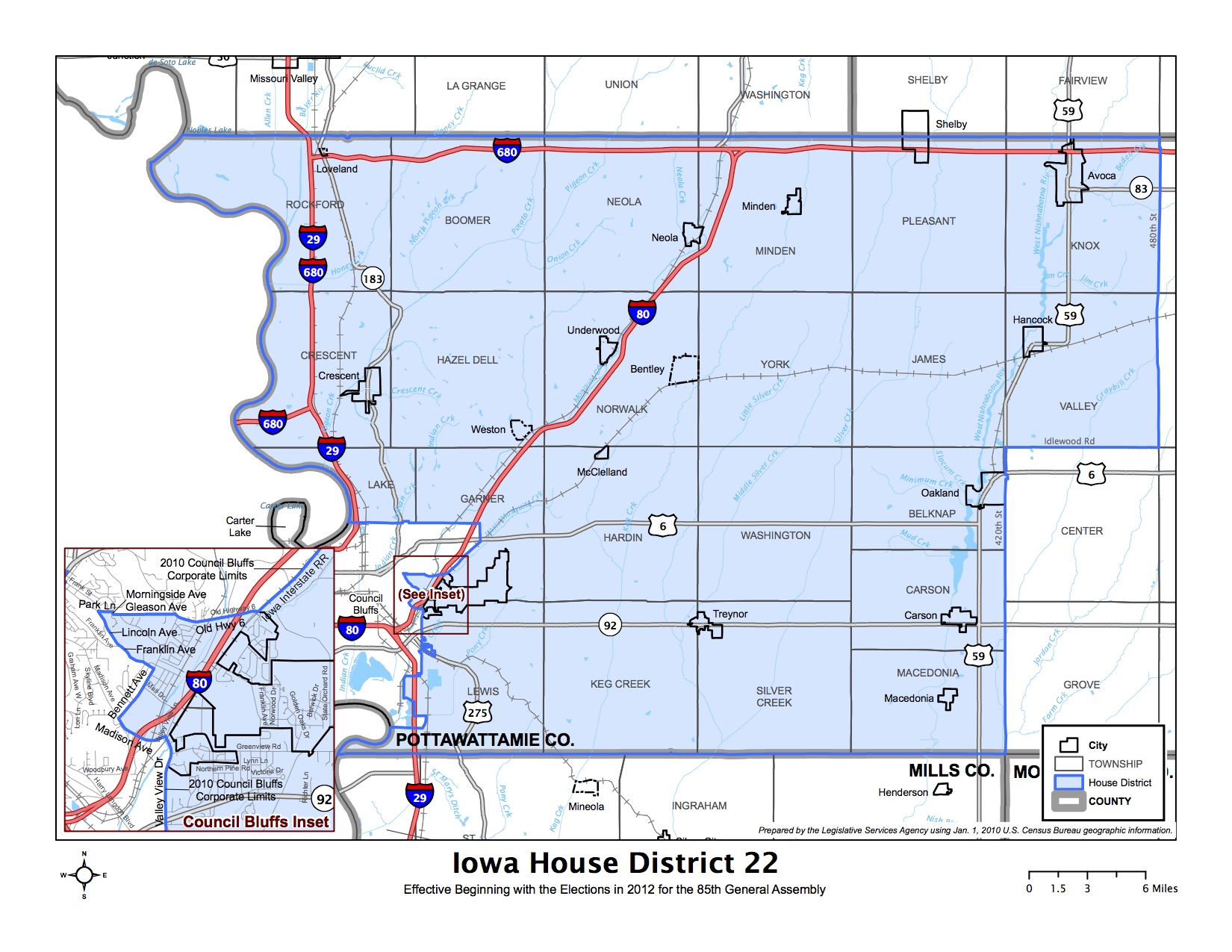
Final note: although it was sunny and unseasonably warm today in Des Moines, only about 100 people showed up for the “Spirit of America” rally by the Capitol building. A much larger crowd came to the Capitol on a very cold Thursday in February to march against President Donald Trump’s “Muslim ban” and immigration executive orders. An estimated 26,000 turned out for the Iowa Women’s March at the same venue on a Saturday morning in January.

UPDATE: Added after the jump side by side photos of the Women’s March and today’s event. SECOND UPDATE: A reader sent me his photo (taken by a drone) of the crowd at the Capitol for the “Day Without Immigrants” rally on Thursday, February 16. Added below.

Zaun was the first speaker to the pro-Trump audience today, and he noted (accurately) that he was the first Iowa Republican elected official to endorse Trump for president. He didn’t mention that he had previously declared himself “110 percent behind” Wisconsin Governor Scott Walker, whose campaign flamed out months before the Iowa caucuses. On caucus night, Trump finished third in the Senate district Zaun represents, behind Senators Marco Rubio and Ted Cruz.

UPDATE: Past and future presidential candidate Martin O’Malley was back in central Iowa on March 4, attending a fundraiser for State Senator Nate Boulton, among other events. O’Malley’s 2016 presidential campaign had a strong organization on the east side of Des Moines, which is part of Boulton’s district. The former governor of Maryland has visited Iowa regularly since the election, including stops in Davenport to support the special election campaigns of Jim Lykam for the Iowa Senate and Monica Kurth for the Iowa House.

Continue Reading...

David Young's weak excuse for flip-flop on Trump's tax returns

Have you wondered why U.S. Representative David Young (IA-03) voted with fellow Republicans to table indefinitely a resolution “directing the House to ask for 10 years of [President Donald] Trump’s tax returns,” only four days after telling constituents the president should release those returns?

Explaining his vote today, Young demonstrated that he is ill-suited to the task of holding Trump accountable.

Continue Reading...

Anna Ryon is the second Democratic candidate in IA-03

Anna Ryon has filed papers with the Federal Election Commission to run for Congress in Iowa’s third district, she confirmed on March 2. Her official campaign launch will take place in Des Moines on March 8; scroll down for event details. Ryon is also planning a March 11 event in Council Bluffs, the second-largest city in IA-03.

An attorney currently working for the Office of Consumer Advocate, Ryon began publicly exploring a Congressional campaign last month. Bleeding Heartland posted more background on the candidate here. Ryon said yesterday that new English and Spanish-language versions of annaryon.com will be online soon. Blue Wave Political Partners will help manage her campaign, and she has chosen to open her campaign bank account “at an institution that is not invested in the Dakota Access pipeline.”

Ryon is the second Democratic challenger in IA-03 to declare this week. Mike Sherzan formally entered the race on March 1. As Bleeding Heartland discussed here, other possible candidates include State Senator Matt McCoy and longtime Iowa Democratic campaign operative Pete D’Alessandro.

Two-term Representative David Young is on the Democratic Congressional Campaign Committee’s long list of targets for 2018. The sixteen counties in IA-03 contain 167,249 active registered Democrats, 177,408 Republicans, and 167,222 no-party voters, according to the latest figures from the Iowa Secretary of State’s office.

Continue Reading...

GOP Senator Mark Chelgren still padding his educational resume

Republican State Senator Mark Chelgren has a history of grabbing headlines by filing unworkable bills or making offensive statements. This year, his attention-seeking behavior backfired in a big way.

Corky Siemaszko reported for NBC News yesterday that Chelgren’s official bio wrongly claimed he had a “business degree” from the “Forbco Management school.” In reality, Chelgren took a management course while working for the Sizzler restaurant chain. The story went viral, not just in Iowa.

Chelgren denied any “attempt to inflate” his resume. But although the Iowa Senate Republicans have removed any reference to the so-called business degree from their website, Chelgren’s corporate website still misleads regarding his college education.

Continue Reading...

Mike Sherzan is first Democrat running in IA-03; field likely to expand soon

Mike Sherzan made it official yesterday: he is running for Congress again in Iowa’s third district. I enclose below his announcement and background on the candidate, who finished second to Jim Mowrer in the 2016 Democratic primary. Sherzan has attended numerous recent political events in central Iowa, including last night’s fundraiser for the House Truman Fund in Des Moines.

In a short new video, Sherzan said, “Like most Iowans, I’m fed up with what’s going on with Washington politics. Iowans deserve a progressive leader, not a Washington career politician. That’s why I’ve decided to run for Congress.” During last year’s campaign, he highlighted his business practices as a reflection of his values: treating workers fairly, sharing profits with employees, paying women the same as men, and promoting employees of either gender based on performance.
Speaking to Kathie Obradovich of the Des Moines Register, Sherzan criticized “the lack of leadership we have in the 3rd District” and charged, “We have individuals who have been elected to office who hid their intentions, in my opinion, and they’re using what people voted for to put into policy and then legislative action their own agendas, they’re far-right agendas.”

GOP Representative David Young has drawn criticism this week for voting against a House resolution seeking to force President Donald Trump to release his tax returns. During a public forum in Urbandale on February 23, Young had said, “Donald Trump should release his taxes. It’s a no-brainer.”
At least one candidate will likely compete against Sherzan for the Democratic nomination in IA-03. Anna Ryon, an attorney with the Office of Consumer Advocate, has scheduled a “Meet Anna/Special Announcement” event in Des Moines on March 8, which is International Women’s Day. Ryon confirmed last month that she is considering a Congressional campaign and already has a website up. UPDATE: Added below a March 2 news release from Ryon about her upcoming event.

Pat Rynard reported for Iowa Starting Line on February 28,

Some recent rumors point to longtime Iowa political consultant Pete D’Alessandro strongly considering a bid as well. D’Alessandro served most recently as Bernie Sanders’ campaign coordinator for Iowa in the caucus. He’s been involved in nearly every major Iowa Democratic race in one way or the other for the past two decades, serving in key roles on Tom Vilsack, Chet Culver and Leonard Boswell’s campaigns, as well as Bill Bradley’s Iowa Caucus operation in 2000.

When I sought comment, D’Alessandro didn’t rule out a campaign in IA-03: “Bernie Sanders has inspired so many people over the last two years–both veterans of the political process and those new to the process. Like many of them, I’m looking as to how I can help move the progressive movement forward. Running for office is certainly one of those options.”

The sixteen counties in IA-03 contain 167,249 active registered Democrats, 177,408 Republicans, and 167,222 no-party voters, according to the latest figures from the Iowa Secretary of State’s office. Young won re-election in 2016 by 53.4 percent to 39.7 percent, outperforming the top of the GOP ticket by about five points. Although Trump carried IA-03 by 48.5 percent to 45.0 percent, the swing to the Republican presidential nominee here was significantly smaller than in Iowa’s first and second Congressional districts.

IA-03 is on the Democratic Congressional Campaign Committee’s long list of 2018 targets but not among the 20 top-priority Republican-held districts.

UPDATE: Forgot to mention State Senator Matt McCoy, who considered but decided against running for Congress in 2016. He is up for re-election next year in Senate district 21, covering parts of Des Moines and West Des Moines. He would have to abandon his seat in the legislature in order to challenge Young in 2018.

SECOND UPDATE: McCoy didn’t rule out running for Congress, telling me, “I won’t make any decision until fall 2017.”

Continue Reading...

"Personhood" in trouble as Iowa legislative deadline approaches

One of the anti-abortion community’s top legislative priorities, a bill declaring that life begins at conception, appears likely to perish in this week’s “funnel.” Social conservatives introduced companion “personhood” bills in the Iowa House and Senate two weeks ago. Under legislative rules, all non-appropriations bills must pass at least one committee in one chamber by March 3 in order to remain eligible for consideration this year.

However, House File 297 has not even been assigned to a House Human Resources subcommittee, and Senate File 253 appears not to have the votes to get out of the Senate Judiciary Committee.

Continue Reading...